1/2 dinar 1965
Market Prices
23 salesAbout This Note
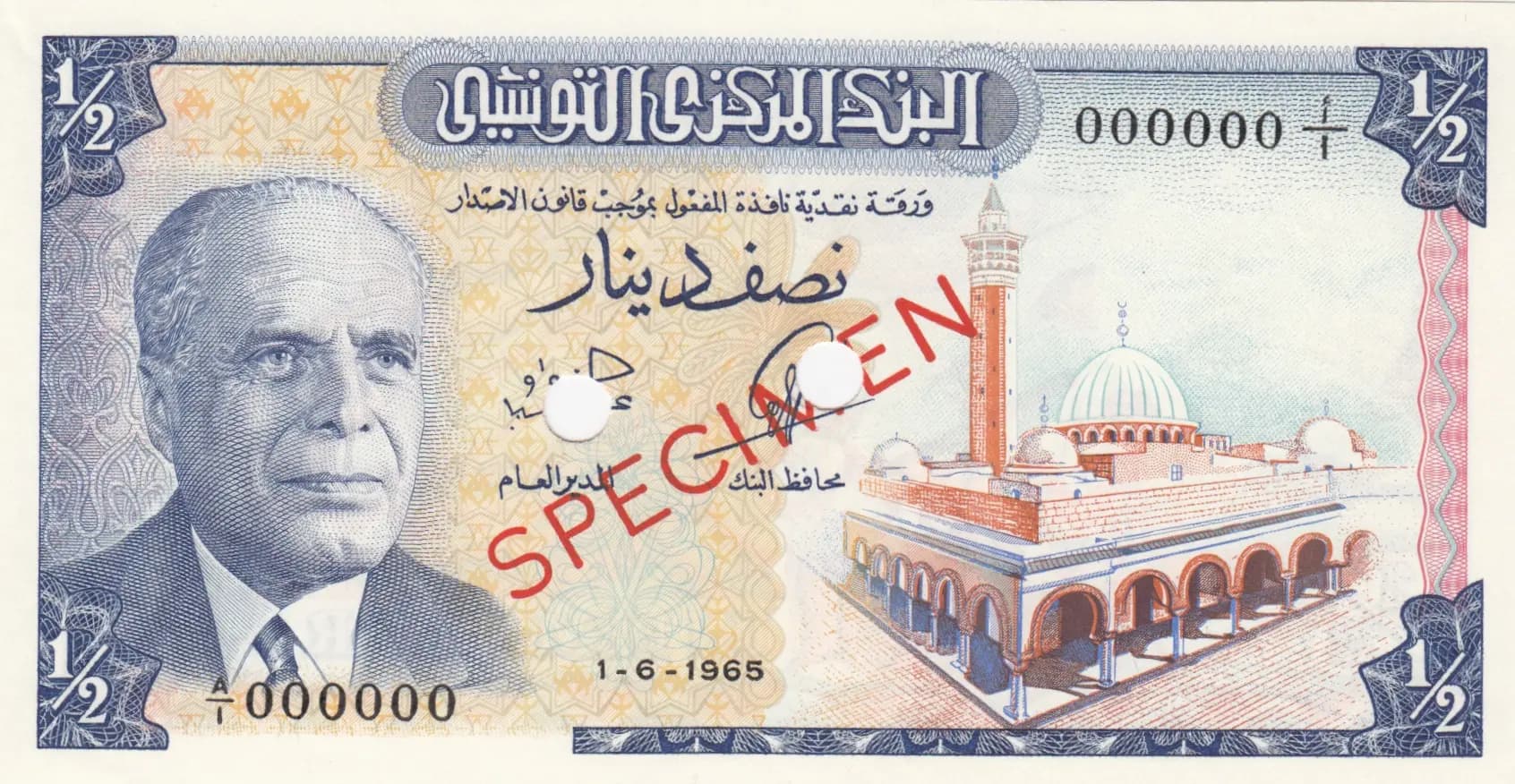
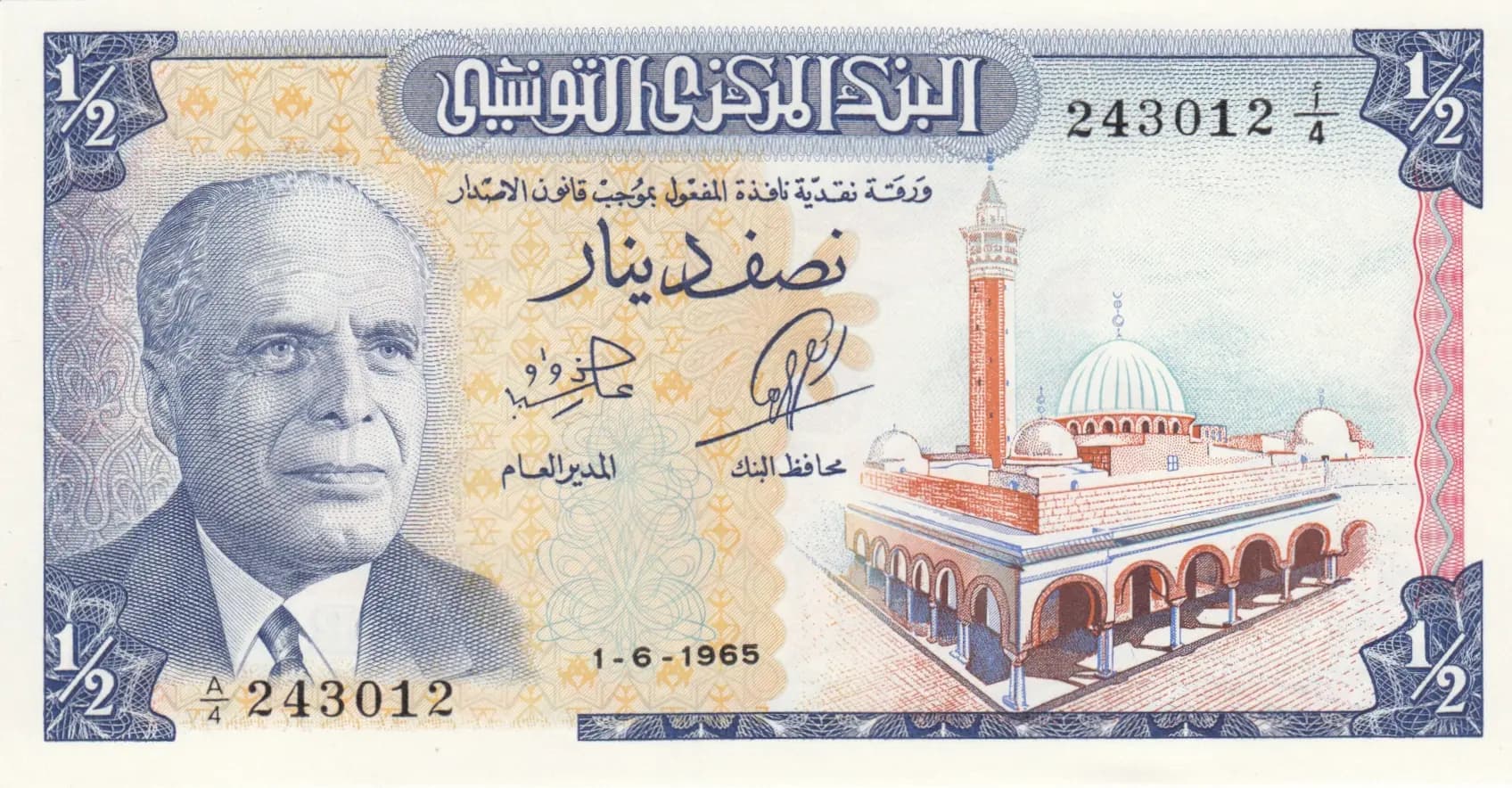
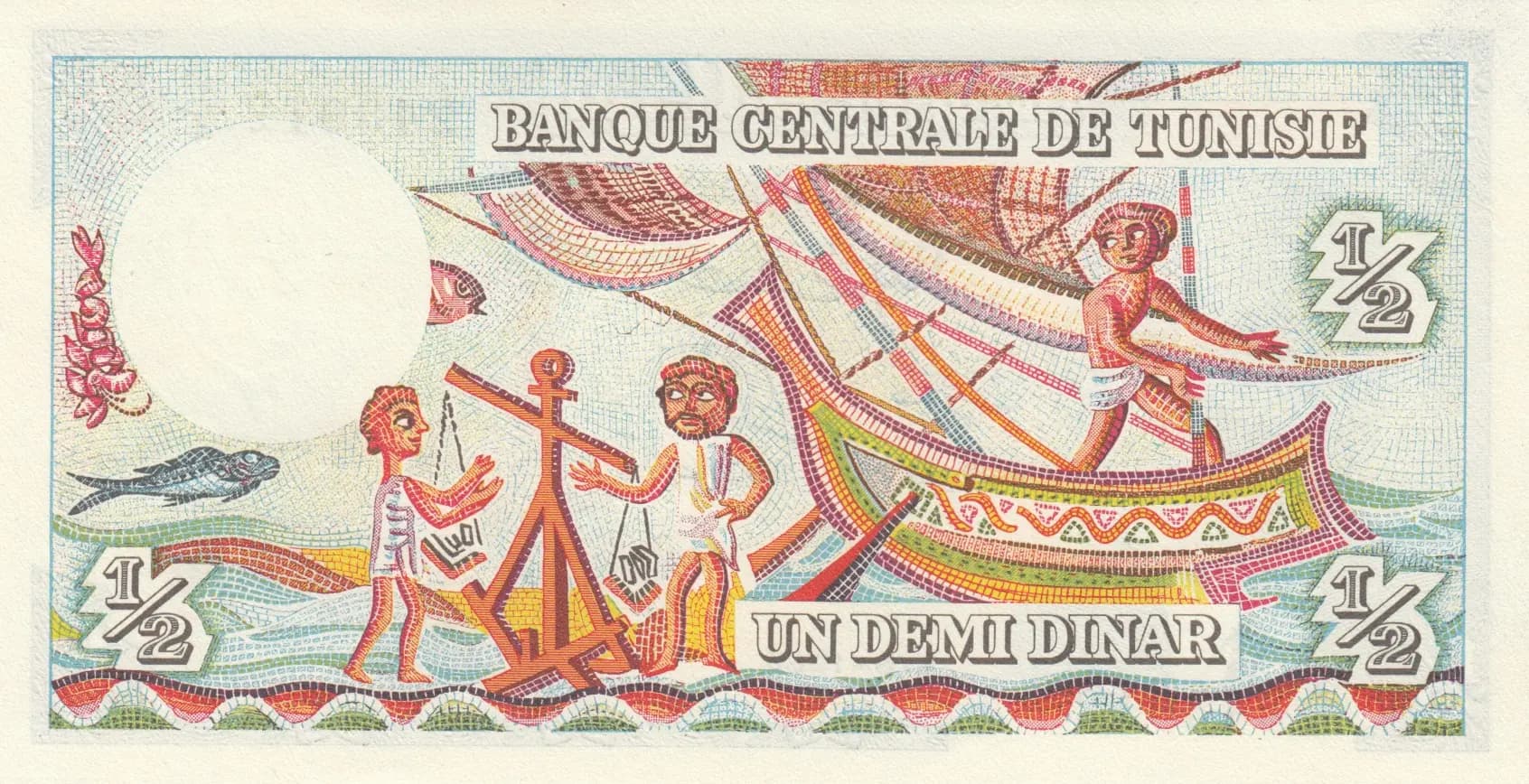
This is a Tunisian 1/2 Dinar banknote from 1965 (Pick P-62), issued by the Banque Centrale de Tunisie and graded as UNC (Uncirculated). The obverse features an outstanding portrait of President Habib Bourguiba in formal business attire on the left, paired with an elegantly rendered architectural illustration of a mosque with minaret and red-terracotta arched colonnade on the right. The reverse showcases an intricate multicolor mosaic design depicting ancient Phoenician traders in a maritime scene, consistent with the historical Monastir mosaic tradition. The note displays exceptional condition with pristine surfaces and no visible wear, making it an attractive example for collectors.
Common. This is a regular-issue banknote from 1965 with substantial circulation potential. eBay market data shows consistent sales with values ranging from $2.90 (VG condition in 2020) to $50.50 (EF condition in 2014), with most graded examples selling in the $10-35 range. The catalog value for UNC condition is $150, which represents the upper end of the market but reflects availability. The note is not from a recalled series, was not issued in limited quantity, and the Banque Centrale de Tunisie was well-established at the time of issuance, indicating a substantial print run.
This note was issued during Tunisia's early post-independence period under President Habib Bourguiba, whose portrait appears prominently on the obverse—reflecting his central role in Tunisia's development and modernization. The reverse's depiction of Phoenician traders and maritime commerce references Tunisia's ancient heritage as a center of Mediterranean trade, while the mosque imagery on the obverse emphasizes Tunisia's Islamic cultural identity. Together, these design elements celebrate both Tunisia's classical antiquity and its contemporary Islamic character during the nation's formative decades.
The obverse features a formal portrait of President Habib Bourguiba positioned on the left side, rendered in fine engraving detail, wearing a dark suit and tie. The right side displays an architectural rendering of an Islamic mosque with a prominent tall minaret, white dome, and distinctive red-terracotta arched colonnade supported by columns—characteristic of North African Islamic architecture. The background incorporates sophisticated geometric and floral decorative patterns in cream and gold tones. The reverse presents an elaborate mosaic-inspired design (referencing the historical Monastir mosaic) depicting ancient Phoenician traders engaged in maritime activities, with ornate boats featuring colorfully patterned sails, fish, cherub figures, and multiple human figures rendered in intricate multicolored linework creating a rich tapestry effect. The design palette includes reds, oranges, yellows, greens, and blues, all executed with fine detailed engraving.
FRONT: 'البنك المركزي التونسي' (Central Bank of Tunisia), 'نصف دينار' (Half Dinar), '1-6-1965' (Issue date: June 1, 1965), 'المديرالعام' (General Manager), 'حافظ البنك' (Governor of the Bank), Serial number '243012', Series/plate number '4', Series letter 'A'. BACK: 'BANQUE CENTRALE DE TUNISIE' (Central Bank of Tunisia in French), 'UN DEMI DINAR' (One Half Dinar in French), Denomination marking '1/2'.
Intaglio (engraved) printing on multicolor underprint, characteristic of security banknote production from this era. The note displays fine line engraving throughout, complex guilloche patterns on borders, and detailed portrait engraving typical of the Banque Centrale de Tunisie's production standards. The printer is identified as TDLR (Tunisian Dinar/Letterpress Refinery) in the PMG variant catalog, though this was likely a local or contracted security printer handling Tunisian banknote production in the 1960s.
Pick catalog identifies variant P-62a with printer TDLR. The observed note shows Series letter 'A' and plate number '4' with serial number '243012', consistent with early printings of this issue. The date inscription '1-6-1965' (June 1, 1965) matches the official issue date. No overprints or error varieties are evident in this UNC example. Collectors should note that the Habib Bourguiba watermark (as noted in external references) serves as a key identifying feature of this Pick number.