1/2 dinar 1958
Market Prices
10 salesAbout This Note
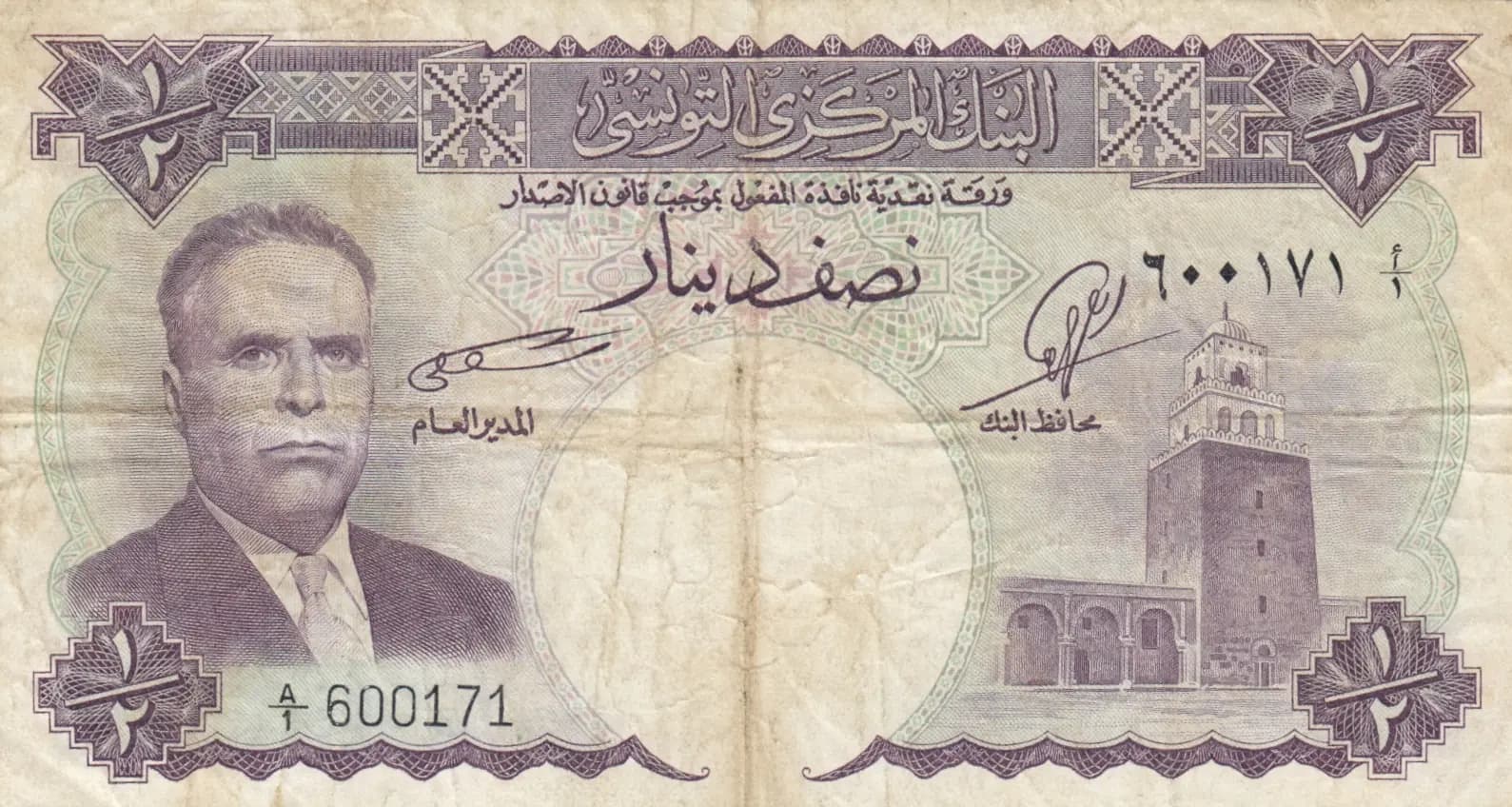
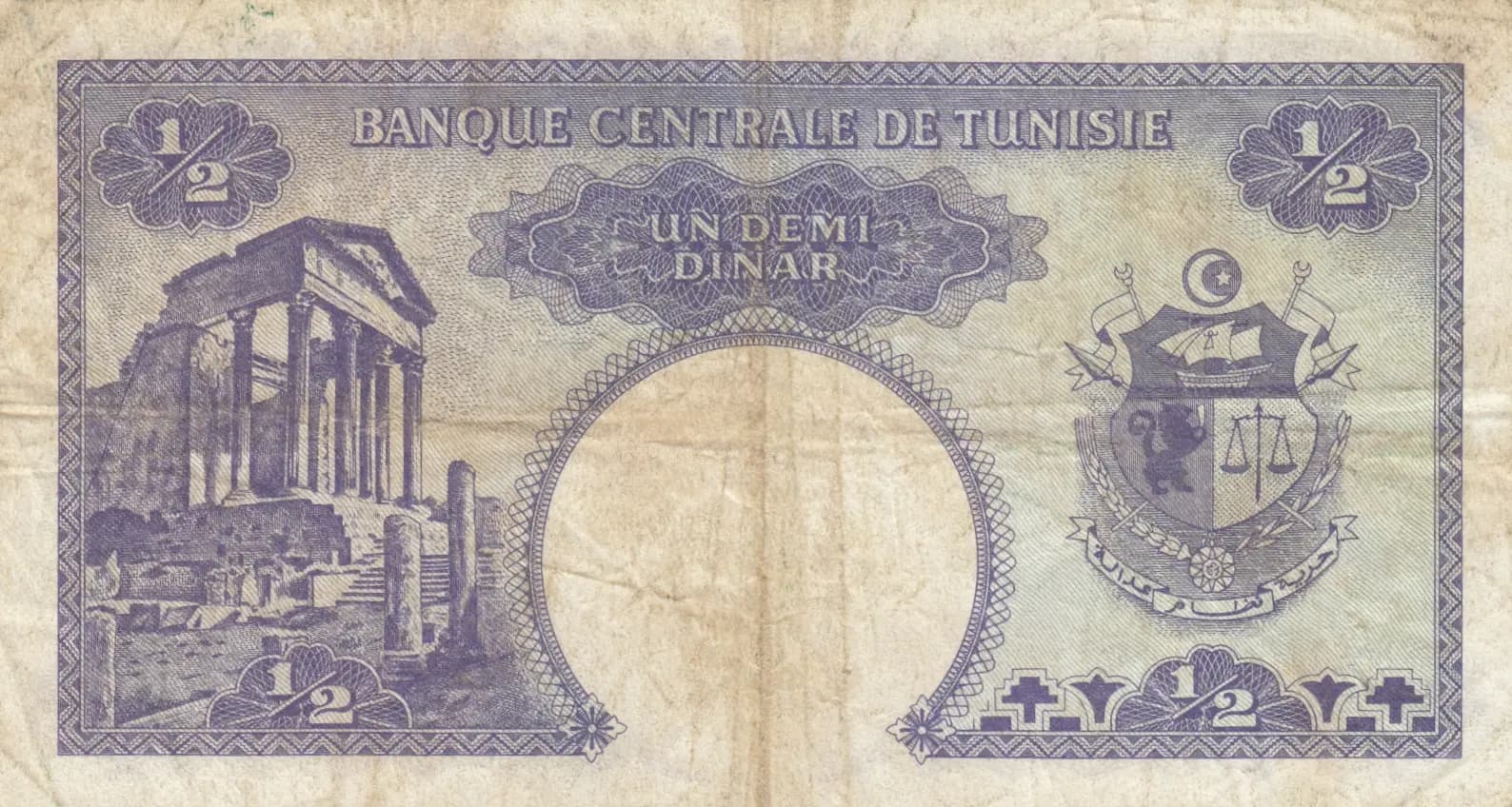
This is a Tunisia 1/2 Dinar from 1958 (Pick P-57), issued by the Banque Centrale de Tunisie in the early years of national independence. The note features a portrait of President Habib Bourguiba on the obverse and displays the Sidi Okba Mosque minaret and Sbeitla temple ruins on its respective sides. In Fine condition, the note exhibits period-appropriate wear including a central vertical fold, light foxing, and creasing consistent with circulation, yet all design elements remain clearly legible.
Common. The eBay price history provided shows regular sales activity across multiple condition grades spanning over a decade (2012-2024), with Fine condition notes consistently selling in the $8-$12.50 range, with occasional outliers. The 2016 catalog valuation for Fine condition is approximately $8-$12, corroborated by actual market sales. Print run data for this first series of independent Tunisia's currency was substantial, and this denomination remains readily available to collectors. The circulation history and abundance in the numismatic market confirm common status.
This banknote was issued in 1958, the year Tunisia gained full independence from France and established its central bank. The imagery reflects the nation's dual heritage and aspirations: President Bourguiba's portrait symbolizes modern nationalist leadership, while the depicted Islamic mosque (Sidi Okba, Kairouan) and classical Roman ruins (Sbeitla temple) represent Tunisia's rich cultural and architectural legacy spanning Islamic and pre-Islamic periods. The bilingual design (Arabic and French) reflects Tunisia's transitional status during this pivotal moment in North African history.
The obverse features a formal three-quarter portrait of President Habib Bourguiba positioned on the left in business attire (suit and tie), symbolizing modern Tunisia's leadership during the independence era. To the right rises the minaret of the Sidi Okba Mosque in Kairouan, one of Tunisia's most important Islamic architectural monuments. The design employs purple and violet as dominant colors with green ornamental borders featuring Islamic geometric patterns and decorative rosette motifs in all four corners. The reverse showcases the classical ruins of Sbeitla (ancient Sufetula), a Roman archaeological site in central Tunisia, depicted on the left with standing columns. The right side carries the Tunisian national coat of arms featuring scales of justice, a crescent moon, and a ship, representing governmental authority, Islamic heritage, and maritime commerce. A watermark area is prominently featured in the center-right of both sides. The bilingual presentation (Arabic script on obverse, French on reverse) reflects the post-independence transitional period.
Front side: 'البنك المركزي التونسي' (Central Bank of Tunisia), 'نصف دينار' (Half Dinar), 'حافظ البنك' (Bank Governor), 'المديرالعام' (General Manager/Director), serial number 'A 600171'. Back side: 'BANQUE CENTRALE DE TUNISIE' (Central Bank of Tunisia in French), 'UN DEMI-DINAR' (Half Dinar in French). The note also features denomination numeral '2' in corners on the back, referring to the fractional subdivision system.
Intaglio engraving with multicolor printing on the underprint. The fine line engraving is evident throughout the design, particularly in the geometric borders, portrait detailing, and architectural rendering. The complexity of the color scheme and the precision of the corner rosette designs indicate advanced security printing techniques typical of European security printers contracted for newly independent African nations during this period. The use of a watermark security feature (visible as the blank circular area) was standard for Central Bank of Tunisia issues of this era.
This note is cataloged as P-57 (standard variety) in the Pick standard. The visual analysis identifies serial number 'A 600171', indicating an 'A' series prefix typical of early production runs. The PMG population report indicates variants P-57 and P-57s (specimen) exist for this Pick number. The observed note appears to be a regular circulation issue (P-57) rather than a specimen note (P-57s). No overprints, date variations, or signature varieties are apparent in the visual examination, consistent with the 1958 ND (no date) regular issue designation.