5 dollars 1964
About This Note
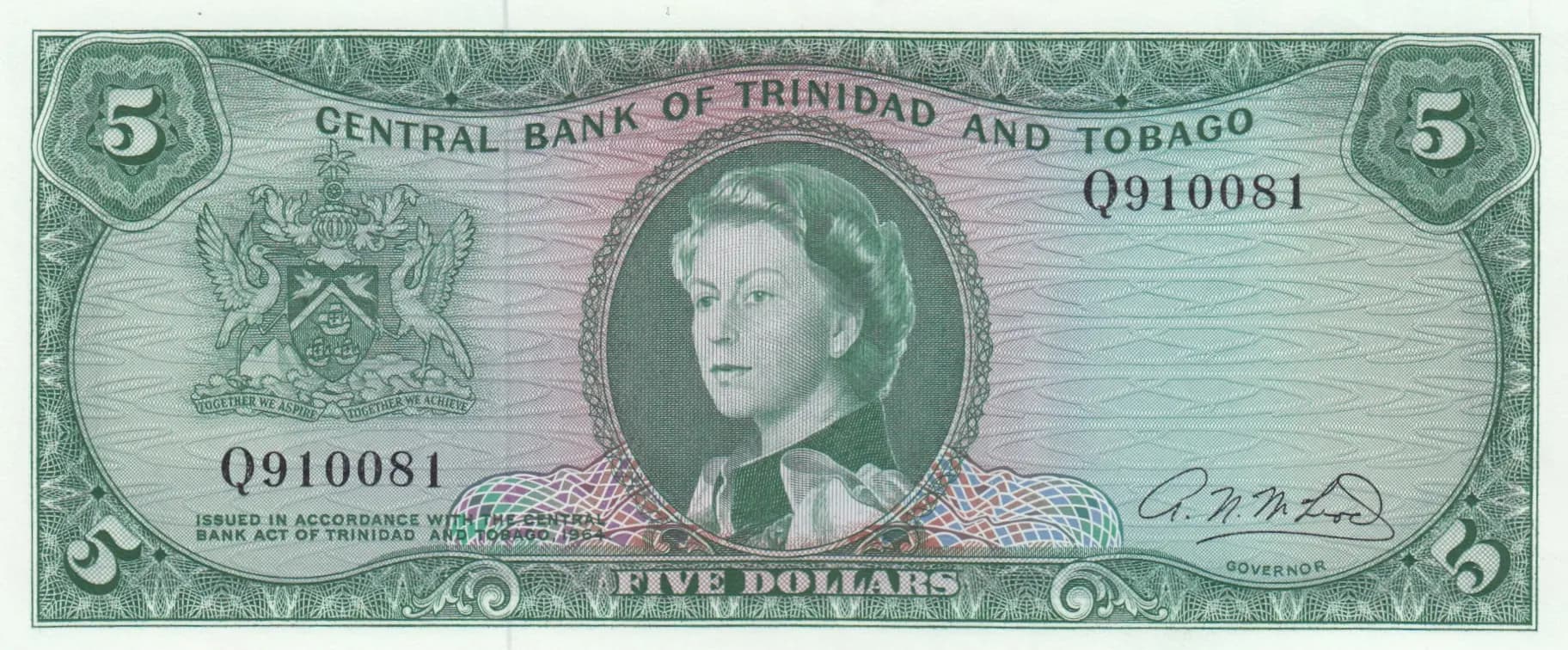
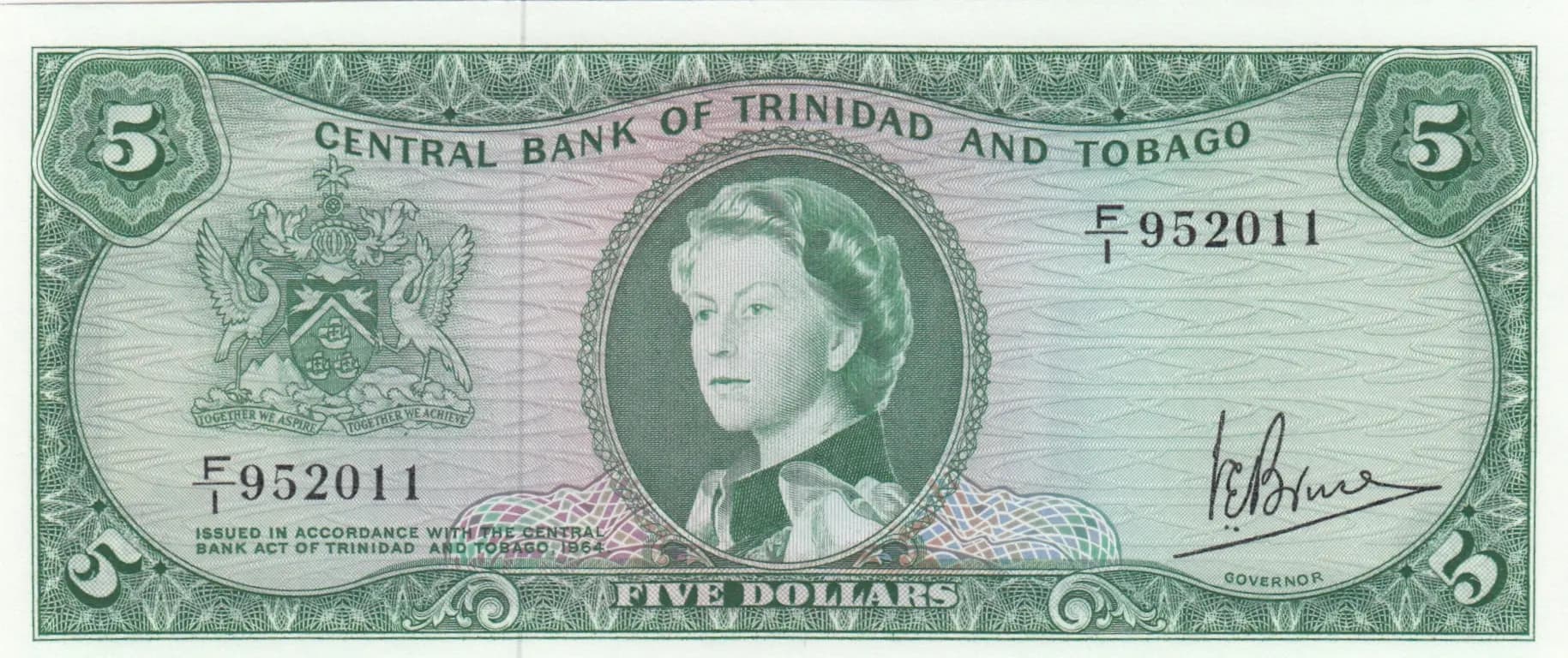
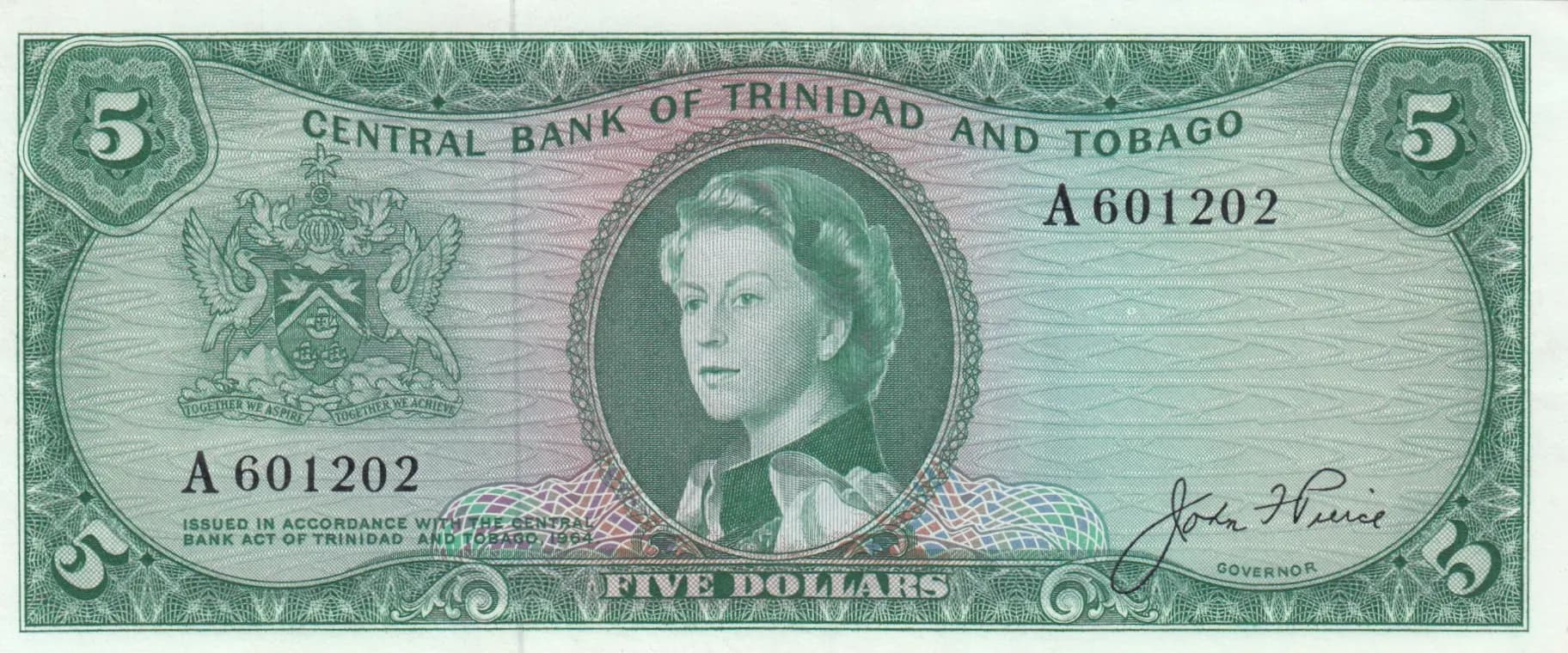
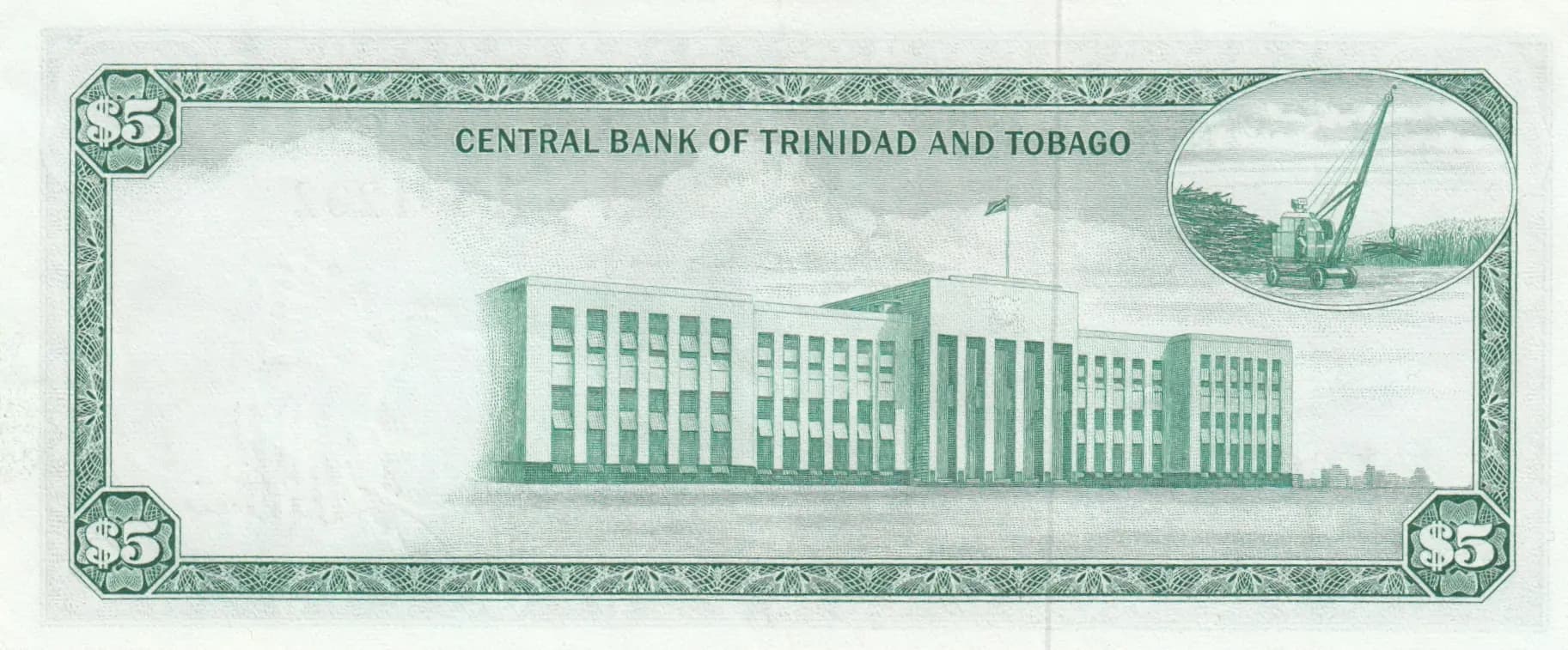
This 1964 Trinidad & Tobago 5 Dollar note (P-27a) is presented in excellent uncirculated condition with vibrant green and pink coloring and crisp detail throughout. The obverse features a striking central portrait of Queen Elizabeth II in profile within an ornate circular frame, flanked by the coat of arms of Trinidad & Tobago, while the reverse showcases the Central Bank building with an agricultural vignette depicting sugar cane production—a key element of the nation's economy. The fine line engraving and multi-color printing technique demonstrate the high-quality craftsmanship characteristic of early Central Bank issues.
Common. The 1964 5 Dollar note P-27a is a widely-issued founding banknote of the Central Bank of Trinidad and Tobago with substantial print runs. In uncirculated condition it remains readily available in the numismatic market at modest valuations, typically in the $5-15 range for raw notes, with no indicators of scarcity or collector premiums. Uncirculated specimens are common rather than scarce.
Issued in 1964 concurrent with Trinidad and Tobago's independence from British rule, this note represents the newly-formed Central Bank of Trinidad and Tobago's inaugural currency series. The depiction of Queen Elizabeth II on the obverse reflects the country's continued membership in the Commonwealth, while the reverse's emphasis on sugar cane production and the Central Bank building symbolizes the nation's economic foundation and institutional stability in this formative period. The 'ISSUED IN ACCORDANCE WITH THE CENTRAL BANK ACT OF TRINIDAD AND TOBAGO 1964' inscription directly references the legislative act establishing the central banking authority.
The obverse features a left-facing profile portrait of Queen Elizabeth II as the primary design element, positioned within an elaborate circular frame with ornamental borders rendered in green and pink. The coat of arms of Trinidad and Tobago—featuring heraldic elements with wings and shield—is positioned on the left side. Shield-shaped denomination frames containing the numeral '5' and dollar sign symbols appear in the upper corners. The reverse depicts the Central Bank of Trinidad and Tobago building, a modern multi-story structure with a regular grid of windows and a national flag on its roof. A circular vignette in the upper right corner illustrates the agricultural/industrial sector, showing sugar cane machinery, reflecting the nation's primary export industry. All four corners contain shield-shaped frames with denomination markers.
FRONT: 'CENTRAL BANK OF TRINIDAD AND TOBAGO' (issuing authority), 'FIVE DOLLARS' (denomination), 'ISSUED IN ACCORDANCE WITH THE CENTRAL BANK ACT OF TRINIDAD AND TOBAGO 1964' (legal authorization), 'GOVERNOR' (signature line designation), 'A 601202' (serial number). BACK: 'CENTRAL BANK OF TRINIDAD AND TOBAGO' (issuing authority), '5' (denomination markers in corners).
Intaglio (recess) printing, characterized by fine line engraving patterns visible throughout both sides, combined with multi-color lithographic or letterpress overlay. The precise detail in the portrait, ornamental borders, and building architecture, along with the distinct color registration in green, pink, and white, indicates professional security printing by a specialized currency printer—likely the British American Bank Note Company or similar Commonwealth-contracted security printer active in 1964.
This note is identified as P-27a variant, characterized by the Bird of Paradise watermark. The PMG population data indicates four cataloged varieties (P-27a, P-27b, P-27c, and P-27s), suggesting variations in watermark placement, serial number prefixes, or signature lines across the 1964 emission. The serial number prefix 'A' and the condition grade (UNC) should be recorded for variety differentiation, though all variants remain common in the market.