10 dollars 1977
About This Note
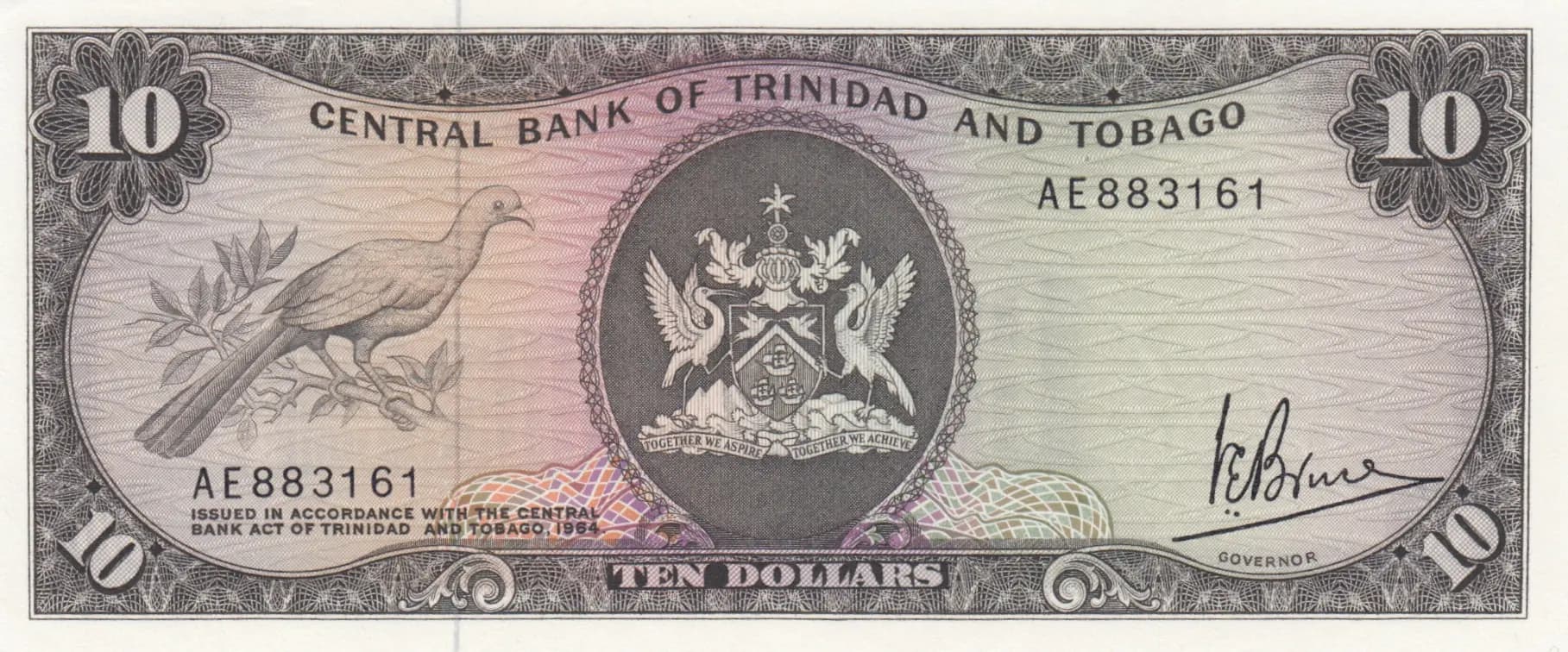
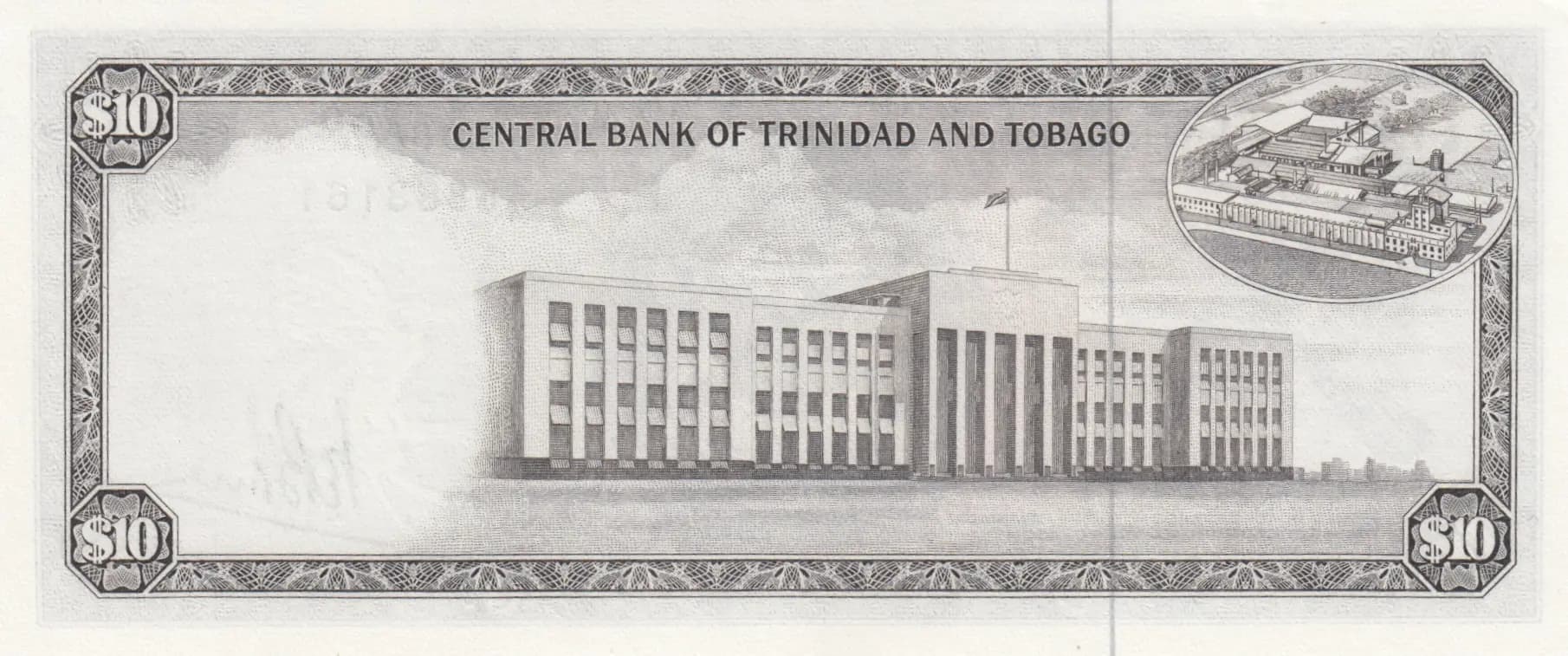
This is a Trinidad and Tobago 10 Dollar note from 1977 (Pick P-32) in uncirculated condition, featuring the national coat of arms with winged supporters and the endemic Cocrico bird on the obverse in pink and mauve tones. The reverse depicts the Treasury Building (home of the Central Bank) alongside sugar cane processing facilities, reflecting the nation's economic foundations. The note displays minimal circulation wear with only light creasing, preserving the fine engraving details and security features characteristic of Central Bank of Trinidad and Tobago currency from this era.
Common. The 1977 10 Dollar note from Trinidad and Tobago (Pick P-32) remains readily available in the secondary market. Standard circulation issues from major Caribbean central banks of this era were produced in substantial quantities and have survived in reasonable numbers. No evidence of limited print runs, early recall, or scarcity conditions applies to this denomination and year. Notes of this type and condition typically trade at modest premiums reflecting their age and uncirculated state rather than numismatic rarity.
Issued under the Central Bank Act of Trinidad and Tobago 1964, this 1977 note represents the post-independence monetary period when Trinidad and Tobago was establishing its distinct national identity. The imagery—combining heraldic symbols of state authority with depictions of the Treasury Building and sugar cane industry—reflects the dual emphasis on institutional governance and the agricultural-industrial economy that sustained the nation. The national motto 'Together We Aspire Together We Achieve' inscribed on the obverse encapsulates the development aspirations of the period.
The obverse features a centrally-positioned coat of arms of Trinidad and Tobago flanked by two winged heraldic supporters, with a shield bearing a cross design and a five-pointed star above, all rendered in fine detail. To the left is an illustration of the Cocrico (Ortalis ruficauda), the national bird endemic to Trinidad, perched naturally on a branch with foliage. Ornamental rosette patterns and decorative corner elements frame the denomination '10' in elaborate cartouches at the top corners. The reverse displays a prominent engraving of the Treasury Building—a modern multi-story government structure with regular fenestration characteristic of 1960s institutional architecture—with an aerial inset view in the circular vignette at the top right showing the broader institutional complex. Both sides incorporate guilloché patterns and fine line engraving throughout.
FRONT: 'CENTRAL BANK OF TRINIDAD AND TOBAGO' (issuing authority); 'ISSUED IN ACCORDANCE WITH THE CENTRAL BANK ACT OF TRINIDAD AND TOBAGO, 1964' (legal authorization); 'GOVERNOR' (signature line designation); 'TOGETHER WE ASPIRE TOGETHER WE ACHIEVE' (national motto); Serial number 'AE883161'. BACK: 'CENTRAL BANK OF TRINIDAD AND TOBAGO' (issuing authority); '$10' (denomination in decorative frames).
Intaglio (engraved) printing, with fine line work and decorative guilloché patterns characteristic of high-security banknote production. The note exhibits the precision hallmarks of professional security printing, likely executed by a specialized currency printer such as De La Rue or Bradbury Wilkinson, companies that commonly produced Caribbean central bank notes during this period. Watermark elements are evident in the background security infrastructure.
This note corresponds to Pick P-32, with PMG cataloging three variants (P-32a, P-32p, P-32s). The serial number AE883161 and signature characteristics visible in the images would place this within one of those variant categories, likely P-32a as the standard circulation variety. The 'L. 1964' date reference on the note refers to the legal authority (Central Bank Act of 1964) rather than the actual issue date of 1977, a common practice in Caribbean currency design.