10 dollars 1964
About This Note
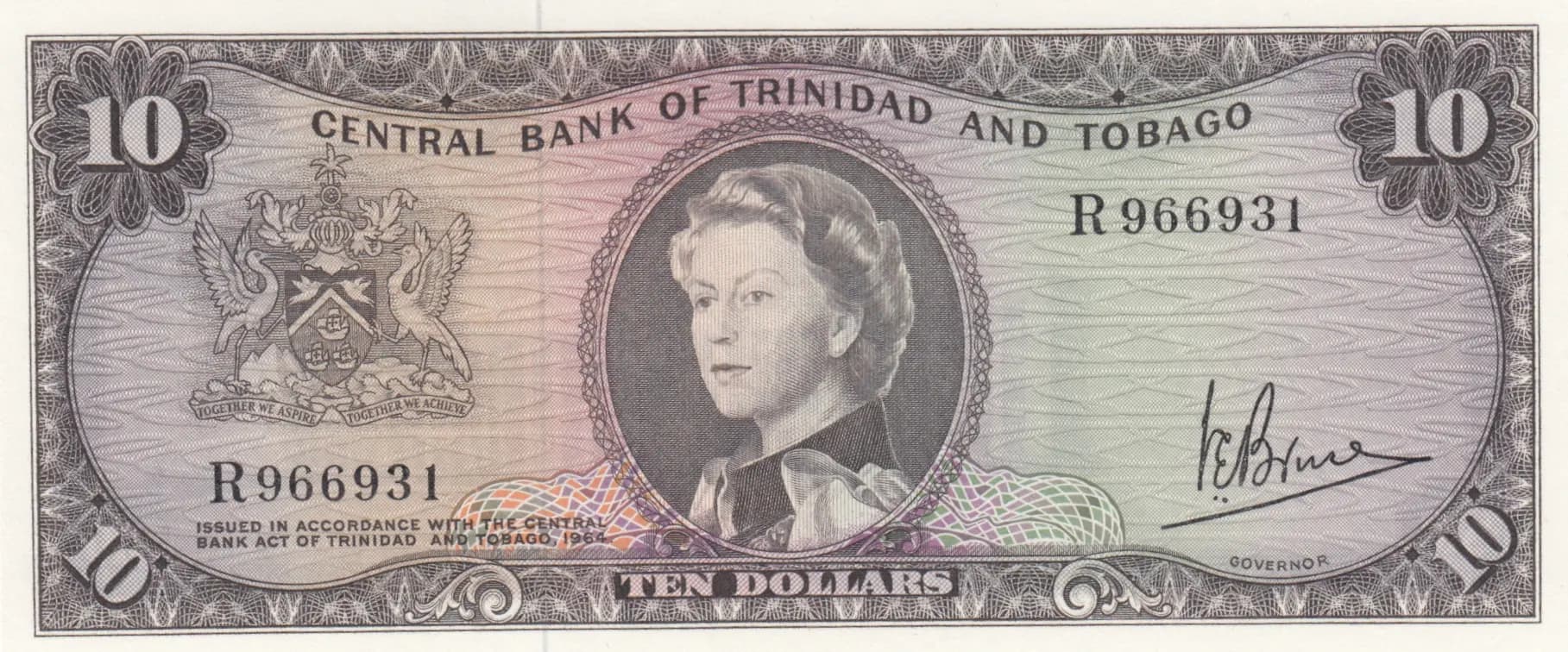
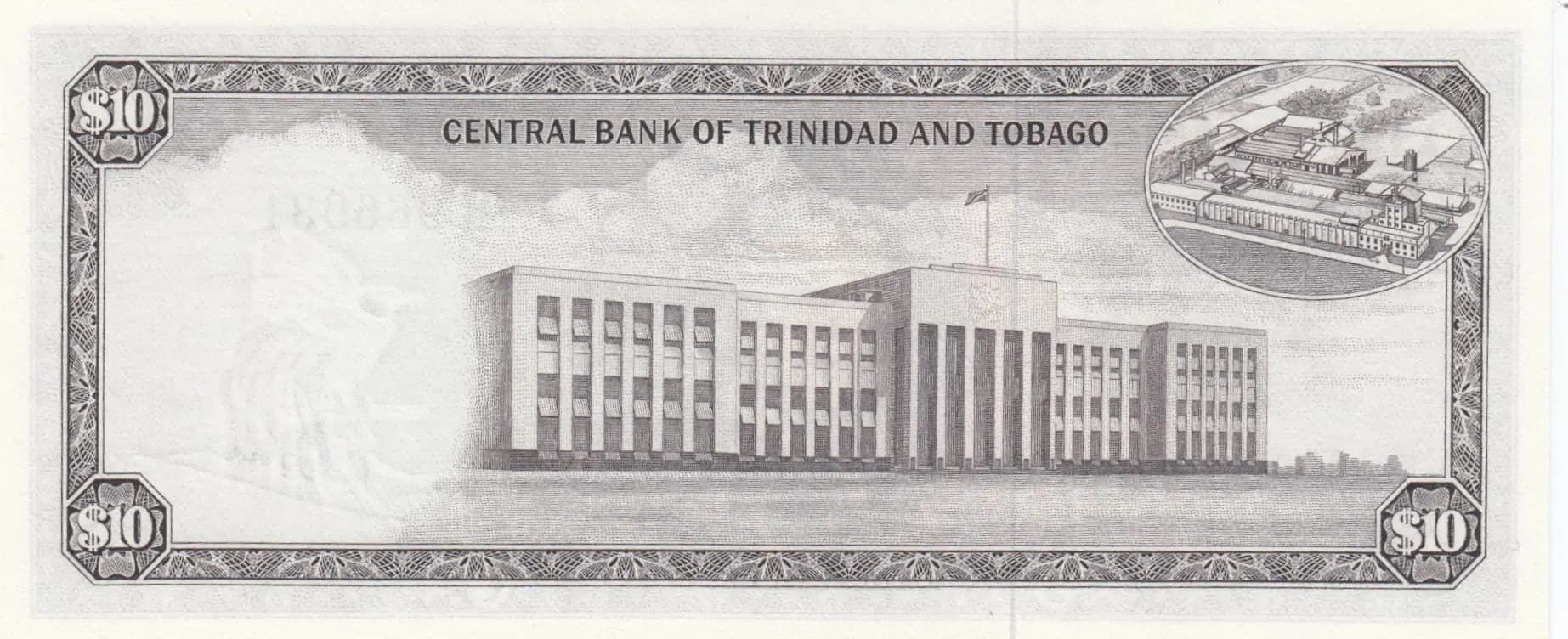
This is an uncirculated 1964 Central Bank of Trinidad and Tobago 10 dollar note (Pick P-28c) in exceptional condition, featuring a portrait of Queen Elizabeth II on the obverse with the national coat of arms and the motto 'TOGETHER WE ASPIRE TOGETHER WE ACHIEVE.' The reverse displays the modernist Central Bank building alongside an industrial facility inset, reflecting Trinidad and Tobago's economic development during the post-independence period. The note exhibits pristine preservation with no visible wear, creases, or stains, and displays the fine engraving and intricate security features characteristic of Commonwealth banknotes from this era.
Common. This is a standard post-independence issue from the Central Bank of Trinidad and Tobago with no evidence of restricted print runs, short circulation periods, or recall. The note remains widely available in the collector market, particularly in circulated grades. Even in UNC condition, such Commonwealth issues from the mid-1960s typically trade at modest premiums reflecting face value plus collector demand rather than scarcity.
This note was issued in 1964, coinciding with Trinidad and Tobago's independence from British colonial rule, as evidenced by the explicit reference to the Central Bank Act of 1964 on the obverse. The inclusion of Queen Elizabeth II's portrait reflects the nation's continued membership in the Commonwealth immediately following independence. The architectural imagery—the Central Bank building and industrial/port facilities—symbolizes the nation's modernization and economic aspirations during this pivotal period of nation-building.
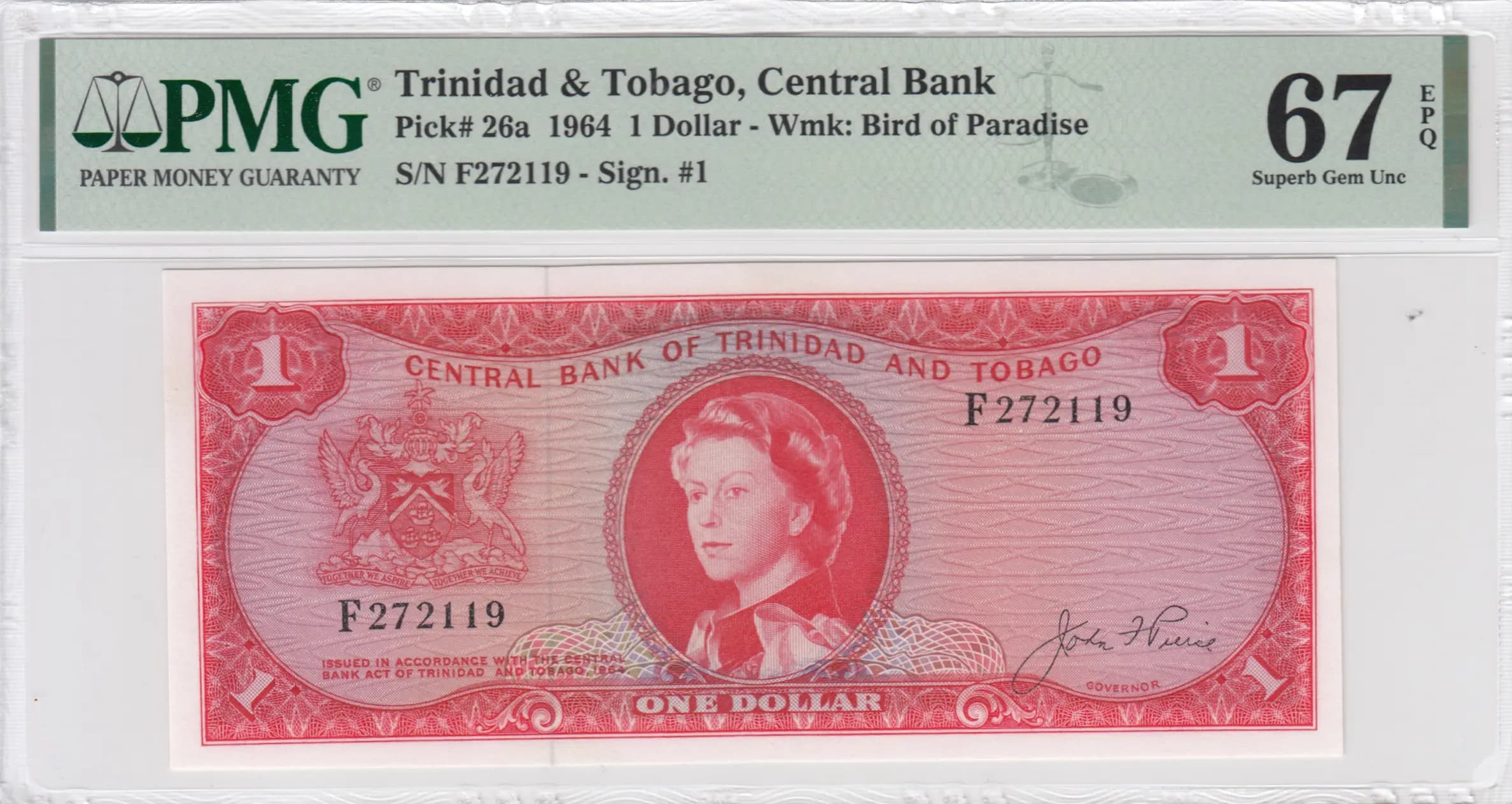
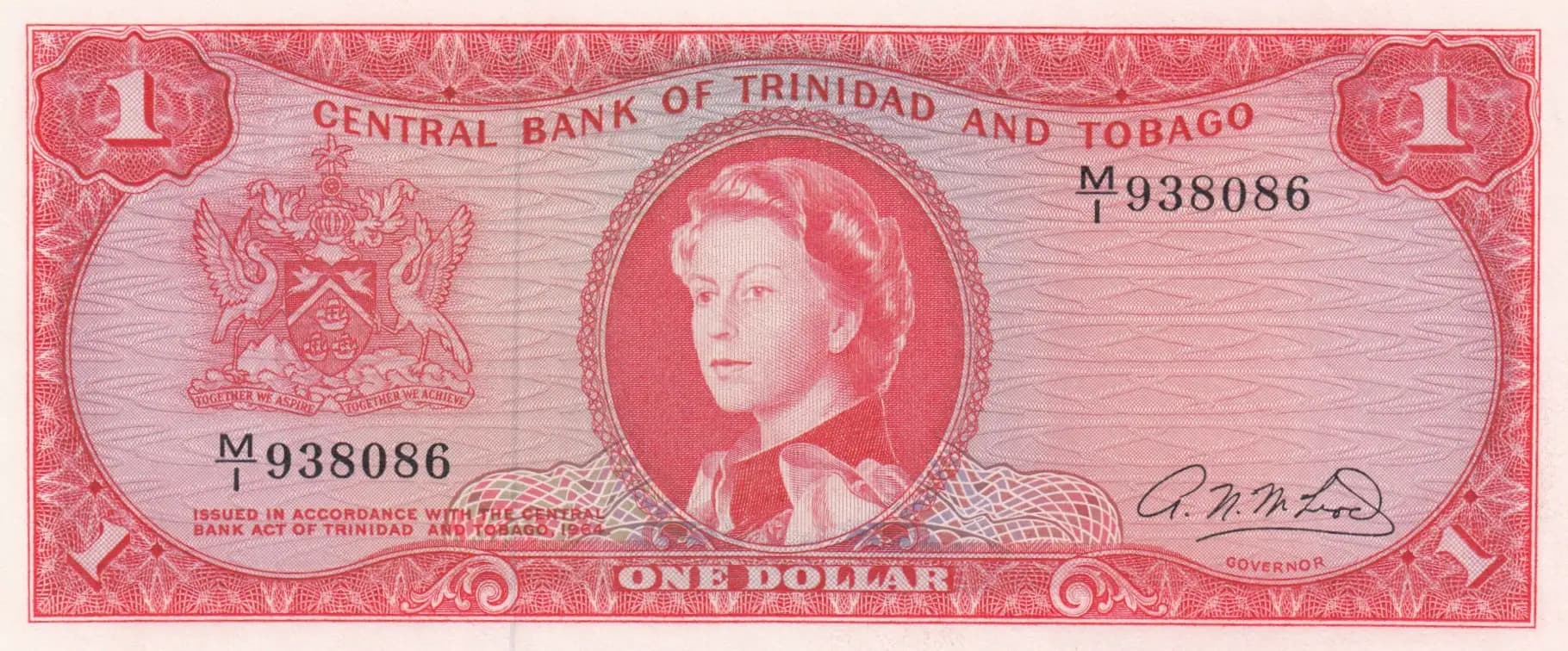
The obverse features a left-facing profile portrait of Queen Elizabeth II in formal mid-20th century style, centered within an ornate circular border with intricate decorative engraving. The Trinidad and Tobago national coat of arms appears on the left side, featuring two supporting jaguars flanking a shield containing crossed symbols and a house motif, underlaid with the national motto. The design employs a predominantly pink/mauve color scheme with black and gray engraving, accented with green. The reverse showcases the modernist Central Bank of Trinidad and Tobago building as the dominant image—a multi-story structure with regular horizontal window patterns—with an inset aerial view of industrial/port facilities in the upper right, rendered in black, gray, and white. Ornate decorative borders with floral patterns frame both sides.
Front: 'CENTRAL BANK OF TRINIDAD AND TOBAGO' (issuing authority); 'TEN DOLLARS' / '10' (denomination); 'TOGETHER WE ASPIRE TOGETHER WE ACHIEVE' (national motto); 'ISSUED IN ACCORDANCE WITH THE CENTRAL BANK ACT OF TRINIDAD AND TOBAGO, 1964' (legal authority); 'GOVERNOR' and signature of Le Blanc (issuing authority signature); Serial number 'R 966931'. Back: 'CENTRAL BANK OF TRINIDAD AND TOBAGO' (issuing authority); '$10' in all four corners (denomination).
Intaglio engraving (line engraving), the standard security printing technique for Commonwealth banknotes of this period. The note displays characteristic fine detail work, intricate line patterns, and complex circular borders typical of high-security banknote production. The printer for this 1964 Central Bank issue was likely Bradbury, Wilkinson & Co. or De La Rue, the primary Commonwealth security printers of this era, though attribution cannot be confirmed without visible printer marks in the provided images.
This note is catalogued as Pick P-28c, one of four documented variants (P-28a, P-28b, P-28c, P-28s) for the 1964 10 dollar denomination. All variants share the Bird of Paradise watermark. The specific variety (P-28c) may be distinguished by signature variants, date notations, or serial number prefix ranges, though these details cannot be definitively confirmed from the visual analysis alone. The serial number 'R 966931' visible on this specimen may correspond to a specific printing series characteristic of P-28c.