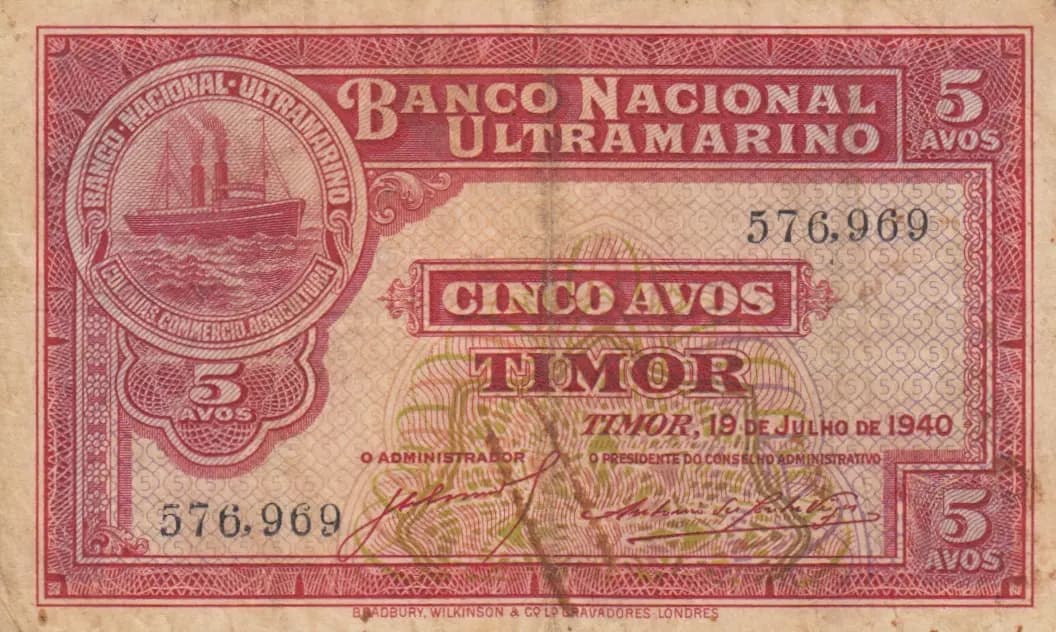
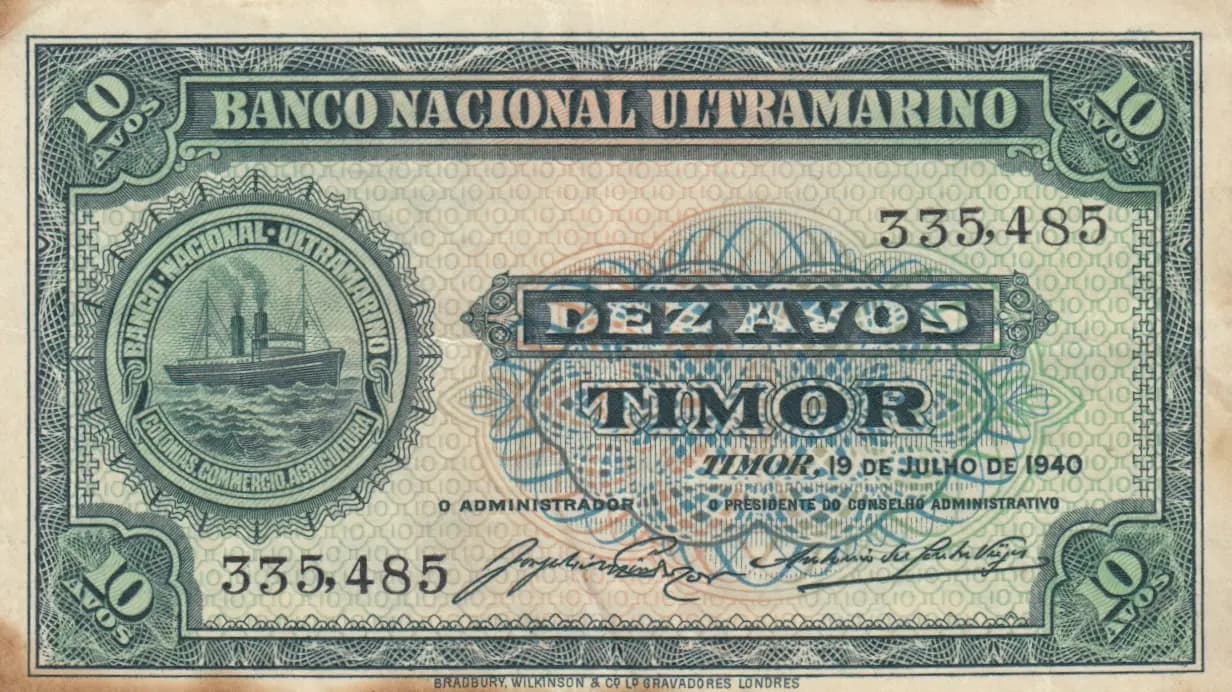
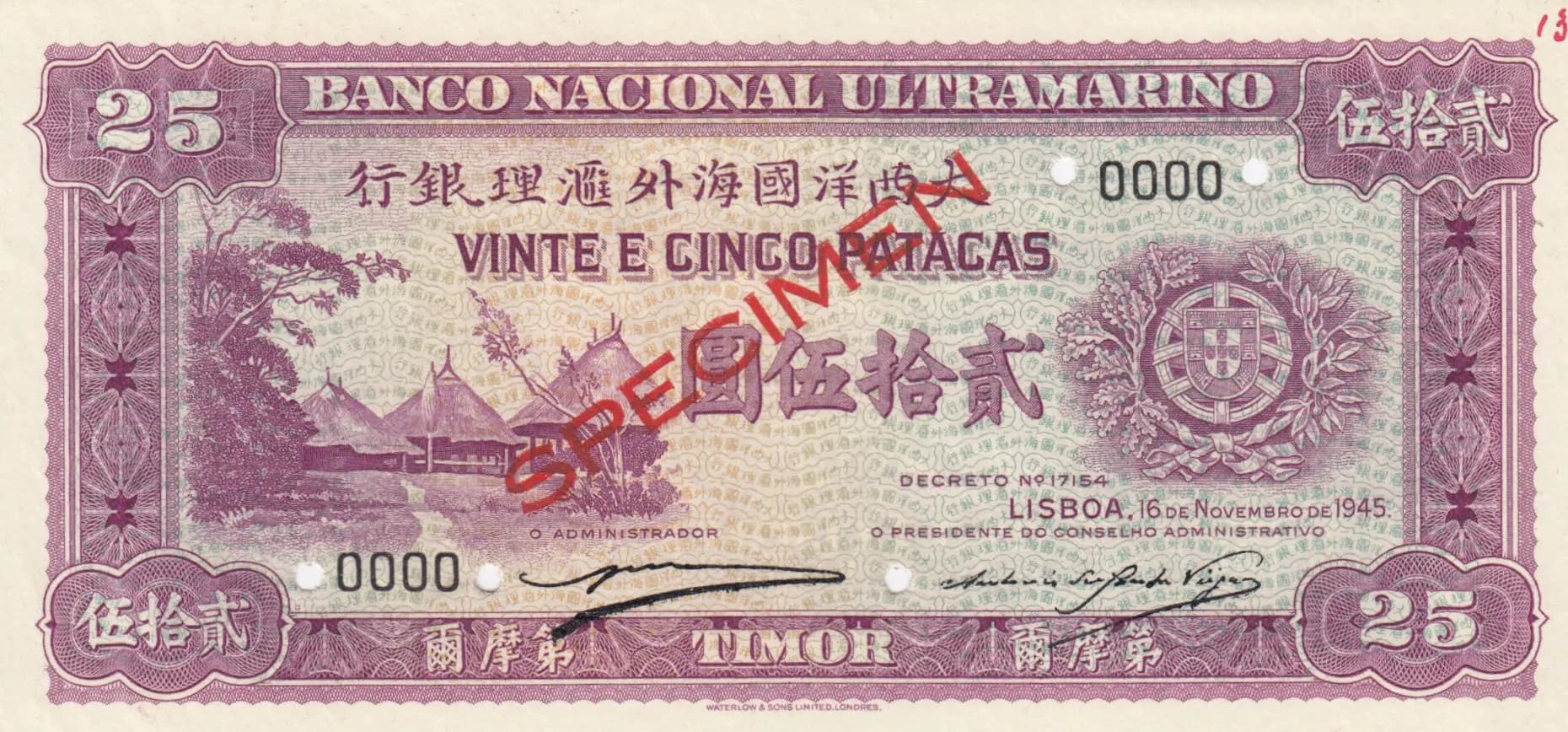
60 escudos 1959 specimen
Market Prices
About This Note
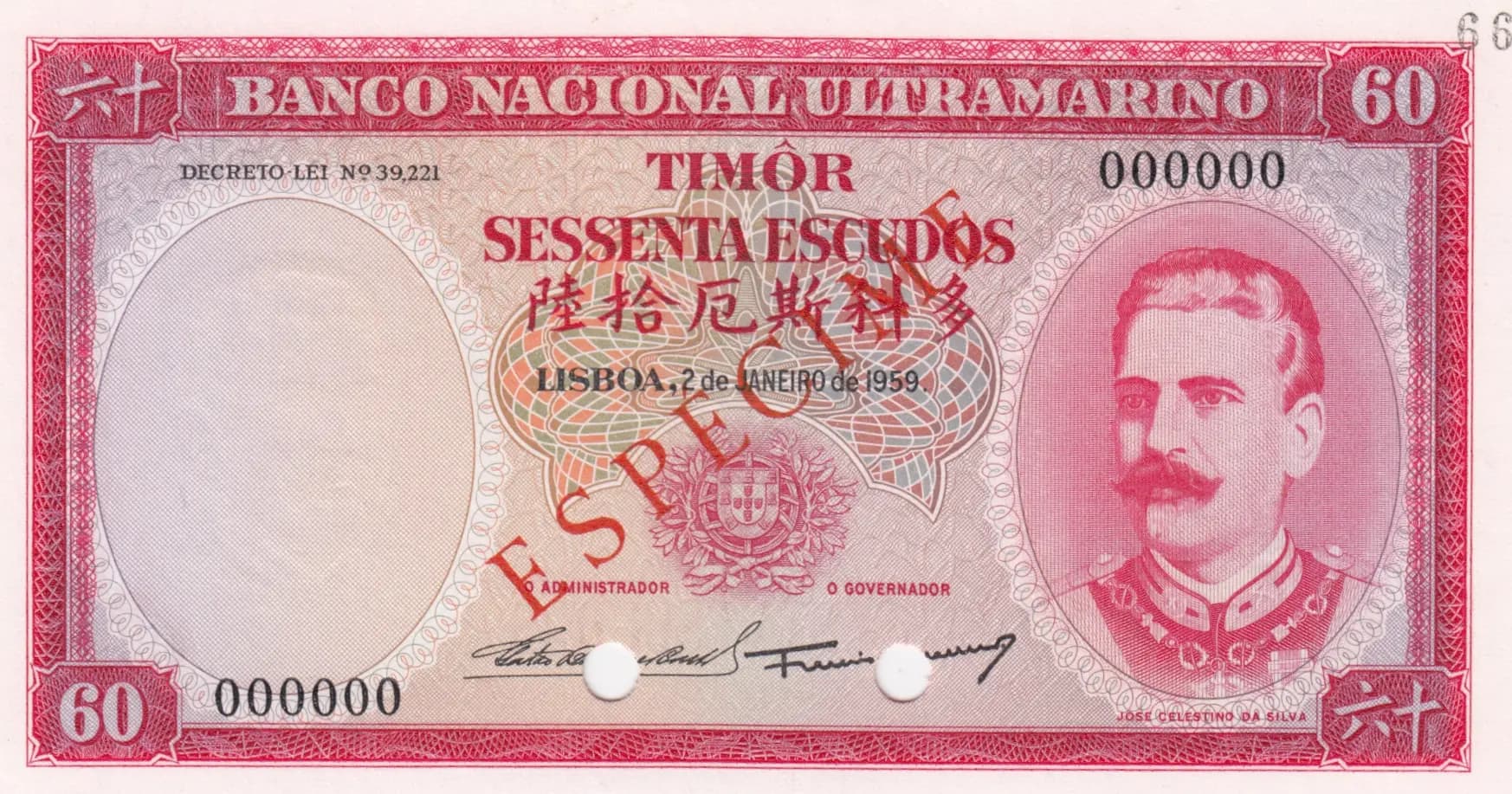
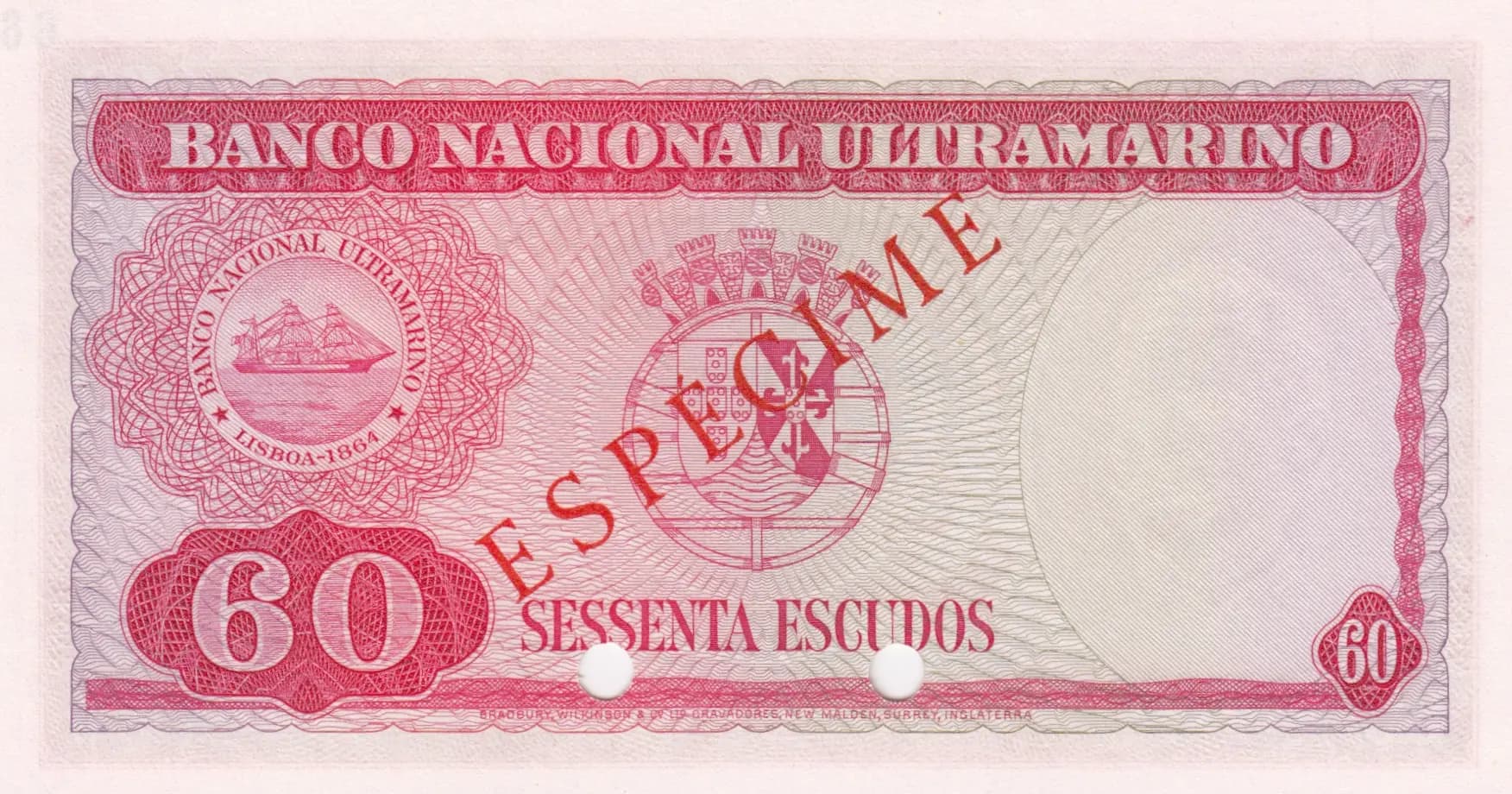
This is an uncirculated 1959 specimen note from the Banco Nacional Ultramarino for Portuguese Timor, featuring an elegant pink and red color scheme with fine engraving throughout. The front showcases a portrait of José Celestino da Silva in military uniform on the right, with the bank's coat of arms prominently displayed in the center, while the reverse features the distinctive ship medallion of the Banco Nacional Ultramarino within an ornamental circular frame. The note exhibits the characteristic specimen markings (two binding holes and SPECIMEN overprint) with crisp, sharp printing and no signs of wear, representing a well-preserved example of Portuguese colonial currency.
Common. While this is a specimen note from a colonial territory, the eBay market data provided shows substantial price variation with UNC examples selling in the $3.99-$4.99 range and circulated examples at $7.00-$8.50, with the 2016 catalogue value for UNC at $135. The relatively modest market prices at the lower end and the availability of multiple sales indicate this is a common specimen note. Portuguese Timor banknotes were issued in reasonable quantities, and specimen notes—while not circulating—were produced in sufficient numbers that they remain readily available to collectors. The lack of rarity designation in standard catalogs for this Pick number further supports common status.
This banknote was issued under Decree-Law No. 39,221 on January 2, 1959, during the final decade of Portuguese colonial rule in Timor, which would continue until 1975. The portrait of José Celestino da Silva reflects the Portuguese colonial administration's leadership during this period, while the ship emblem on the reverse represents the Banco Nacional Ultramarino's historic role in managing currency across Portugal's overseas territories. The note's Portuguese language inscriptions and heraldic imagery underscore Timor's status as a Portuguese colony during the height of the Estado Novo regime.
The obverse features José Celestino da Silva, a Portuguese colonial administrator, depicted in profile wearing military dress uniform with chest insignia and displaying a prominent mustache, positioned on the right side of the note. The center displays the Portuguese coat of arms with shield and heraldic design, flanked by ornate decorative borders and a cross symbol in the upper left corner. An empty oval watermark frame is positioned on the left side. The reverse showcases the iconic ship medallion of the Banco Nacional Ultramarino—a sailing vessel enclosed within an ornamental circular frame with rosette patterns—positioned on the left side, with large denomination numerals (60) and spiral line decorative patterns occupying the right portion of the design. Both sides exhibit fine line engraving and intricate guilloche patterns characteristic of high-security banknote production.
FRONT: 'BANCO NACIONAL ULTRAMARINO' (National Bank of the Overseas), 'TIMOR' (Timor), 'SESSENTA ESCUDOS' (Sixty Escudos), 'DECRETO-LEI Nº 39.221' (Decree-Law No. 39,221), 'LISBOA-2 de JANEIRO de 1959' (Lisbon-2nd of January 1959), 'O ADMINISTRADOR' (The Administrator), 'O GOVERNADOR' (The Governor), 'JOSÉ CELESTINO DA SILVA' (José Celestino da Silva). BACK: 'BANCO NACIONAL ULTRAMARINO' (National Bank of the Overseas), 'SESSENTA ESCUDOS' (Sixty Escudos), 'SPECIMEN' (Specimen), 'BANCO NACIONAL ULTRAMARINO LISBOA-1860' (National Bank of the Overseas Lisbon-1860), 'BRADBURY WILKINSON & CO. LTD ENGRAVERS, NEW MALDEN, SURREY, ENGLAND' (Bradbury Wilkinson & Co. Ltd Engravers, New Malden, Surrey, England).
Intaglio engraving with fine line guilloche security patterns, produced by Bradbury Wilkinson & Co. Ltd, a renowned British security printer located in New Malden, Surrey, England. The multicolor printing technique combines red and pink dominant colors with cream and white underprints. The fine detail line work, intricate decorative patterns, and sharp impression throughout indicate professional steel plate engraving typical of mid-20th-century banknote production by this established security printer.
This is identified as P-23s (specimen variety) per the Pick catalog system. The PMG population report notes two catalogued variants for the base Pick number P-23: P-23a and P-23cts, indicating variant printing details exist. This specific note is the specimen variety (indicated by the SPECIMEN overprint and binding holes visible in the images), distinguishing it from regular circulation issues. The zero serial numbers (000000) visible on the front are consistent with specimen note production protocols. The printer attribution (BWC - Bradbury Wilkinson & Co. Ltd) matches the engraver credit visible on the reverse.