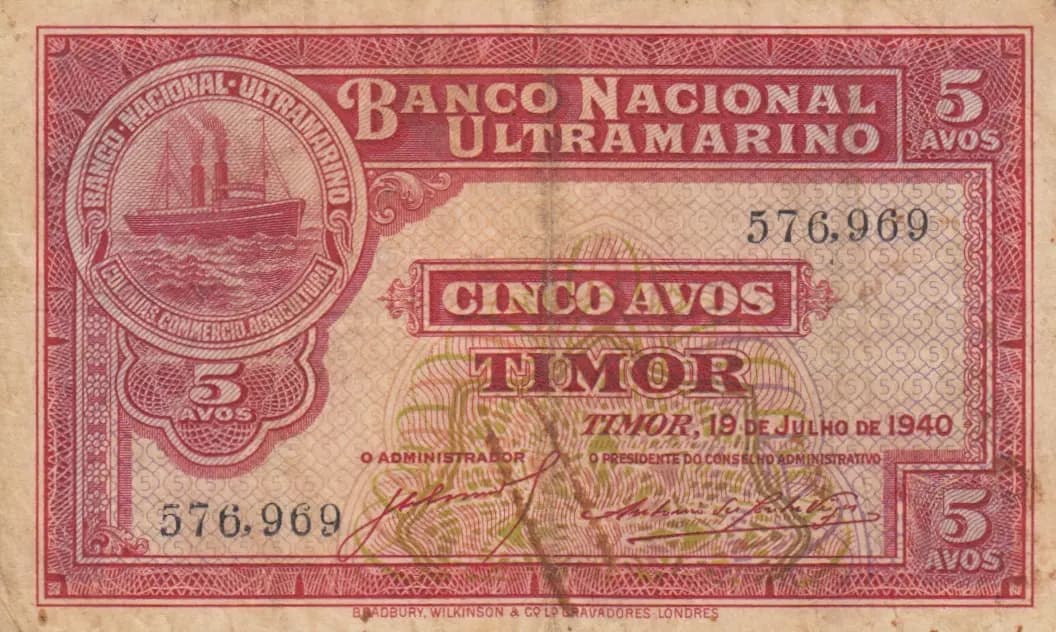
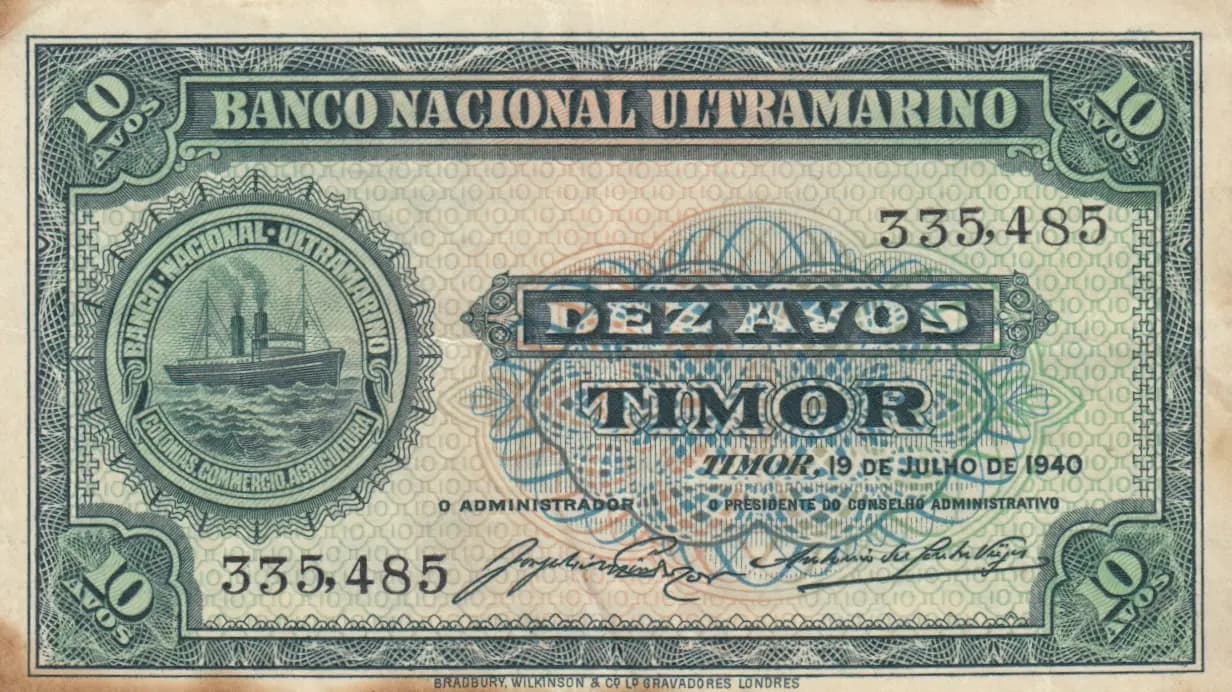
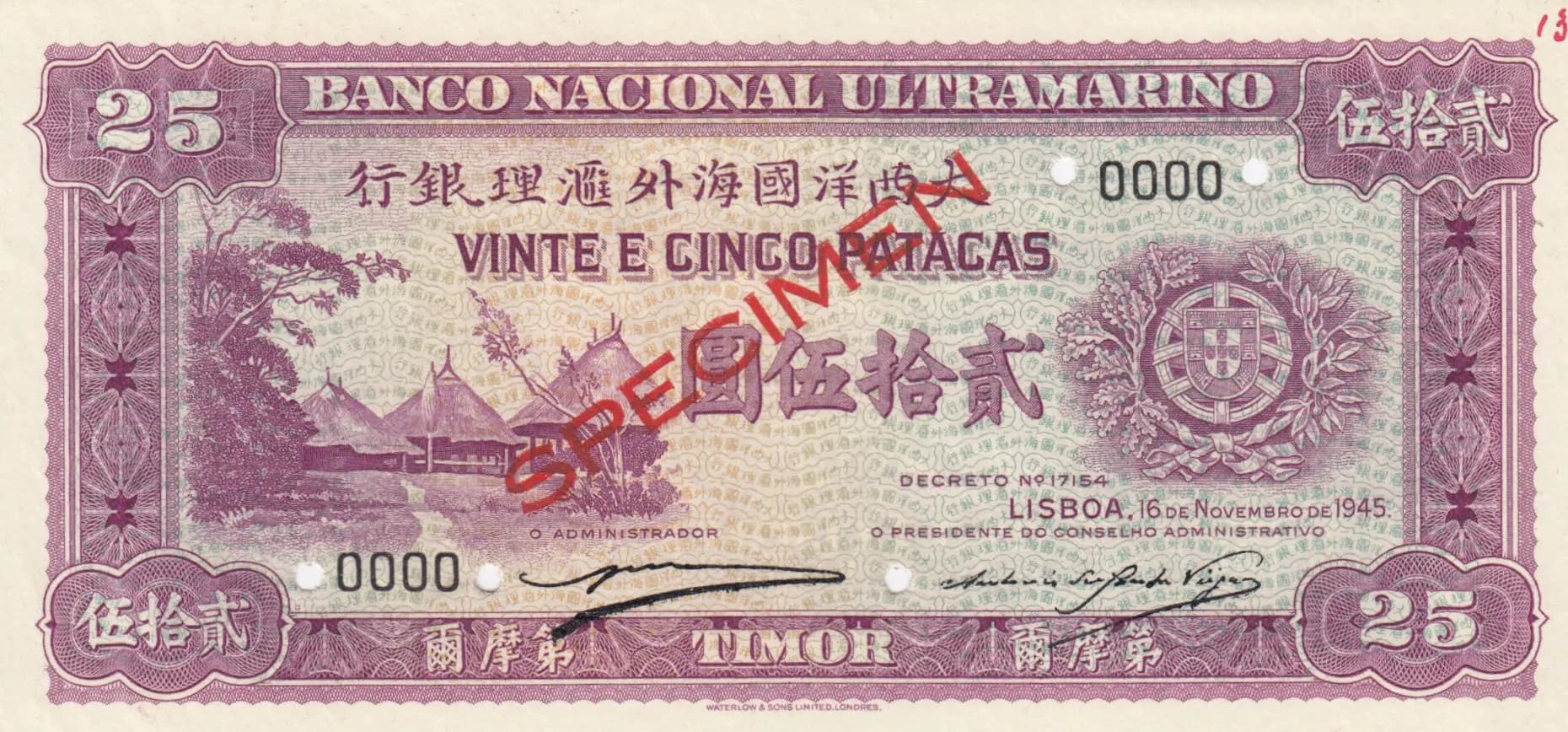
1000 escudos 1968 specimen
Market Prices
1 saleAbout This Note
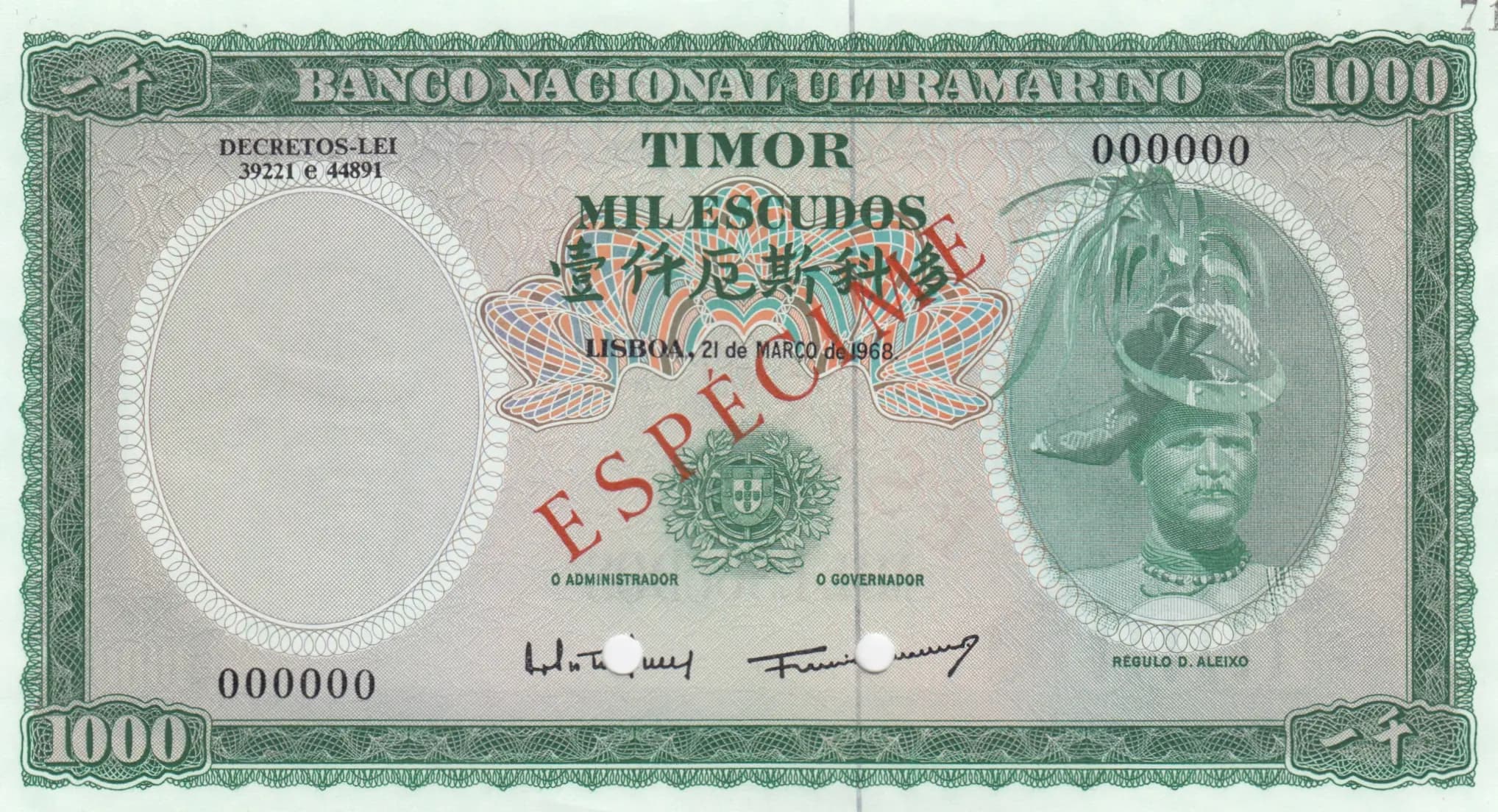
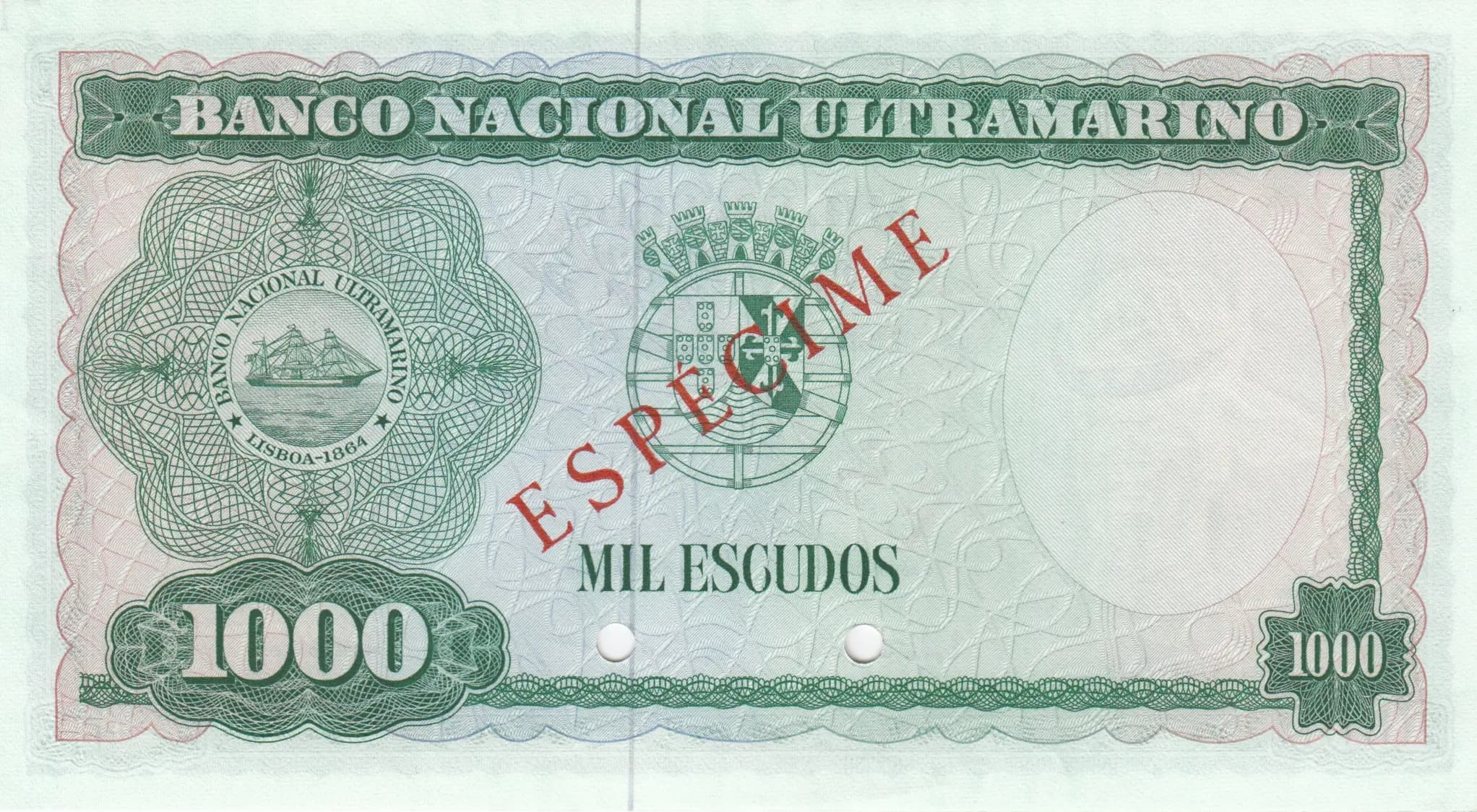
This is a 1000 Escudos specimen note from Timor issued by Banco Nacional Ultramarino in 1968, printed by BWC. The note features a striking green and multicolored design with a portrait of Regulo D. Aleixo in military dress on the obverse, complemented by a crowned Portuguese coat of arms and an ornate ship seal on the reverse. As a specimen note, it bears a red diagonal 'ESPÉCIME' overprint and two punch holes indicating cancellation, yet remains in pristine uncirculated condition otherwise—a desirable artifact from Portugal's colonial period in Southeast Asia.
Common. While specimen notes by nature have a more limited distribution than circulation issues, this note appears in multiple variants within the PMG population report (P-30a, P-30cts, P-30pp, P-30s) and sold relatively recently (2017) on eBay for $347.99 in PMG 65 condition. The 2019 catalog value of $185 for UNC examples, combined with the existence of multiple variants, indicates this is a readily available specimen note in the collector market. Specimen notes from well-documented colonial issues like this are typically produced in sufficient quantities to remain accessible to collectors.
This note was issued during the final years of Portuguese colonial rule in Timor, authorized under Decree-Laws 39221 and 44891, dated March 21, 1968. The imagery reflects Portugal's imperial identity, with the crowned coat of arms and ship seal symbolizing the Portuguese maritime empire and overseas territories (ultramarino). Regulo D. Aleixo, depicted in formal military dress, was a significant figure in Timorese colonial administration during this period of transition that would ultimately lead to Timor's independence in 1975.
The obverse features a left-facing portrait of Regulo D. Aleixo, a colonial administrator, rendered in profile wearing a decorated military or formal dress uniform, positioned on the right side of the note. The center displays an impressive winged heraldic emblem with a shield and the Portuguese coat of arms, flanked by decorative oval frames with ornamental borders. The reverse showcases an ornate circular seal containing a ship or vessel on the left side—representing the Banco Nacional Ultramarino's maritime heritage—with a crowned Portuguese coat of arms displaying heraldic divisions positioned center-right. Both sides employ intricate guilloche patterns, geometric networks, and fine decorative line work throughout the design. The dominant color scheme combines green with white/cream backgrounds and pink/rose accents, unified by the red diagonal specimen overprint.
Front Side: 'BANCO NACIONAL ULTRAMARINO' (National Overseas Bank), 'TIMOR' (Timor), 'MIL ESCUDOS' (One Thousand Escudos), 'DECRETOS-LEI 39221 e 44891' (Decree-Laws 39221 and 44891), 'LISBOA, 21 de MARÇO de 1968' (Lisbon, March 21, 1968), 'O ADMINISTRADOR' (The Administrator), 'O GOVERNADOR' (The Governor), 'REGULO D. ALEIXO' (Regulo D. Aleixo), 'ESPÉCIME' (Specimen), serial number '000000'. Back Side: 'BANCO NACIONAL ULTRAMARINO' (National Overseas Bank), 'MIL ESCUDOS' (One Thousand Escudos), 'ESPÉCIME' (Specimen), denomination '1000'.
Intaglio (engraved) printing, as evidenced by the fine detail work, intricate guilloche patterns, ornamental borders, and precise line work visible throughout both obverse and reverse. The printer is identified as BWC (Bradbury, Wilkinson & Company), a renowned British security printer specializing in banknote and security document production. The specimen overprint was applied separately in red ink.
This note is specifically cataloged as P-30s, the specimen variant of the 1000 Escudos issue. It is distinguished by the red diagonal 'ESPÉCIME' overprint and two punch holes through the note (typical specimen cancellation marks), with serial numbers printed as 000000. The PMG population report identifies four cataloged variants for this base Pick number (P-30a, P-30cts, P-30pp, P-30s), suggesting variations in printing or overprint treatments. This particular specimen bears all characteristic markings of the 's' (specimen) designation.