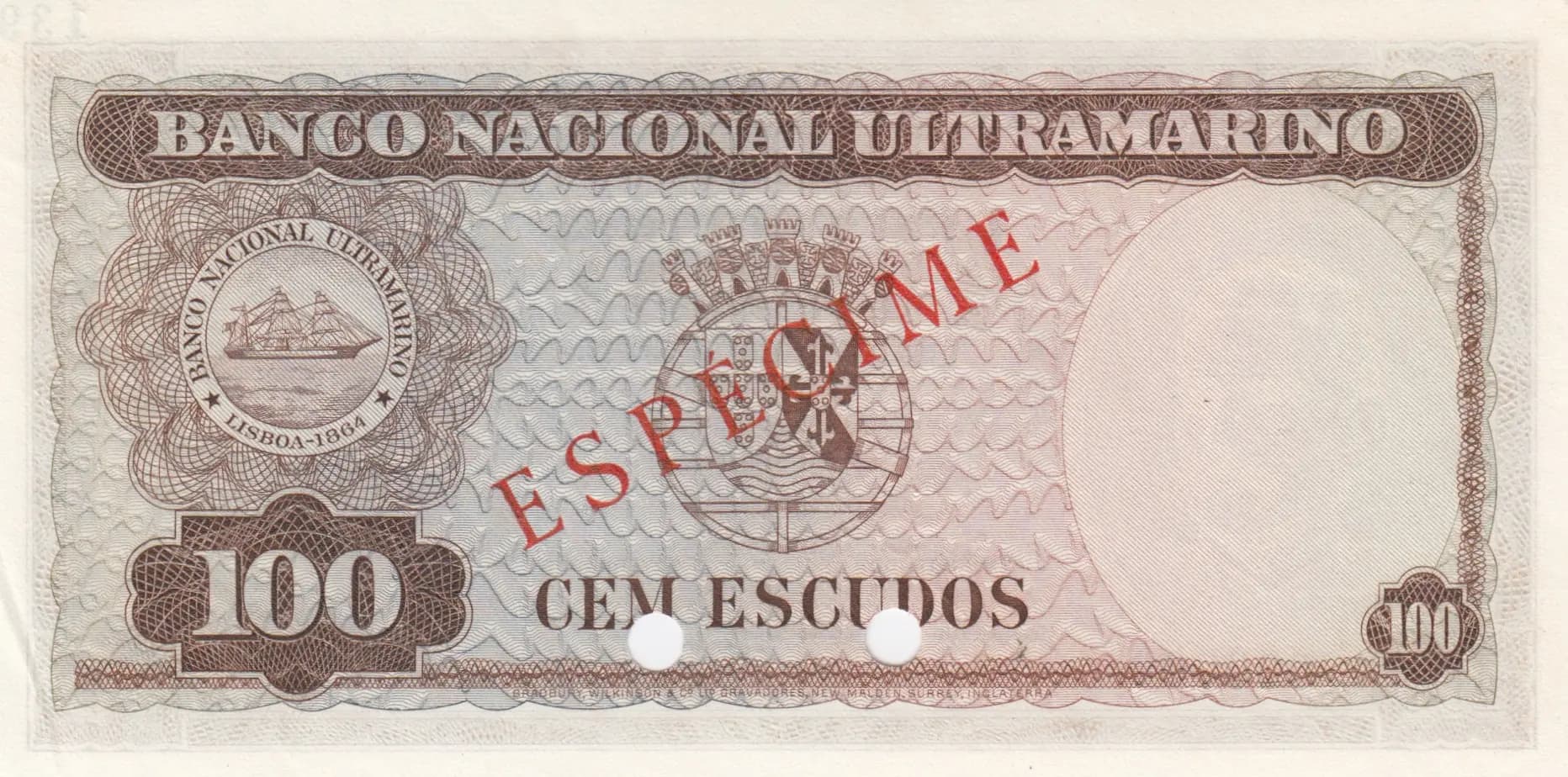
100 escudos 1959 specimen
Market Prices
About This Note
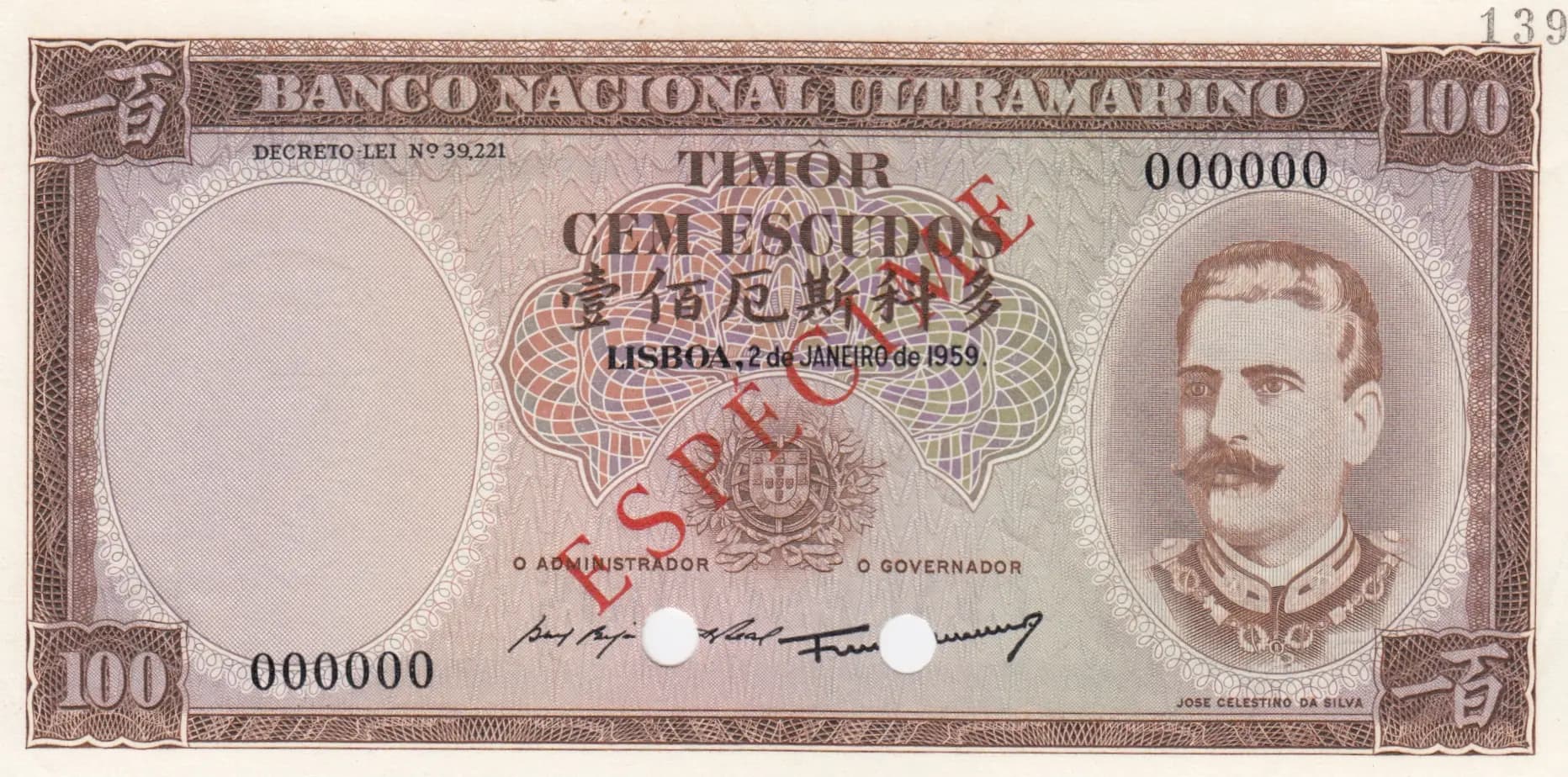
This is an exceptional uncirculated specimen of the 1959 Timor 100 Escudos note issued by Banco Nacional Ultramarino, featuring a striking portrait of José Celestino da Silva in formal military dress on the obverse. The note displays pristine condition with only minor specimen handling holes evident, showcasing the intricate brown and tan guilloche patterns and ornate heraldic elements that characterize this Portuguese colonial issue. With UNC market values reaching $250 and catalog values of $175 (2016), specimen notes of this vintage and condition represent desirable pieces of Portuguese colonial numismatic history.
Uncommon. While specimen notes of this series exist in the PMG population report (P-24s variant), the specific combination of this denomination, date, and condition grade remains relatively scarce in the market. eBay pricing for UNC examples reaches $250, significantly higher than circulated grades ($8-$35), indicating limited availability of pristine specimens. However, the note is not extremely rare—specimen examples were produced in moderate quantities for official distribution. The 2016 catalog value of $175 UNC and current market activity suggest this is an uncommon rather than rare issue, with desirability driven by colonial numismatic interest and specimen status rather than extreme scarcity.
This 1959 note was issued under Decreto-Lei Nº 39.221 dated January 2, 1959, during the later period of Portuguese colonial rule in Timor. The Banco Nacional Ultramarino, chartered in Lisbon in 1864 (as referenced by the seal on the reverse), served as the central monetary authority for Portuguese overseas territories. José Celestino da Silva, portrayed on the obverse, was a significant administrative figure in Portuguese colonial governance, and his inclusion on this denomination reflects the hierarchical colonial power structure of the period.
The obverse features a right-facing profile portrait of José Celestino da Silva, a colonial administrator, rendered with fine detail showing his distinctive mustache and formal military-style collar. An empty oval frame appears on the left side, typical of presentation specimen notes. The center displays elaborate heraldic elements including the Portuguese coat of arms with ornate floral and botanical ornamental designs. The reverse presents the circular seal and coat of arms of Banco Nacional Ultramarino dated 1864, emphasizing institutional continuity and Portuguese metropolitan authority. The entire design employs extensive guilloche patterning throughout in brown tones on a cream/beige underprint, creating sophisticated anti-counterfeiting visual complexity characteristic of high-value colonial notes.
FRONT: Banco Nacional Ultramarino (National Bank of Overseas) | 100 / Cem Escudos (100 / One Hundred Escudos) | Timor | Decreto-Lei Nº 39.221 (Decree-Law No. 39,221) | Lisboa, 2 de Janeiro de 1959 (Lisbon, January 2, 1959) | O Administrador (The Administrator) | O Governador (The Governor) | Especimen (Specimen) | 000000 (serial number) | José Celestino da Silva. BACK: Banco Nacional Ultramarino (National Bank of Overseas) | 100 / Cem Escudos (100 / One Hundred Escudos) | Especimen (Specimen) | Lisboa-1864 (Lisbon-1864, foundational date of the central bank).
Intaglio (copperplate) engraving, evidenced by the crisp, precise guilloche patterns, fine line work, and the depth of impression visible in the ornamental borders and heraldic elements. The printer is identified as BWC (Bradbury Wilkinson & Company), a world-renowned British security printer specializing in banknote production. The specimen overprint and serial number placeholder (000000) were applied using standard printing techniques for specimen notes prepared for distribution to banking authorities and collectors.
This is the P-24s variety—specifically identified as a specimen note (indicated by 'ESPECIMEN' overprint and the two characteristic holes from specimen stapling/pinning visible in the condition observations). The PMG population report identifies three variants for Pick 24: P-24a (standard issue), P-24cts (trial/color trial), and P-24s (specimen). This example is the specimen variety printed by BWC, distinguishing it from circulation issues. The serial number field showing 000000 is standard for specimen notes and confirms this is a presentation example rather than a circulation piece.