100 baht 1968
Market Prices
33 salesAbout This Note
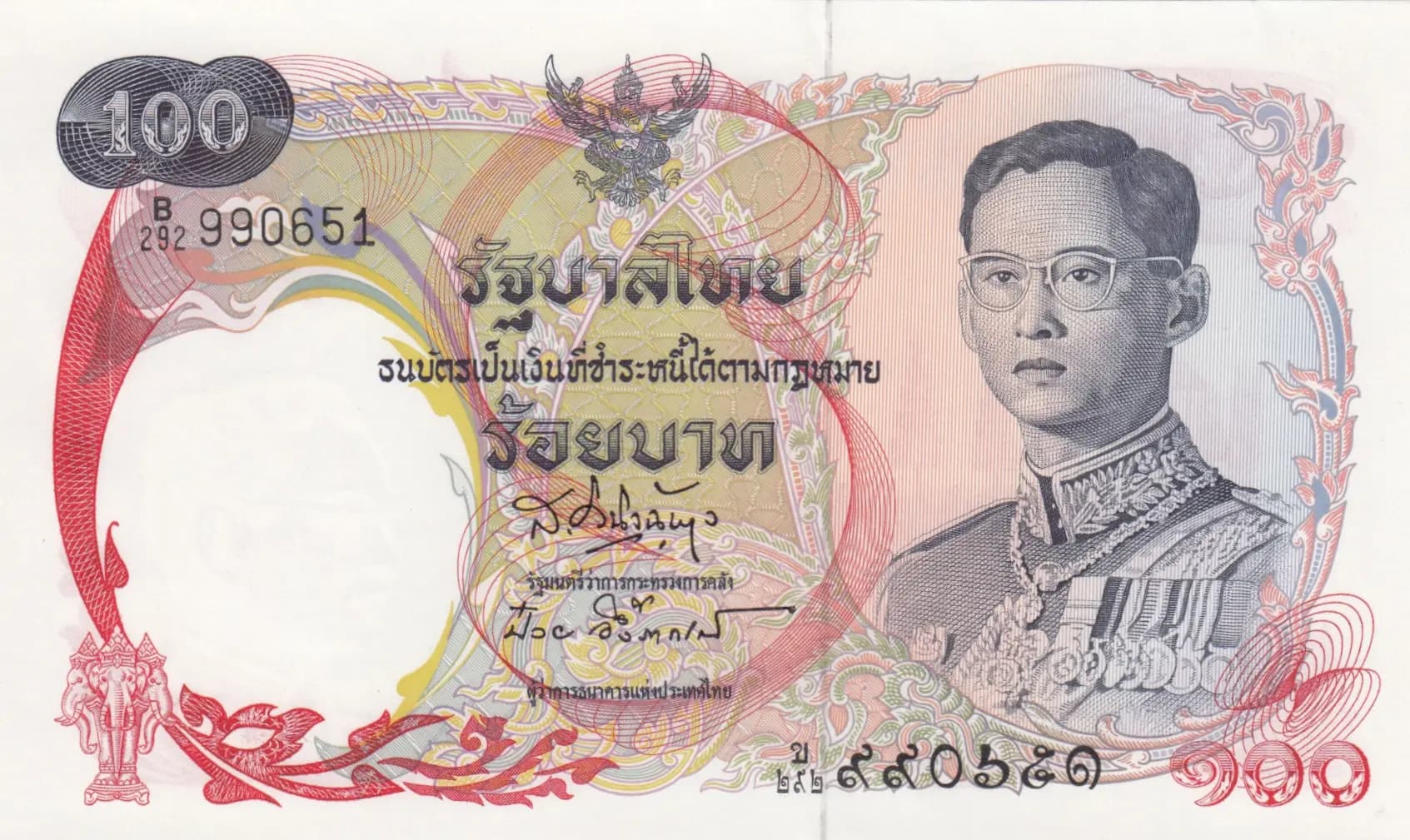
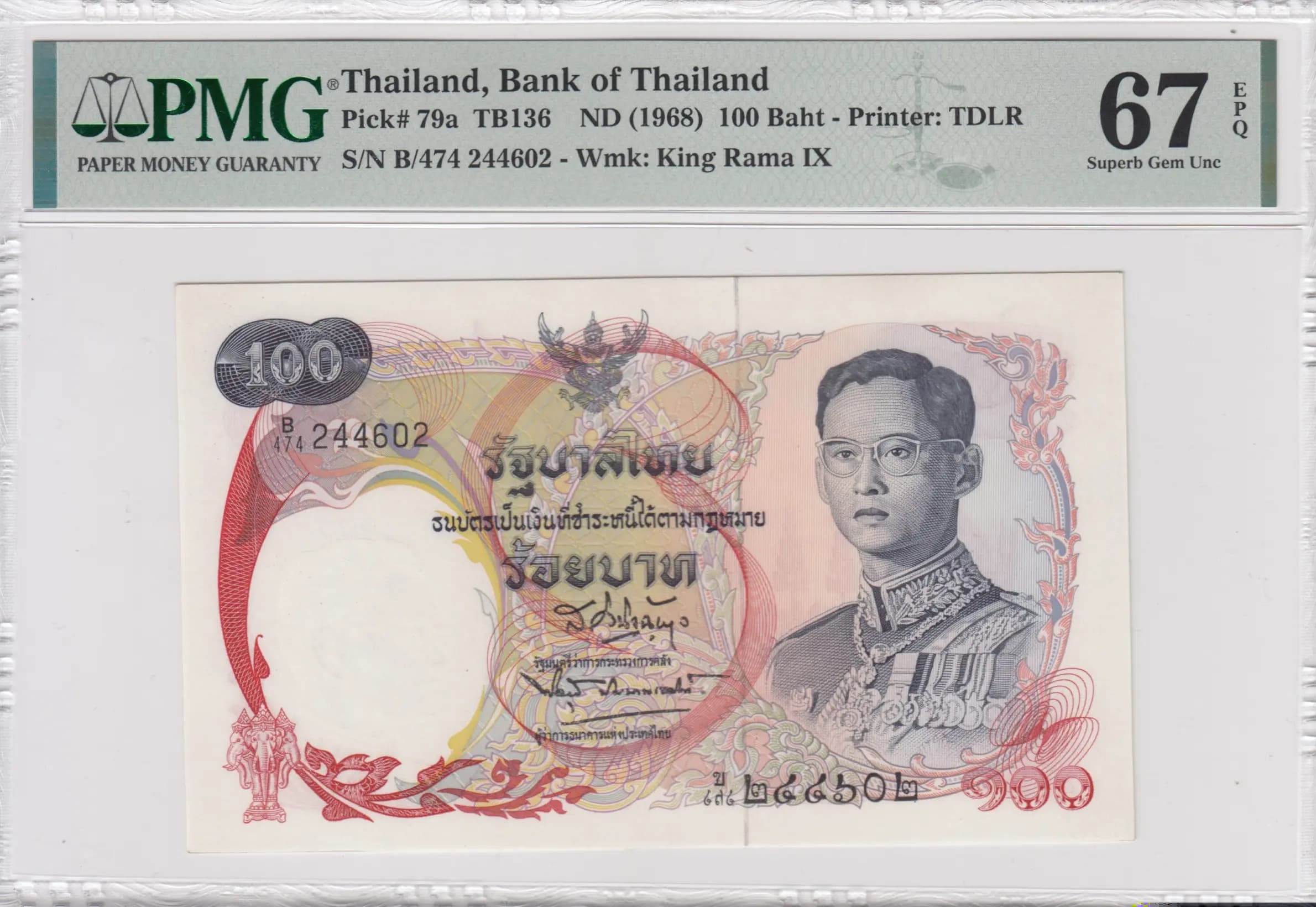
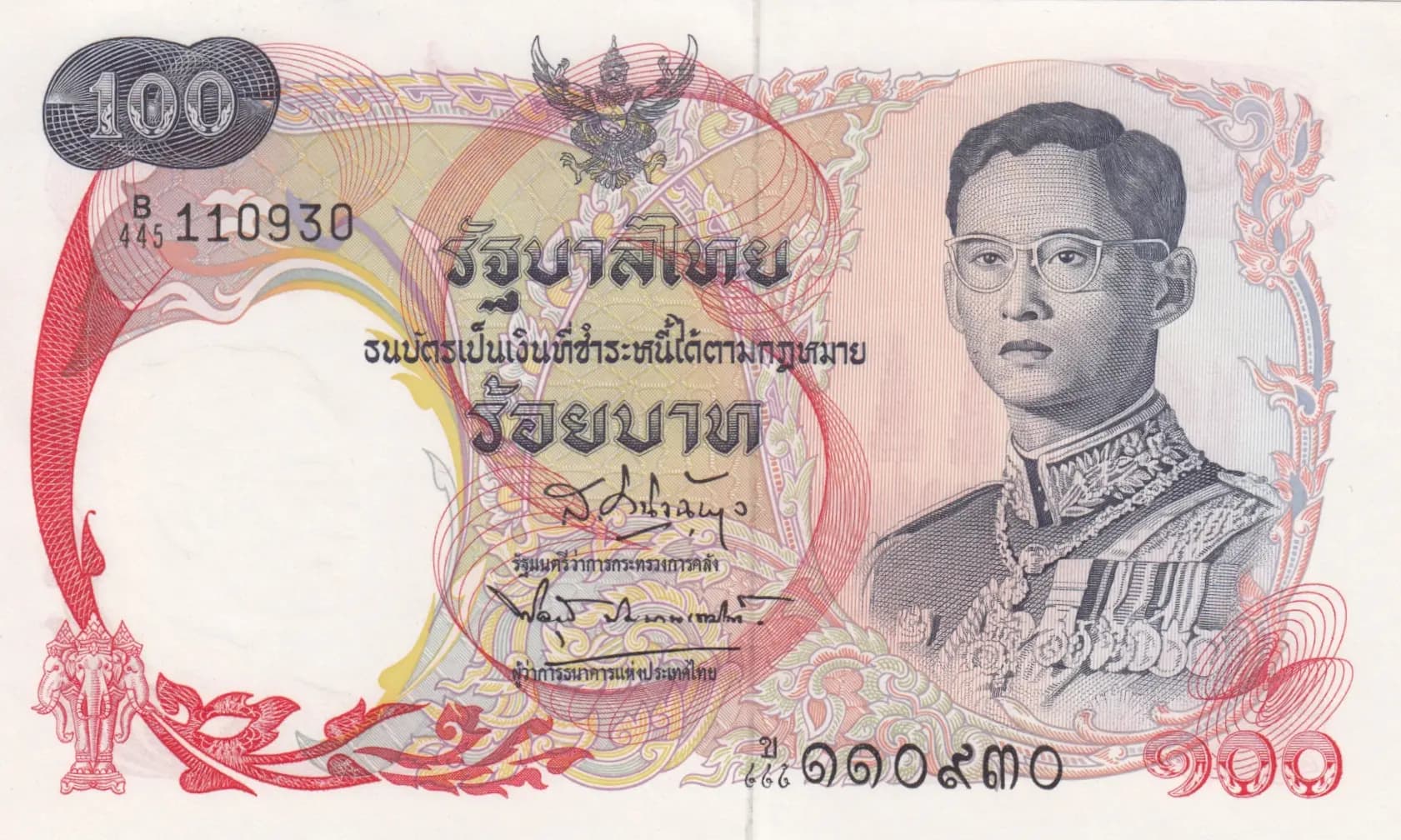
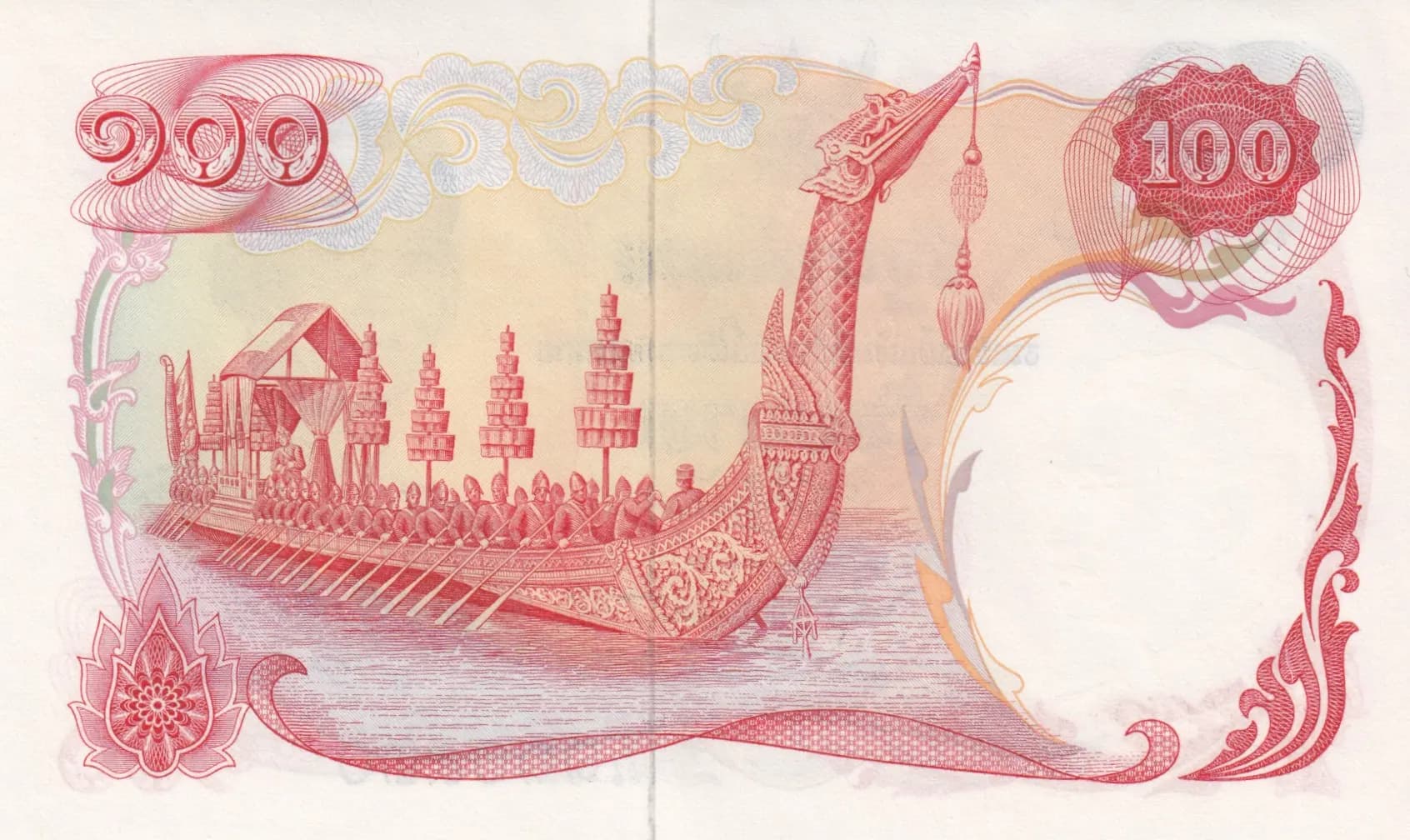
This is a Thailand 100 Baht banknote from 1968 (Pick P-79), depicting King Rama IX Bhumibol Adulyadej in formal military dress uniform with glasses on the obverse, and the Royal Barge Suphannahong on the reverse. The note presents in Uncirculated condition with crisp, sharp printing throughout, though a light vertical center fold is visible. The vibrant red, pink, gold, and cream color palette with intricate Thai architectural and floral motifs exemplifies the high-quality engraving typical of this classic Thai issue.
Common. This is a standard regular-issue banknote from Thailand's extensive 1968 series, with no evidence of limited printing or early recall. eBay auction data spanning 2013-2026 shows consistent availability across all condition grades, with UNC examples regularly selling in the $20-90 range, indicating steady collector supply. Catalogue values from 2019 list UNC at only $13, further confirming this as a readily available note. The absence of any notation regarding rare varieties or limited printings in the PMG population data supports a common classification.
Issued in 1968 during King Bhumibol Adulyadej's reign, this banknote celebrates the Thai monarchy through its dual imagery: the reigning sovereign in military regalia on the obverse and the legendary Royal Barge Suphannahong on the reverse. The Suphannahong, one of Thailand's most sacred ceremonial vessels, symbolizes royal power and cultural heritage, making it an appropriate choice for Thai currency of this period. This note represents a transitional era in Thai monetary design when such elaborate engravings and multi-color printing demonstrated the nation's modern banking infrastructure.
The obverse features a formal three-quarter portrait of King Rama IX (Bhumibol Adulyadej) wearing glasses and an ornately decorated military-dress uniform with elaborate collar insignia, positioned on the right side of the note. The composition is framed by an elaborate Thai architectural border incorporating floral motifs, Thai royal emblems including a multi-headed Garuda (Thai national symbol) at the top center, and decorative scrollwork in red, pink, gold, and cream tones. The reverse showcases the Suphannahong, the Royal Barge, rendered with multiple tiered spires and ornamental towers characteristic of traditional Thai naval architecture. The barge is depicted on stylized waters with lotus flower motifs and Thai architectural frame elements. Both sides employ guilloché patterns and fine-line engraving in the denomination areas, creating sophisticated security features.
FRONT SIDE: '100' (denomination in Arabic numerals); 'B 445 110930' (serial number); 'ธนบัตรไทย' (Thai Banknote); Additional Thai text includes references to banknote denomination specifications, certificate designation, issue date, Ministry of Finance, and 'ผู้ว่าการธนาคารแห่งประเทศไทย' (Governor of the Bank of Thailand); '999' (security/control number). BACK SIDE: '100' (denomination); '999' (control number). The front contains formal Thai administrative inscriptions typical of central bank currency issuance.
This note was produced using multi-color intaglio (engraved) printing, the standard security printing method for Thai banknotes of this era. The printer is identified as TDLR (Thai Dini Limited/Thailand's official security printer). The fine guilloché patterns visible in the denomination areas, the precision of the multi-color registration, and the crisp engraved line work throughout are characteristic of high-security intaglio production. The watermark features a portrait of King Rama IX in uniform, a feature typical of Thai currency security measures.
This note is catalogued as Pick P-79a by PMG with one identified variant. The observed serial number 'B 445 110930' and the printer attribution to TDLR are consistent with standard 1968 production. No overprints, signature varieties, or unusual serial number prefixes that would indicate a scarce sub-variety are evident from the visual analysis. The single vertical fold visible through the center of both sides appears to be post-printing handling damage rather than a printing variety.