5 yuan 1961
Market Prices
12 salesAbout This Note
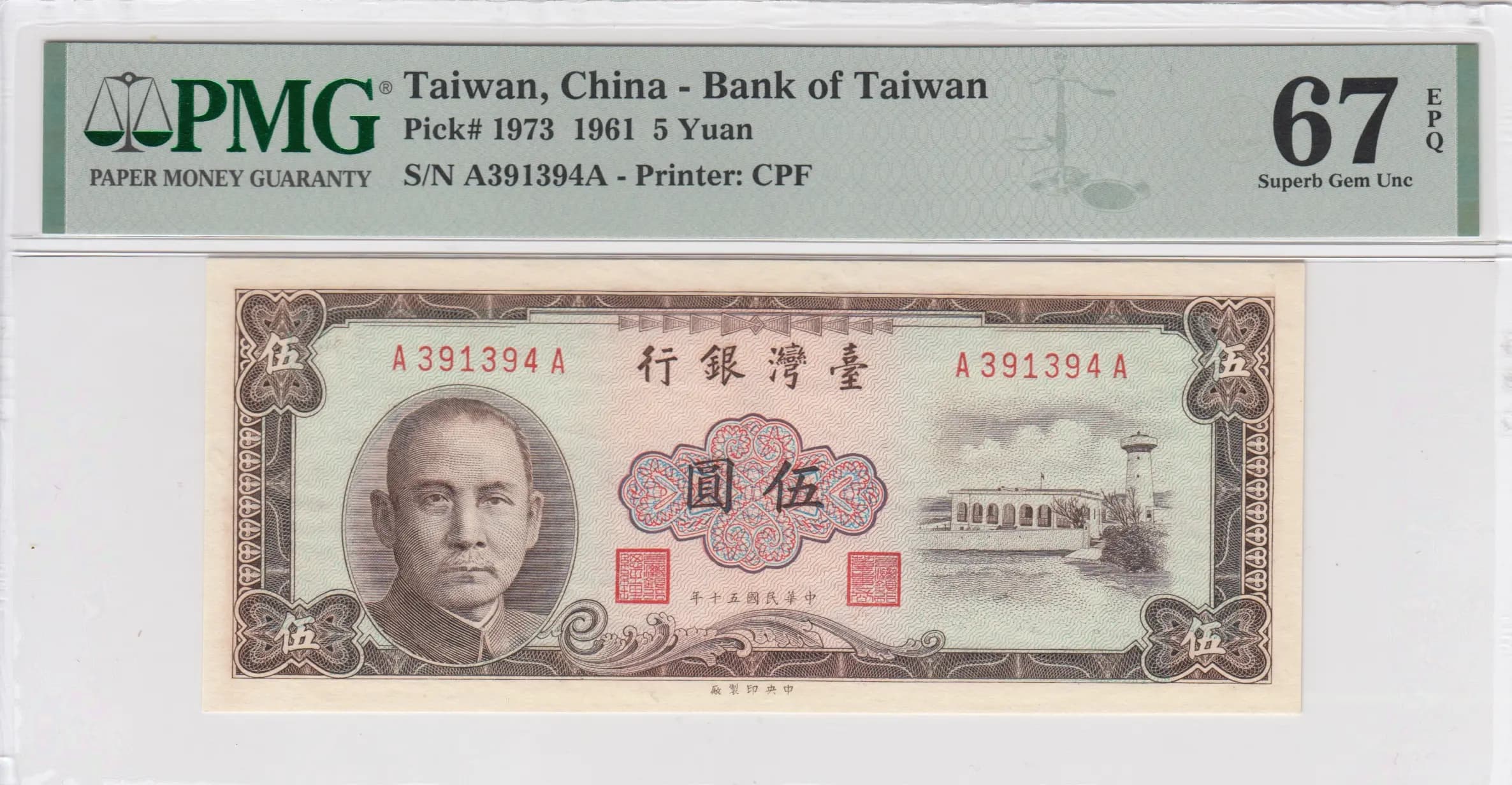
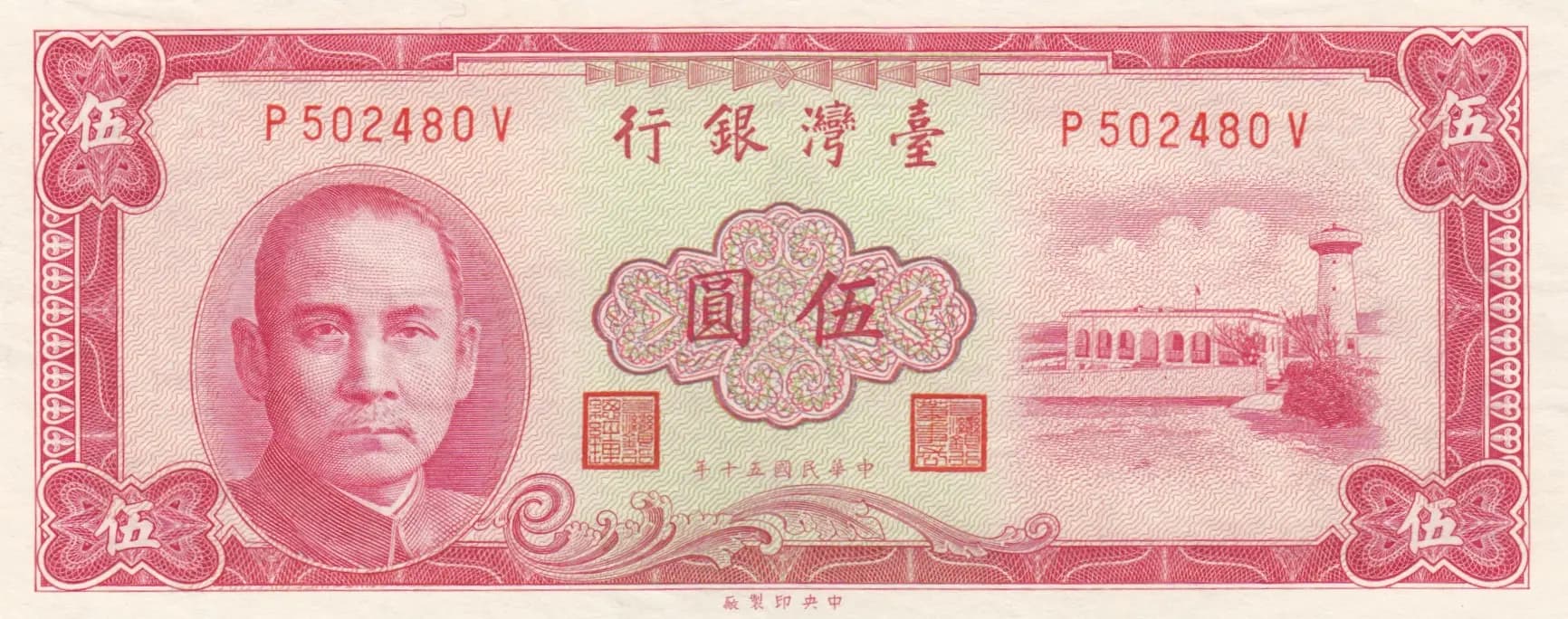
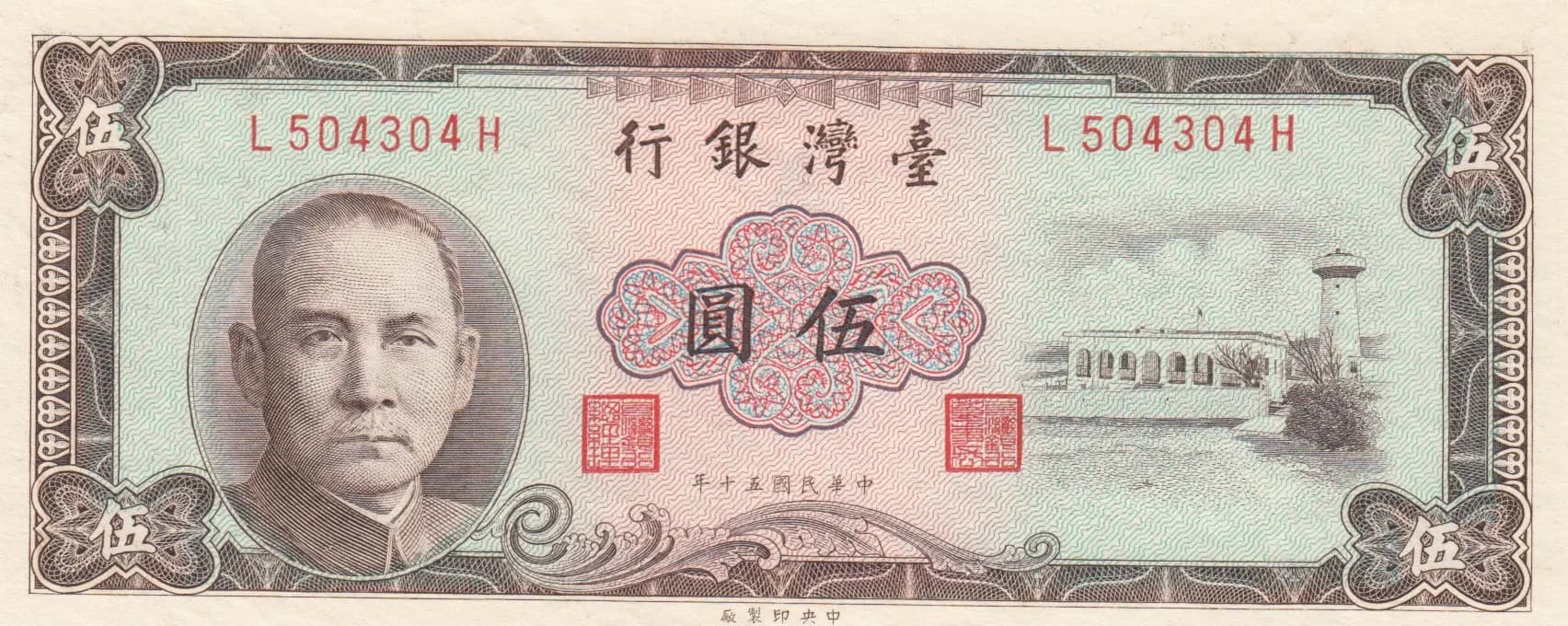
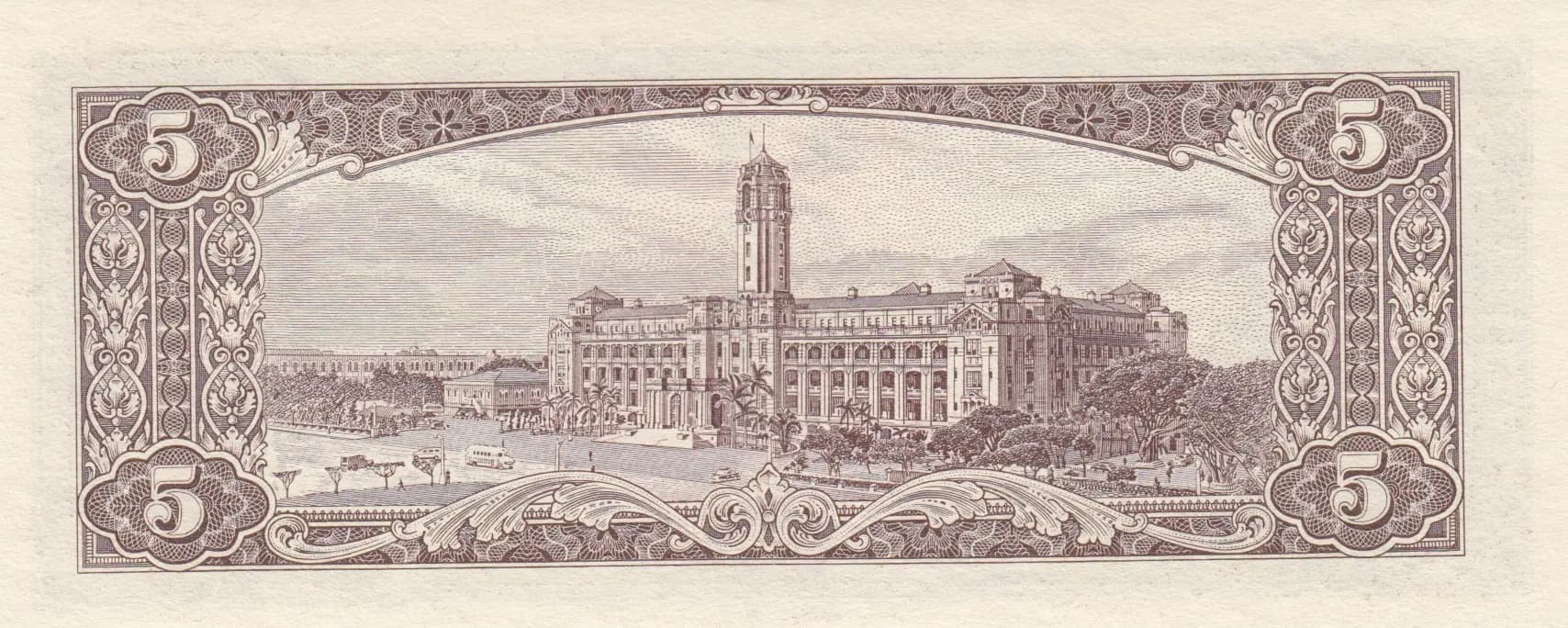
This is an uncirculated example of the 1961 Taiwan 5 Yuan banknote (Pick P-1973), featuring a portrait of Dr. Sun Yat-sen on the obverse and the Presidential Palace on the reverse rendered in fine engraved detail. The note displays the characteristic brown and multicolored palette typical of early Bank of Taiwan currency, with intricate ornamental borders and security engraving throughout. In UNC condition, this note represents a well-preserved example of mid-20th century Republic of China currency with strong eye appeal and no visible circulation wear.
Common. Market data from realbanknotes.com shows consistent trading activity with relatively modest prices across all grades: UNC examples have sold for $10-30 on eBay in recent decades, while lower grades trade for under $5. The 1961 5 Yuan was a regular issue with substantial circulation, and significant quantities remain available in both UNC and circulated grades. No evidence of a limited print run, recall, or special circumstances that would elevate this to scarce or rare status.
Issued in 1961 (Year 50 of the Republic of China calendar, dating from the 1911 Proclamation), this banknote reflects Taiwan's post-war monetary consolidation under the Bank of Taiwan. The prominent imagery of Dr. Sun Yat-sen, founder of the Republic of China, and the Presidential Palace in Taipei underscore the legitimacy and continuity of the ROC government during the Cold War period, when Taiwan maintained the official claim to represent all of China while consolidating its own distinct governance structures and economy.
The obverse features a three-quarter profile portrait of Dr. Sun Yat-sen (1866-1925), founder of the Republic of China, positioned at the left side in sepia engraving on a light greenish-blue background. The right side depicts the O-Luan Pi lighthouse (mentioned in catalog references as representing Southern Taiwan), rendered as a classical architectural structure. The reverse displays the Presidential Palace in Taipei as the central focal point, a grand neoclassical government building with a prominent central tower, multiple stories, arched windows, and surrounding landscape elements including palm trees. Both sides feature ornamental borders with intricate floral and geometric patterns, decorative corner pieces, red official seals, and fine-line engraved security work throughout. Large denomination numerals '5' appear in ornamental frames in all four corners of the reverse.
Front side: 台灣銀行 (Bank of Taiwan), 五圓 (Five Yuan), 中華民國 (Republic of China), Serial number L504304H. Back side: 5 (Arabic numeral denomination in corner frames). All inscriptions are in Traditional Chinese characters with the exception of the alphanumeric serial number.
Intaglio engraving (recess printing), the primary technique evident from the fine line work, intricate background patterns, and detailed cross-hatching visible throughout the note. The security features include complex background pattern work and ornamental elements characteristic of high-security banknote production. Printer: CPF (China Print Factory), as documented in numismatic references for this issue.
Serial number prefix L observed on this specimen (L504304H). Bank of Taiwan 5 Yuan notes from 1961 exist with various serial number prefixes (A, B, C, D, L series documented). The specific prefix and serial combination may be cataloged by advanced collectors, but no major varieties affecting catalog value are known for this Pick number. Standard printing variations typical of the era may exist but do not constitute recognized distinct varieties in major catalogs.