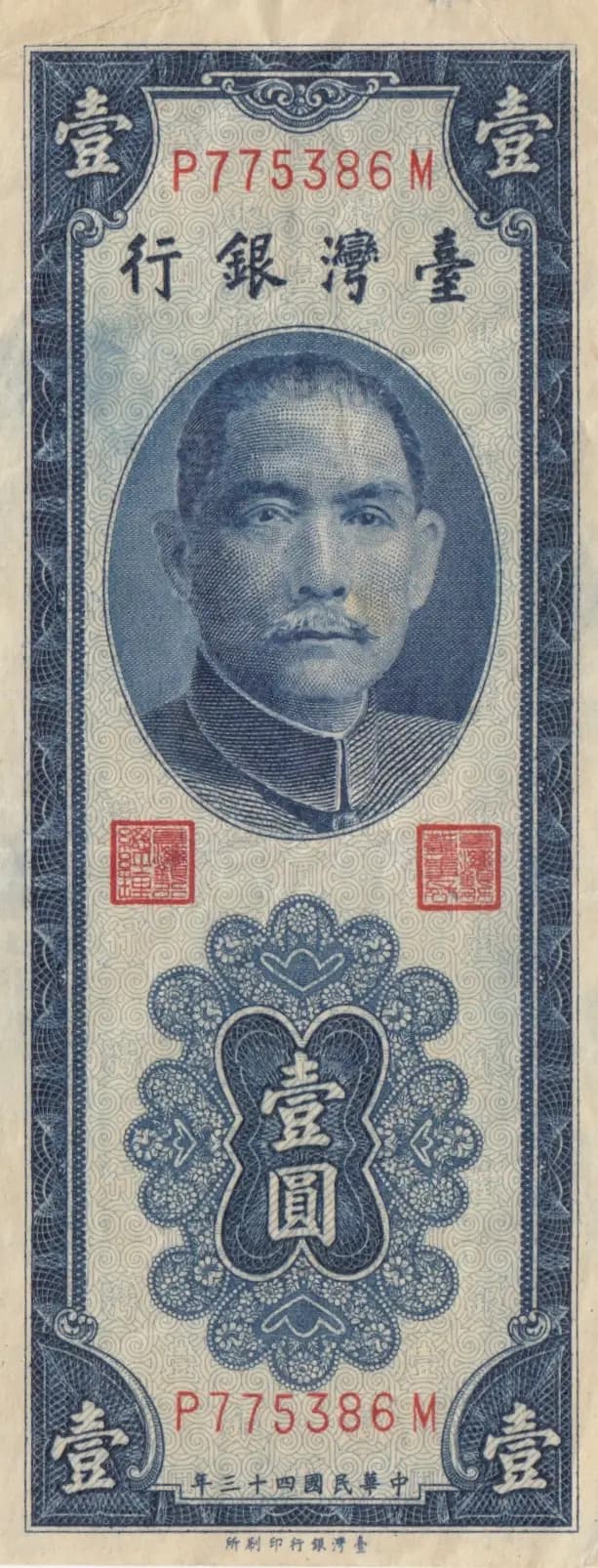
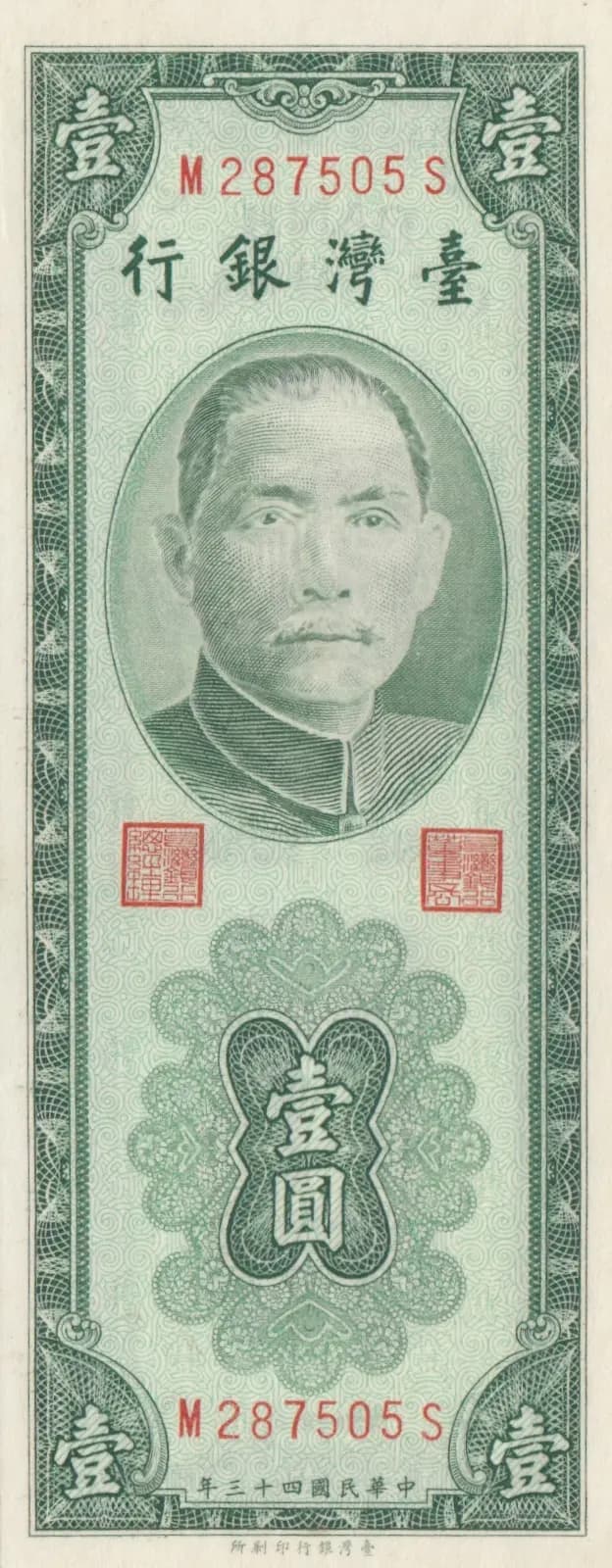
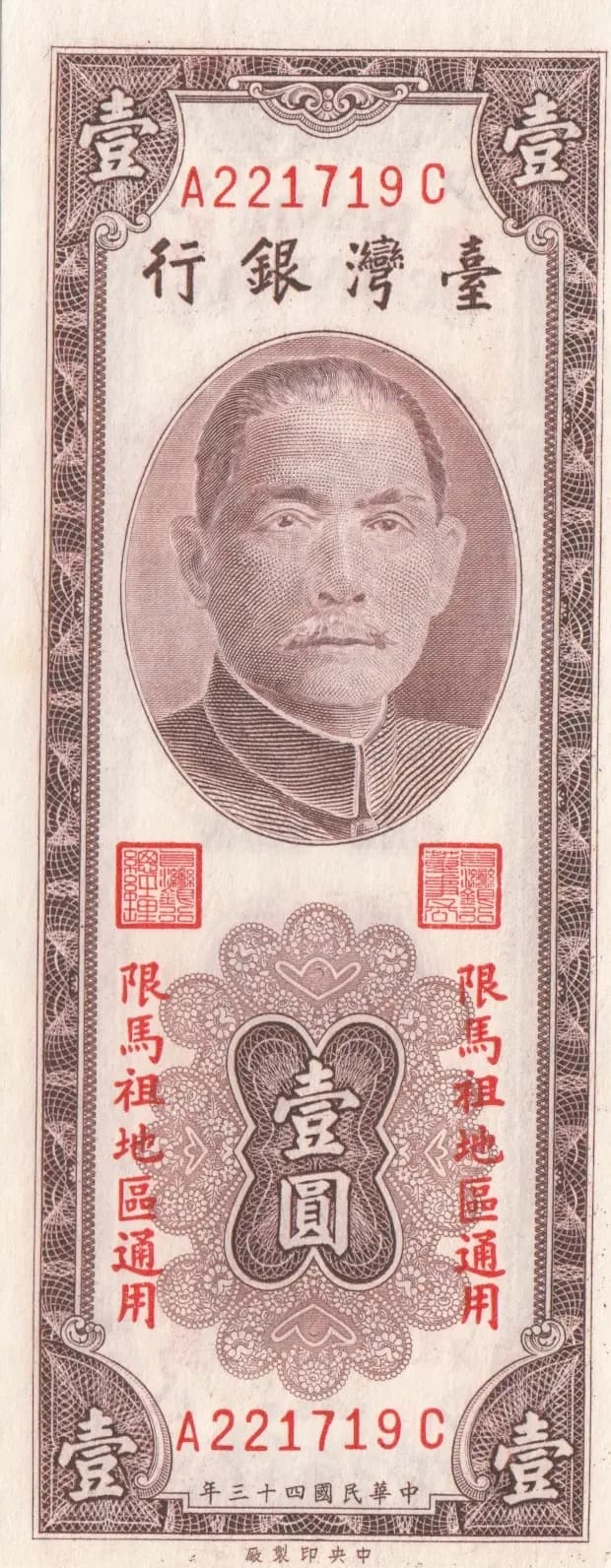
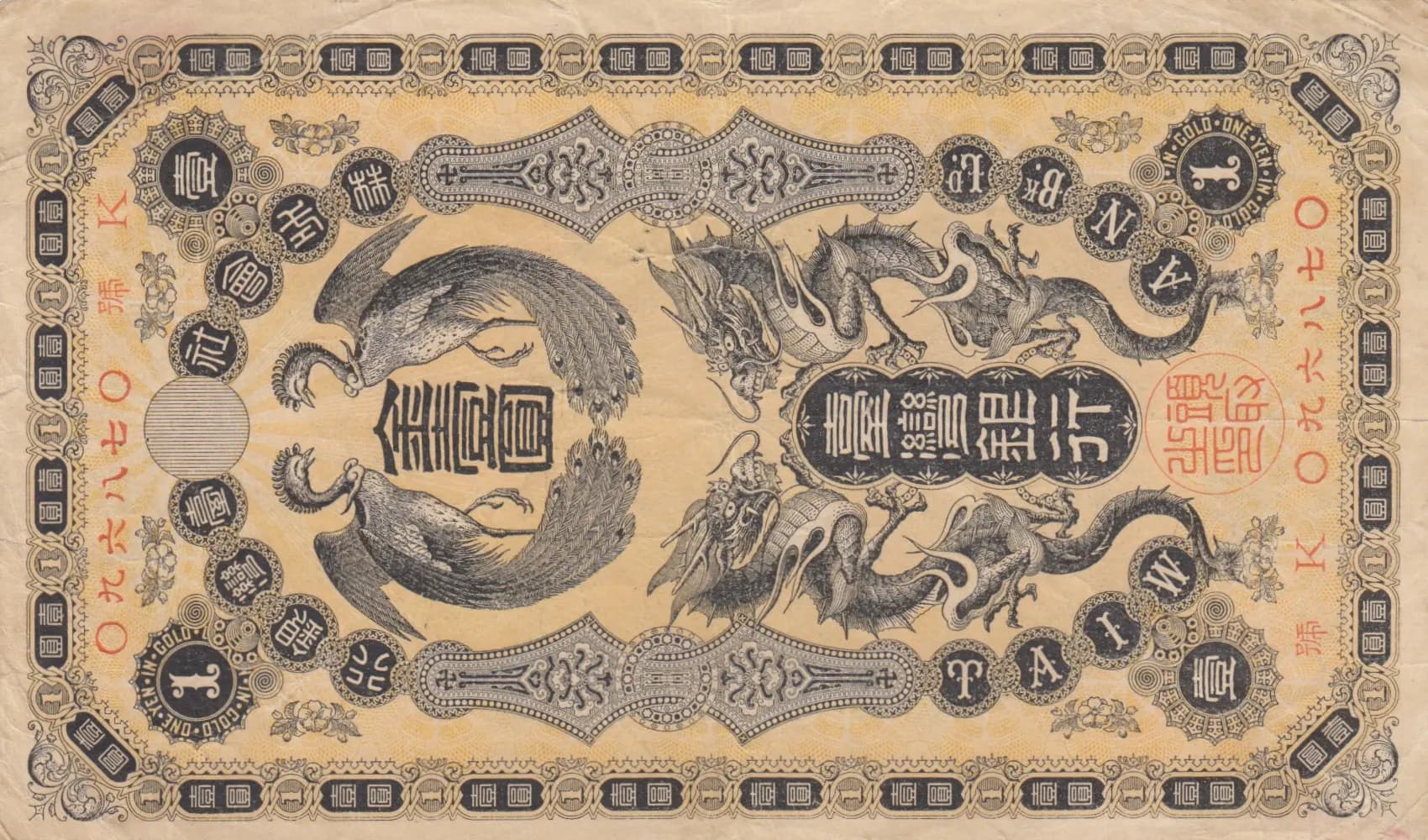
1 yuan 1954
“Matsu”
Market Prices
3 salesAbout This Note
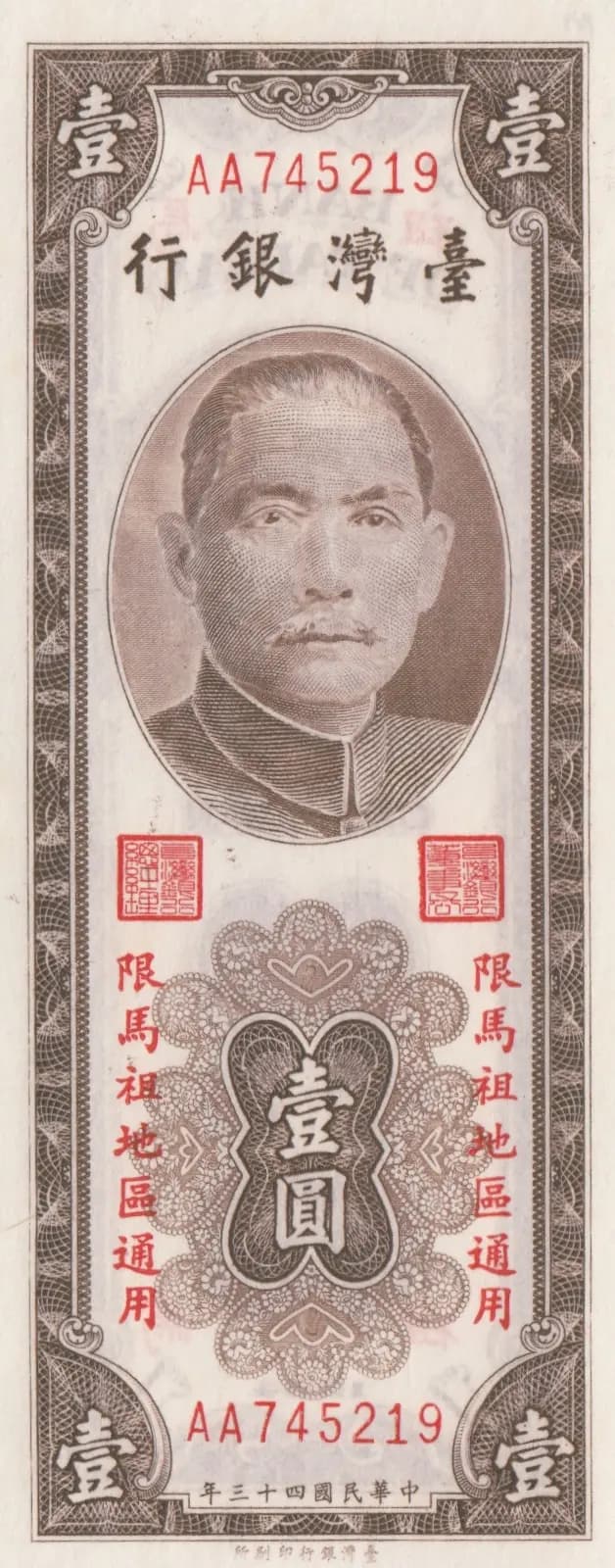
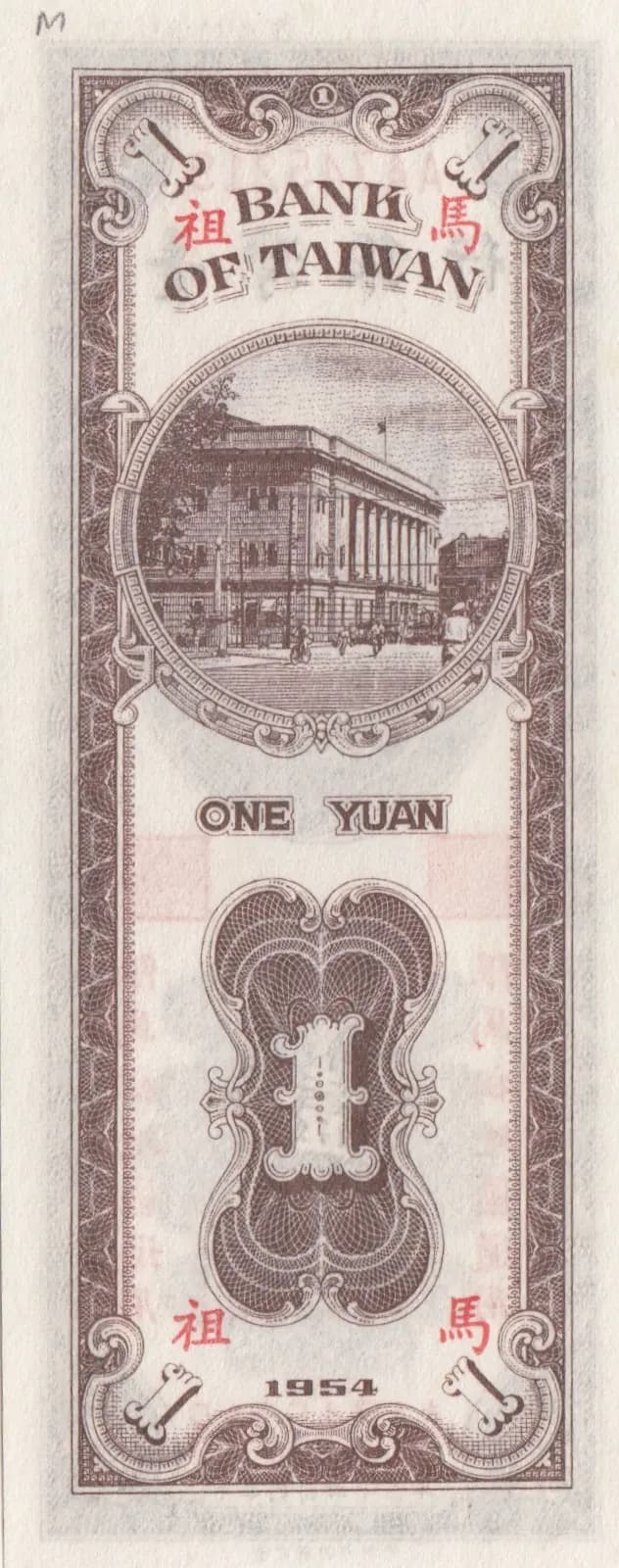
This 1954 Bank of Taiwan 1 Yuan note is a regional currency issue specifically produced for circulation in the Matsu area, as explicitly stated in the inscription '限馬祖地區通用' (Limited to use in Matsu area). The note displays excellent condition consistent with UNC grading, featuring crisp printing, vibrant red and brown coloration, and minimal wear despite nearly 70 years of age. The portrait of a formal-attired gentleman with distinctive mustache dominates the obverse, while the reverse showcases a classical bank building, representing Taiwan's financial institutions during the post-war reconstruction period.
Common. This regular issue from 1954 shows moderate circulation demand based on eBay price tracking data, with UNC examples selling for $23.50 in 2012 and AUNC for $11.50 in 2018. The 2008 catalog valuation of $5 for UNC and current market prices under $25 indicate this is a readily available note to collectors. While Matsu-specific currency issues have regional collecting interest, the print run was sufficient to ensure ongoing availability. This is a collectible but not scarce issue.
Issued in 1954 during Taiwan's early post-war period, this note reflects the Republic of China's efforts to establish separate monetary systems for outlying territories. The Matsu islands, strategically positioned off the coast of mainland China, received their own regional currency to facilitate local commerce while maintaining central government control. The classical bank building depicted on the reverse symbolizes financial stability and institutional governance during Taiwan's economic development phase, while the formal portraiture represents the leadership of the period.
This vertical format banknote features a distinguished gentleman in formal military-style dress uniform as the central portrait, identifiable as a high-ranking government or military official of the period, rendered in fine detail within an ornate oval frame. The reverse depicts the Bank of Taiwan's institutional headquarters or a significant financial building of the era, featuring classical architectural elements including prominent columns, multiple stories, and a symmetrical facade characteristic of 1950s civic architecture. Both sides employ ornate brown borders with traditional Chinese decorative motifs including cloud scrollwork, guilloche patterns, and geometric flourishes that reflect cultural design sensibilities. The color palette of brown, red, and cream tones creates visual hierarchy while maintaining the formal character appropriate to regional government currency.
Front side: '臺灣銀行' (Bank of Taiwan); '中華民國三十四年' (Republic of China Year 34, corresponding to 1945 in Western calendar); '限馬祖地區通用' (Limited to use in Matsu area); Serial number 'AA745219' appears at top and bottom in red. Back side: 'BANK OF TAIWAN' (English designation); 'ONE YUAN' (denomination in English); '1954' (Western year); '祖馬' (Matsu, appearing on both sides). The note carries repeated serial numbers and institutional identification consistent with formal currency protocols.
This note employs intaglio (engraved) printing methods, evidenced by the fine line work, intricate crosshatching patterns, detailed portraiture with subtle tonal gradations, and precision in the guilloche and decorative border elements. The crisp impressions and depth of detail observable in both the portrait and architectural rendering are characteristic of high-quality intaglio production. The Taiwan banknote issues of this era were typically produced by the Taiwan Currency Printing Plant or contracted security printers experienced in government currency production. The fine engraving quality and security printing techniques reflect Cold War-era standards for regional currency security and counterfeiting prevention.
This note exhibits the specific Matsu regional overprint variety denoted by the inscription '限馬祖地區通用,' distinguishing it from standard Taiwan 1 Yuan notes without regional restrictions. Serial number AA745219 identifies this as an early printing from the series. Known varieties for Pick R119 include different serial number prefixes and potentially different signature combinations, though the visual analysis confirms this example's standard formatting and inscriptions consistent with the primary variety of this regional issue.