20 franken 1960
Market Prices
About This Note
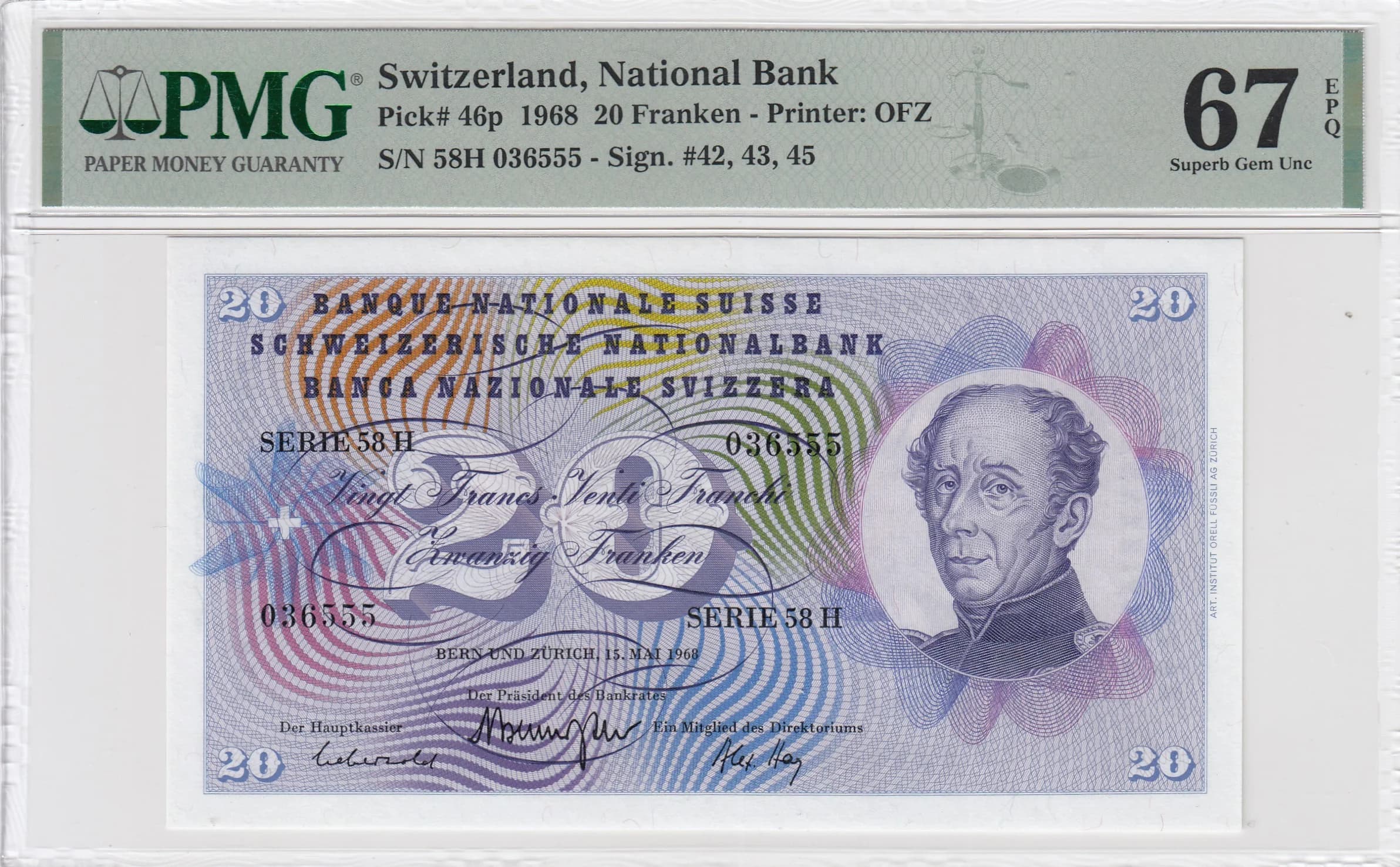
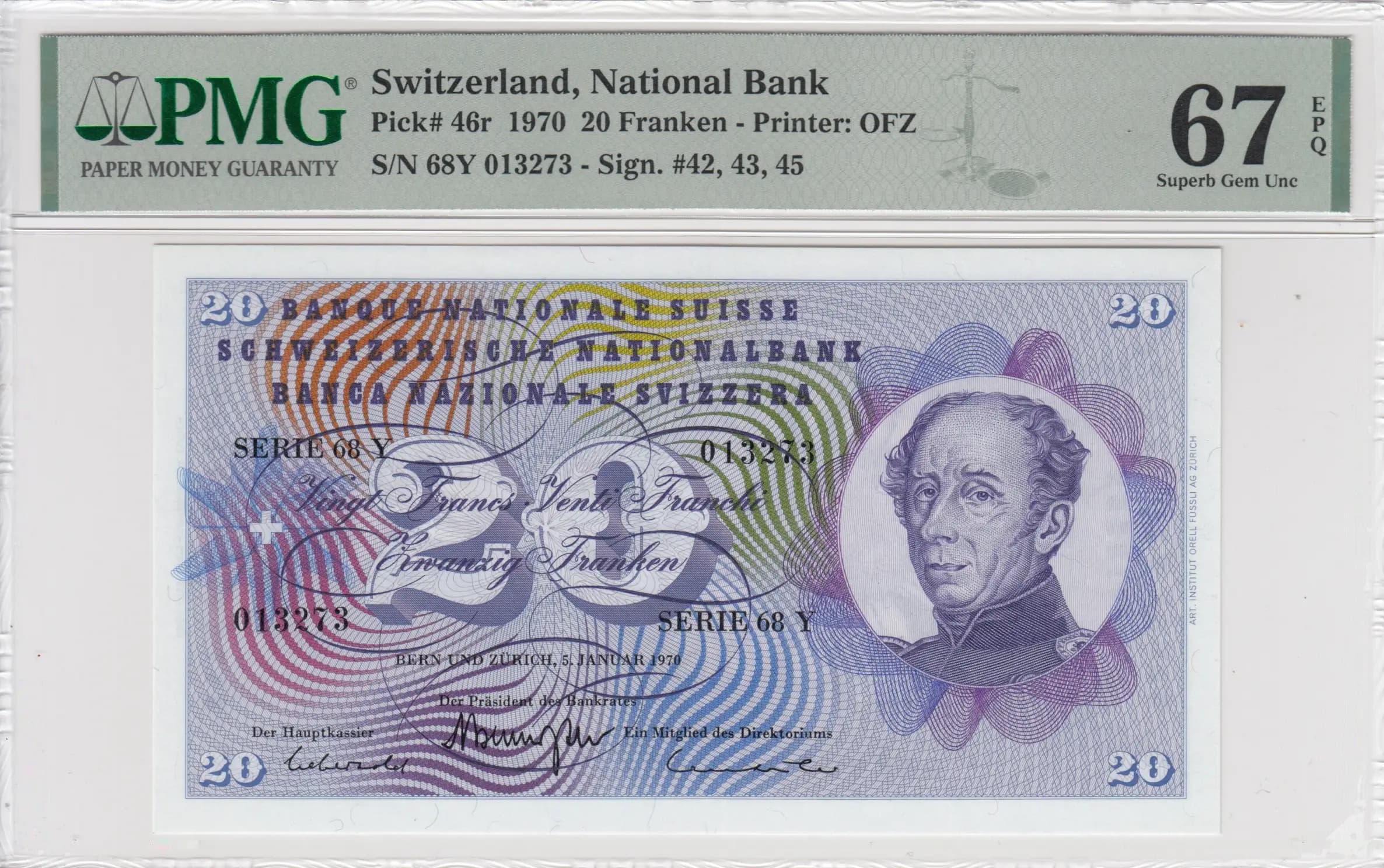
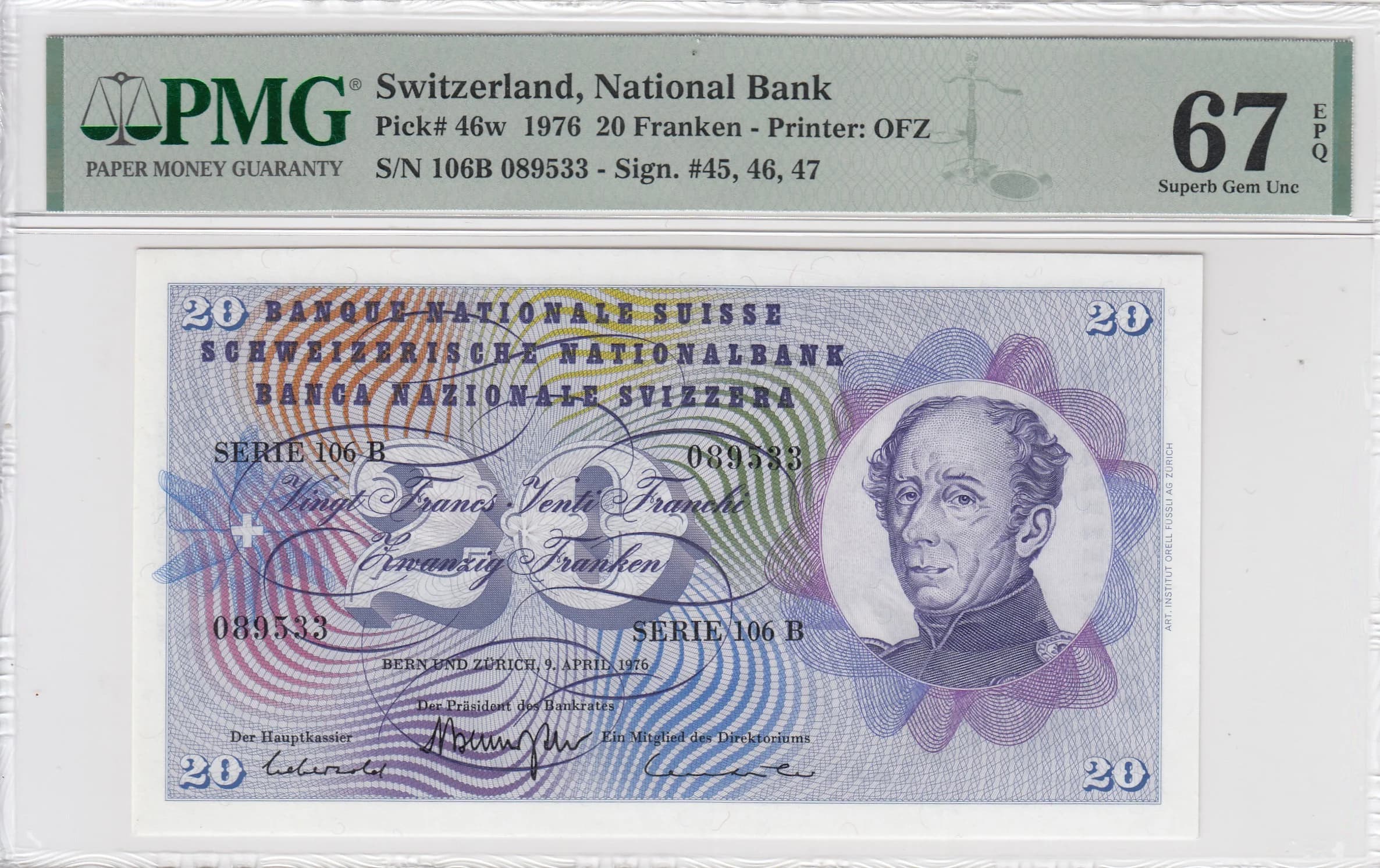
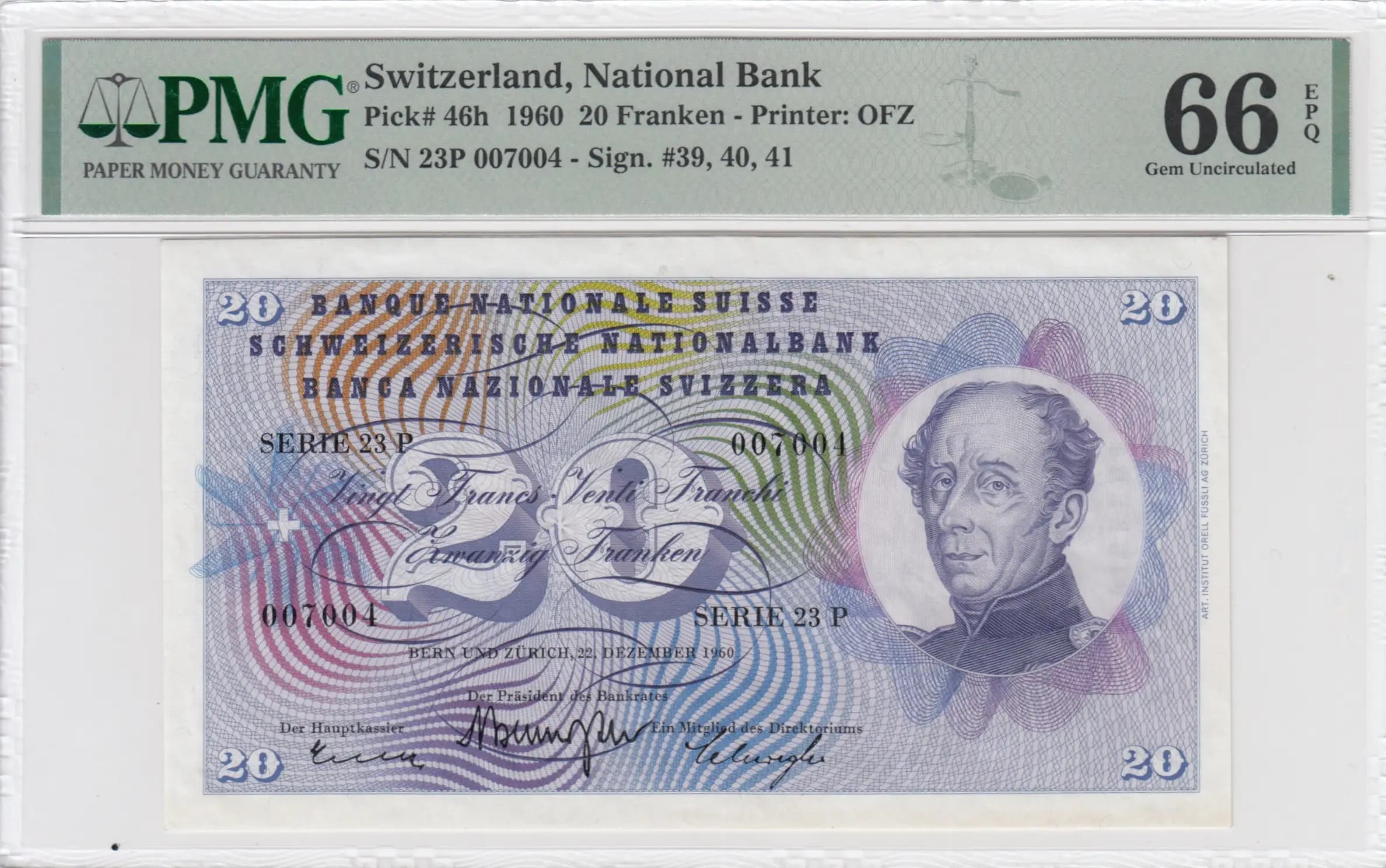
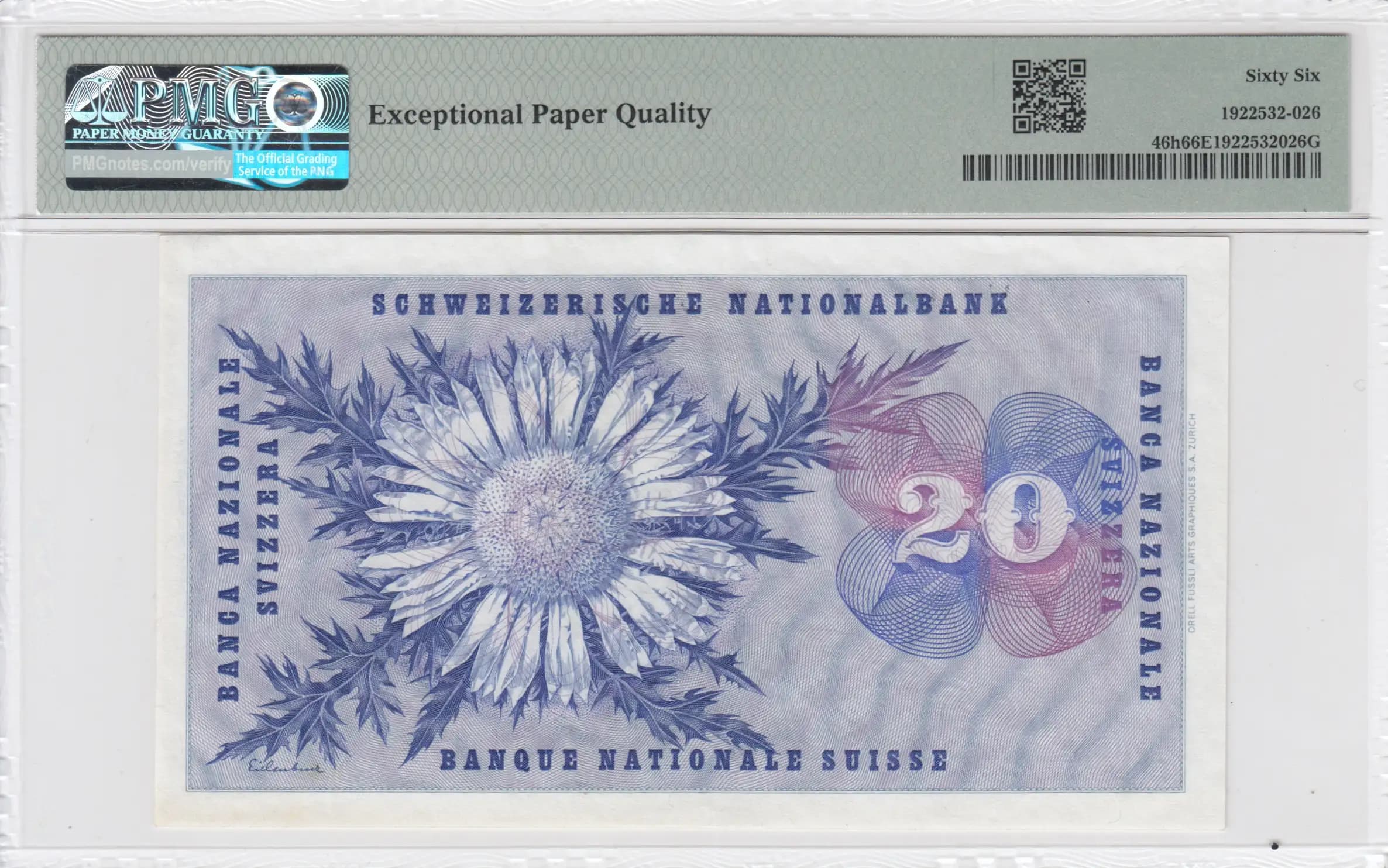
This is a PMG 66 EPQ Swiss 20 Franken banknote from 1960, representing Series 23P with serial number 007004. The note exhibits excellent condition with sharp, crisp intaglio printing throughout, displaying the characteristic blue and purple color scheme with intricate guilloche security patterns. The obverse features a formal portrait of General Guillaume-Henri Dufour in profile, while the reverse showcases a detailed botanical engraving—though visually described as a sunflower, this is the silver thistle (Carlina acaulis) that defines this denomination.
Common. This is a regular-issue note from a long production run (1954–1976) with substantial circulation. eBay market data shows these notes trading in the $9–$40 range across various condition grades, with VF specimens averaging $8–$18 and UNC specimens around $30, consistent with common-date currency. The PMG 66 EPQ grade indicates above-average quality but not a rare variety. No evidence of limited print run or recall status exists for Pick number P-46h.
Issued by the Schweizerische Nationalbank on 22 December 1960, this note belongs to the sixth series of Swiss banknotes (Series 23), which circulated from 1954 to 1976. General Guillaume-Henri Dufour, depicted on the obverse, was a 19th-century Swiss military officer and prominent figure in Swiss history, reflecting Switzerland's tradition of honoring national heroes on currency. The choice of the alpine silver thistle on the reverse connected the note to Swiss natural heritage and mountainous identity during a period of economic stability in post-war Switzerland.
The obverse presents General Guillaume-Henri Dufour (1787–1875) in formal historical dress with curled hair, depicted in profile within an ornate oval frame featuring elaborate scrollwork and decorative cartouches. The composition is framed by the trilingual institutional text of the Swiss National Bank, with the denomination '20' positioned prominently. The reverse features the silver thistle (Carlina acaulis), an alpine wildflower native to Swiss mountain regions, rendered in fine detail as the primary design element positioned at left-center. A geometric circular cartouche containing the denomination occupies the center-right area. Both sides employ multi-colored guilloche patterns in red, green, yellow, pink, and magenta tones overlaid on a blue and purple base, creating the characteristic security architecture of this series.
Front side: 'SCHWEIZERISCHE NATIONALBANK' (German) / 'BANQUE NATIONALE SUISSE' (French) / 'BANCA NAZIONALE SVIZZERA' (Italian) — all meaning 'Swiss National Bank'; '20' — denomination; 'SERIE 23 P' — Series 23P; 'S/N 23P 007004' — Serial Number; 'BERN UND ZÜRICH, 22 DEZEMBER 1960' — 'Bern and Zurich, 22 December 1960'; 'Der Präsident der Nationalbank' — 'The President of the National Bank'; 'Der Hauptkassier' — 'The Chief Cashier'; 'Ein Mitglied des Direktoriums' — 'A Member of the Directorate'. Back side: 'SCHWEIZERISCHE NATIONALBANK' (German) / 'BANQUE NATIONALE SUISSE' (French) / 'BANCA NAZIONALE SVIZZERA' (Italian) — all meaning 'Swiss National Bank'; '20' — denomination.
Intaglio printing (engraving) executed by Orell-Füssli (OFZ) of Zurich, the official Swiss National Bank security printer. The visual evidence of fine line work, elaborate guilloche patterning in multiple colors, and the exceptional clarity and depth visible in the portrait oval and thistle engraving are characteristic of traditional intaglio techniques. The multi-layered colored security printing, achieved through successive impressions, was a hallmark of Swiss banknote production during this period.
This note is identified as Pick P-46h (1960 issue date), representing one of at least eight catalogued variants (P-46d, P-46f, P-46g, P-46h, P-46i, P-46r, P-46t, P-46u, P-46v) within the broader 20 Franken sixth series. The variety designation likely reflects differences in signatures, date ranges, or security features across the series production period. The serial number prefix '23P' indicates Series 23P. No specific rarity markers (overprints, commemorative issues, or signature variants) are evident in the visual analysis provided.