5 francs 1926
Market Prices
1 saleAbout This Note
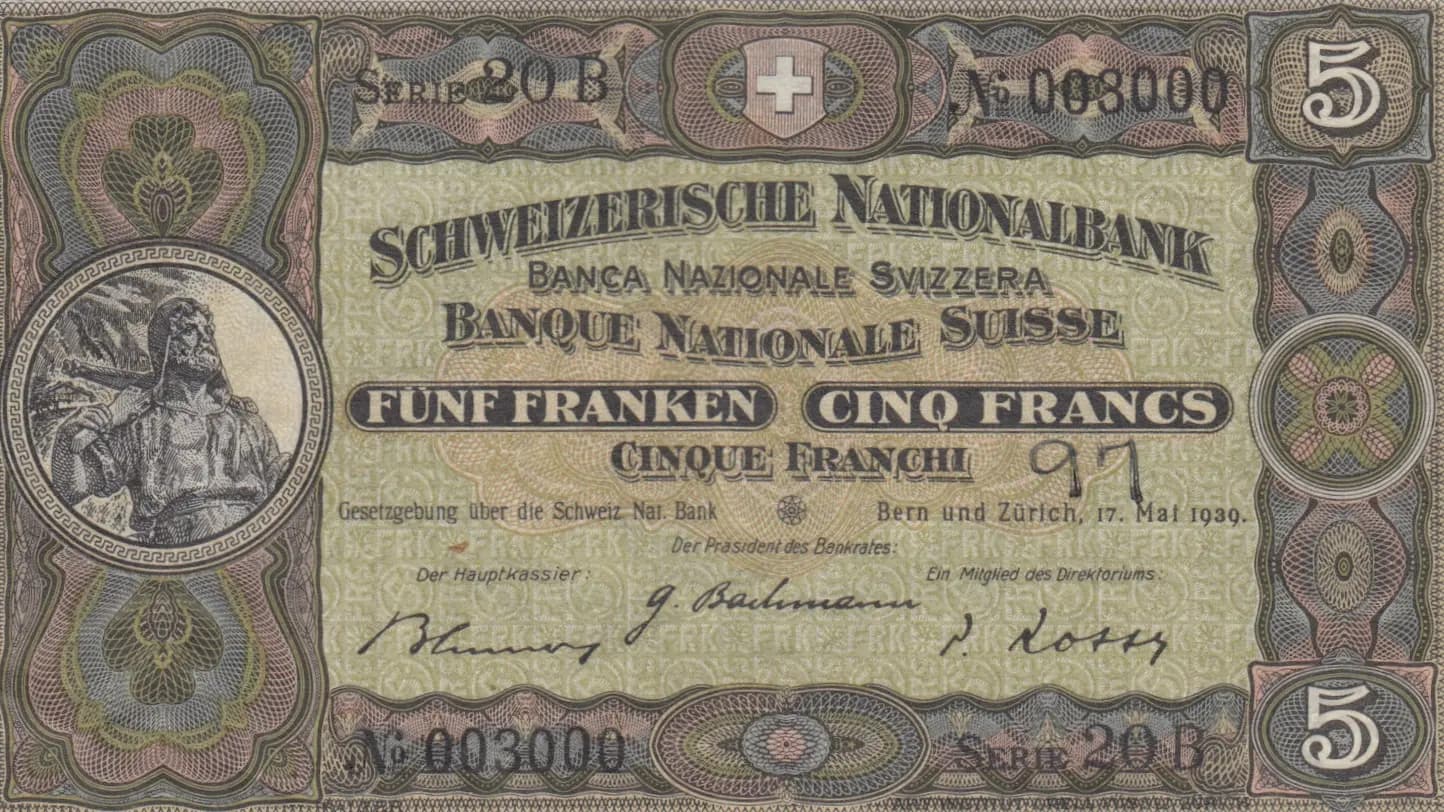
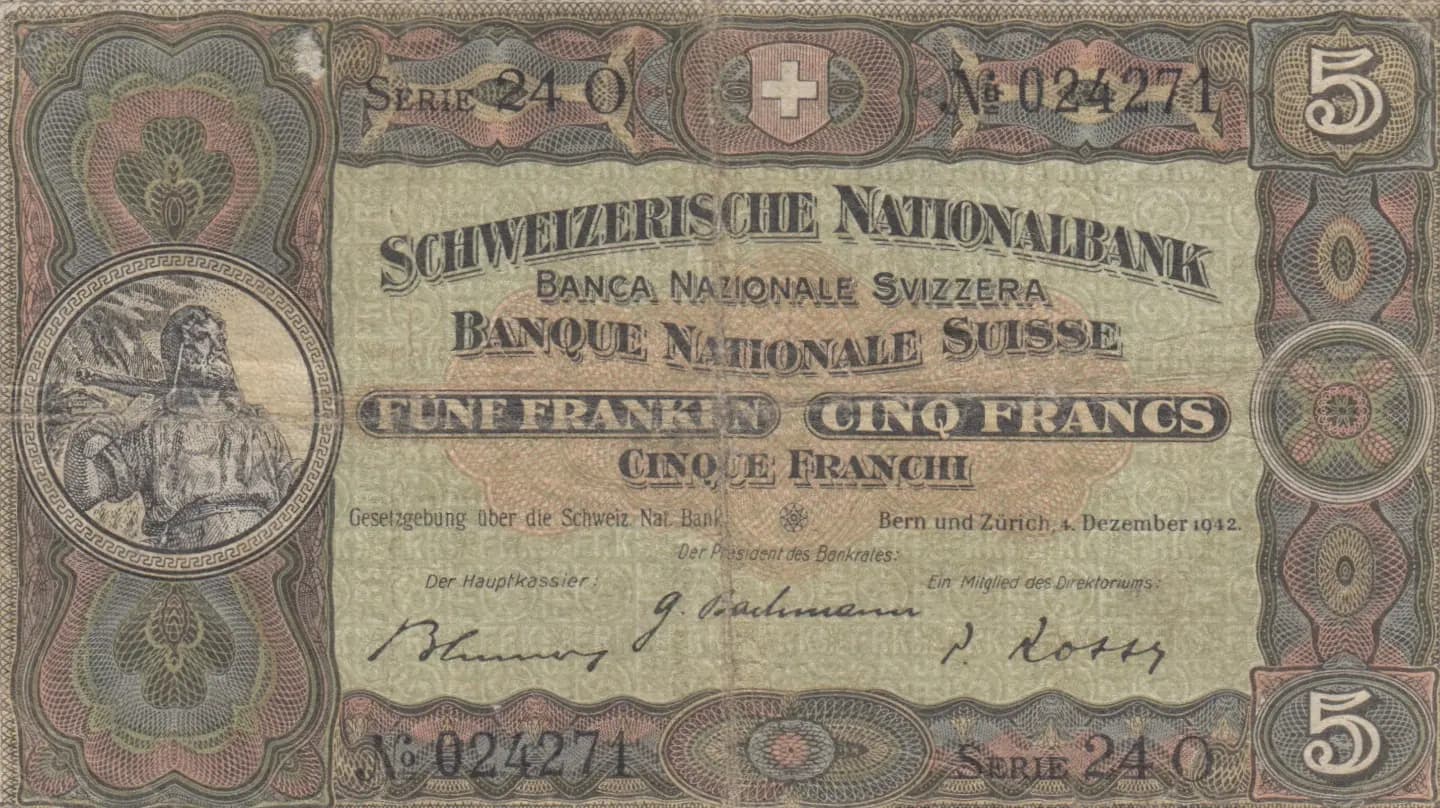
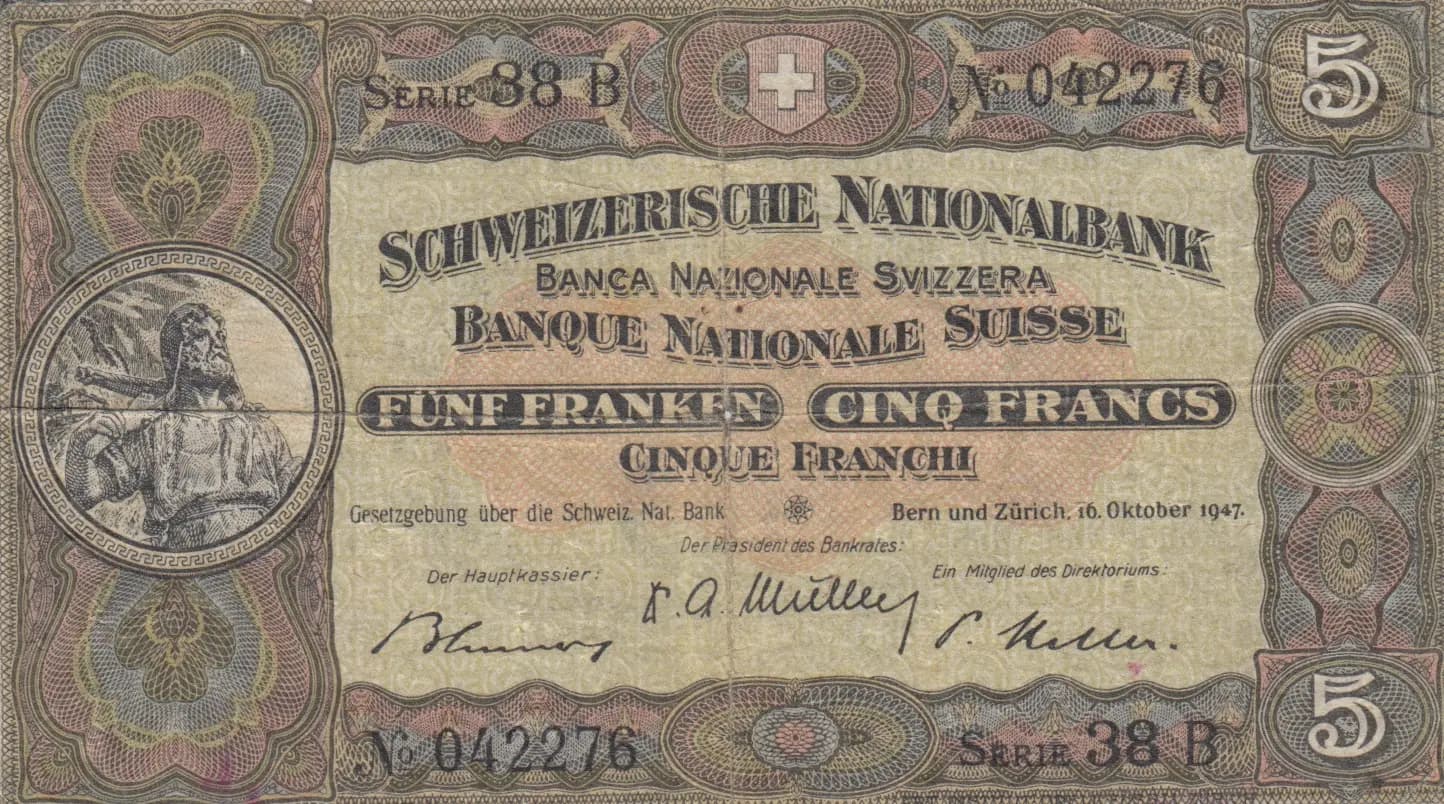
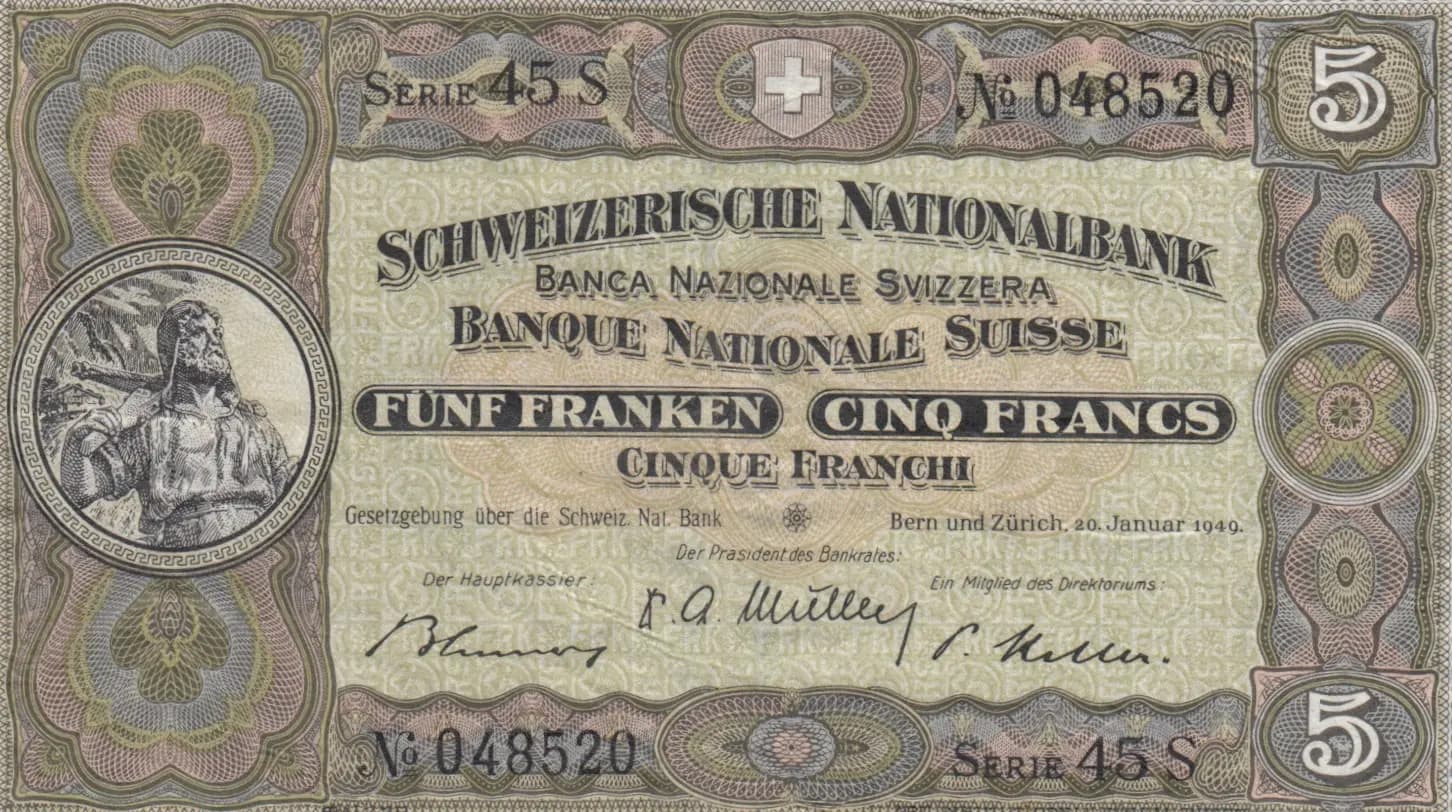
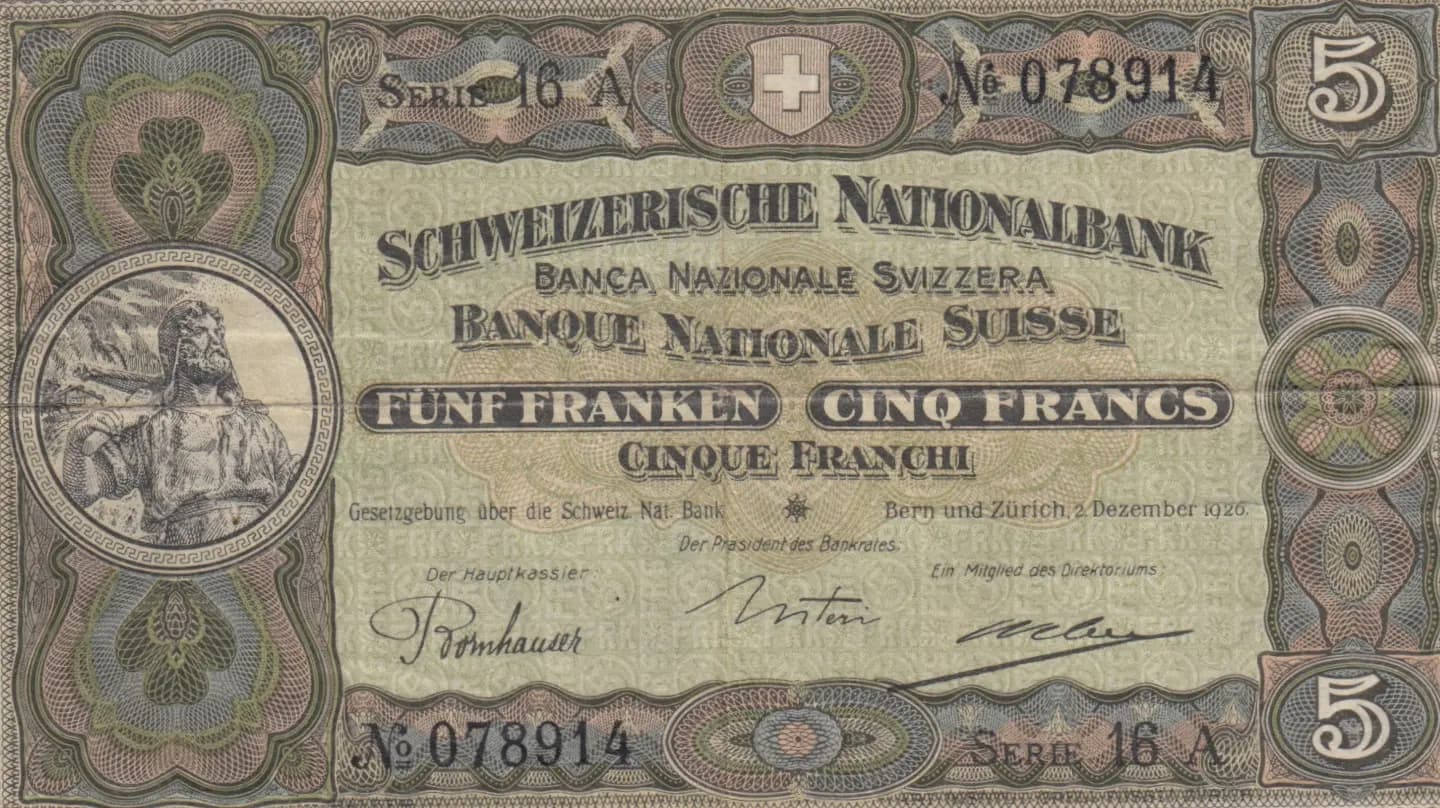
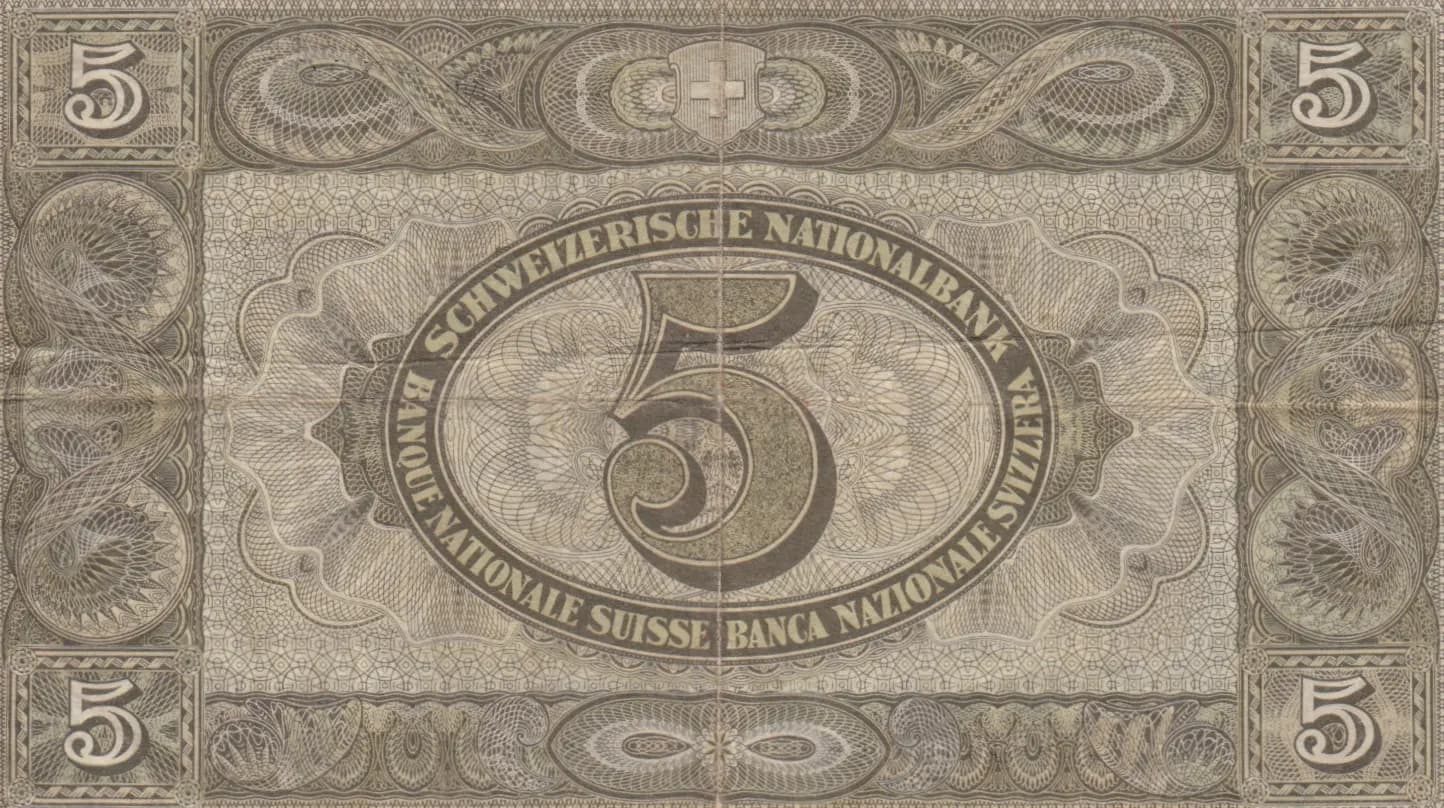
This Swiss 5 Francs note from 1926 (Pick P-11g) presents an exceptional example of early 20th-century Swiss banknote design, featuring an ornate Art Nouveau-inspired aesthetic with intricate engraved borders and a prominent bearded portrait in historical dress on the obverse. The note displays VF condition with crisp, well-preserved printing, sharp detail work, and excellent color contrast across both sides, showing minimal wear consistent with careful handling or light circulation. This denomination and series represents an important transitional period in Swiss currency design and remains actively traded in the numismatic market, with comparable examples in Fine condition cataloging around $40.
Common. This note shows consistent market activity with documented eBay sales (Fine condition example sold for $27.06 in 2018), and catalog values in the $40 range for Fine condition indicate steady collector demand without scarcity premiums. The 1926 issue was a foundational series for the modern SNB with substantial print runs. The observed condition grade (VF) and specific variety (P-11g) do not command significant rarity premiums, as eight documented variants exist within this Pick number base designation, suggesting adequate survival rates across the series. Pricing consistent with common European banknotes of similar age and condition confirms this assessment.
The 1926 issue of Swiss 5 Francs notes marks a pivotal moment following the establishment of the modern Swiss National Bank under legislation dated December 2, 1926, as inscribed on the obverse. The ornate design reflects the artistic conventions of late 19th and early 20th-century engraving standards, emphasizing security through elaborate geometric patterns and fine-line work rather than modern anti-counterfeiting features. The trilingual inscriptions—German, French, and Italian—reflect Switzerland's commitment to representing all three major linguistic regions within its federal structure.
The obverse features a left-facing bearded male portrait in an oval medallion, depicted in historical dress with draped fabric, representing a historical Swiss figure—likely William Tell or another Swiss national hero given the catalog reference to the William Tell monument. The reverse is dominated by a large ornamental numeral '5' enclosed within a circular medallion frame. Both sides feature the Swiss white cross on shield in ornate frames at the top center, symbolizing Swiss national identity and sovereignty. The design employs extensive decorative corner ornaments with fan-like or shell-like motifs (rococo-influenced), repeating geometric cross-hatch patterns, and concentric circular borders throughout. Multiple layers of fine engraving create a highly symmetrical composition emphasizing security through artistic complexity. Serial numbers appear in the top right and bottom left corners on the obverse. The color scheme of brown, green, tan/beige, and black provides excellent contrast for visibility and anti-counterfeiting purposes.
OBVERSE: 'SCHWEIZERISCHE NATIONALBANK' (Swiss National Bank), 'BANCA NAZIONALE SVIZZERA' (Swiss National Bank - Italian), 'BANQUE NATIONALE SUISSE' (Swiss National Bank - French), 'FÜNF FRANKEN' (Five Francs - German), 'CINQ FRANCS' (Five Francs - French), 'CINQUE FRANCHI' (Five Francs - Italian), 'Gesetzegebung über die Schweiz Nat. Bank' (Legislation concerning the Swiss National Bank), 'Bern und Zürich, 2 Dezember 1926' (Bern and Zurich, 2 December 1926), 'Der Präsident des Bankrates' (The President of the Board of Directors), 'Der Hauptkassier' (The Chief Cashier), 'Ein Mitglied des Direktoriums' (A Member of the Board of Directors), followed by signatures 'Pomhäuser,' 'Nöten,' and 'Müller,' with 'Serie 10 A' (Series 10 A) and serial number 'No 073914.' REVERSE: 'BANCONOTE SVIZZERA' (Swiss Banknote - Italian), 'BANCA NAZIONALE SUISSE' (Swiss National Bank - French), 'SCHWEIZERISCHE NATIONALBANK' (Swiss National Bank - German), with large denomination numeral '5' displayed prominently.
Intaglio (engraved steel plate) printing, the standard security printing method for Swiss National Bank notes of this era. The visual evidence shows extremely fine lines, complex cross-hatching patterns, concentric circular elements, and the precise three-color registration (red, blue, black on olive-green underprint as noted in catalog data) characteristic of high-security intaglio work. The sharp detail preservation and fine-line integrity visible in both images, particularly the geometric patterns and portrait rendering, are hallmarks of engraved plate printing executed by skilled security printers contracted to the SNB. The Swiss National Bank employed leading engravers and printers of the period for this series.
This example is cataloged as Pick P-11g, one of eight identified variants (P-11c, P-11g, P-11h, P-11j, P-11m, P-11n, P-11o, P-11p, P-11s) within the 1926 5 Francs series according to PMG population records. The specific variety appears to be distinguished by signature combination and/or serial number series, as evidenced by the visible signatures of Pomhäuser, Nöten, and Müller, along with 'Serie 10 A' designation and serial number 073914. Collectors should note that variants within this series may differ by signature authority combinations (reflecting changes in SNB leadership positions), printer variants, or serial number range assignments, though detailed identification of which combination defines P-11g specifically requires access to comprehensive Pick catalog notation details.