1000 gulden 1963
Market Prices
27 salesAbout This Note
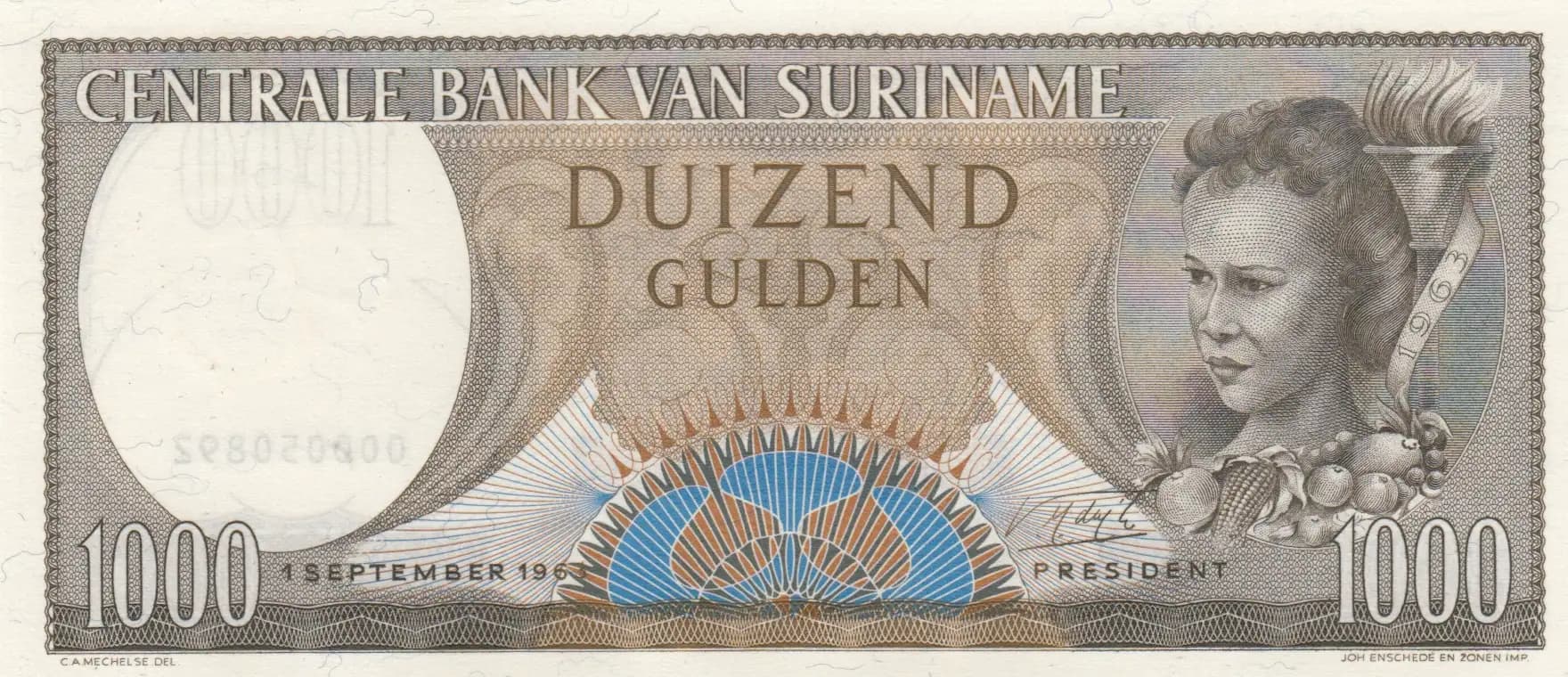
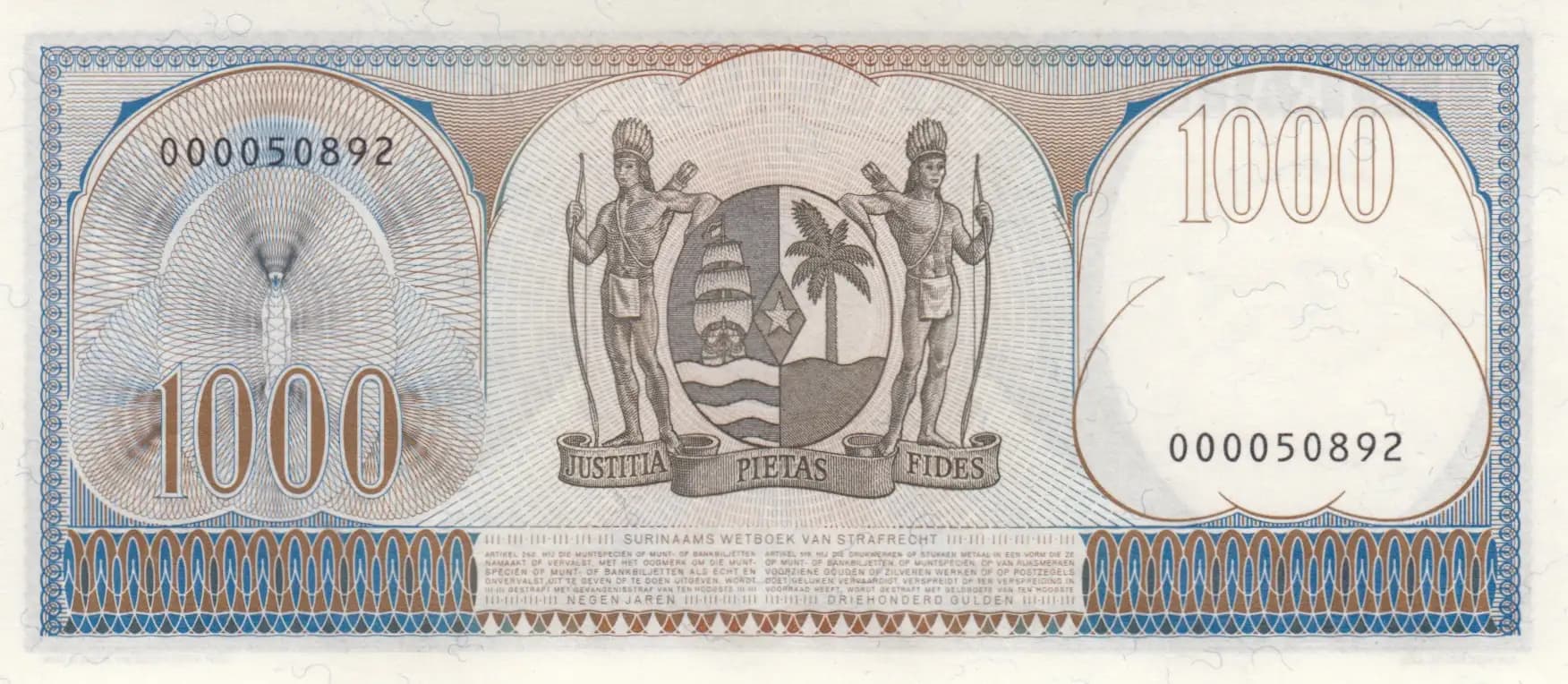
This is a Surinamese 1000 Gulden note from 1963, issued by the Centrale Bank van Suriname and printed by Johan Enschede en Zonen. The note presents attractive early 1960s design with a woman's portrait on the obverse and a coat of arms flanked by indigenous figures on the reverse. The offered example shows significant age-related patina with foxing and discoloration throughout, consistent with a note now over 60 years old, placing it in the lower-UNC range despite the stated grade.
Common. This is a regular issue from a major bank with a straightforward design, and no evidence suggests a limited print run or short-lived issue. Market data from realbanknotes.com shows consistent sales of UNC examples ranging from $12–$28 over the past decade, with numerous transactions recorded across multiple grades (PMG 64-67 regularly bringing $15–$36). The abundance of eBay sales data itself indicates good availability in the collector market. This note, while attractive and historically significant, presents no scarcity factors.
This note was issued on September 1, 1963, during Suriname's final years under Dutch colonial administration before independence in 1975. The reverse design emphasizes national symbols through the coat of arms bearing a palm tree and water, flanked by two indigenous figures in traditional dress with spears, reflecting the multicultural composition of Surinamese society. The Latin motto 'Justitia Pietas Fides' (Justice Piety Faith) underscores the formal, dignified presentation of state authority at a pivotal moment in the nation's history.
The obverse features a formal portrait of a woman in profile facing left, rendered in 1960s style with period-appropriate curled hair and formal attire, positioned on the right side of the note under the label 'PRESIDENT.' The center of the obverse displays an ornate stylized sun design with radiating lines in blue and orange, a symbol associated with national identity and sovereignty. The reverse showcases Suriname's coat of arms at center, which incorporates a shield containing a palm tree and water elements, symbolizing the nation's tropical environment and resources. The arms are supported by two indigenous male figures in traditional attire with feathered headdresses, holding spears, representing Suriname's indigenous heritage. The entire design is rendered in fine intaglio engraving with intricate geometric border patterns in beige, brown, and blue tones characteristic of high-quality security printing from this era.
FRONT SIDE: 'CENTRALE BANK VAN SURINAME' (Central Bank of Suriname) / 'DUIZEND GULDEN' (One Thousand Gulden) / '1 SEPTEMBER 1963' (1 September 1963) / 'PRESIDENT' (President) / '1000' (denomination) / 'C.A.MECHELSE DEL' (C.A. Mechelse del., artist signature) / 'JOH ENSCHEDE EN ZONEN IMP' (Joh Enschede en Zonen Imp., printer). BACK SIDE: '1000' (denomination, repeated left and right) / 'JUSTITIA PIETAS FIDES' (Justice Piety Faith, Latin motto) / Serial number '00005892' / Additional legal text references visible but partially obscured by condition.
Intaglio engraving, produced by Johan Enschede en Zonen (noted as 'JEZ' in market references), one of Europe's premier security printers. The visual analysis confirms the use of fine-line engraving throughout, with complex geometric patterns, intricate decorative borders, and detailed portraiture characteristic of intaglio security printing. The multicolor printing on colored underprint was achieved through multiple passes of the intaglio press, a standard technique for high-denomination notes of this period.
The 1963 issue is known to differ from the 1957 issue, specifically in the coat of arms design on the reverse, as noted in market references. This particular example carries serial number 00005892 and bears the artist signature 'C.A. MECHELSE DEL' and printer mark 'JOH ENSCHEDE EN ZONEN IMP.' The watermark is identified as a toucan's head, consistent with Surinamese banknote security features of this period. No major recognized varieties (such as color shifts, overprints, or signature variations) are evident from the visual analysis, suggesting this is a standard printing of the 1963 regular issue (Pick P-124).