1 gulden 1951
Market Prices
4 salesAbout This Note
This is a well-preserved example of the Suriname 1 Gulden from 1951 (Pick P-107), featuring a striking green/teal color scheme with fine engraving characteristic of Joh. Enschede's high-quality work. The note displays typical age-related patina with cream and tan discoloration consistent with genuine 1951 currency, and shows good structural integrity with no major tears or damage. In Fine condition, this note represents a solid mid-range specimen of this classic Surinamese denomination.
Common. This is a regular issue note from a substantial 1951 printing with no indication of limited production or early recall. Market data from realbanknotes.com shows multiple sales of Fine-condition examples ranging from $23.73 (2011) to $47 (2016), with a 2016 catalog value of $40 for VG condition. These modest prices and repeated sales at this grade level are consistent with common-date currency that circulated widely. The note's availability in the secondary market and multiple documented sales indicate it was produced in significant quantities.
This 1 Gulden was issued on March 1, 1951, pursuant to decrees from the late Dutch colonial period (1940-1941), during Suriname's transition toward greater autonomy within the Dutch colonial framework. The note's legal tender declaration and counterfeiting penalties reflect the formal monetary authority of Suriname under the colonial administration, while the prominent mention of the Governor and Finance Administrator underscores the hierarchical governance structure of the period. The 1951 issuance date places this note at a pivotal moment in Surinamese history, just a decade before the territory would gain full independence in 1975.
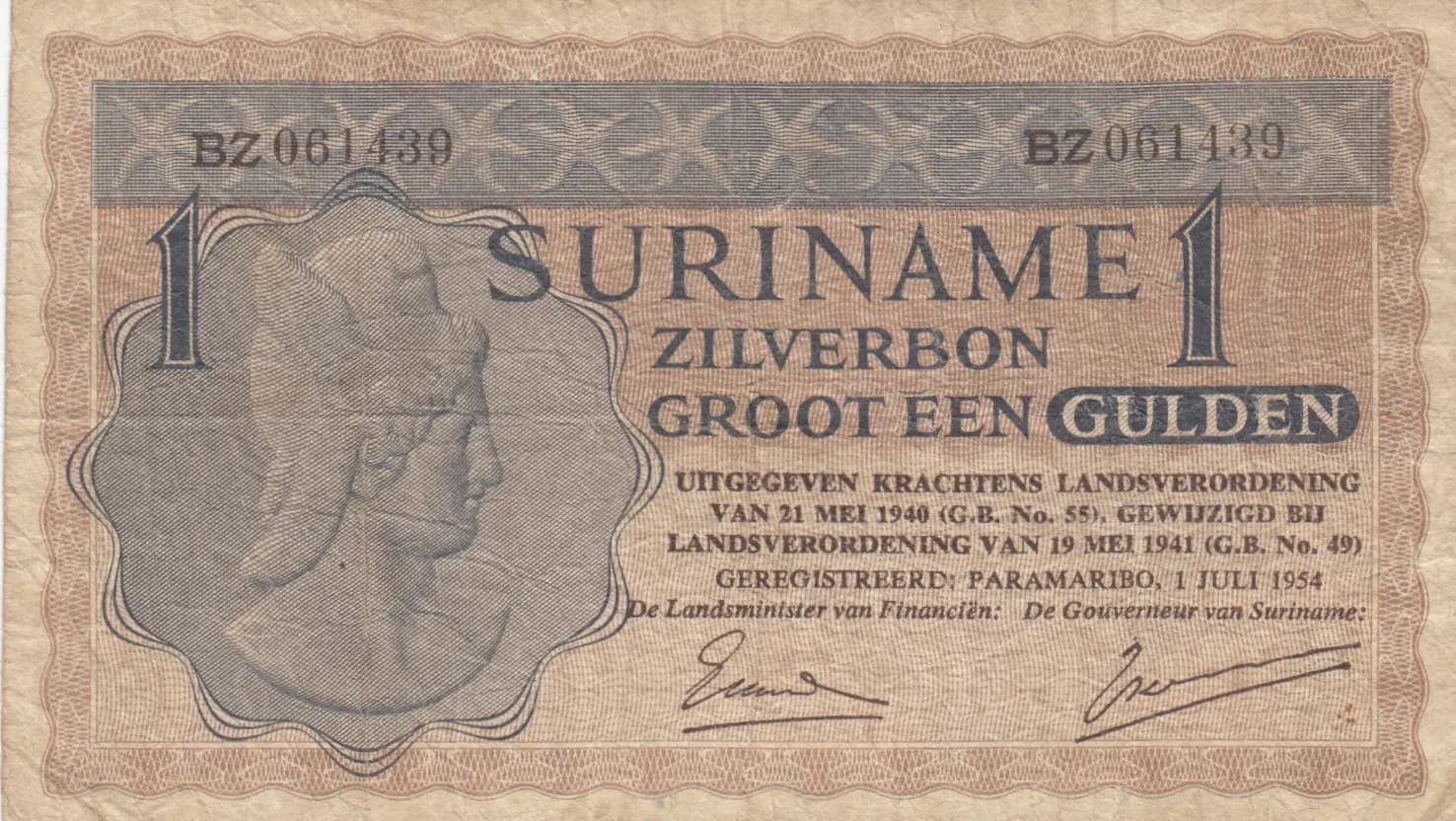
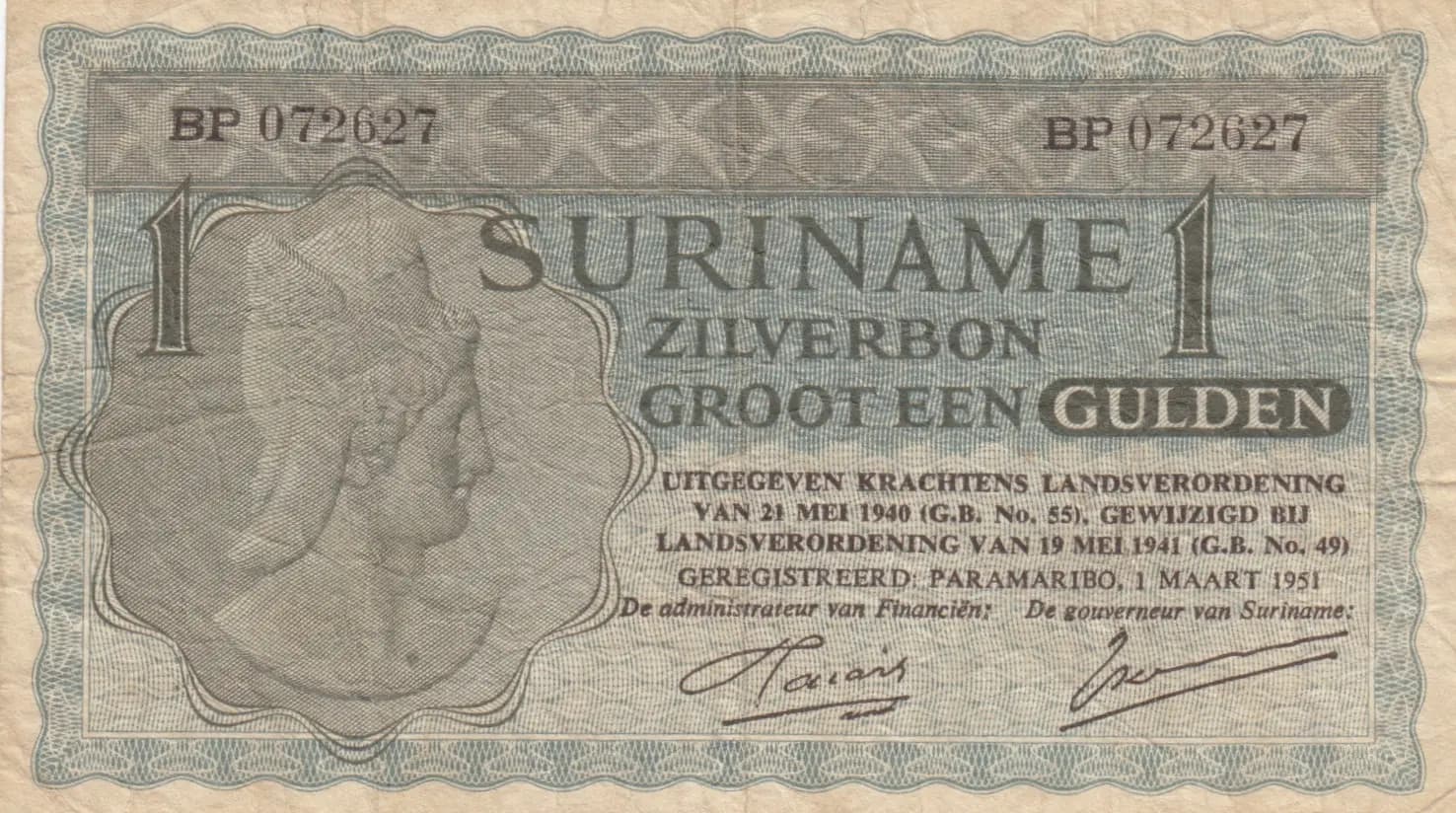
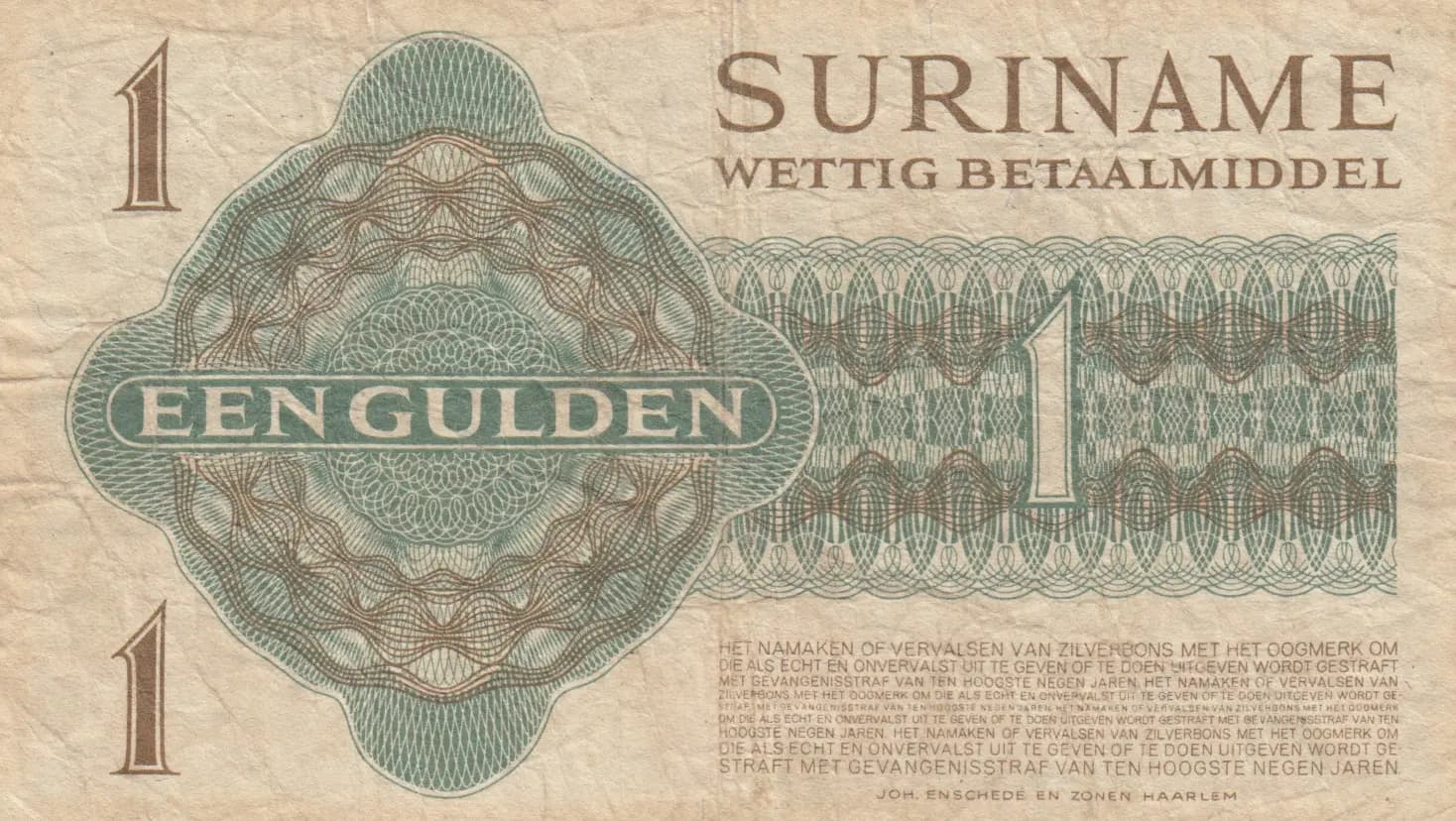
The front side features a left-facing profile portrait in an ornate rectangular frame on the left portion of the note; based on the catalog reference mentioning Mercury and Surinamese iconography, this likely represents Mercury, the Roman god of commerce and trade, symbolizing economic vitality. The design employs classical allegorical imagery common in mid-20th century currency design. The back features a large ornate circular medallion with intricate geometric and floral patterns characteristic of Baroque-influenced security design, positioned on the left side with text fields occupying the right portion. Both sides are dominated by green and teal tones with cream/beige backgrounds, creating a dignified and historically authentic appearance. Fine-line engraving and cross-hatching patterns throughout provide anti-counterfeiting security, while wavy border patterns frame the note's edges. The overall design reflects the formal, classical aesthetic preferred by Dutch security printers during this era.
FRONT: Serial numbers appear as 'BP 072627' (upper left and right). The note identifies itself as issued by Suriname and denominated as 'ZILVERON' (silver currency) and 'GROOTEN GULDEN' (great gulden). The primary legal text reads: 'Issued pursuant to Decree of 21 May 1940 (G.B. No. 55), amended by Decree of 19 May 1941 (G.B. No. 49) Registered Paramaribo, 1 March 1951.' The note is signed by 'De administrateur van Financiën' (The Administrator of Finance) and 'De gouverneur van Suriname' (The Governor of Suriname). BACK: The denomination appears as 'EEN GULDEN' (One Gulden) in an ornate cartouche, with the number '1' repeated in upper and lower left corners. The note declares itself 'WETTIG BETAALMIDDEL' (Legal Tender). A lengthy counterfeiting warning states: 'The counterfeiting or falsification of silverguldens with the intent to issue or cause to be issued them as genuine and unaltered shall be punished with imprisonment of not more than nine years.' The printer's mark identifies 'JOH. ENSCHEDE EN ZONEN HAARLEM' (Joh. Enschede and Sons, Haarlem).
This note was produced using intaglio (engraved) printing by Joh. Enschede en Zonen of Haarlem, the Netherlands, one of Europe's most prestigious security printers. The visual analysis confirms the use of fine-line engraving, complex cross-hatching patterns, and detailed guilloche work throughout both sides. The intricate decorative frames, geometric patterns in the circular medallion, and overall print quality are hallmarks of high-security intaglio production. No offset or lithographic elements are apparent; the entire note appears to be a single-pass intaglio impression with exceptional detail and clarity.
The observed serial number prefix 'BP' with six-digit sequential numbering (072627) is consistent with the standard issue. No overprints, signature variants, or security printing differences are evident from the visual analysis. PMG has cataloged one variant for Pick P-107, confirming this is a straightforward regular issue with no known major varieties. The 1 March 1951 issue date appears uniform across examples of this type.