1 gulden 1954
Market Prices
1 saleAbout This Note
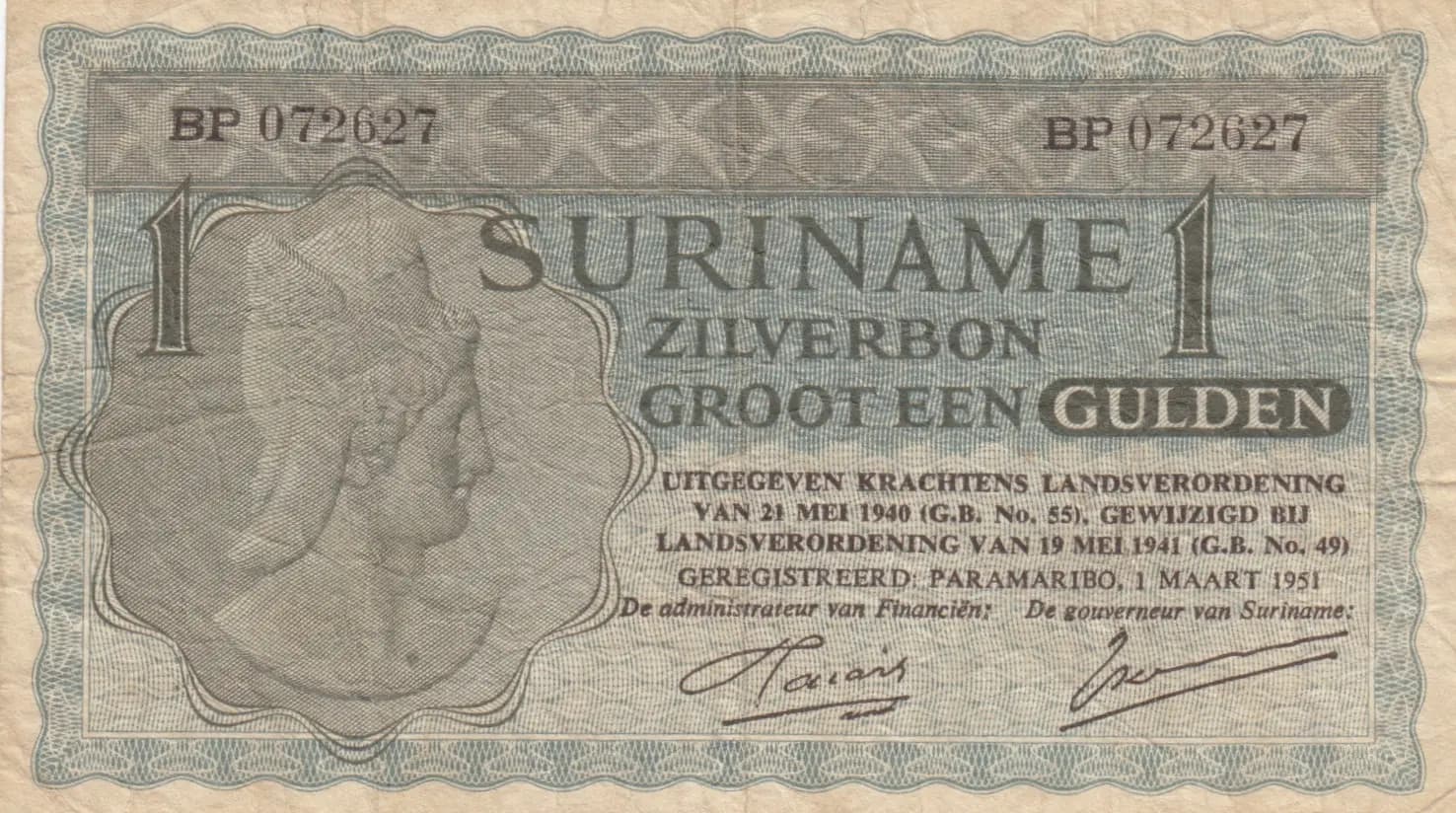
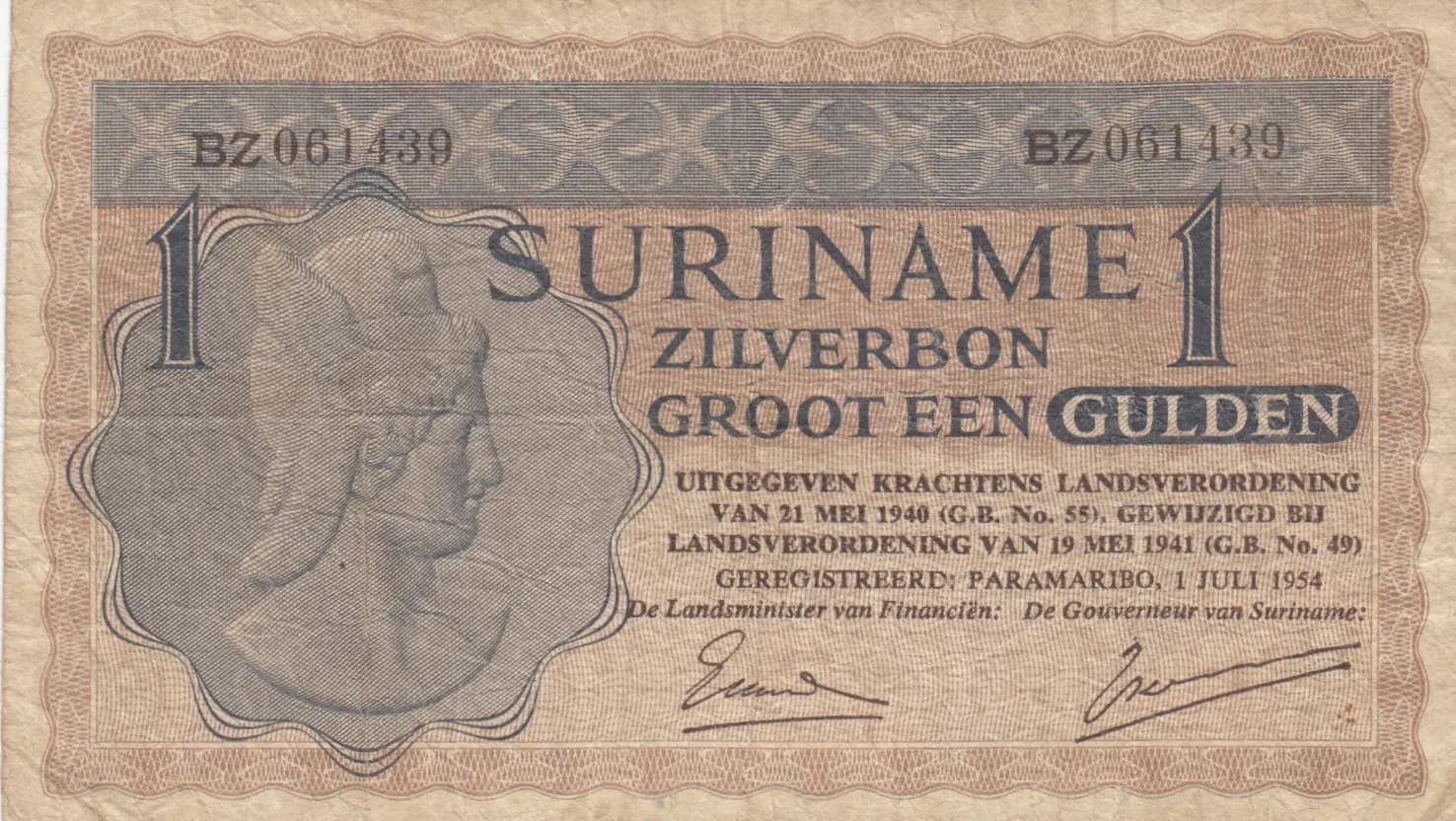
This is a 1954 Suriname 1 Gulden 'Zilverbon' (Silver Note) in Fine condition, featuring a striking portrait of a man in formal profile within an ornate scalloped frame on the obverse. The note displays excellent security printing with intricate guilloche patterns and line work throughout, characteristic of Joh. Enschedé's craftsmanship. Despite showing age-appropriate yellowing and patina consistent with a 70-year-old note, it remains structurally sound with no major tears or creases, making it a desirable example for collectors of Surinamese currency.
Common. The eBay sales data provided shows a Fine-graded example selling for $20.01 in 2018, with catalog values indicating VG at $25 and VF at $60, suggesting a well-established secondary market with modest pricing typical of common circulating issues. The 1954-1960 date range indicates a regular issue with presumably substantial print runs. While Surinamese currency from this period may not be as commonly encountered as major world currencies, the modest market price and availability of catalog pricing suggest this is a standard collectible rather than a scarce or rare issue.
Issued on July 1, 1954, this Zilverbon was produced under the authority of Surinamese colonial governance, as reflected in the official ordinances cited on the obverse (May 21, 1940 and May 19, 1941). The note represents a transitional period in Suriname's monetary history, with the Dutch printer Joh. Enschedé providing the technical expertise typical of colonial-era currency production. The legal tender inscription and counterfeiting penalty text underscore the formal monetary status these notes held in mid-20th century Suriname.
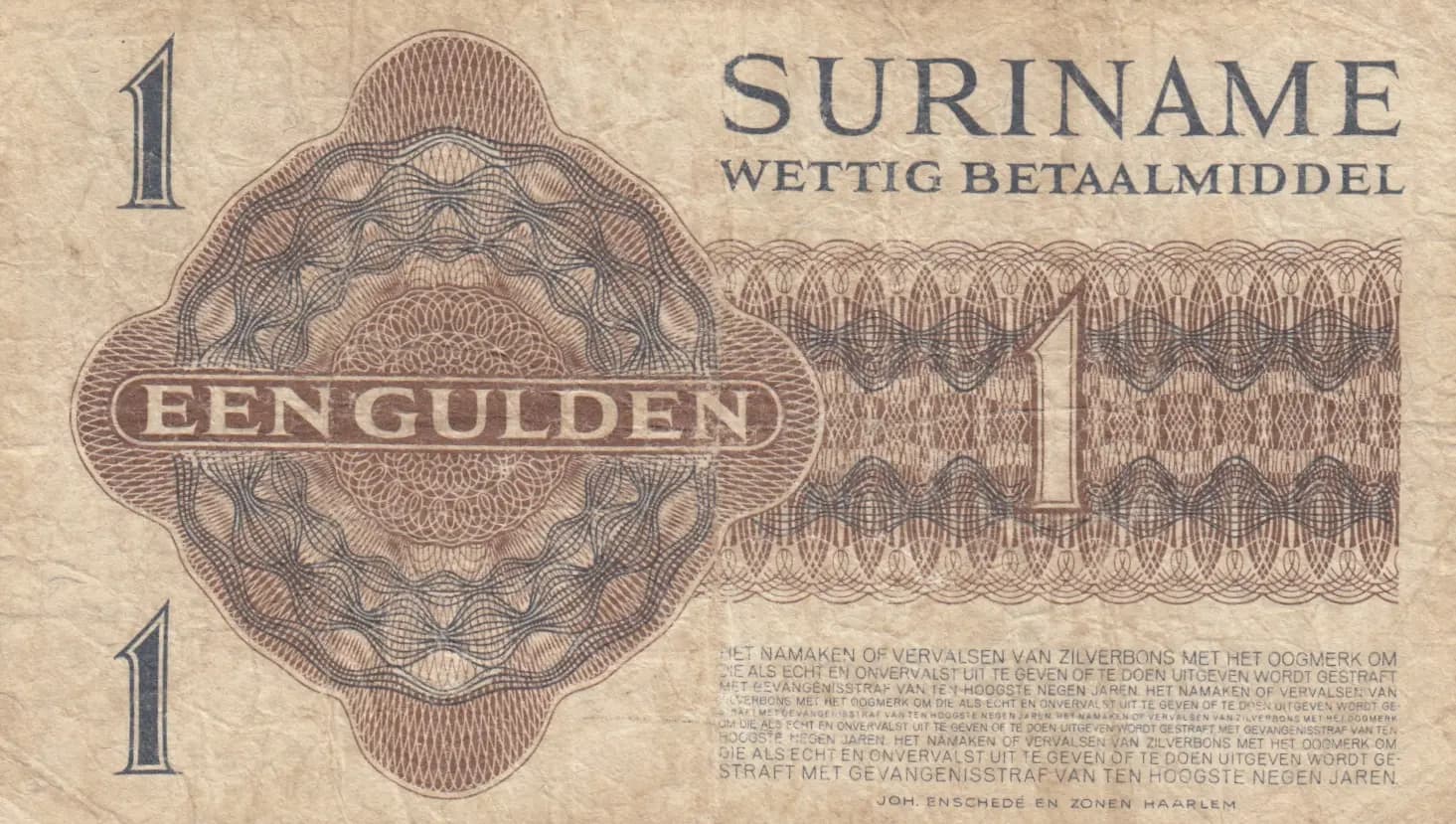
The obverse features a formal male portrait in left-facing profile, positioned within an elaborate scalloped octagonal frame on the left side of the note. The portrait subject wears formal attire typical of mid-20th century official portraiture, though the specific historical figure depicted is not identified in the catalog data provided. The reverse displays prominent denomination numerals '1' positioned on both lateral sides, with an ornate circular rosette or mandala pattern serving as the central decorative element. Both sides employ extensive guilloche work, fine parallel line security printing, and wave-and-scroll patterns characteristic of high-security banknote production. The beige-to-tan color palette with brown and dark gray accents creates a warm, aged aesthetic appropriate to the note's vintage. The design emphasizes security features throughout, with no photographic elements, only engraved security printing.
FRONT SIDE: 'SURINAME' (Suriname); 'ZILVERBON' (Silver Note); 'GROOT EEN GULDEN' (Large One Gulden); 'UITGEGEVEN KRACHTENS LANDSVERORDENING VAN 21 MEI 1940 (G.B. No. 55), GEWIJZIGD BIJ LANDSVERORDENING VAN 19 MEI 1941 (G.B. No. 49)' (Issued under the Land Ordinance of May 21, 1940 [G.B. No. 55], amended by Land Ordinance of May 19, 1941 [G.B. No. 49]); 'GEREGISTREERDE PARAMARIBO, 1 JULI 1954' (Registered Paramaribo, 1 July 1954); 'De Landsminister van Financiën:' (The State Minister of Finance:); 'De Gouverneur van Suriname:' (The Governor of Suriname:); Serial numbers: 'BZ061430' (left), 'BZ061139' (right). BACK SIDE: 'SURINAME' (Suriname); 'WETTIG BETAALMIDDEL' (Legal Tender); 'EEN GULDEN' (One Gulden); '1' (denomination); 'HET NAMAKEN OF VERVALSEN VAN ZILVBRBONS MET HET OOGMERK OM DIE ALS ECHT EN ONVERVALST UIT TE GEVEN OF TE DOEN UITGEVEN WORDT GESTRAFT MET GEVANGENISSTRAF VAN TE HOOGTSTE NEGEN JAREN' (Counterfeiting or falsifying silver notes with the intention to issue them as genuine and unaltered is punishable by imprisonment of up to nine years); 'JOH. ENSCHEDE EN ZONEN HAARLEM' (Joh. Enschedé and Sons, Haarlem - printer).
Intaglio engraving (line engraving) produced by Joh. Enschedé en Zonen of Haarlem, Netherlands, as noted on the reverse. The visual evidence of intricate guilloche patterns, fine parallel line work, cross-hatching, and the scalloped frame design are all hallmarks of traditional intaglio engraving used for high-security banknote production. The precise, consistent fine line work visible throughout both sides confirms professional security printing using steel plates and intaglio press technology standard to this era.
This note is cataloged as Pick P-108a, with a known variant P-108b existing for the same denomination and year. The visual analysis does not reveal specific distinguishing characteristics definitively identifying this as P-108a versus P-108b (such as signature variations, printer marks, or serial number prefix variations), though the catalog assignment indicates this is the P-108a variety. Collectors should note the existence of the P-108b variant and compare signatures, date placement, or other subtle design elements to confirm exact variety when acquiring examples.