10 dollars 1935
About This Note
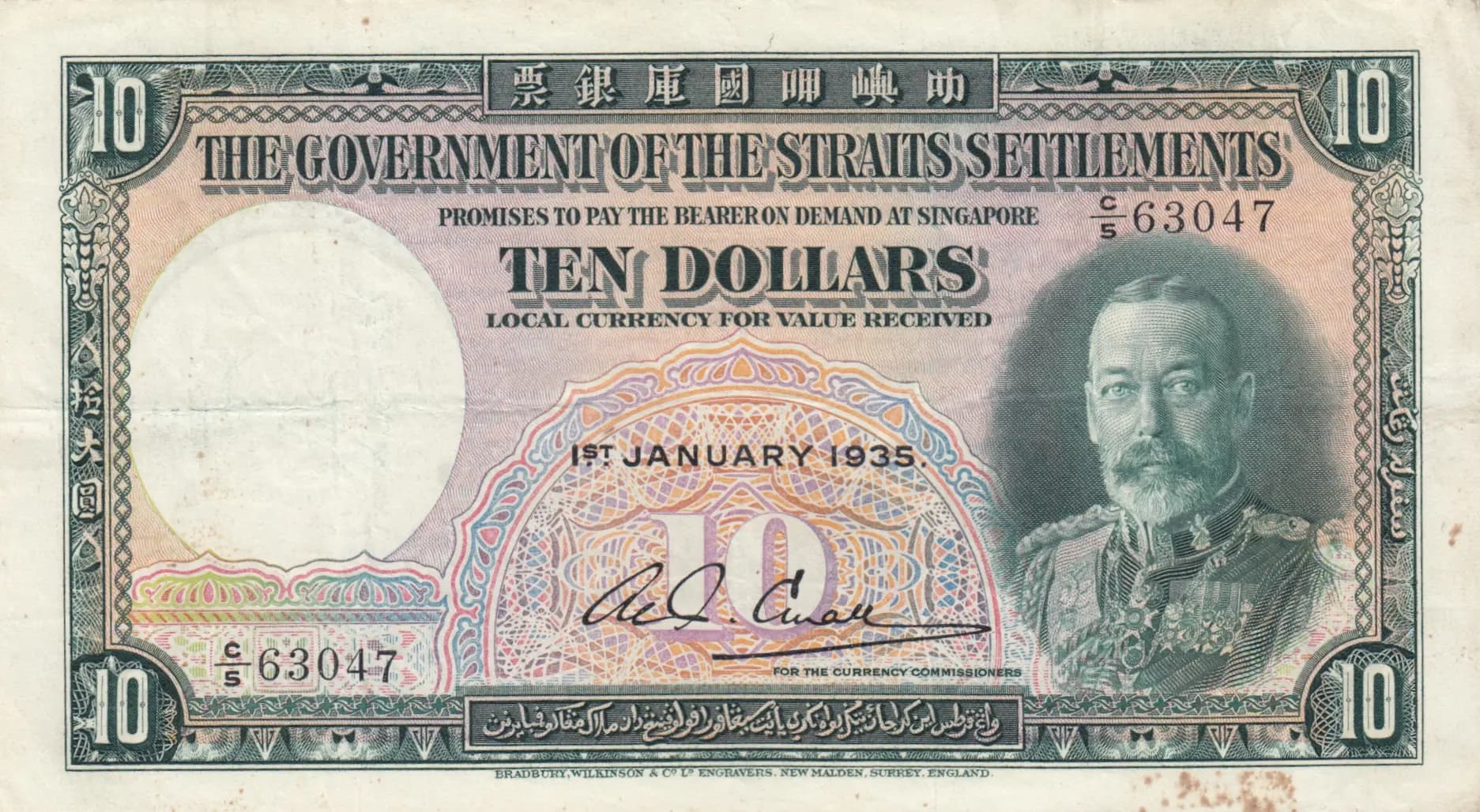
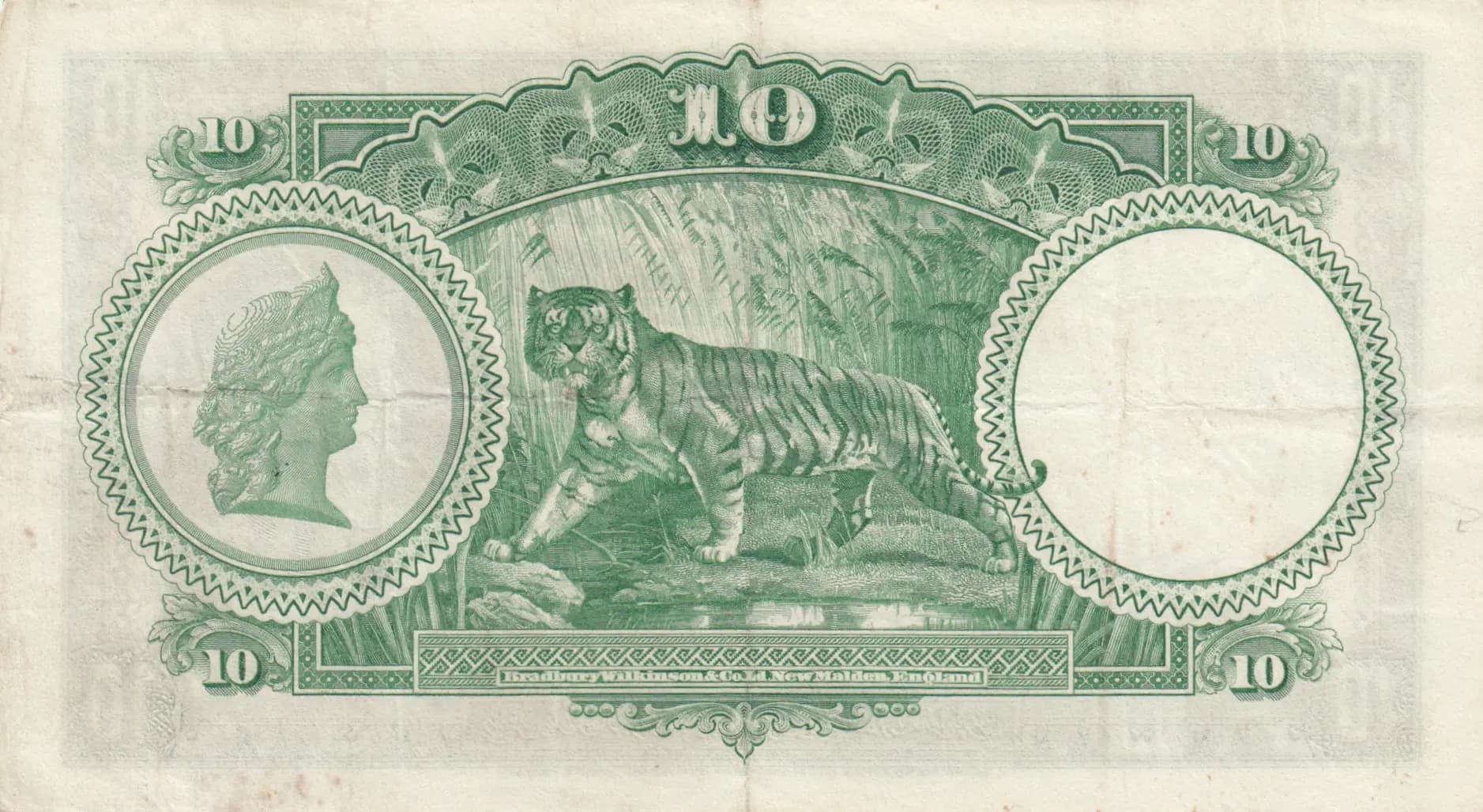
This is a VF-grade 10 Dollar note from the Straits Settlements dated 1st January 1935, printed by Bradbury, Wilkinson & Co Ltd. The note exhibits the characteristic two-sided design of this issue with a bearded military portrait on the front and a striking central tiger illustration on the reverse, both rendered in fine engraved detail. While showing expected age-related wear including creasing, foxing, and yellowing consistent with nearly 90 years of circulation, the note retains good visual clarity and remains an attractive example of this colonial currency.
Common. The Straits Settlements 10 Dollar 1935 issue (Pick-18 variants) represents a substantial print run typical of colonial currency intended for regular circulation in a major trading center. While the note is now over 80 years old and collectible, it does not command premium prices reflecting scarcity—examples regularly appear in collections and auctions at modest valuations appropriate to VF condition. No historical evidence suggests a recalled issue, short print run, or significant survival rate problems that would elevate rarity status. The existence of eight catalogued variants (P-18a through P-18cts) further indicates substantial production across multiple printings.
Issued during the final two decades of the Straits Settlements as a British crown colony (dissolved in 1946), this 1935 note represents the Government of the Straits Settlements' assertion of monetary authority in Southeast Asia. The military portrait on the obverse and the symbolic tiger on the reverse reflect the colonial administration's dual purpose: projecting British imperial authority while incorporating regional imagery to appeal to local populations in Singapore, Penang, and Malacca. The Chinese characters horizontally inscribed on both sides acknowledge the substantial Chinese merchant and laboring populations that formed the economic backbone of these trading settlements.
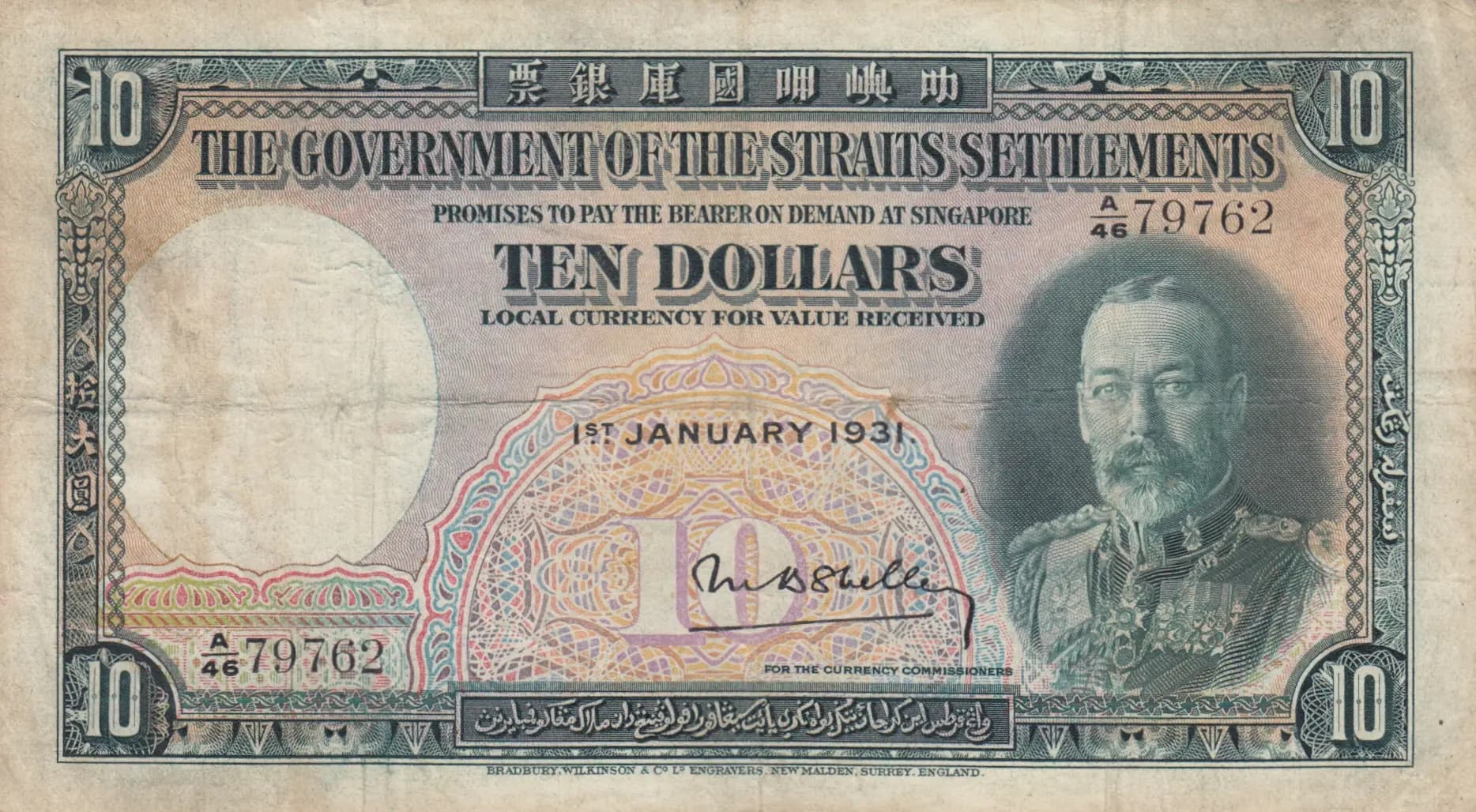
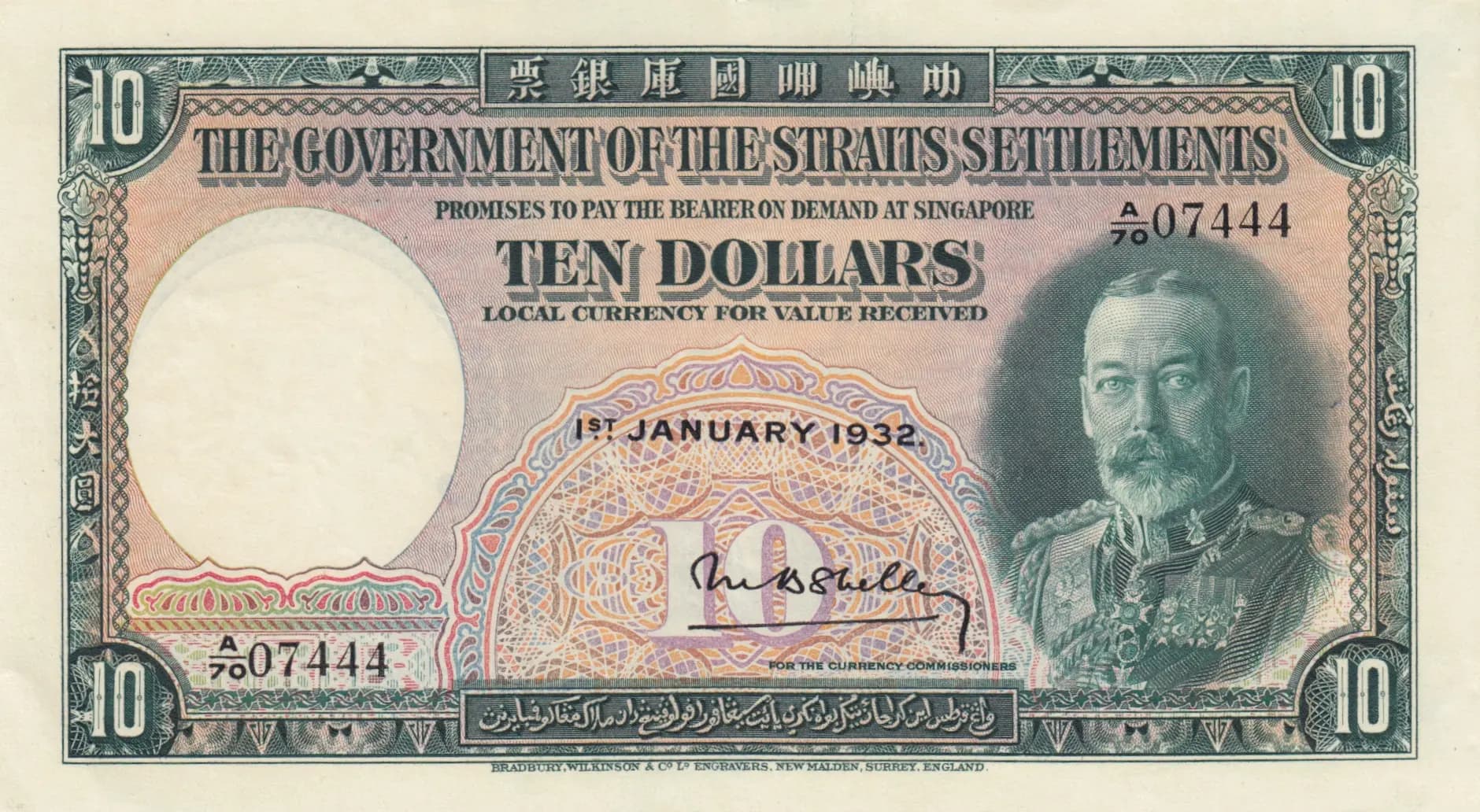
The obverse features a formal portrait of a bearded military officer in dress uniform positioned on the right side, likely representing a British colonial administrator or official of the era. An ornate circular rosette with intricate geometric and floral patterns dominates the center, serving both decorative and security purposes. The design employs pink/rose and green/teal coloring with elaborate corner flourishes and Asian-inspired geometric borders. The reverse, rendered entirely in green ink, showcases a naturalistic central vignette of a tiger in a landscape setting with water, reeds, and vegetation—a powerful symbol of the Malayan region. Flanking the tiger are two circular frames: the left contains a profile portrait of a woman with elaborate curled hair (likely Britannia or an allegorical representation), while the right remains blank, mirroring the obverse design philosophy.
FRONT SIDE: 'THE GOVERNMENT OF THE STRAITS SETTLEMENTS' (top center); 'PROMISES TO PAY THE BEARER ON DEMAND AT SINGAPORE' (center); '10' and 'TEN DOLLARS' (denomination indicators); '1ST JANUARY 1935' (date of issue); 'LOCAL CURRENCY FOR VALUE RECEIVED' (legal tender declaration); 'FOR THE CURRENCY COMMISSIONERS' (authorization); Chinese characters reading 'Straits Settlements' (海峽殖民地, traditional right-to-left inscription); Serial number reference 'C/5 63047'; Printer attribution 'BRADBURY, WILKINSON & CO LTD ENGRAVERS NEW MALDEN SURREY ENGLAND'. BACK SIDE: '10' (denomination markers in corners); Fine print at bottom (partially legible, containing printer and security information).
This note was produced using fine line engraving, the standard security printing method of the era. Bradbury, Wilkinson & Co Ltd, the renowned British security printer based in New Malden, Surrey, employed intaglio engraving throughout—evidenced by the exceptionally detailed line work, cross-hatching, and depth visible in both the military portrait and the tiger illustration. The intricate rosette patterns and ornamental borders showcase the high-quality craftsmanship characteristic of BWC's work. Multiple color printing (pink/rose on obverse, green on reverse) was accomplished through separate engraved plates, a standard practice for Commonwealth currency of this period.
This note is catalogued as Pick-18b, printed by Bradbury, Wilkinson & Co Ltd. The 'b' designation within the P-18 group indicates a specific printing variety; other documented variants include P-18a, P-18as, P-18ax, P-18bs, P-18cts, P-18p, and P-18s, suggesting differences in signatures, serial number prefixes, or minor design variations. The serial number reference observed ('C/5 63047') may serve as an identifier for this particular printing variety. Collectors should note that P-18 variants may show differences in signature blocks or numbering conventions that distinguish between the catalogued sub-types.