50 rupees 1961
About This Note
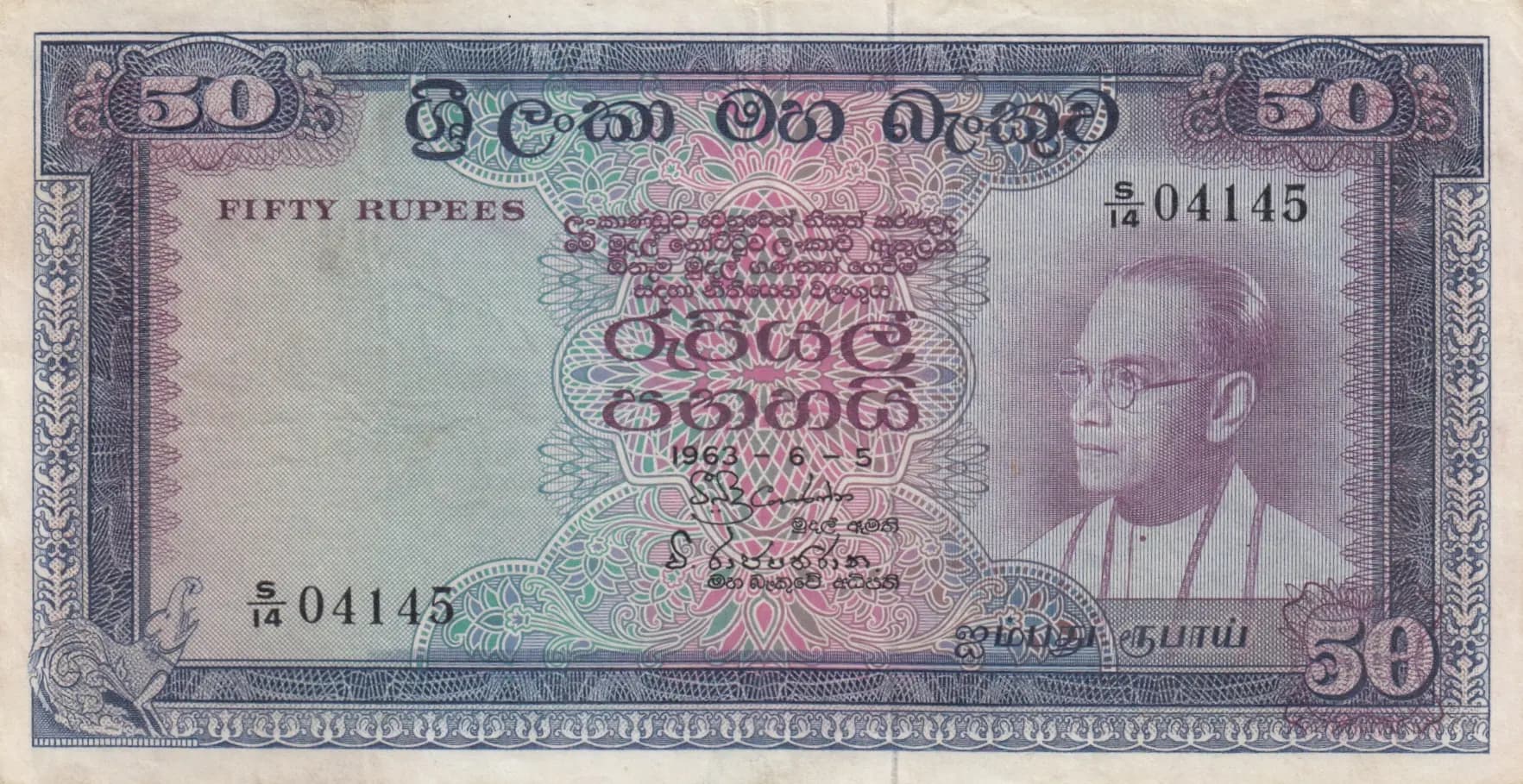
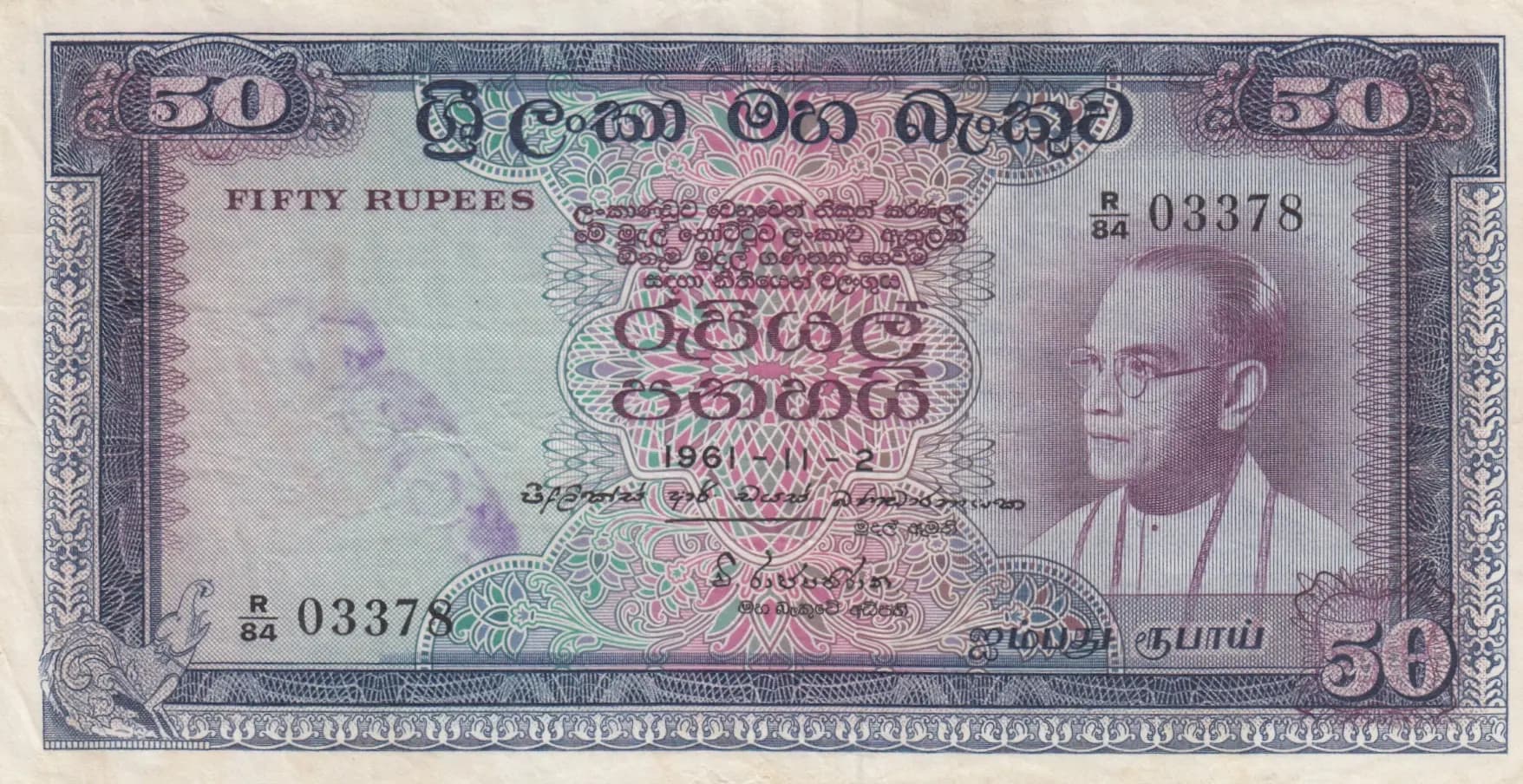
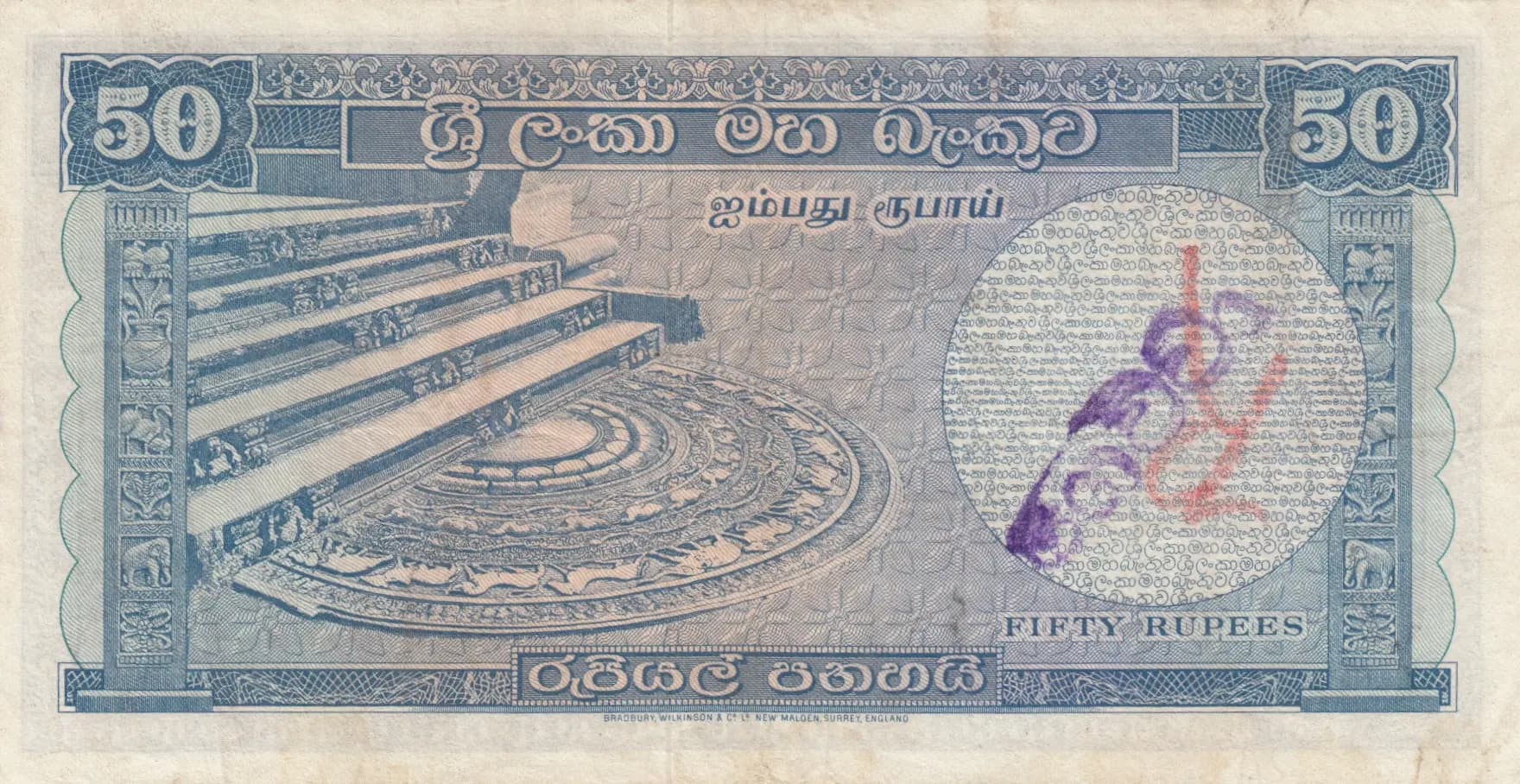
This is a 1961 Central Bank of Ceylon 50 rupees note (Pick 65a) in Fine condition, featuring a striking purple and mauve color scheme with the portrait of Prime Minister Solomon West Ridgeway Dias Bandaranaike on the obverse. The note exhibits significant circulation wear with visible creasing, fold marks, and discoloration throughout, though the ornate engraving work and security features remain clearly visible. The reverse showcases the architectural heritage of Polonnaruwa with its distinctive moonstone and Vatadage stairs design in blue-green tones, making this an important example of Ceylon's post-independence numismatic design.
Common. The 50 rupees denomination of the 1961-1965 series issued by the Central Bank of Ceylon is widely available in numismatic markets. The print run for this series was substantial, and these notes circulated extensively throughout the 1960s. The Fine condition grade, while not pristine, is typical for notes from this era that saw heavy circulation. There is no evidence of scarcity, limited distribution, or recall that would elevate this to uncommon or rare status.
Issued during the early years of the Central Bank of Ceylon's operation, this 50 rupees note reflects the newly independent nation's pride in its cultural heritage and political leadership. The obverse portrait honors Solomon West Ridgeway Dias Bandaranaike, Ceylon's first Prime Minister, while the reverse depicts the moonstone and Vatadage stairs at Ratnagiri in Polonnaruwa, emphasizing the country's ancient Buddhist architectural legacy and connection to its pre-colonial past. This series (dated 1961-1965) represents a transitional period in Sri Lankan monetary history, issued before the 1966 currency revaluation.
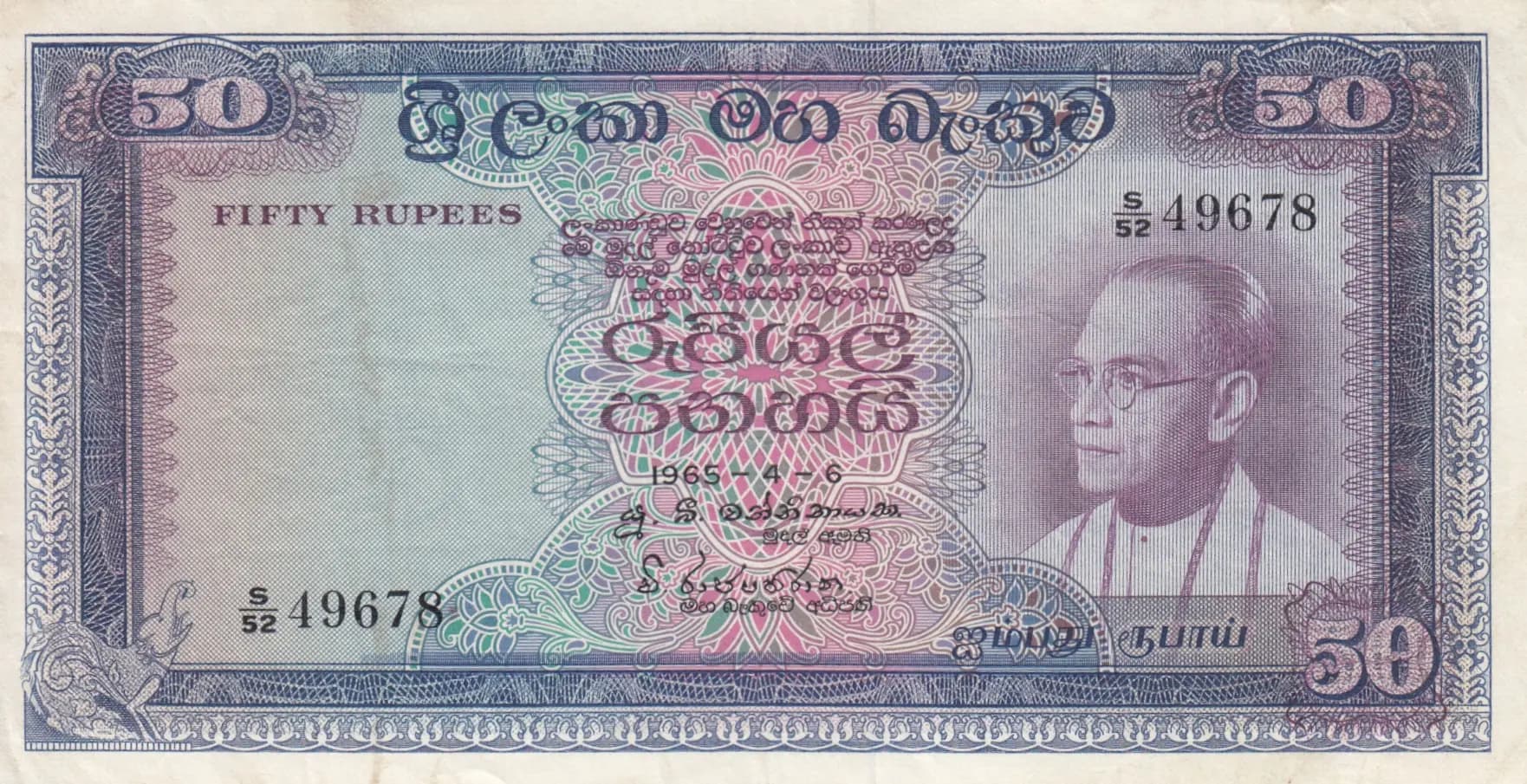
The obverse features a right-profile portrait of Solomon West Ridgeway Dias Bandaranaike, Ceylon's first Prime Minister, rendered in formal attire. The portrait is surrounded by intricate ornamental designs including floral and geometric patterns in purple, mauve, blue, and green, with a decorative border framing the composition. The reverse depicts the moonstone and architectural balustrades of the Vatadage (circular relic house) at Ratnagiri, Polonnaruwa, one of Ceylon's most significant medieval Buddhist monuments. Large ornamental circular medallions with intricate geometric and floral patterns dominate the reverse design, complemented by fine engraved railings and architectural details. Multilingual inscriptions in English and Sinhala appear throughout, reflecting Ceylon's post-independence commitment to linguistic inclusivity.
FRONT: '50' and 'FIFTY RUPEES' in English numerals and text appear in top left and right corners; '1961' indicates the issue year; Serial number 'R 84 03378' appears twice on the note. BACK: '50' and 'FIFTY RUPEES' in English numerals and text; 'ශ්රී ලංකා ධනපති බැංකුව' in Sinhala (Central Bank of Sri Lanka/State Bank); Text in Tamil script (likely regional or linguistic inscription); 'BRADBURY, WILKINSON & CO. LTD. NEW MALDEN, SURREY, ENGLAND' identifies the printer; Additional Sinhala text present as part of the design.
Intaglio engraving, executed by Bradbury Wilkinson & Co. Ltd., the renowned London-based security printer. The fine line work, complex ornamental patterns, and portrait rendering are characteristic of high-quality intaglio production. Security features include watermarks in the portrait region and the intricate engraved designs that would be difficult to counterfeit. The multi-color printing was achieved through successive intaglio passes, as evidenced by the distinct color layering visible on the note.
This example is cataloged as Pick 65a, representing the standard 1961-dated issue. The serial number prefix 'R 84' is consistent with the early production runs of this series. Varieties within this Pick number may include different letter prefixes (R, S, T, etc.), signature variations of Central Bank officials, and serial number ranges corresponding to different printing batches. The visual analysis indicates this is a standard variety without overprints, security overprints, or other notable variations that would distinguish it as a special issue.