25 cents 1942
About This Note
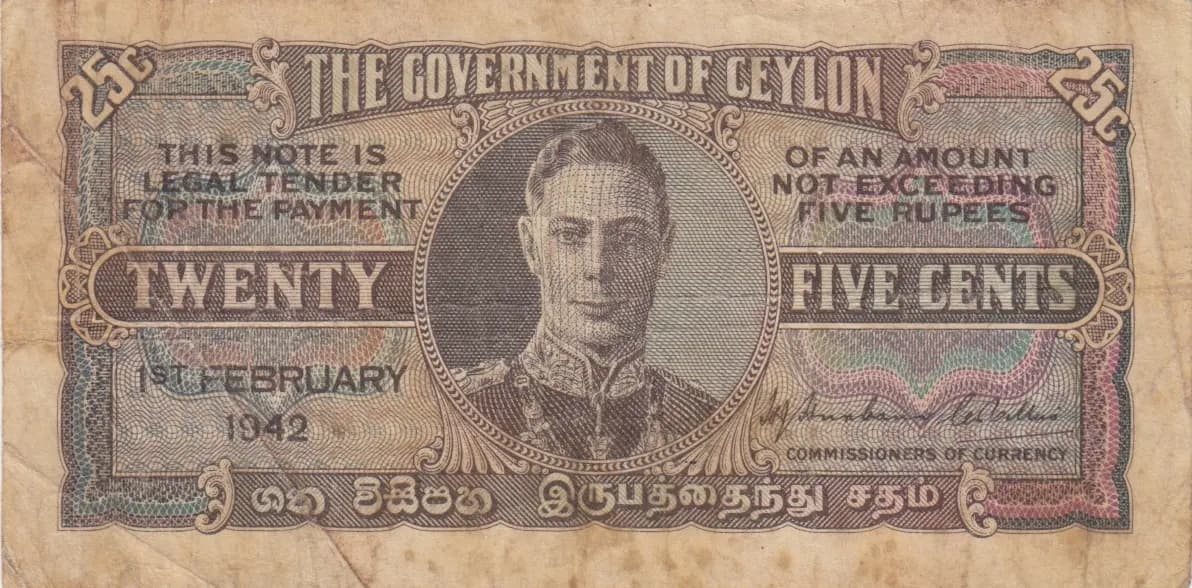
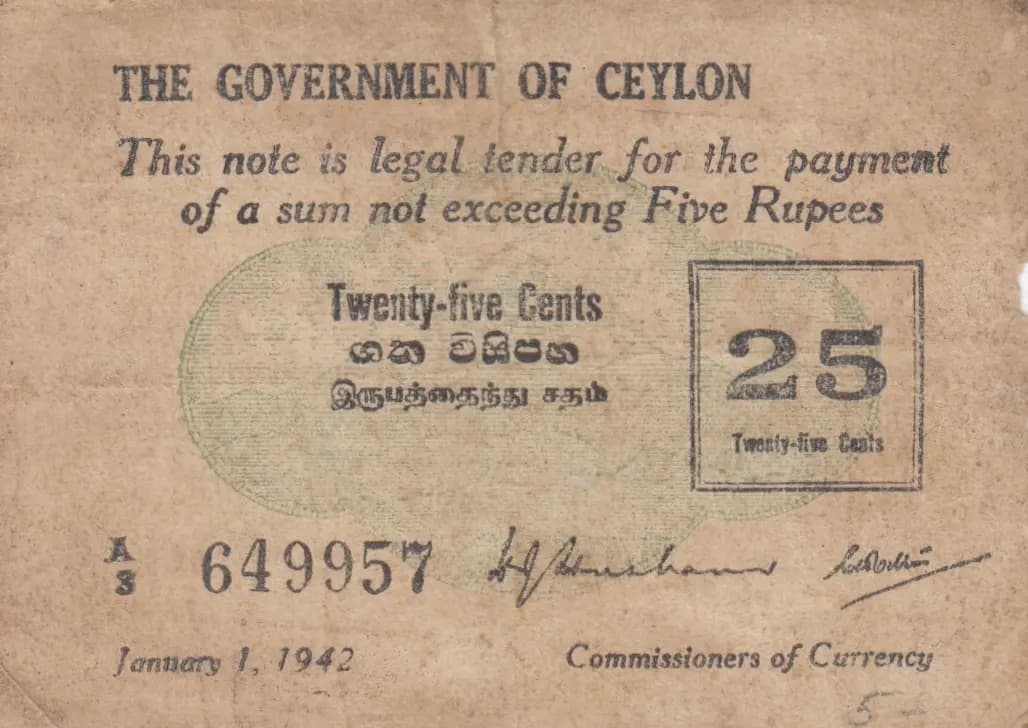
A 1942 Government of Ceylon 25 Cents note (Pick P-40) in Fair condition, displaying the characteristic tan and beige coloration typical of wartime currency from this period. The note exhibits significant age-related deterioration including foxing, browning, oxidation, and multiple creases, with visible wear consistent with circulation during the 1940s. The front features trilingual text in English, Sinhala, and Tamil, reflecting Ceylon's linguistic diversity, along with a rectangular denomination box and serial number 649957 dated January 1, 1942.
Common. The Government of Ceylon issued 25 Cents notes throughout the 1942-1951 period in substantial quantities to support Ceylon's wartime economy. Pick P-40 represents a standard denomination from a major issuing authority with no documented limited print run, short issue period, or recall. While the Fair condition grade reflects age and circulation wear, the denomination itself remains readily available in the numismatic market at modest valuations. No specific scarcity factors are known for this particular Pick number.
This note was issued by the Government of Ceylon during World War II, a critical period when Ceylon (now Sri Lanka) was under British colonial administration and served as an important strategic location in the Indian Ocean theater. The trilingual inscriptions in English, Sinhala, and Tamil reflect the colonial administrative structure and the island's ethnic composition during the 1940s. The denomination of 25 Cents represents a fractional currency unit within Ceylon's pre-decimal monetary system, with the note's legal tender value capped at Five Rupees as printed on the obverse.
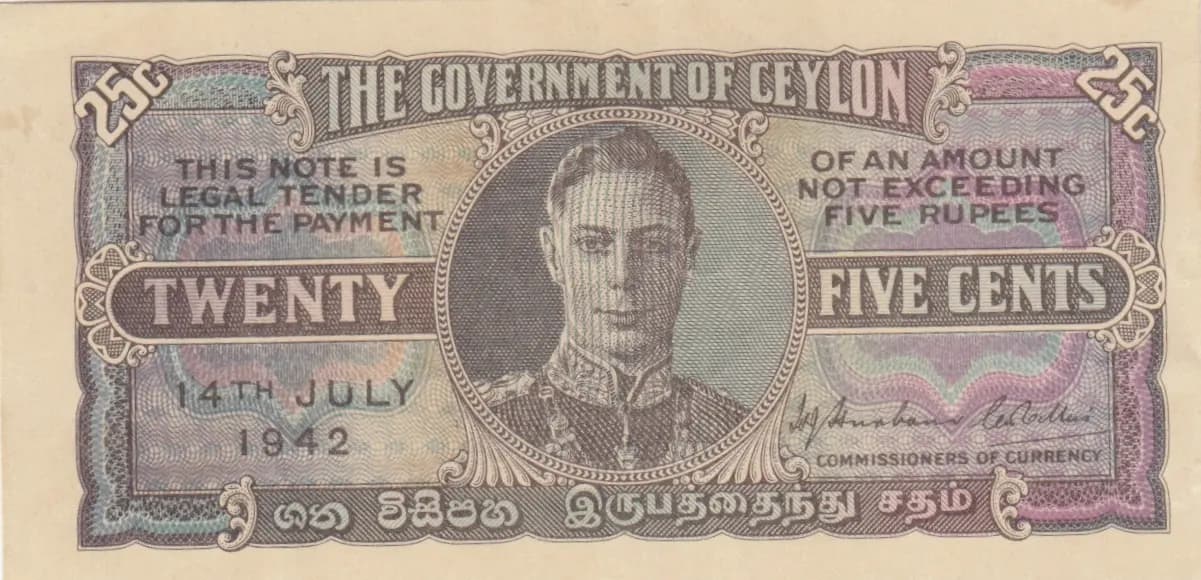
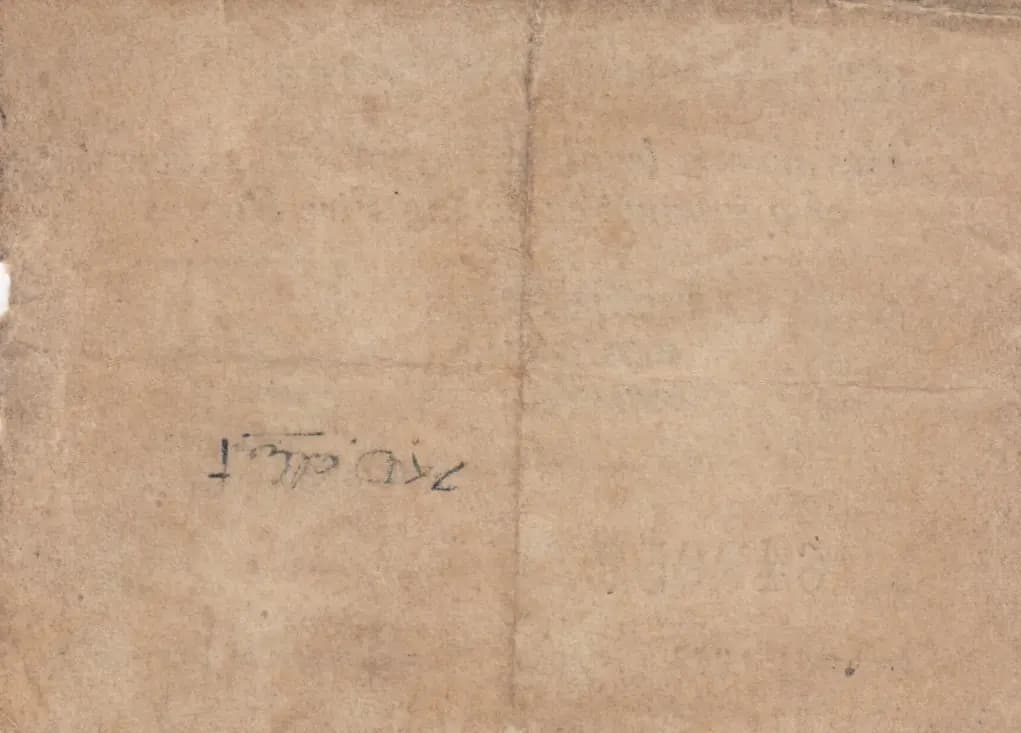
The front of this wartime Ceylon note features a clean, utilitarian design typical of emergency currency issued during the 1942 period. The note is dominated by text-based security elements rather than portraiture or elaborate imagery. The primary design element is a rectangular box on the right side containing the denomination in numerals and words. The note includes an oval area containing multilingual text and local scripts (Sinhala and Tamil), serving both security and administrative identification purposes. The color scheme utilizes brown and blue inks on a tan/beige paper stock. The reverse side is predominantly blank with minimal printing, consistent with many emergency-issue notes of this era. No portraits, historical landmarks, or elaborate heraldic symbols are depicted; instead, the design emphasizes text, denomination clarity, and issuing authority credentials.
FRONT SIDE: 'THE GOVERNMENT OF CEYLON' (English); 'This note is legal tender for the payment of a sum not exceeding Five Rupees' (English); 'Twenty-five Cents' (English); 'ශතක පැන්සේ' (Sinhala - Twenty-five Cents); 'ஐம்பத்தைந்து சதம்' (Tamil - Twenty-five Cents); '25' (Arabic numeral); Serial number '649957'; 'January 1, 1942' (date of issue); 'Commissioners of Currency' (issuing authority). BACK SIDE: 'I77201L' (handwritten annotation/notation).
This note was produced using letterpress/relief printing techniques, the standard method for banknote production in 1942. The multiple inscriptions in English, Sinhala, and Tamil were likely composed using separate type settings or plates to achieve the multilingual display. The brown and blue ink colors indicate separate printing passes. The relatively simple design with heavy reliance on typography rather than engraved vignettes is characteristic of wartime emergency currency produced under resource constraints during World War II. The specific printer is not identified in the visible inscriptions, though Ceylon's currency was typically printed by De La Rue or other established British security printers during this period.
This example is dated January 1, 1942, representing the initial issue date for this series. The serial number 649957 falls within the range typical of early 1942 production. Varieties of Pick P-40 may exist related to different signature combinations (the 'Commissioners of Currency' block may have featured different authorized signatories across the printing period), though the visual analysis does not provide sufficient detail to identify specific signatures. The handwritten notation 'I77201L' on the reverse appears to be a collector's catalog or archival marking rather than a production variety indicator.