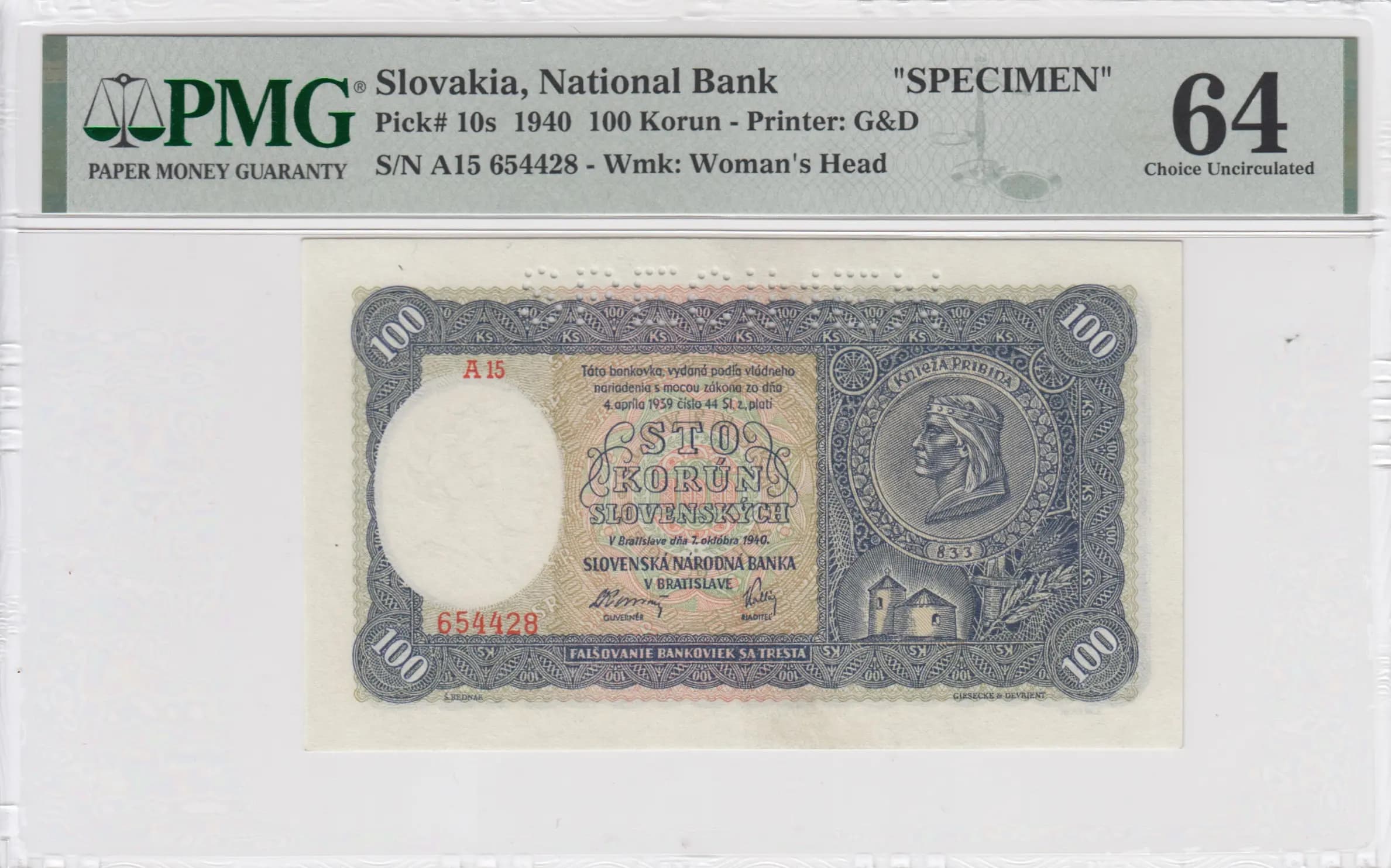
50 korun 1940
Market Prices
16 salesAbout This Note
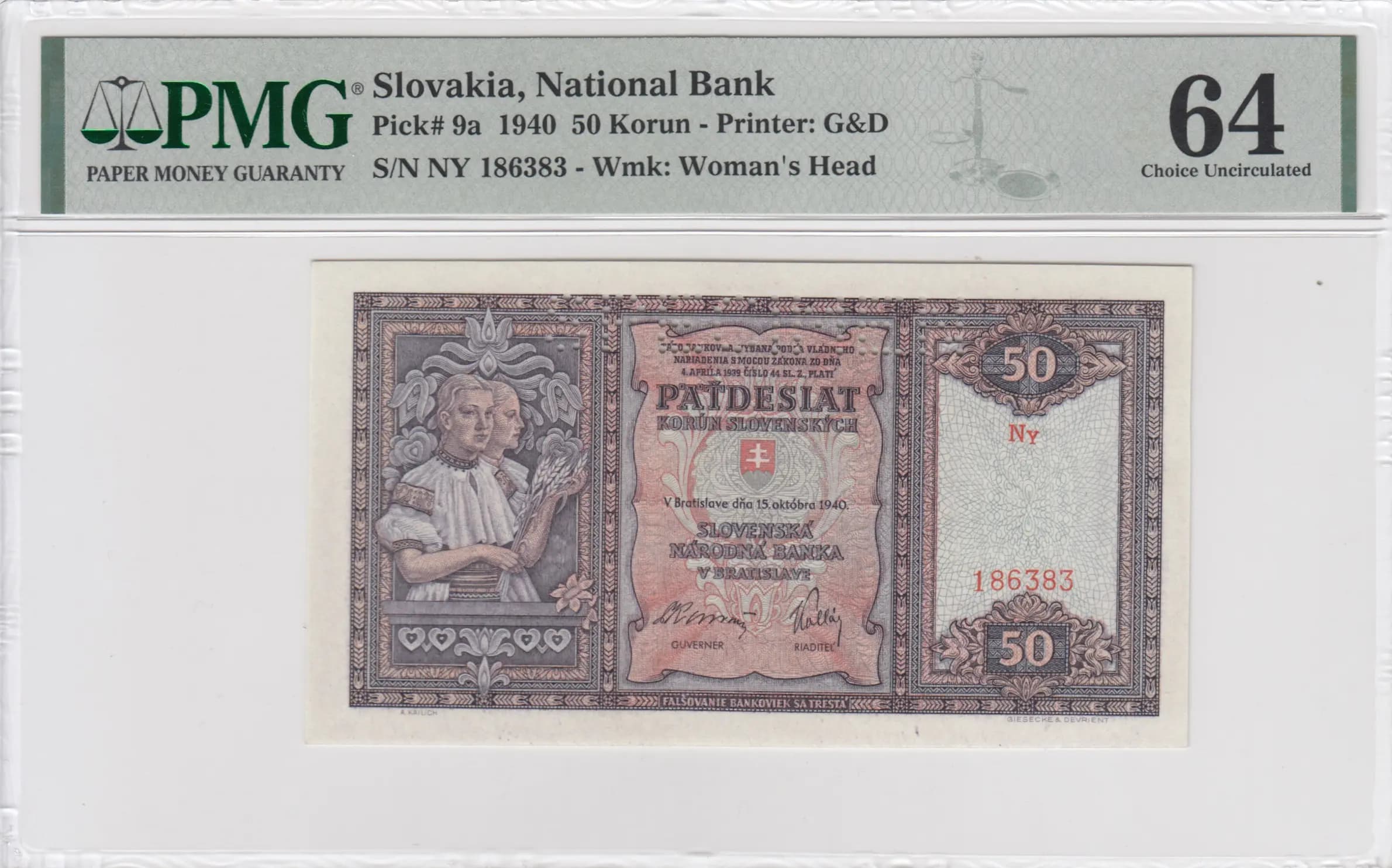
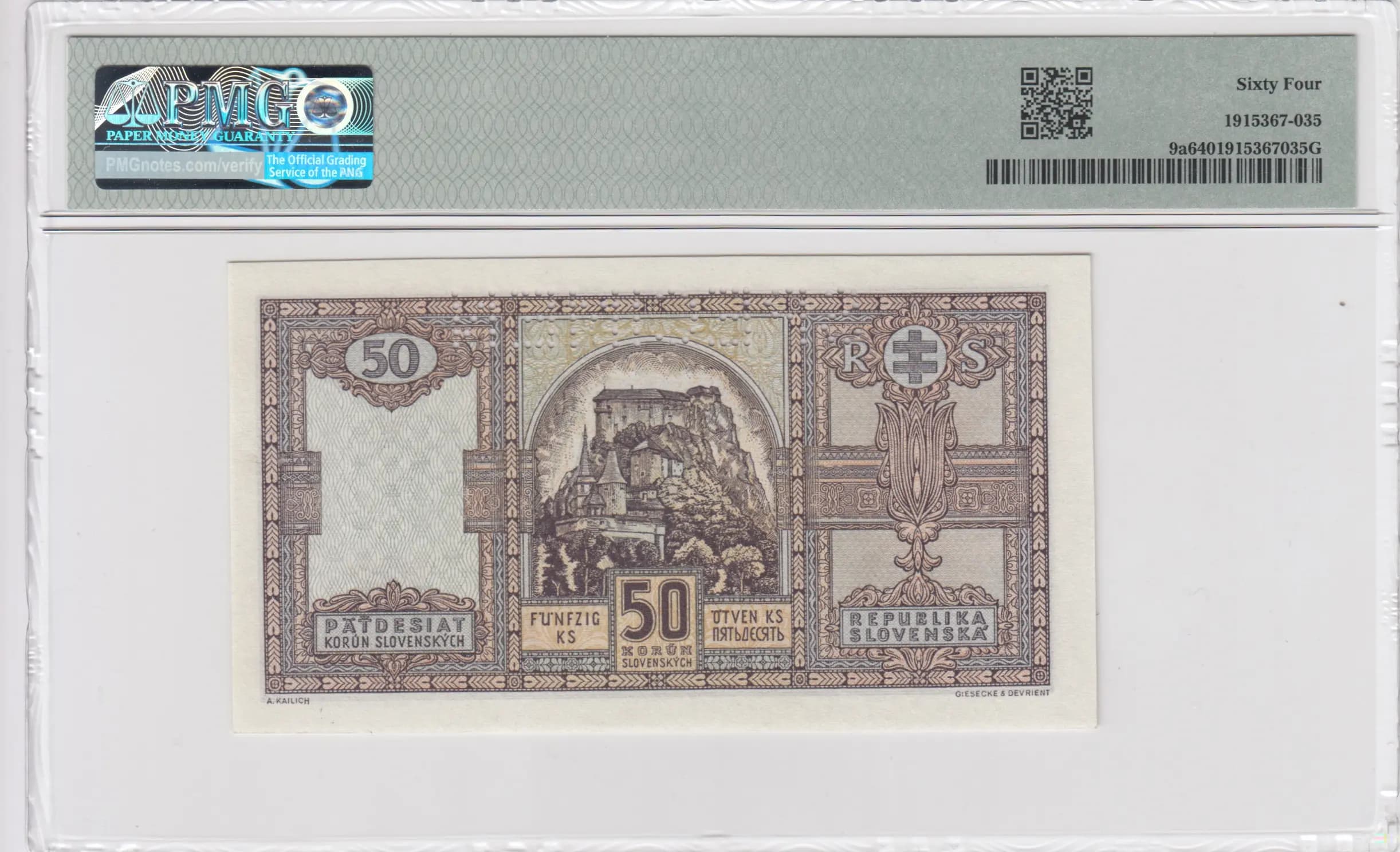
This is a PMG 64 (Choice Uncirculated) example of the Slovak National Bank's 50 Korun note from October 15, 1940, featuring a striking tri-paneled design with a classical woman's portrait on the obverse and a detailed castle landscape on the reverse. The note exhibits sharp, clear engraving throughout with no visible wear, folds, or circulation marks, representing an excellent preservation of this early Slovak Republic currency. The vibrant purple, brown, and salmon color palette combined with intricate decorative borders and multiple-language inscriptions exemplifies the sophisticated design standards of interwar Central European banknotes.
Common. Despite being from an early 20th-century Slovak currency issue, this note shows consistent circulation across the eBay market with regular sales ranging from $4 to $34 depending on condition grade. The 2016 catalog value of $4 in VF condition and observed sales of similar-grade notes in the $10-15 range confirm this is a readily available note for collectors. The relatively high print run by the Slovak National Bank and lack of any recorded scarcity or recall issues support a common classification. The PMG 64 grade represents excellent preservation but does not indicate rarity of the underlying note type.
Issued during the Slovak Republic period (1939-1945), this banknote represents the currency of the first Slovak state, which emerged following the German occupation of Czechoslovakia. The castle depicted on the reverse likely represents a significant Slovak landmark symbolizing national identity and sovereignty during this turbulent historical period. The trilingual inscriptions (Slovak, German, and Cyrillic) reflect the multicultural nature of the Slovak territories and the geopolitical realities of the era.
The obverse features a classical tri-paneled composition with a woman's head in left-facing profile occupying the left panel, rendered in fine engraved detail within an ornate rectangular frame. The center panel contains the issuer information and official text of the Slovenská Národná Banka, while the right panel displays the denomination '50' in large numerals with decorative flourishes. A shield with cross emblem, representing Slovak national symbols, appears in the center. The reverse mirrors this architectural layout, replacing the portrait with a detailed landscape engraving of a fortified castle or significant Slovak landmark on a hilltop, occupying the center panel. Both sides feature elaborate decorative borders with floral and geometric patterns, heart-shaped ornamental elements, and corner embellishments. The color scheme transitions between purple/mauve and brown tones on a cream background, creating visual distinction between obverse and reverse. Multiple languages appear on the back (Slovak, German, and Cyrillic script), emphasizing the note's international and multicultural context.
FRONT SIDE: 'PÄŤDESIAT KORÚN SLOVENSKYCH' (Fifty Slovak Korun) / 'SLOVENSKÁ NÁRODNÁ BANKA' (Slovak National Bank) / 'V BRATISLAVE' (In Bratislava) / 'V Bratislave dňa 15 októbra 1940.' (In Bratislava on October 15, 1940) / 'GUVERNÉR' (Governor) / 'RIADITEĽ' (Director) / Serial number: 186383. BACK SIDE: 'PÄŤDESIAT KS' (Fifty pieces - Slovak) / 'FÜNFZIG KS' (Fifty pieces - German) / 'UTVEN KS' (Fifty pieces - Cyrillic) / 'PÄŤDESIAT KORÚN SLOVENSKÝCH' (Fifty Slovak Korun) / 'REPUBLIKA SLOVENSKÁ' (Slovak Republic) / 'A. KALICH' (Artist signature) / 'GIESECKE & DEVRIENT' (Printer: Giesecke & Devrient).
Intaglio engraving (line engraving), the traditional currency printing method of the era, executed by Giesecke & Devrient (G&D), one of Europe's premier security printers. The sharp definition of facial features, landscape details, and decorative elements visible throughout both sides confirms high-quality engraved plate production. Security features include a watermark depicting a woman's head, incorporated during the paper manufacturing process. The complex border work and fine line patterns throughout both sides represent the anti-counterfeiting techniques standard to professional currency production of the 1940s period.
Pick 9a designation confirmed. The visual analysis identifies this as the standard regular issue without 'II EMISIA' (Second Emission) overprint designation, confirming the P-9a variety rather than later emissions. Serial number 186383 is visible on the obverse. Printer attribution to Giesecke & Devrient (G&D) and artist signature 'A. KALICH' are confirmed. No overprints, serial number prefixes of significance, or other varieties distinguishing this specimen from the standard issue are noted. This represents a straightforward P-9a regular issue example in superior condition.