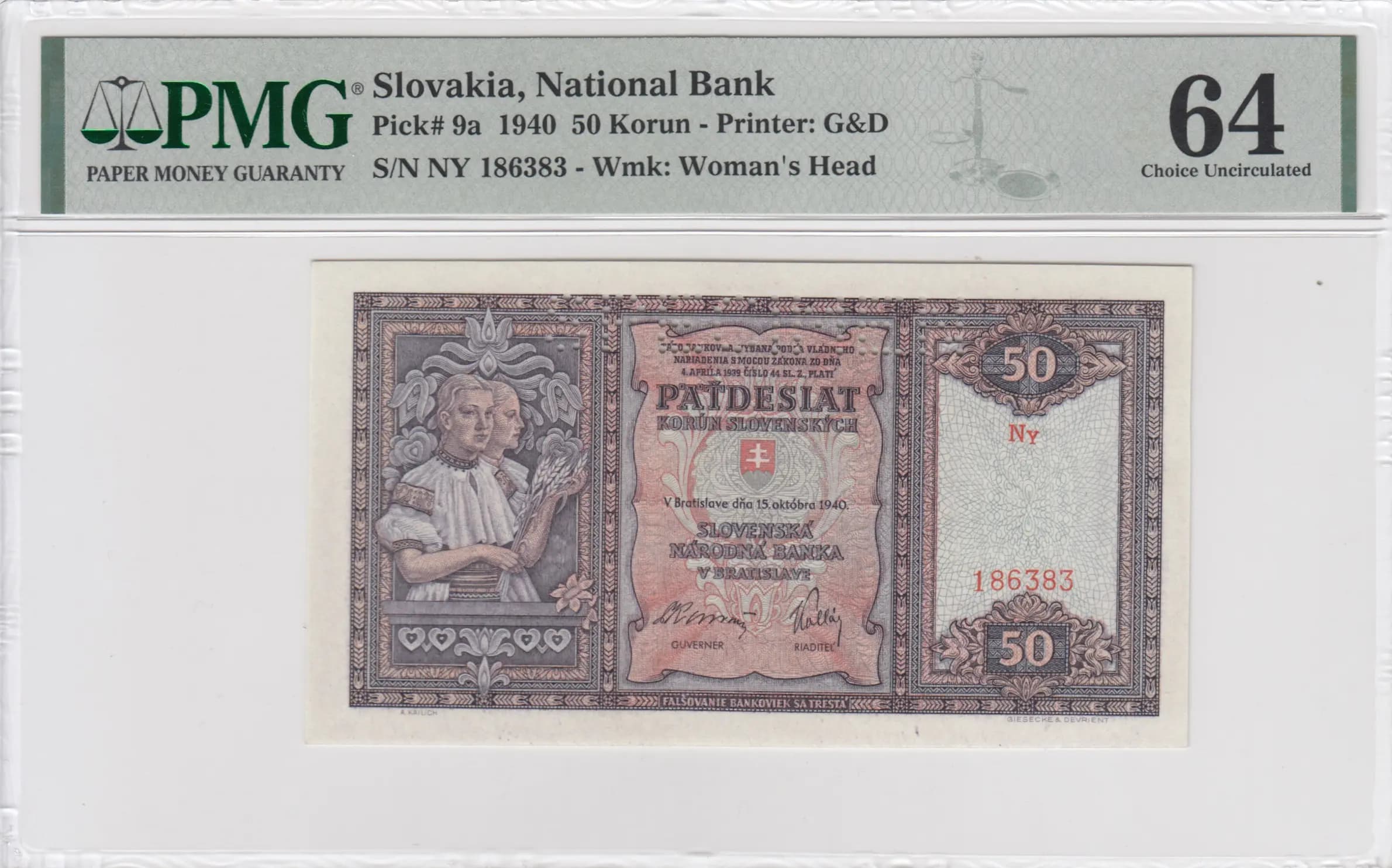
100 korun 1940 specimen
Market Prices
18 salesAbout This Note
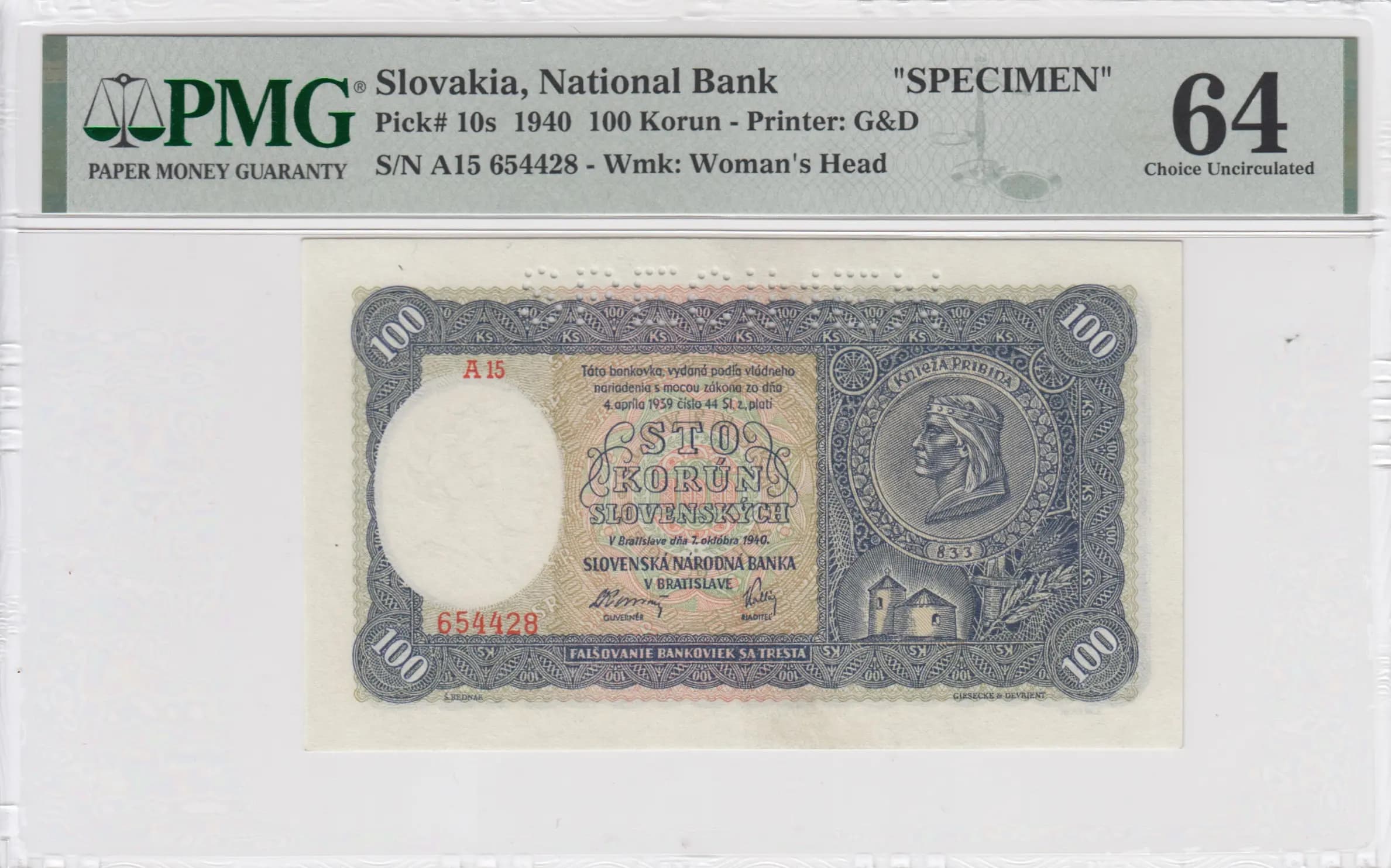
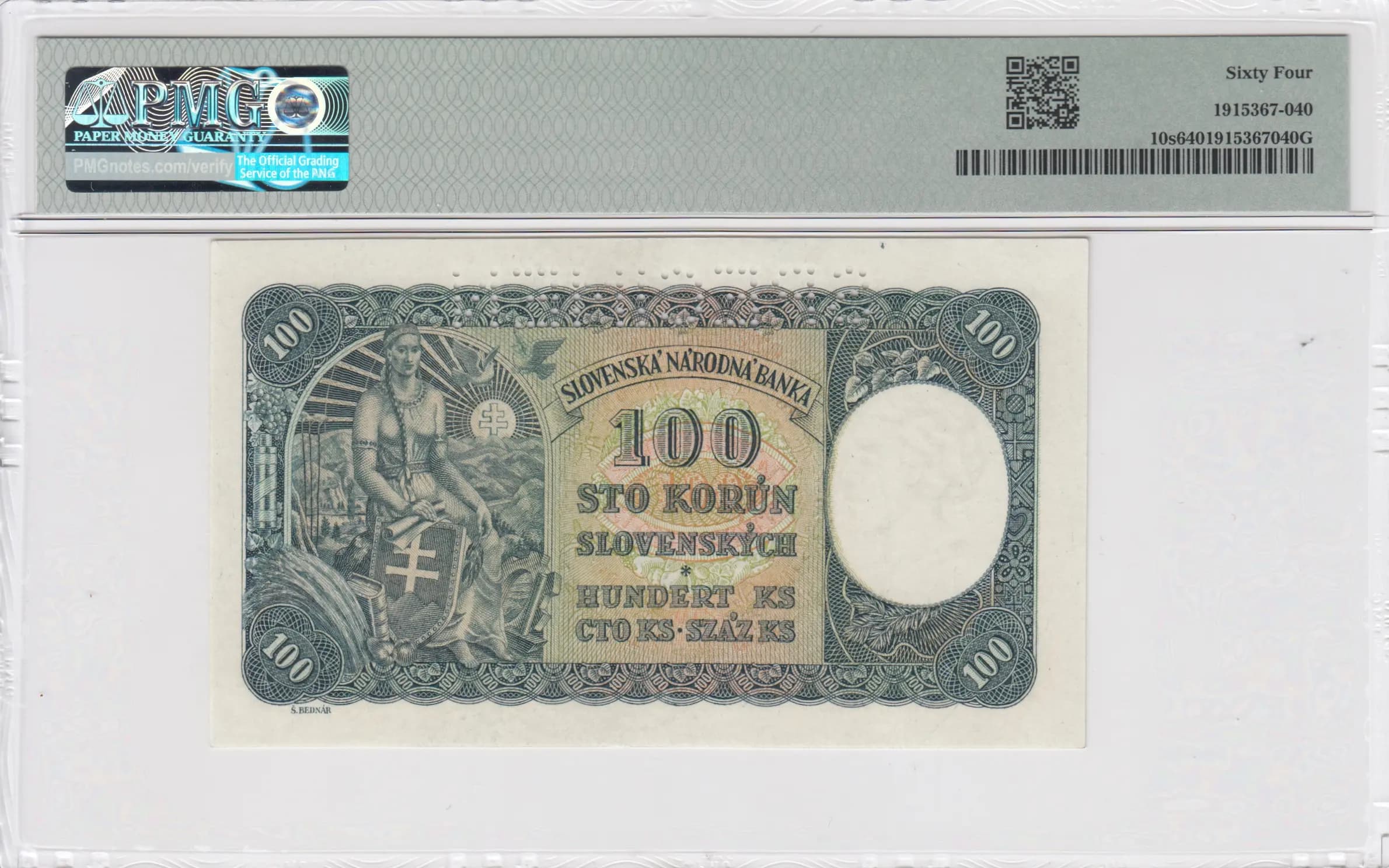
This is a scarce specimen note of Slovakia's first 100 Korun denomination, issued by Slovenska Narodna Banka on October 7, 1940. The note displays exceptional technical engraving quality with a classical woman's portrait on the obverse and an allegorical female figure holding a heraldic shield on the reverse, both rendered in fine detail typical of G&D's printing. In PMG 64 condition, this specimen note represents an important early Slovak currency issue from the tumultuous 1940-1945 period and exhibits the characteristic clarity and preservation expected of specimen notes.
Common. While specimen notes command a modest premium over circulated examples, this particular issue remains abundant in the collector market. eBay sales data shows consistent pricing in the $5-$15 range for circulated grades, with PMG 64 examples expected in the $25-$50 range based on recent auction activity (a PMG 67 sold for $91 in January 2024, indicating modest but not exceptional scarcity). The note was part of a substantial initial currency issuance by the Slovak National Bank and specimen examples were produced in reasonable quantities. The PMG population report confirms only 1 catalogued variant for P-10s, but specimen notes from this era were typically issued in moderate quantities for distribution and archives.
This 100 Korun note was issued during the Slovak Republic (1939-1945), a period following the dissolution of Czechoslovakia under Nazi pressure. The note's classical allegorical imagery—featuring a woman's portrait on the obverse and Liberty-type figure holding a shield with heraldic symbols on the reverse—reflects Slovak national identity and sovereignty aspirations during this controversial period. The October 7, 1940 issue date places it early in the Slovak state's independent currency circulation, before the dramatic hyperinflation and currency instability of the war's final years.
The obverse features a classical woman's head in profile facing right, rendered within a circular medallion frame with fine engraved detail. This portrait likely represents Patriotic or national virtue in the Slovak context. The reverse displays an allegorical female figure (representing Liberty or the Slovak nation) seated on the left, holding a shield bearing heraldic arms of Slovakia including a prominent cross symbol. Both sides are framed with ornate decorative borders featuring repeating fan-like or shell-pattern guilloche work and double-headed eagle heraldic emblems characteristic of Central European state symbolism. The denomination '100' appears in decorative corner frames on both sides. Blank oval areas on both sides indicate watermark positions (showing a woman's profile), a key security feature of this issue. The multilingual text (Slovak, German, and Cyrillic transliteration) reflects the polyglot nature of the Slovak state's diverse population during this period.
FRONT SIDE: 'STO KORUN SLOVENSKYCH' (One hundred Slovak crowns); 'SLOVENSKÁ NÁRODNÁ BANKA' (Slovak National Bank); 'V BRATISLAVE' (In Bratislava); 'Táto bankovka vydand podľa vládneho nariadenia s mocou zákona zo dňa 4.apríla 1939 čísla 44 Sl.zb.plati' (This banknote issued according to government decree with force of law from April 4, 1939 number 44 Sl.zb. valid); 'V Bratislave dňa 7.októbra 1940.' (In Bratislava on October 7, 1940); 'FAISOVANIE BANKOVIEK SA TRESTA' (Counterfeiting of banknotes is punishable); Serial number prefix 'A15' with number '6544428'. BACK SIDE: '100' (denomination); 'STO KORÚN SLOVENSKYCH' (One hundred Slovak crowns); 'SLOVENSKÁ NÁRODNÁ BANKA' (Slovak National Bank); 'HUNDERT KS' (German: One hundred crowns); Cyrillic transliteration 'CTO KS·SZÁ KS' (One hundred crowns); Artist signature 'S. REBNAR'.
This note was produced by Giesecke+Devrient (G&D), a leading German security printer, using intaglio/steel engraving techniques. The fine line work, detailed portraiture, intricate guilloche borders, and multi-color printing visible in the specimen indicate the sophisticated engraving processes G&D employed. The clarity and sharpness of the specimen note preserve the original engraved details without circulation wear, making this an excellent example of 1940s high-security banknote production standards.
This is the P-10s specimen variety, issued October 7, 1940, without the 'II. EMISIA' (2nd edition) overprint that distinguishes P-11. The specimen is identifiable by the 'SPECIMEN' perforation marking and the blank oval watermark areas. The serial number prefix 'A15' with serial number 6544428 is visible on this example. The note lacks the overprint designation for later printings, confirming this as a first-edition specimen. G&D is confirmed as the printer for this Pick number variant.