25 rupees 1979
Market Prices
6 salesAbout This Note
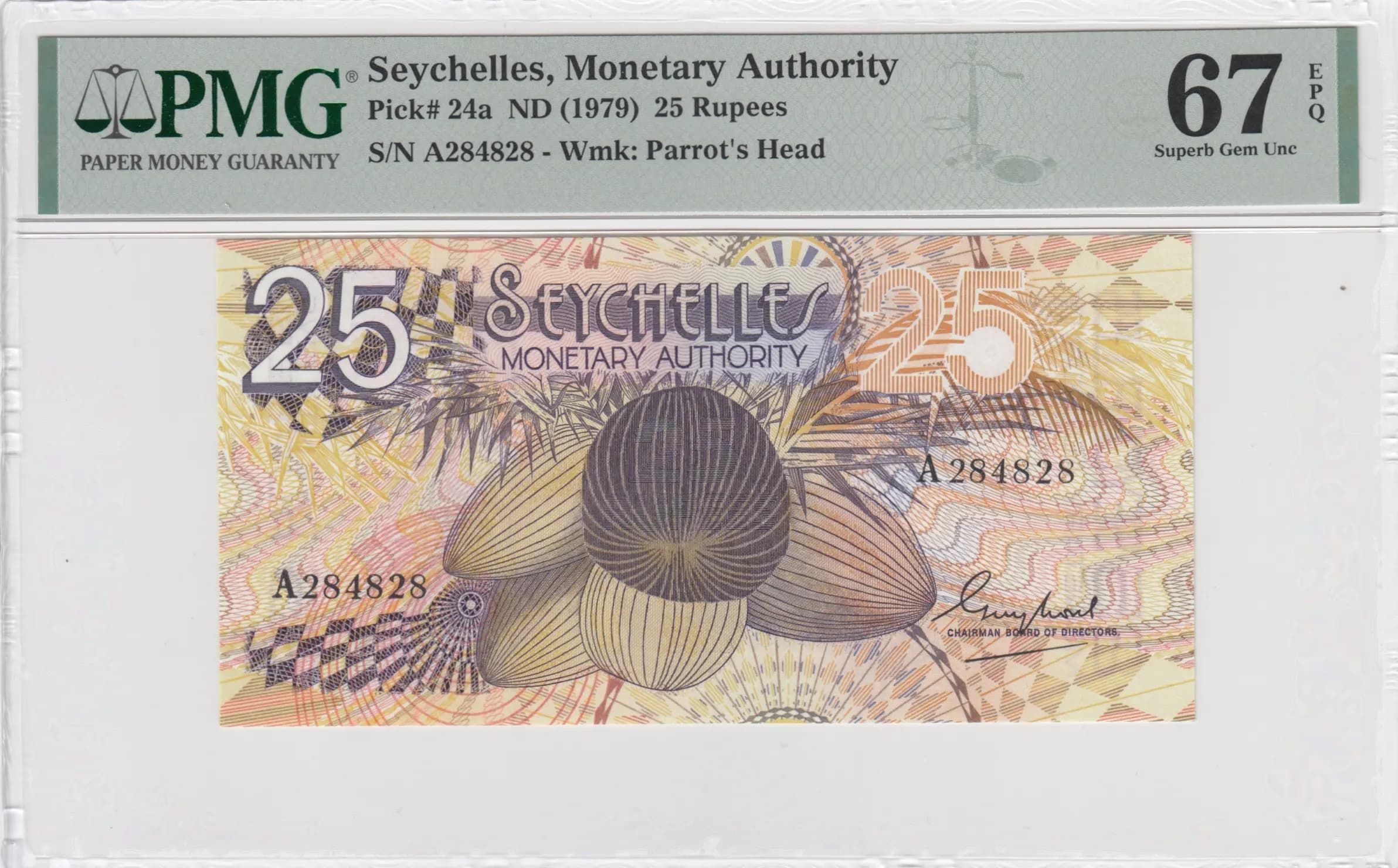
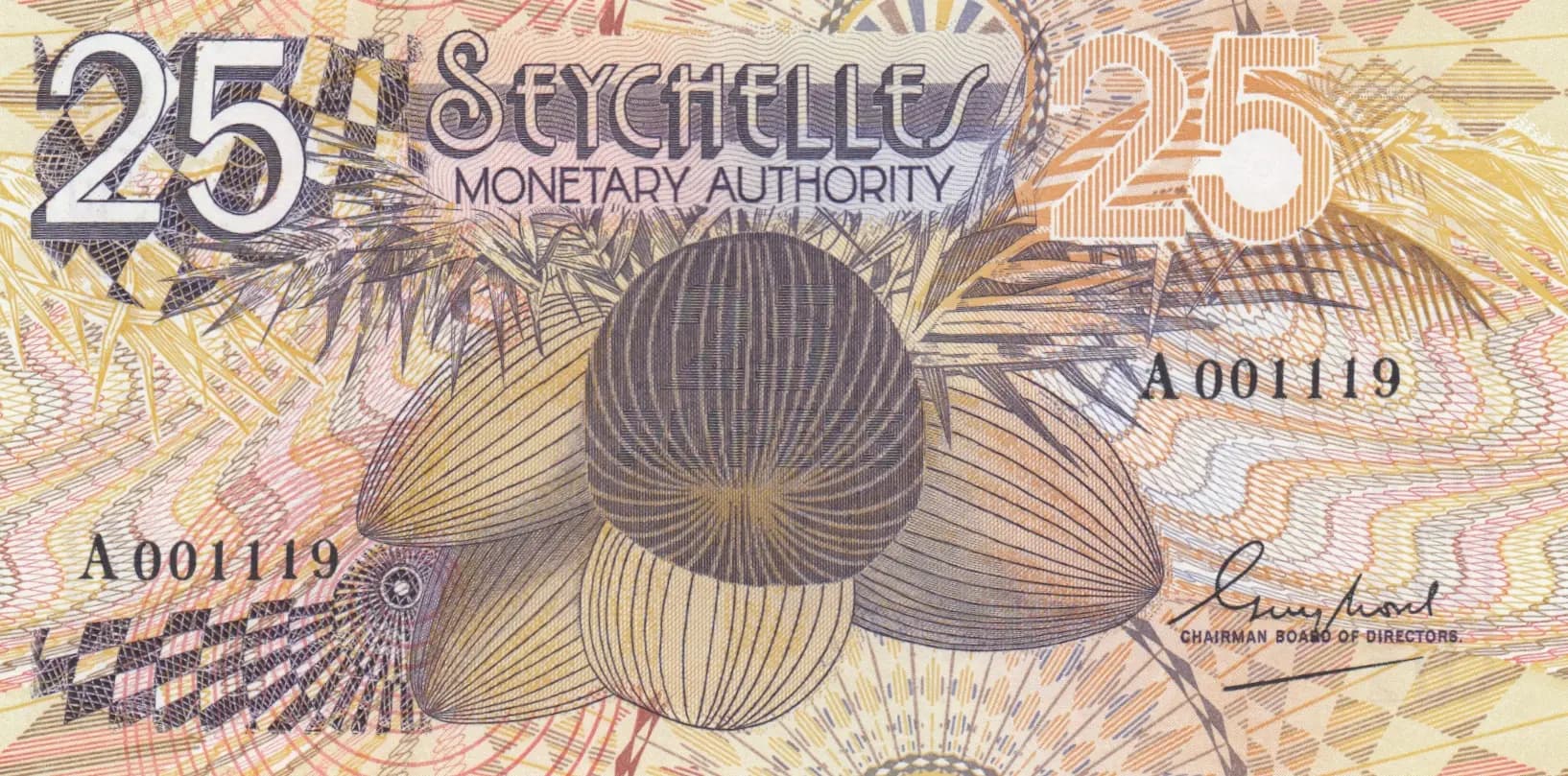
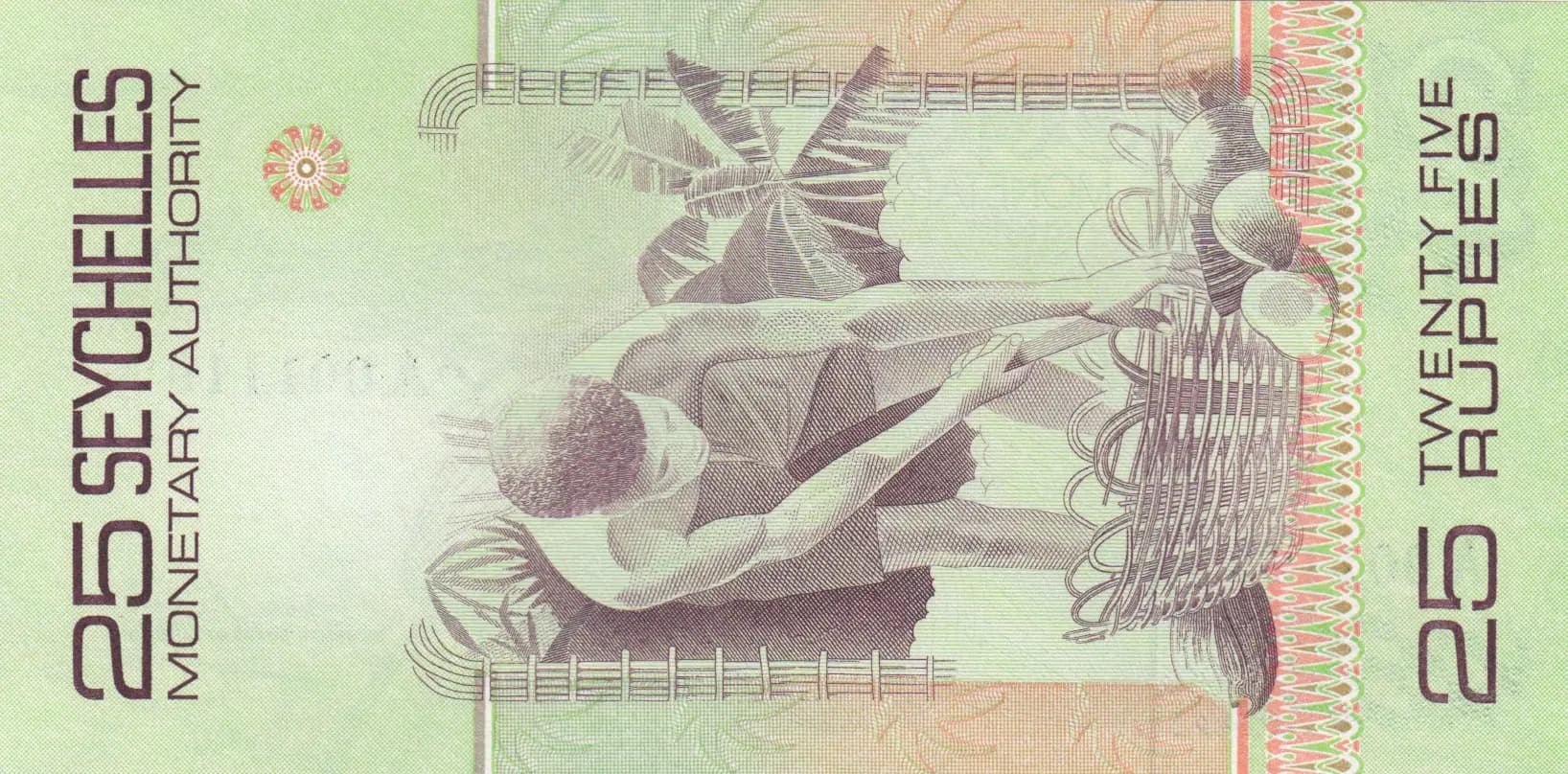
This is a crisp, uncirculated 1979 Seychelles 25 rupee note (Pick P-24) issued by the Seychelles Monetary Authority, displaying excellent preservation with no visible wear, creases, or damage. The obverse features an intricately engraved Coco de Mer (coconut) at center with complex stippling and radiating line work in warm brown, orange, and beige tones, while the reverse showcases detailed botanical imagery—likely flowering plants or seed pods—rendered in green with decorative geometric borders. This early Seychelles currency note represents the nation's post-independence monetary identity and remains highly sought in premium grades.
Common. While this is an early Seychelles note from 1979, eBay market data shows regular circulation in the $25–60 range for UNC and PMG-graded examples, with UNC specimens cataloging at $25 (2019). Print runs for this denomination were substantial, and the note has been available in the secondary market consistently. No evidence suggests a limited issue, recall, or scarcity premium. The UNC grade observed here aligns with typical collector availability.
Issued in 1979, just two years after Seychelles gained independence from Britain in 1976, this banknote reflects the newly sovereign nation's commitment to establishing its own monetary identity under the Seychelles Monetary Authority. The prominent Coco de Mer imagery on the obverse celebrates the endemic giant sea coconut, one of Seychelles' most iconic natural symbols and a source of national pride. The botanical designs across both sides underscore Seychelles' rich island flora and the economic and cultural importance of natural resources to this Indian Ocean archipelago.
The obverse features a large spherical Coco de Mer (giant coconut) occupying the center field, rendered with fine line work and stippling to create depth and texture characteristic of banknote engraving. The denomination '25' appears in opposite corners, with the issuer name and authority inscriptions positioned symmetrically. The background employs ornate radiating geometric patterns in beige, orange, brown, and tan tones. The reverse displays botanical imagery—likely flowering plants or possibly the distinctive double-lobed seed pod structure associated with Coco de Mer—rendered in light green against a pale green field, with decorative geometric borders in red and green along the right edge. Both sides exhibit the fine-line work and complexity typical of high-security banknote design from this period.
Front side: '25' (denomination in numerals), 'SEYCHELLES' (country name), 'MONETARY AUTHORITY' (issuing institution), 'CHAIRMAN BOARD OF DIRECTORS' (signature line), Serial number 'A001119' (appears twice). Back side: '25 SEYCHELLES' (denomination and country), 'MONETARY AUTHORITY' (issuing institution), '25 TWENTY FIVE' (denomination in numerals and words). All inscriptions are in English, reflecting Seychelles' post-colonial linguistic heritage.
Intaglio (engraved) printing, evidenced by the fine stippling, intricate line work, and depth of detail visible throughout the design. The complexity of the background patterns, security line work, and three-dimensional appearance of the central Coco de Mer image are characteristic of intaglio production. The specific printer for this Pick number is not definitively documented in available sources, but Seychelles notes from this era were typically produced by established security printers such as Bradbury Wilkinson or similar firms specializing in Commonwealth currency.
Serial number prefix 'A' is noted on the examined specimen (A001119). Early Seychelles currency from the 1979 issue may show variations in signature lines and minor printing details. No major varieties (overprints, color variants, or signature changes) are documented for Pick P-24 in standard catalogs. The examined note appears to be a standard regular issue without notable variety markers.