10 rupees 1942 radar
Market Prices
1 saleAbout This Note
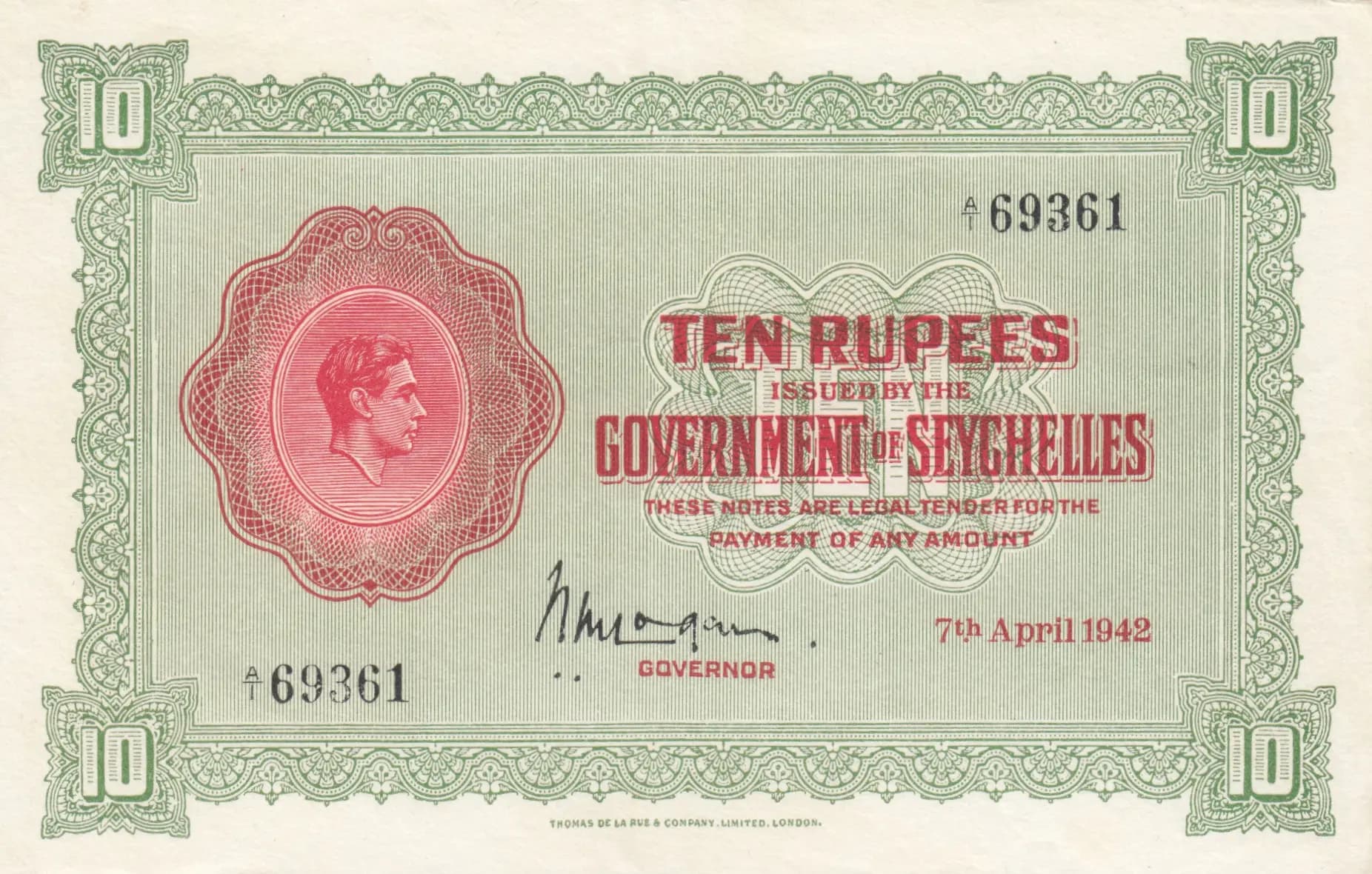
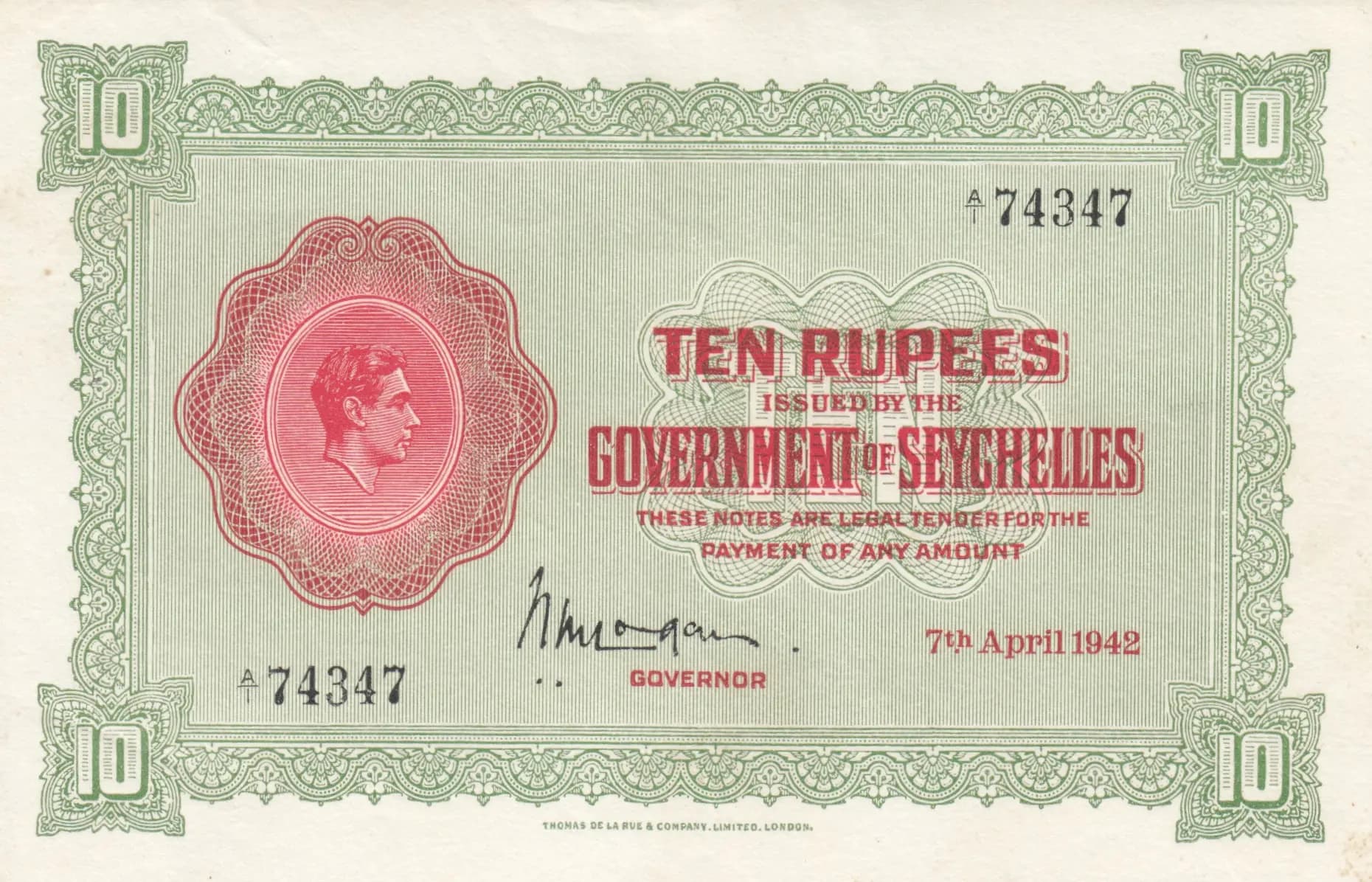
This 1942 Seychelles 10 Rupees note (Pick P-9) presents as an Extremely Fine example of early wartime currency from the British colonial territory. The obverse displays a striking red circular portrait medallion of King George VI set against an ornate green decorative border with intricate scrollwork and geometric patterning, characteristic of Thomas De La Rue's craftsmanship. The note exhibits excellent preservation for an 82-year-old specimen, with minimal wear, no significant creasing or tears, and only subtle age-related foxing on the cream background—a desirable condition grade that aligns well with catalog valuations in the $400 range for VF examples.
Common. While historical and collectible as a mid-20th century Commonwealth banknote, the 1942 Seychelles 10 Rupees is not rare. eBay transaction data shows F-graded examples realizing approximately $114, and catalog valuations place VF specimens at $400 and uncirculated examples at $1,500—price levels consistent with steady collector demand for uncommon (not rare) colonial currency. The note was produced by a major established security printer (Thomas De La Rue) for a functioning government issuer, and sufficient quantities entered circulation and have survived to present day. The EF condition grade of this specimen places it in the upper tier of available examples but does not alter its fundamental rarity classification.
Issued on 7th April 1942 during World War II, this banknote represents Seychelles' monetary authority under the Government of Seychelles during the British colonial period. The prominent portrait of King George VI reflects the sovereignty and constitutional ties to the British Crown, while the legal tender declaration and formal governmental issuing statement underscore Seychelles' status as a Crown Colony managing its own currency in wartime conditions. The Thomas De La Rue printing, London's premier security printer, ensured the note met imperial standards for colonial currency throughout the conflict and postwar period.
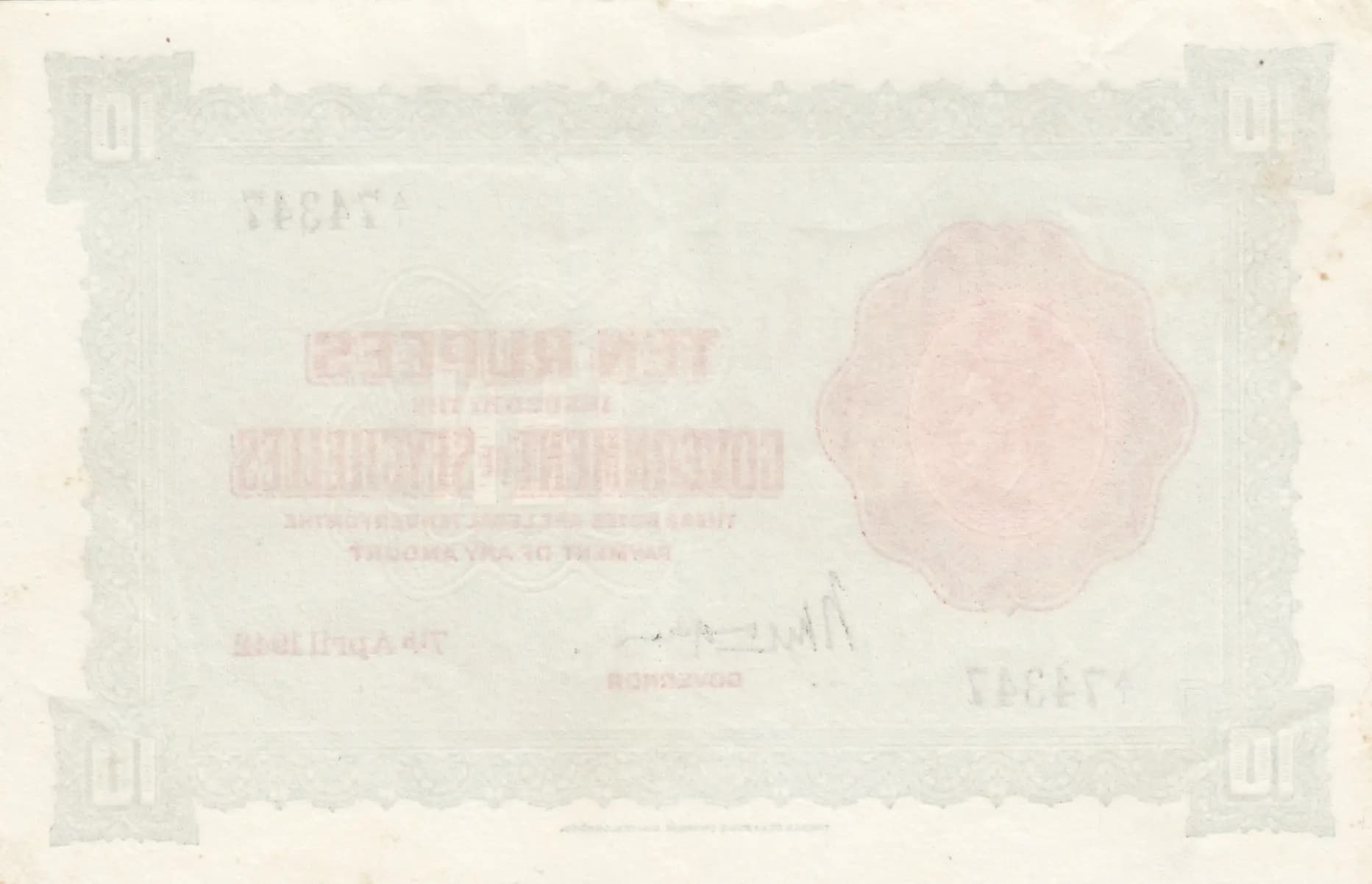
The obverse features a classical colonial-era design centered on a red circular portrait medallion containing a right-facing profile of King George VI in formal dress, bordered by an ornate scalloped circular frame with fine decorative detailing. This portrait is positioned at the left side of the note and serves as the primary security and identification element. Surrounding the entire design is an elaborate green ornamental border featuring intricately engraved corner medallions with geometric and scrollwork patterns typical of high-security banknote production. The denomination 'TEN RUPEES' and issuing information appear in red text to the right of the portrait. A handwritten signature line for the Governor appears in the lower center portion. The reverse side, though faintly visible in the provided image, appears to contain a complementary decorative design with similar scalloped medallion framing and the country name 'SEYCHELLES,' following the uniface or near-uniface design tradition noted for this series.
FRONT: '10' (denomination numeral); 'TEN RUPEES' (denomination in words); 'ISSUED BY THE GOVERNMENT OF SEYCHELLES' (issuing authority); 'THESE NOTES ARE LEGAL TENDER FOR THE PAYMENT OF ANY AMOUNT' (legal tender declaration); '7th April 1942' (issue date); 'GOVERNOR' (signature line designation); 'A 74347' (serial number, appears twice); 'THOMAS DE LA RUE & COMPANY, LIMITED, LONDON' (printer identification and location). BACK: 'SEYCHELLES' (country identification, faint in image).
Intaglio (line engraving and steel plate printing), executed by Thomas De La Rue & Company, Limited, London. The visual characteristics confirm this method: fine line engraving throughout the design, intricate geometric crosshatching in the portrait medallion, detailed scrollwork in the border elements, and the overall crisp, high-relief appearance typical of security banknote production. The precision of the circular portrait frame scalloping and the delicate ornamental patterning are hallmarks of Thomas De La Rue's advanced intaglio techniques from the 1940s era.
Serial number A 74347 is noted on this specimen. The 1942 Seychelles 10 Rupees is recorded as having various signature varieties depending on the Governor in office at the time of issue and subsequent printings. The handwritten signature visible on this example represents one such variety. Date and signature combinations are the primary cataloging variables for this Pick number, as noted in reference sources mentioning 'various date and signature varieties.' Without additional examples for direct comparison, the specific Governor signature on this note (A 74347) represents a particular state of this issue but does not qualify as a separately named major variety in standard catalogs.