10 rupees 1942
Market Prices
1 saleAbout This Note
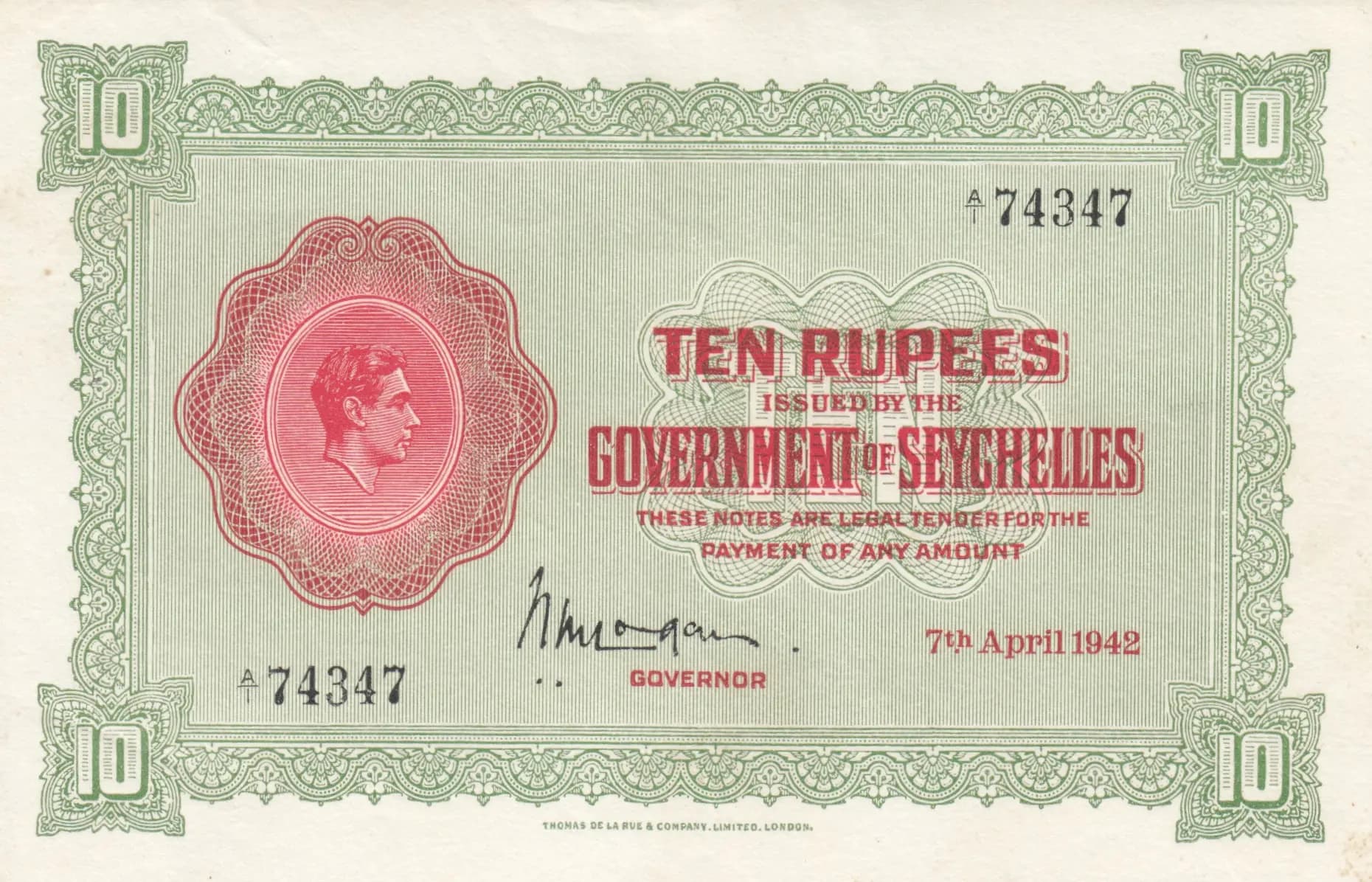
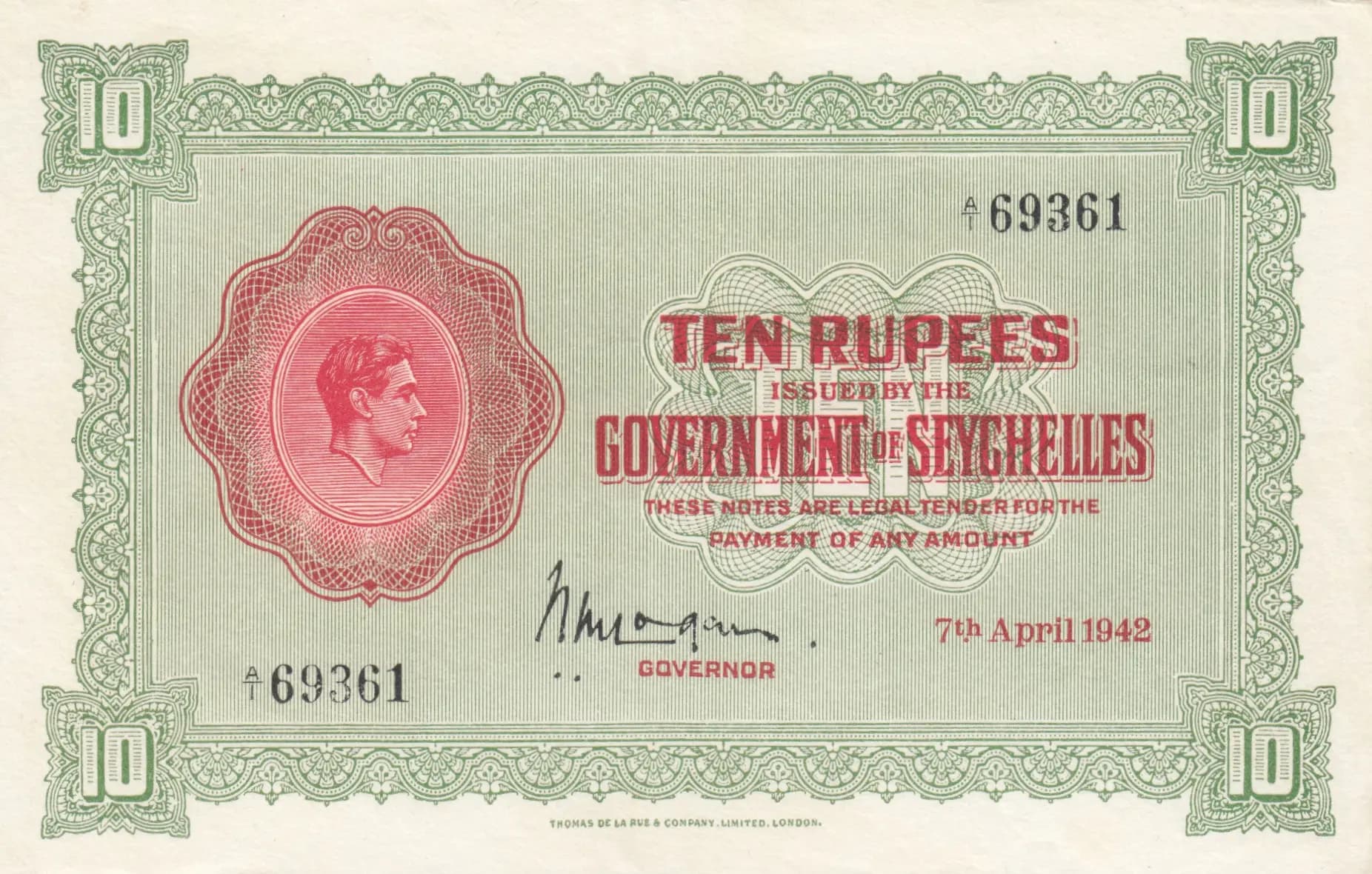
This is a Government of Seychelles 10 Rupees note dated 7th April 1942, issued during World War II and printed by the prestigious Thomas de la Rue & Company of London. The note is presented in EF condition with crisp, well-preserved printing showing minimal wear, featuring an elegant design with King George VI's portrait in a red circular medallion and ornate green decorative borders with geometric and floral patterns. The serial number A 69361 and clear signature line for the Governor are visible, making this a notable example of early Seychelles currency from the colonial period.
Common. The eBay price history shows this note in F condition sold for approximately $114.50 in 2015, and catalog values for EF range around $400, indicating a well-circulated but not particularly scarce issue. While colonial-period Seychelles notes have some collector interest, the 1942 10 Rupees (P-9) appears to have had a reasonable print run for regular circulation use during the wartime period. The note is readily available in the market and represents a standard issue rather than a rare variety.
This note was issued during World War II, a period when Seychelles was a British Crown Colony under wartime conditions. The prominent portrait of King George VI in the red medallion symbolizes the colonial administrative authority and the island's ties to the British Empire during this critical historical period. The formal 'Government of Seychelles' inscription and legal tender declaration reflect the colonial governance structure and the formalization of local currency controls during wartime economic management.
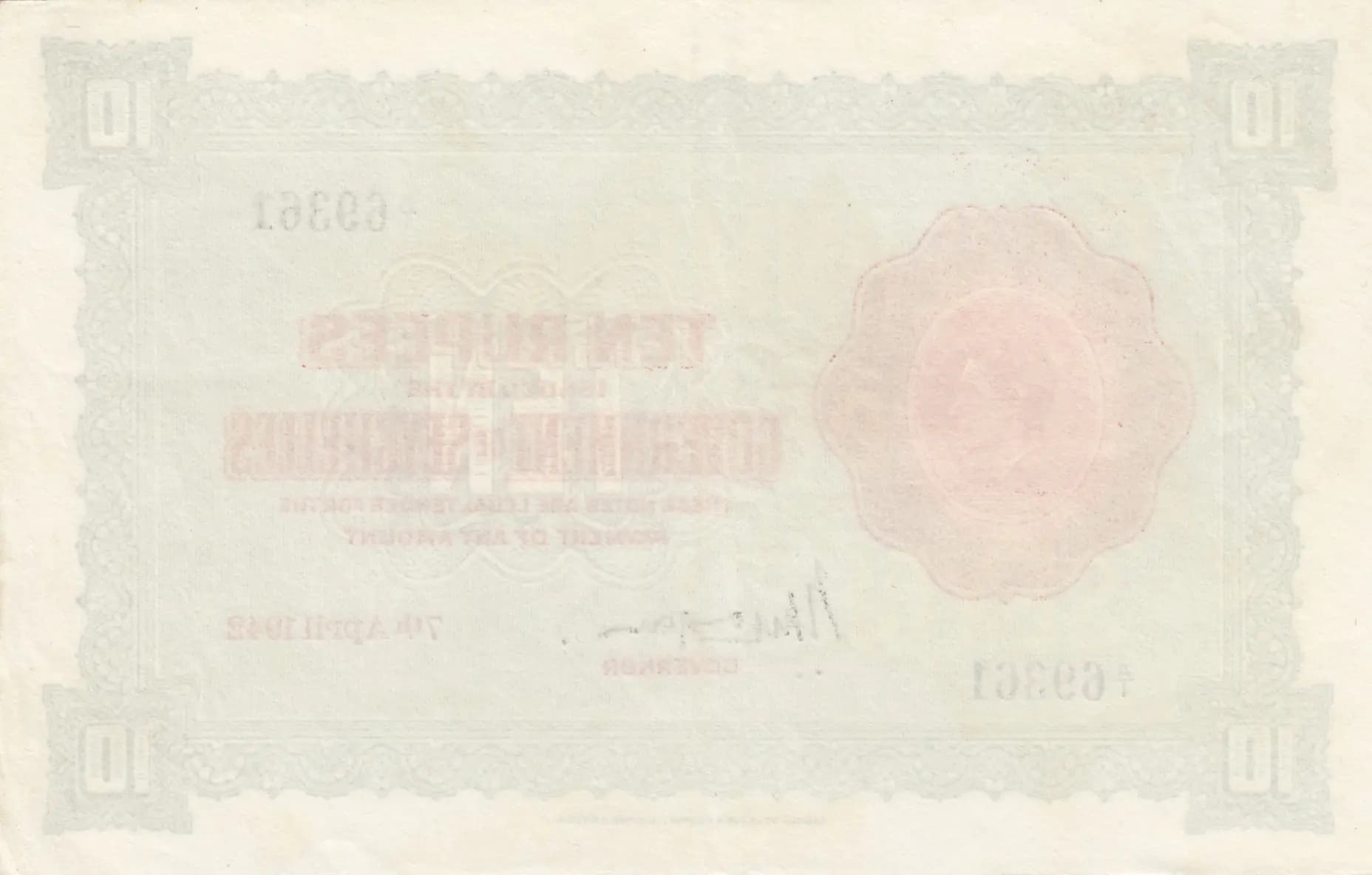
The obverse features a formal colonial-era design with King George VI depicted in right-facing profile within an ornate scalloped red circular medallion frame, positioned at the left side of the note. The denomination 'TEN RUPEES' is prominently displayed in red text in the center-right area, with 'GOVERNMENT OF SEYCHELLES' above it. The entire design is framed by an elaborate green decorative border composed of repeating geometric and floral motifs typical of De la Rue's Art Deco-influenced security printing style. The signature line for the Governor appears centrally below the denomination text. The reverse side appears to be a very faint watermark impression or lightly printed security feature, barely visible in pale tones.
Front side: '10' and 'TEN RUPEES' (denomination), 'ISSUED BY THE GOVERNMENT OF SEYCHELLES' (issuing authority), 'THESE NOTES ARE LEGAL TENDER FOR THE PAYMENT OF ANY AMOUNT' (legal tender clause), '7th April 1942' (issue date), 'GOVERNOR' (signature line designation), Serial numbers 'A 69361' (top right and bottom left), 'THOMAS DE LA RUE & COMPANY, LIMITED, LONDON' (printer identification). Back side: Faint watermark or reverse impression with partial number '10660' visible.
This note was produced using intaglio (engraved) printing by Thomas de la Rue & Company, Limited, as indicated on the face of the note. The visual analysis confirms fine line engraving throughout the design with intricate geometric patterns, detailed hatching, and fine-detail portrait engraving characteristic of De la Rue's security printing methods. The two-color printing (green and red) on cream/beige stock is typical of De la Rue's work during the 1940s. The faint reverse side suggests either a subtle watermark or lightly printed reverse design as a security feature.
The observed serial number is A 69361, indicating a prefix 'A' variety. The visual analysis notes 'Various date and signature varieties' exist for this Pick number according to the reference data. The specific signature line (labeled 'GOVERNOR' on this specimen) may vary by signatory. No overprints or unusual features are evident in the EF specimen examined, suggesting this is a standard printing variant from the initial 7th April 1942 issue date.