1 pound 1961
Market Prices
13 salesAbout This Note
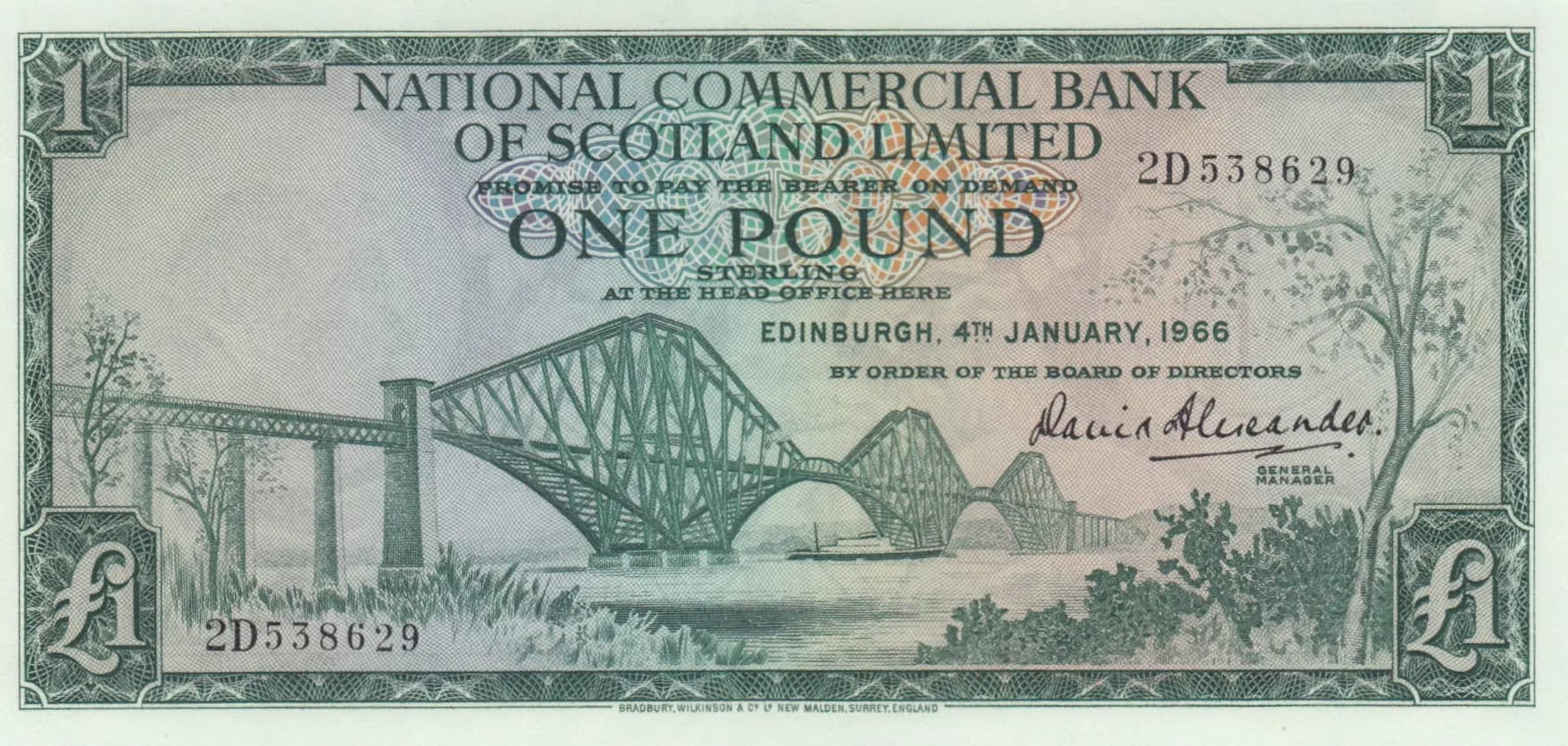
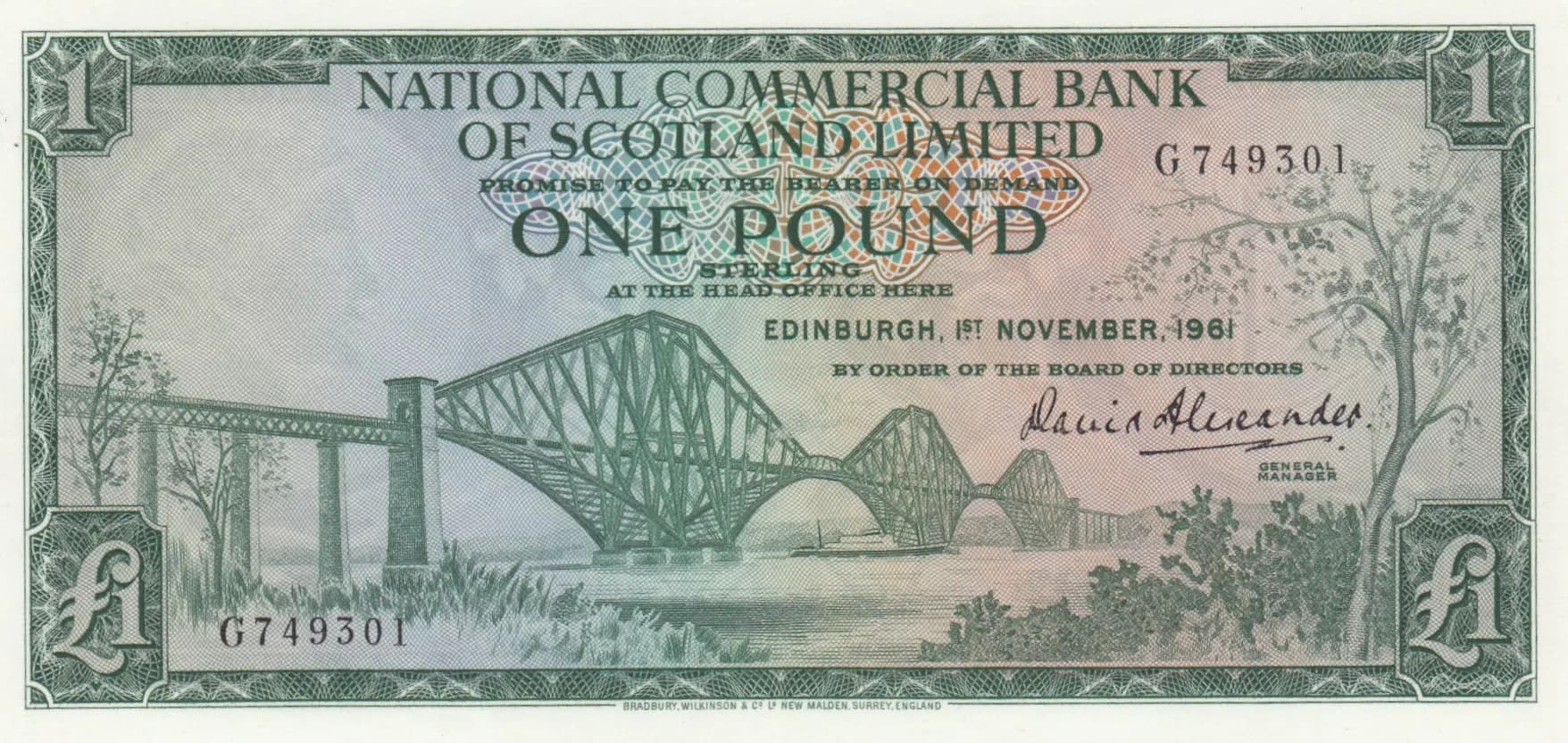
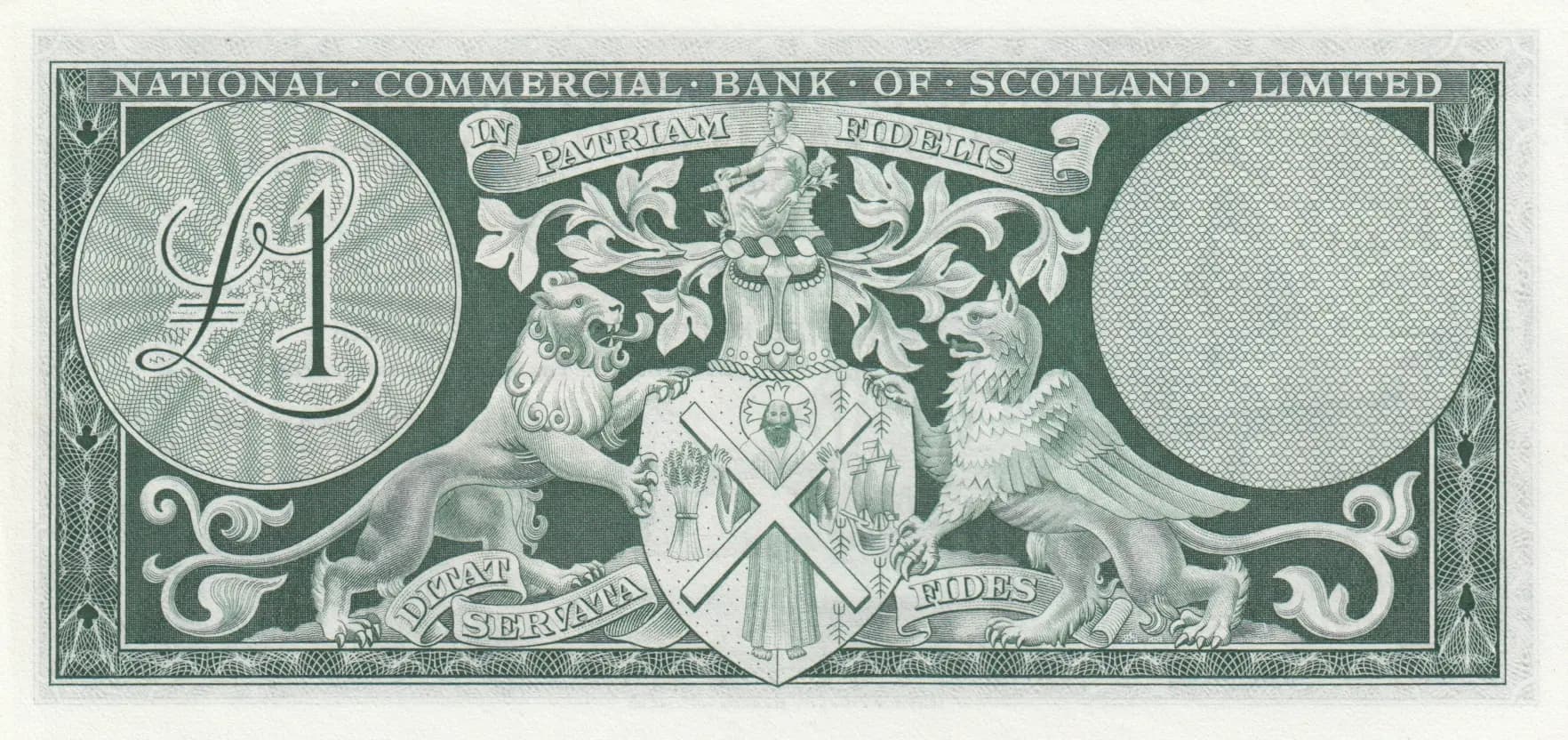
An exceptional example of the National Commercial Bank of Scotland Limited's 1961 one pound note in uncirculated condition, featuring the iconic Forth Railway Bridge rendered in fine detail on the obverse. The note displays crisp, clean surfaces with no visible wear, creases, or soiling, making it an attractive specimen for collectors. The green and multicolor design showcases the bank's heraldic coat of arms on the reverse, with this particular variety notable for the absence of sorting bars on the back, distinguishing it from later issues.
Common. The circulation period for this issue spanned 1961-1966, and the National Commercial Bank of Scotland was a major issuer with substantial print runs. Contemporary eBay market data shows uncirculated examples selling for $12-$60, with median prices around $20-25, and regular sales activity, all indicators of a common banknote. The absence of any documented print run limitations, short-lived status, or recall issues further supports a 'common' classification.
Issued in 1961, this banknote represents a period when the National Commercial Bank of Scotland maintained its own note-issuing privileges, a right granted to Scottish banks under British law. The prominent depiction of the Forth Railway Bridge, completed in 1890 and one of Scotland's most celebrated engineering achievements, underscores Scottish industrial pride during the early 1960s. The Latin motto 'PAVEPATAM' (They have prepared the way) and 'SERVATA FIDES' (Faith Preserved) on the reverse reflect the bank's conservative values and its role in Scotland's commercial life during this period.
The obverse features the Forth Railway Bridge, the great steel cantilever bridge spanning the Firth of Forth near Edinburgh, depicted in exceptional architectural detail in the center-right portion of the note. A large ornamental numeral '1' appears in the left margin, with denomination text 'ONE POUND STERLING' prominently centered. Ornamental cartouches containing the pound sterling symbol (£) occupy all four corners. The reverse displays the coat of arms of the National Commercial Bank of Scotland, a heraldic composition featuring a lion supporter on the left and an eagle supporter on the right, flanking a shield with a cross design. Above the arms is the banner 'PAVEPATAM,' while below are inscribed 'SERVATA' (left) and 'FIDES' (right). The design is framed by elaborate decorative scrollwork, flourishes, and botanical elements. Both sides employ fine line engraving with complex geometric patterns in the background for security purposes.
FRONT: 'NATIONAL COMMERCIAL BANK OF SCOTLAND LIMITED' (bank name); 'PROMISE TO PAY THE BEARER ON DEMAND' (standard banknote promise); 'ONE POUND STERLING' (denomination); 'AT THE HEAD OFFICE HERE' (redemption location); 'EDINBURGH, 1ST NOVEMBER, 1961' (date and place of issue); 'BY ORDER OF THE BOARD OF DIRECTORS' (authorization statement); 'GENERAL MANAGER' (signature designation); Serial number 'G749301'; 'BRADBURY, WILKINSON & Co Ltd, NEW MALDEN, SURREY, ENGLAND' (printer attribution). BACK: 'NATIONAL · COMMERCIAL · BANK · OF · SCOTLAND · LIMITED' (bank name); 'PAVEPATAM' (Latin: 'They have prepared the way'); 'SERVATA' (Latin: 'Preserved/Maintained'); 'FIDES' (Latin: 'Faith/Trust').
Steel plate engraving (intaglio printing). The printer, Bradbury, Wilkinson & Company Ltd. of New Malden, Surrey, England, was a renowned security printing firm specializing in high-quality banknote production. The fine line engraving, detailed architectural rendering of the Forth Bridge, intricate heraldic work, and complex geometric security patterns visible throughout the note are characteristic of the intaglio printing process, which was the standard for banknote production during this era.
This specimen represents Pick 269a, specifically the variety without sorting bars on the back, as noted in the catalog reference. A later variety (Pick 271) introduced sorting bars on the reverse as a security enhancement. Serial number observed: G749301. The date of issue is 1st November 1961, within the authorized issuance period of 1961-1966. The General Manager signature position is consistent with the standard design of this issue.