5000 rublei 1920
About This Note
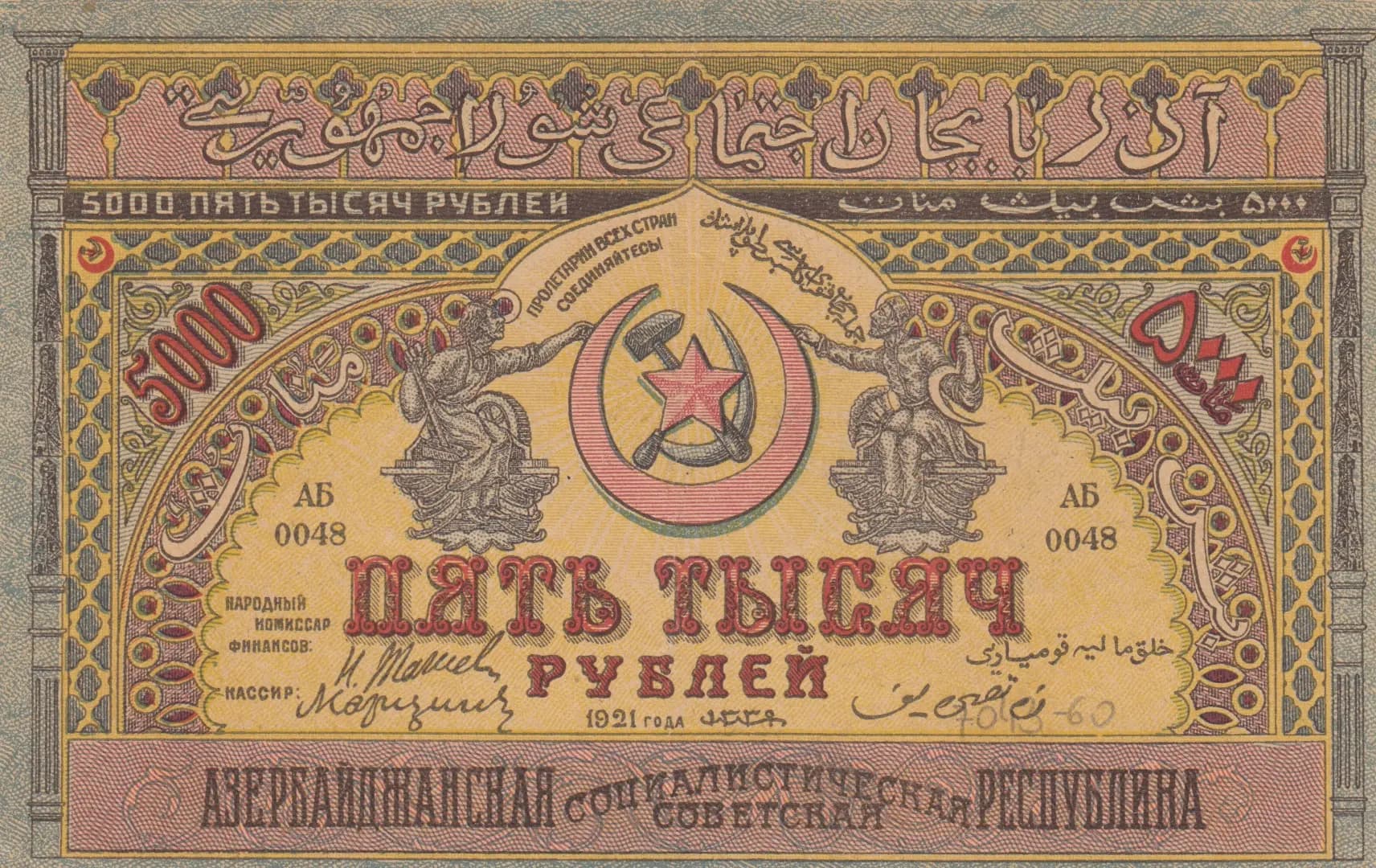
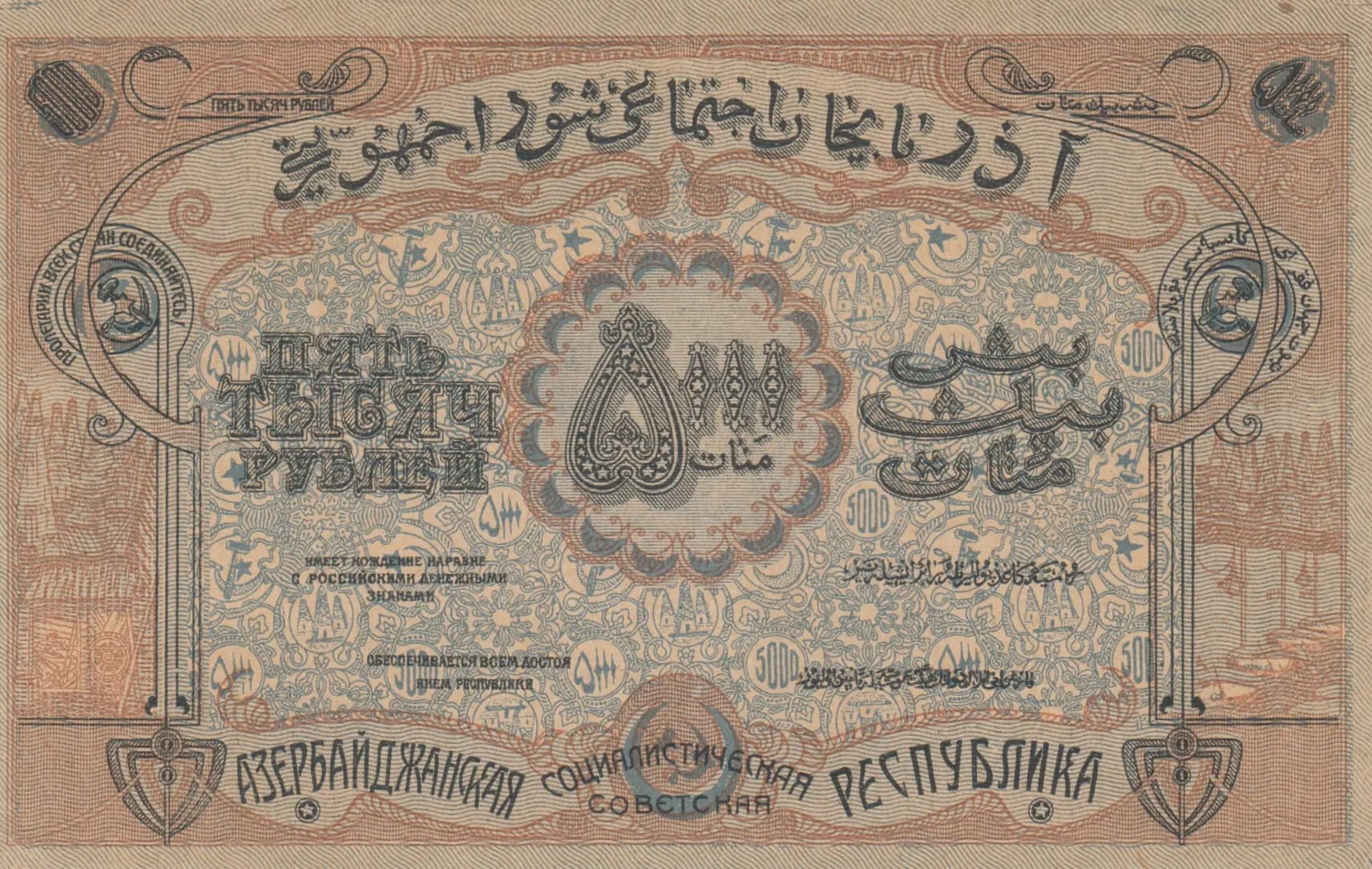
This is an exceptional example of the Azerbaijan S.S.R. 5000 Rublei from 1920 (Pick S713), graded EF, showcasing the early Soviet aesthetic during the revolutionary period. The obverse features a striking central motif of a hammer and sickle within a crescent moon, flanked by winged allegorical figures, rendered in warm yellow, brown, and red tones with intricate ornamental borders. The reverse displays an elaborate Islamic-influenced paisley medallion with fine geometric and floral patterns, reflecting Azerbaijan's cultural heritage within the Soviet framework. Despite age-appropriate wear and minor color fading, the note retains excellent clarity with well-defined engraving throughout, making it a collectible example of early Transcaucasian Soviet currency.
common
This note was issued during the consolidation of Soviet power in the South Caucasus, specifically by the Azerbaijan Soviet Socialist Republic following the 1920 incorporation into the Soviet Union. The imagery combines Soviet revolutionary symbolism—the hammer and sickle with its star—alongside traditional Islamic ornamental design, reflecting Azerbaijan's dual identity during this transitional period. The inscription 'Workers of all countries unite' and explicit designation for the civilian population underscore the propagandistic intent of early Soviet currency, while the inclusion of Arabic script and Oriental geometric patterns acknowledge the local Muslim population being integrated into the Soviet state.
The obverse features a sophisticated neoclassical-Soviet design centered on the Soviet state emblem: a hammer and sickle contained within a crescent moon, topped with a five-pointed star, symbolizing the unity of industrial workers and peasants under communist ideology. This emblem is flanked by two winged allegorical female figures in the classical tradition, representing victory, revolution, and the liberation promised by the Soviet state. The composition is enclosed within elaborate ornamental borders featuring yellow, brown, and red colors with fine decorative scrollwork and geometric patterns. The reverse showcases a prominent teardrop or paisley-shaped central medallion filled with intricate Islamic geometric and floral patterns in tan and dark gray, reflecting Azerbaijani artistic traditions. Corner elements include circular seal medallions and decorative shield designs. The bilingual approach (Cyrillic and Arabic script) was deliberate, serving the ethnically diverse population of the newly formed Soviet republic. The overall aesthetic bridges European neoclassical design principles with Central Asian and Islamic decorative traditions.
OBVERSE: '5000 ПЯТЬ ТЫСЯЧ РУБЛЕЙ' (5000 Five Thousand Rubles) | 'СУММА БУКВА ЦИФРОЮ ВЫРАЖЕНА' (Amount expressed in letters and figures) | 'ОТ ВСЕХ СТРАН ПРОЛЕТАРИЕВ ОБЪЕДИНЯЙТЕСЬ' (Workers of all countries, unite!) | '1921 ГОДА' (Year 1921) | 'НАРОДНЫЙ КОМИССАР ФИНАНСОВ' (People's Commissar of Finance) | 'КАССИР' (Cashier) | Serial number 'АБ 0048'. REVERSE: 'ПЯТЬ ТЫСЯЧ РУБЛЕЙ' (Five Thousand Rubles) | 'ДЛЯ ГРАЖДАНСКОГО НАСЕЛЕНИЯ СОВЕТСКОЙ РЕСПУБЛИКИ' (For the civilian population of the Soviet Republic) | 'АЗЕРБАЙДЖАНСКАЯ СОВЕТСКАЯ РЕСПУБЛИКА' (Azerbaijan Soviet Socialist Republic) | Arabic script inscription at top [specific translation unclear from available image detail].
This note was produced using engraved intaglio printing (copperplate), evident from the fine, precise line work visible throughout both obverse and reverse. The multiple layers of intricate parallel lines creating shading effects, the crisp definition of ornamental borders, and the complexity of the geometric patterns in the reverse's central medallion are characteristic of high-quality intaglio engraving. The color separation and distinct tonal variations suggest multiple printing passes or careful register work. Azerbaijani Soviet notes of this period were typically printed by Russian state security printers, likely the State Printing Works in Moscow or Petrograd, which maintained the technical infrastructure for currency production during the early Soviet period.
The serial number 'АБ 0048' indicates this is from an early printing batch (АБ prefix). Known varieties for Pick S713 include different signature combinations for the People's Commissar of Finance and Cashier positions; this example appears to bear the signature of Sокольnikov (Sokolnikov), who held the Finance Commissariat position during 1921-1926. Variety assessment would require comparison with documented signature combinations in the Pick catalog or specialized Soviet currency references. No overprints or significant alterations are visible on this example.