500 rublei 1918
“Rostov”
About This Note
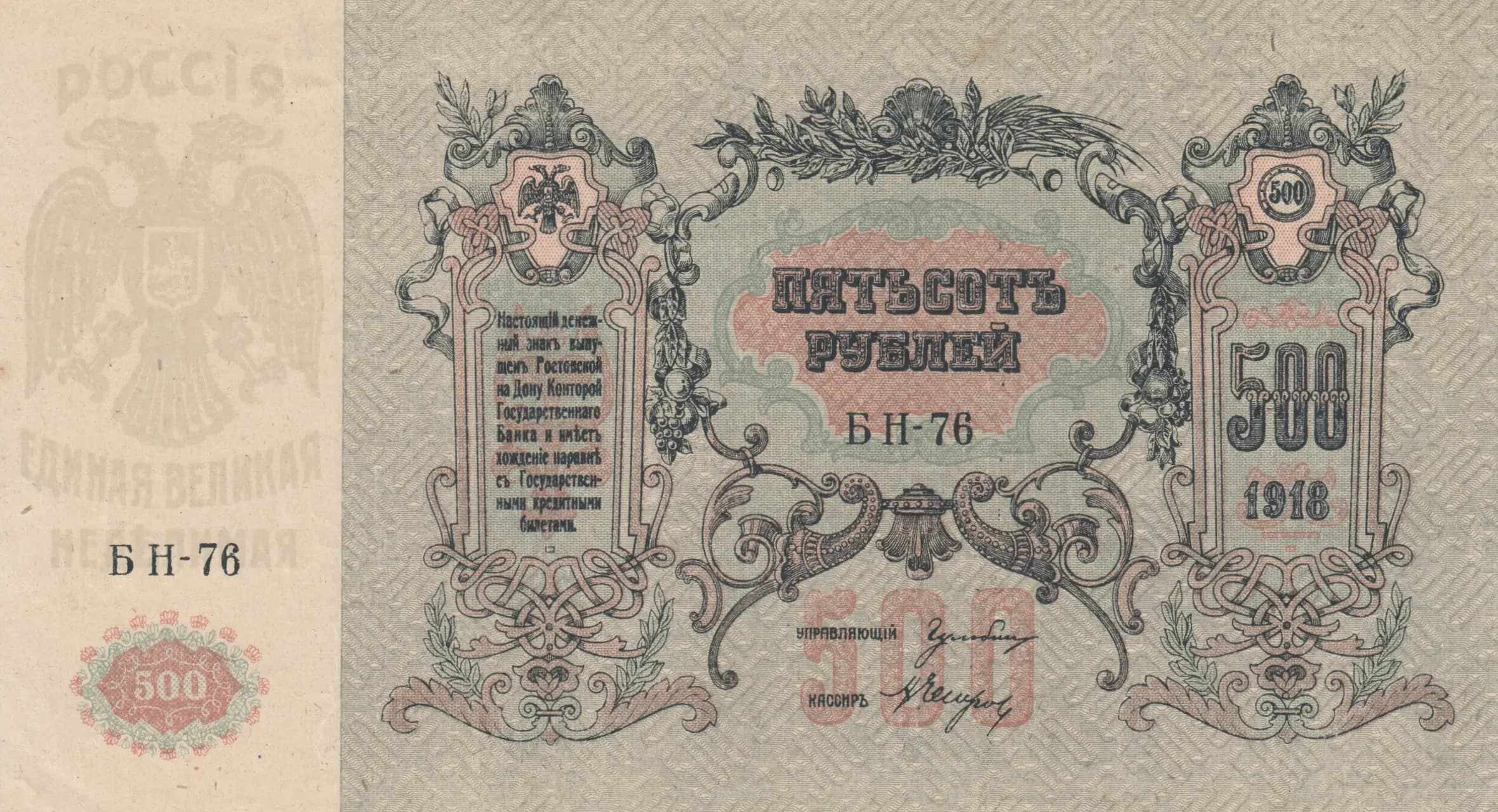
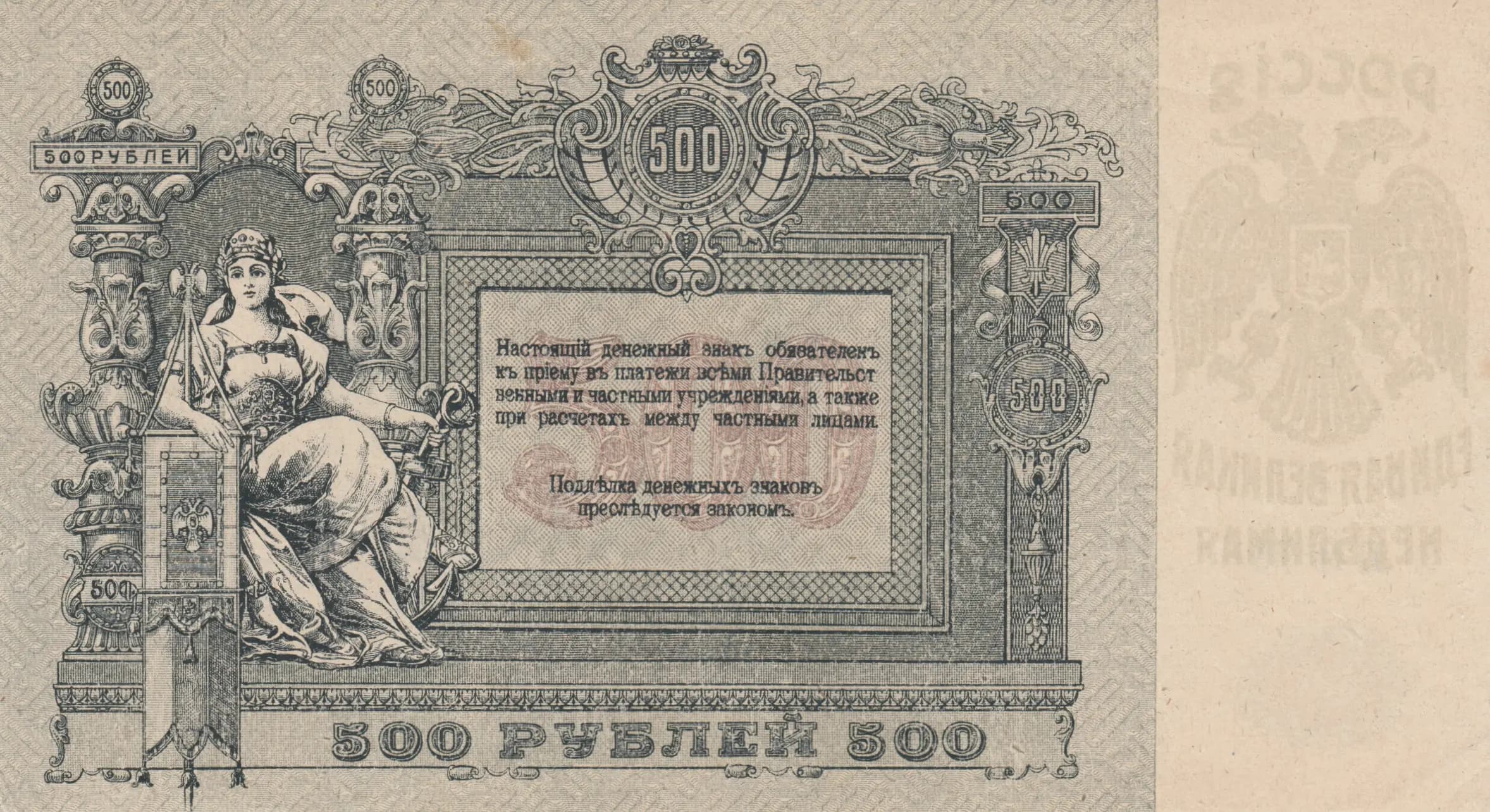
This is an AU-graded 500 Rublei banknote from 1918, issued by the Rostov State Bank Branch during the tumultuous early Soviet period. The note displays exceptional detail in its fine line engraving with ornate baroque-style borders, double-headed imperial eagles, and a classical allegorical female figure on the reverse, all rendered in black ink with red and green accents on aged beige paper. Despite some age-related yellowing and edge wear consistent with AU condition, the crisp engraving quality and historical significance of this regional Russian Civil War-era currency make it a notable collector's piece.
Uncommon. While 1918 Russian banknotes are not particularly rare in general circulation denominations, the Rostov State Bank Branch issue (Pick S415c) represents a specific regional variant with limited geographic distribution. The Rostov branch's limited operational period during the Civil War and the eventual political defeat of White Army-held territories in southern Russia constrained print runs and survival rates. Additionally, the AU condition grade places this example in the upper tier of surviving specimens, as many Civil War-era Russian notes survive in lower grades due to heavy circulation or storage in poor conditions. The combination of regional issuer, high denomination, and excellent preservation makes this a moderately desirable variant for Russian Civil War currency specialists.
Issued in 1918 during the Russian Civil War, this banknote represents the transitional monetary chaos of the early Soviet period, when regional State Bank branches maintained some autonomy in currency issuance before centralization. The retention of imperial heraldic symbols—particularly the double-headed eagle—reflects the ambiguous political status of this issue, as old imperial designs were still in use alongside new Soviet monetary systems. The Rostov branch issue is specifically significant as Rostov was a major center of White Army resistance, making currency from this issuer particularly scarce and historically meaningful.
The obverse features a symmetrical layout with ornate baroque-style decorative borders framing the central denomination text. Flanking the central cartouche are pairs of double-headed imperial eagles (Romanov heraldic emblems) with laurel wreaths and elaborate scrollwork, indicating this note predates the formal adoption of purely Soviet symbolism. The reverse displays a classical allegorical female figure (representing Liberty, Justice, or State Authority in the Imperial Russian tradition) seated in classical drapery, positioned to the left of an ornate Corinthian column with acanthus leaf capital—both architectural elements drawn from neoclassical design traditions of late Imperial Russian currency. The central reverse features a large rectangular frame with geometric lattice patterns containing the legal text, with circular denomination badges marked '500' positioned at cardinal points for easy verification. The overall design vocabulary reflects late Imperial Russian banknote aesthetics adapted for the transitional Civil War period.
FRONT SIDE: 'ПЯТЬ СОТЪ РУБЛЕЙ' (Five Hundred Rubles) - main denomination text; 'БН-76' (Serial designation BN-76); '1918' (Year of issue); '500' (Numeric denomination). BACK SIDE: 'Настоящий денежный знак обязателен к приёму в платежи всеми Правительственными и частными учреждениями, а также при расчетах между частными лицами.' (This banknote is obligatory for acceptance in payment by all Government institutions and private institutions, as well as in settlements between private persons.) 'Подделка денежных знаков преследуется законом.' (Counterfeiting of banknotes is prosecuted by law.) '500 РУБЛЕЙ 500' (500 Rubles 500) - denomination repeated for verification.
This note was produced using classical intaglio engraving (steel plate engraving) and letterpress printing, evidenced by the crisp, fine-line detail work visible throughout the ornamental borders, guilloche patterns, and facial features of the allegorical figure. The multi-color printing (black primary engraving with red and green accents) suggests sequential plate printing typical of Russian State Bank currency production of this era. For Rostov branch issues of 1918, production likely occurred at regional facilities under State Bank supervision, as centralized Moscow printing was disrupted by Civil War conditions.
This example is catalogued as Pick S415c(1), with the serial designation 'БН-76' visible on the obverse. The specific variety designation (1) likely indicates the first variety within this Pick number classification, potentially distinguishing it by printer, signature varieties, or overprint characteristics. The absence of visible overprints or additional markings suggests this is an unoverprinted issue directly from the Rostov State Bank Branch. Russian Civil War banknotes are known for multiple varieties even within single Pick numbers due to rapid printing changes and sourcing of materials from various printers; collectors should verify serial number prefixes and any subtle design variations against specialized Russian Civil War currency references for precise variety identification.