5 rublei 1920
About This Note
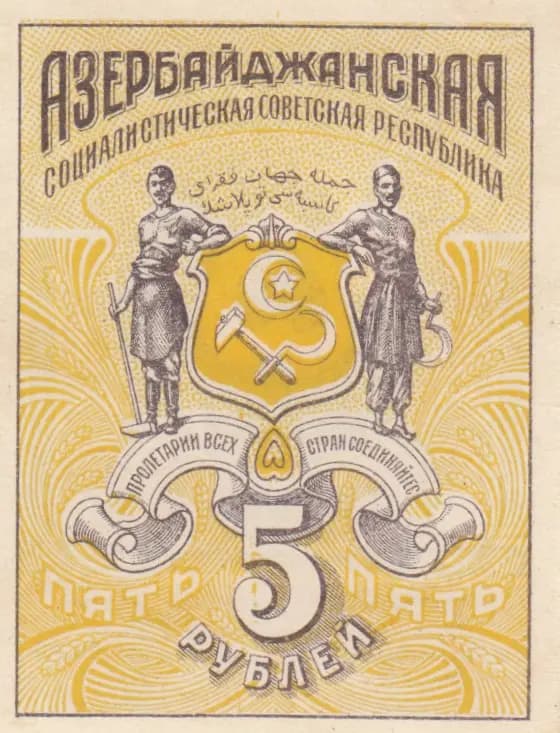
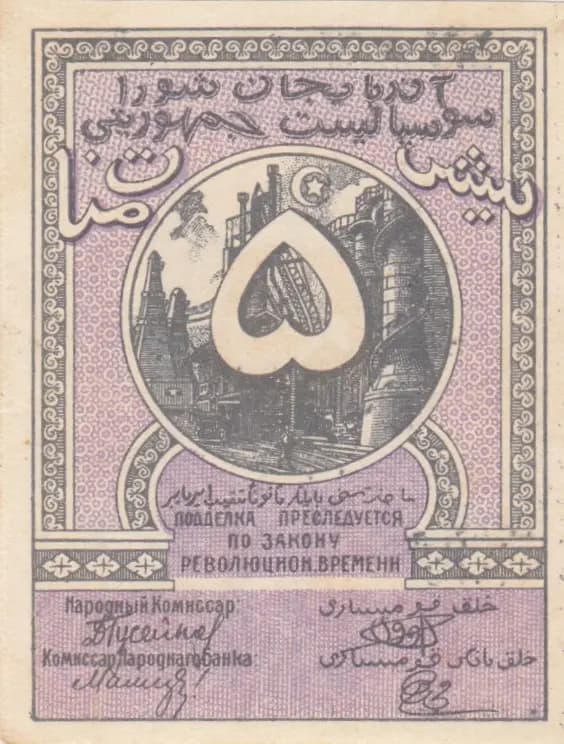
This is an exceptionally well-preserved uncirculated example of the Azerbaijan S.S.R. 5 rublei from 1920 (Pick S709a), featuring stunning bilingual design with Russian and Persian/Arabic inscriptions reflecting the early Soviet period's approach to minority republics. The obverse displays a magnificent golden-yellow background with a central shield containing hammer, sickle, and star symbols flanked by allegorical female figures, while the reverse showcases Islamic architectural imagery with a crescent-and-star emblem in mauve tones, symbolizing the Islamic cultural heritage of Azerbaijan. The sharp printing, vibrant colors, and complete absence of wear make this an excellent example of early Soviet banknote design during the transitional period of the Azerbaijan Socialist Soviet Republic.
Uncommon to Scarce. The Azerbaijan S.S.R. 5 rublei of 1920 (Pick S709a) was issued during a brief transitional period in Azerbaijan's monetary history (1920-1922), before consolidation into the All-Union ruble system. The issuing authority had a short operational lifespan, and print runs for regional Soviet issues of this era were typically more limited than later standard Soviet notes. Additionally, the specific bilingual design and regional character make this note less commonly encountered than contemporary Moscow-issued notes. In uncirculated condition, this note is genuinely scarce, as most surviving examples show evidence of circulation or storage deterioration. The confluence of early date, regional issuer, limited circulation period, and excellent preservation grade places this example in the scarce category for serious collectors.
This banknote was issued during a pivotal moment in Azerbaijan's history, when the region transitioned from the short-lived Azerbaijan Democratic Republic (1918-1920) to Soviet control under the Azerbaijan S.S.R. (1920-1922). The bilingual Russian-Persian/Arabic inscriptions and the blend of Bolshevik symbolism (hammer and sickle) with Islamic architectural and crescent-star motifs reflect the Soviet Union's early attempts to reconcile communist ideology with local cultural and religious traditions in the Caucasus. The 1920 date places this note at the very beginning of Soviet monetary authority in Azerbaijan, making it a rare snapshot of a transitional period before the establishment of the more uniform All-Union ruble system.
The obverse features a striking yellow-golden background with elaborate ornamental scrollwork as the foundation. The central design is dominated by a shield containing the symbols of early Soviet power: a hammer and sickle crossed over a gear or similar industrial symbol, with a five-pointed star positioned above. This shield is flanked by two female allegorical figures representing labor and/or the triumph of the revolution. A crescent and star symbol appears at the apex of the shield, incorporating Islamic iconography into the Soviet design. The denomination '5' appears in large numerals at the bottom center. The reverse presents an architectural vignette within a circular frame set against a mauve-purple background. This vignette depicts Islamic architecture characteristic of the Caucasus region, with visible minarets and domed structures suggestive of Baku or other major Azerbaijani cities. A prominent spade or heart-shaped symbol with a crescent and star is positioned centrally, serving as a heraldic emblem of the Azerbaijan S.S.R. The entire reverse is enclosed in an ornamental border frame with scrollwork, and authoritative inscriptions from the People's Commissariat of the People's Bank are positioned above and below the central image.
FRONT SIDE: 'АЗЕРБАЙДЖАНСКАЯ СОЦИАЛИСТИЧЕСКАЯ СОВЕТСКАЯ РЕСПУБЛИКА' (Azerbaijani Socialist Soviet Republic); 'حقوق دولت اسلام' (Rights of the Islamic State - Persian/Arabic); 'ПЯТЬ РУБЛЕЙ' (Five Rubles); denomination numeral '5'. BACK SIDE: 'Подделма преследуется по закону революционной времени' (Counterfeiting is prosecuted by law of the revolutionary period); 'Народный Комиссар Комиссариата народного банка' (People's Commissar of the People's Bank Commissariat); 'خلق قوم نواینده حق قوم بانك كمسر' (People's Representative / People's Bank Commissariat - Persian/Arabic).
The banknote was produced using intaglio (engraved) printing, evidenced by the fine line printing visible in background patterns, sharp registration of ornamental details, and the precise execution of the complex allegorical and architectural vignettes. The fine line work in both the ornamental borders and background areas is characteristic of high-security intaglio production. For this 1920 Azerbaijan issue, printing was likely conducted by Soviet state security printers, possibly at facilities in Moscow or Baku, employing traditional copperplate engraving techniques with multi-color printing to achieve the distinct color separation between the golden-yellow obverse and mauve-purple reverse.
This example is catalogued as Pick S709a, representing the standard issue of the 5 rublei denomination for the Azerbaijan S.S.R. in 1920. No specific signature varieties, overprints, or date variations are apparent in this uncirculated specimen. The note exhibits the primary design of the 1920 Azerbaijan issue without apparent secondary varieties such as different watermarks, security overprints, or signature block variations that might distinguish other Pick numbers within this series. Serial numbers and any printer's marks, if present, are not clearly legible in the provided visual analysis, but the UNC condition and design consistency indicate this is a standard first-emission example of Pick S709a.