3 rublja 1905
“Sig.Rodionov”
About This Note
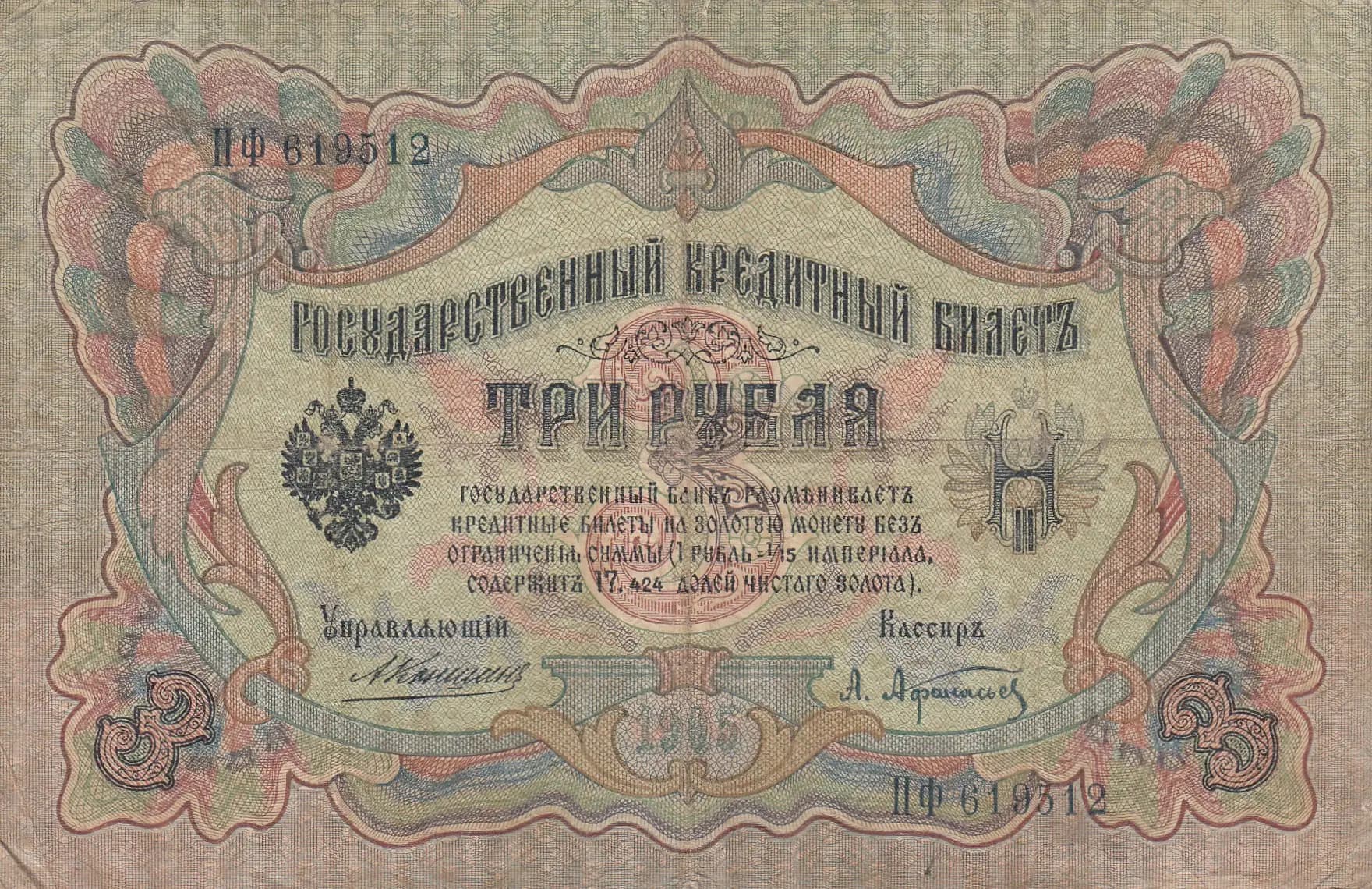
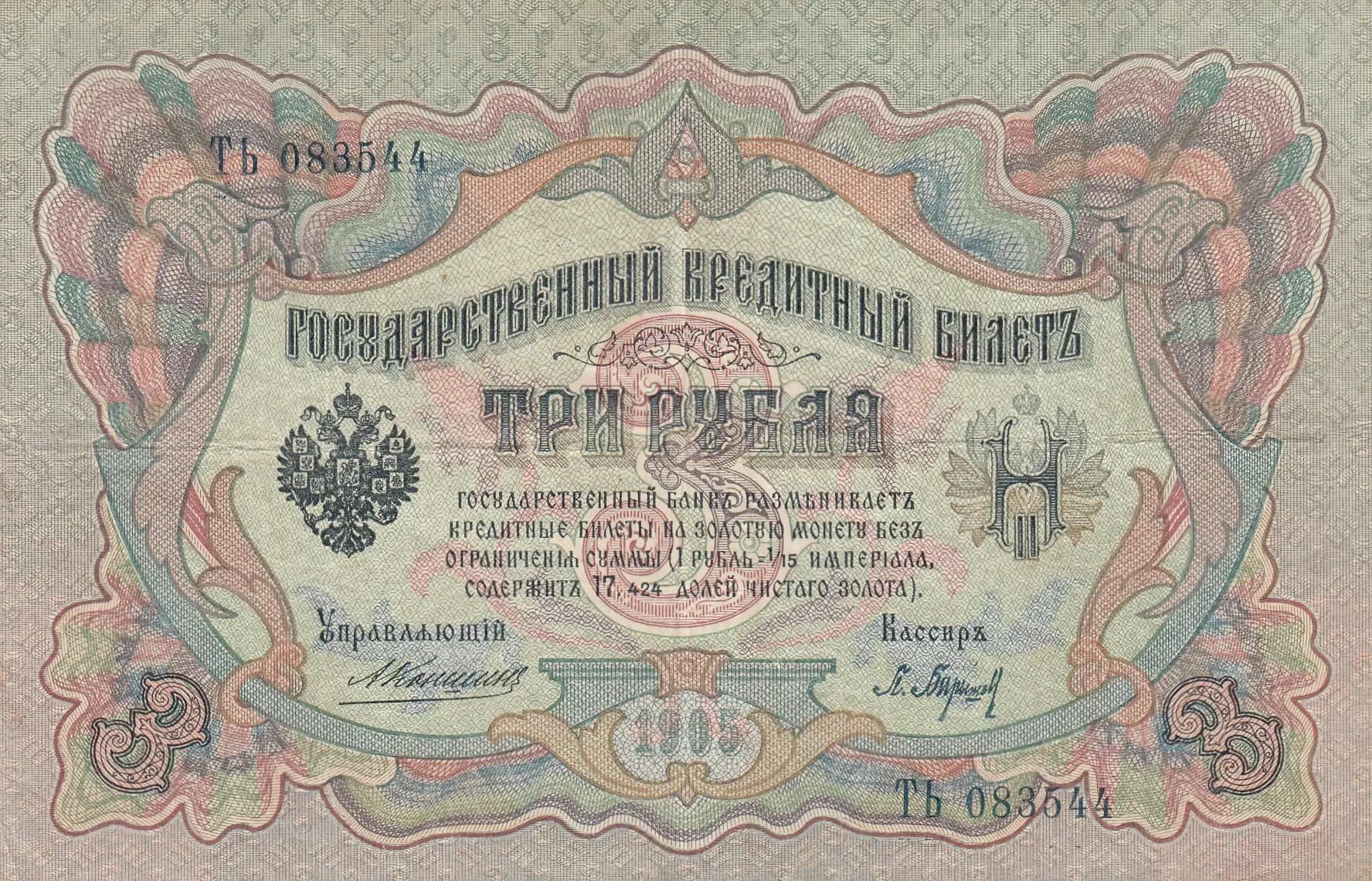
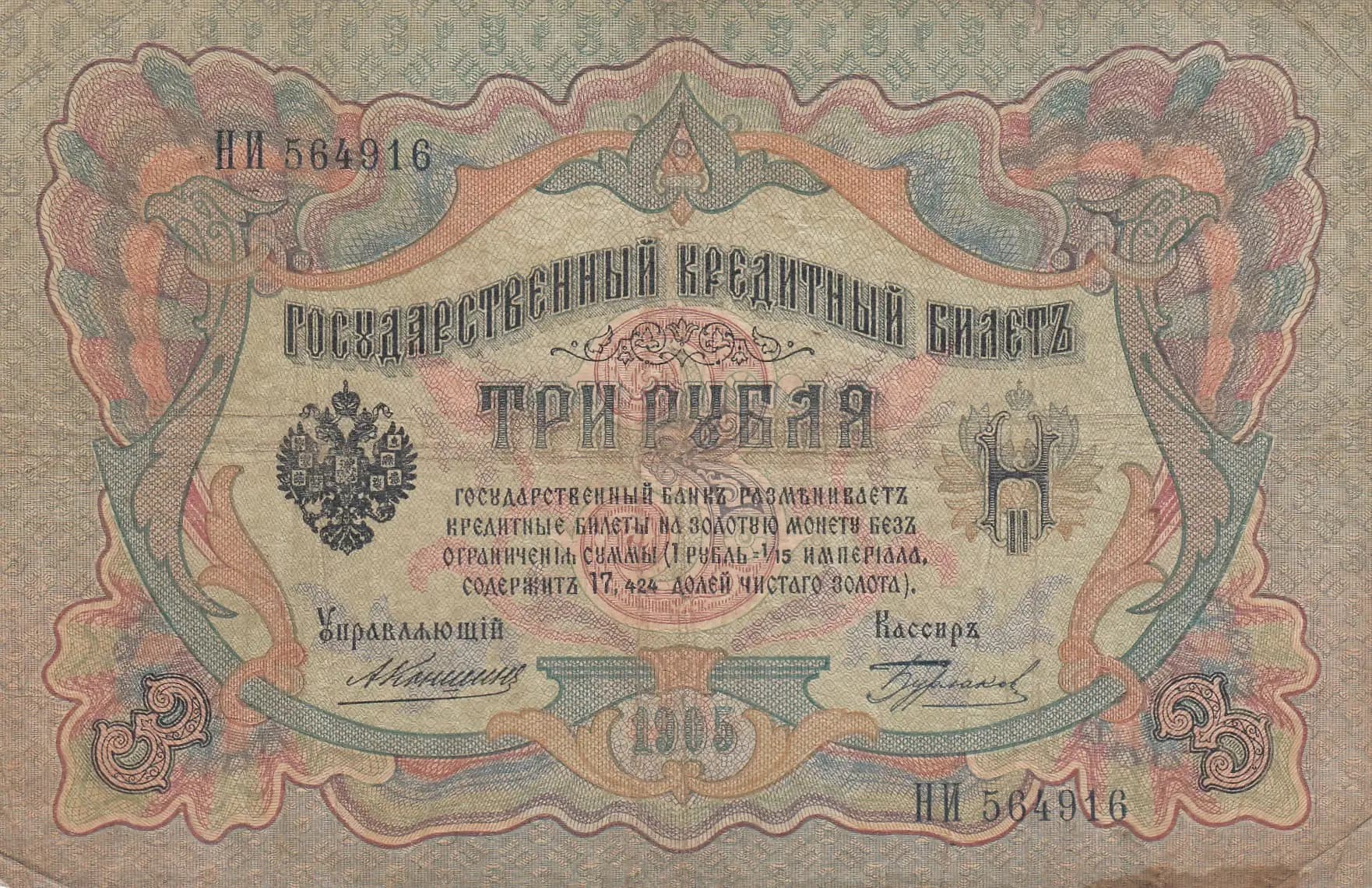
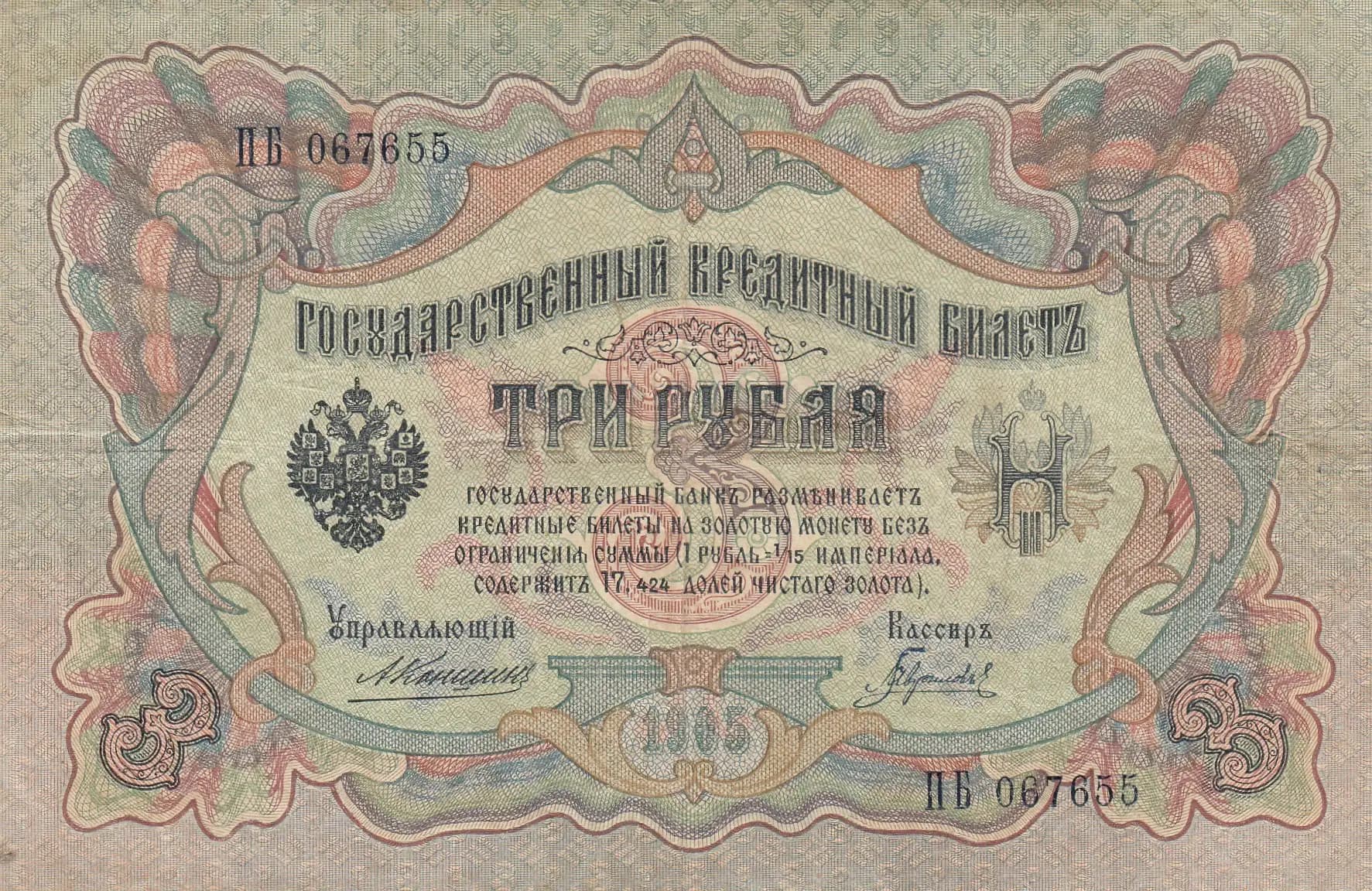
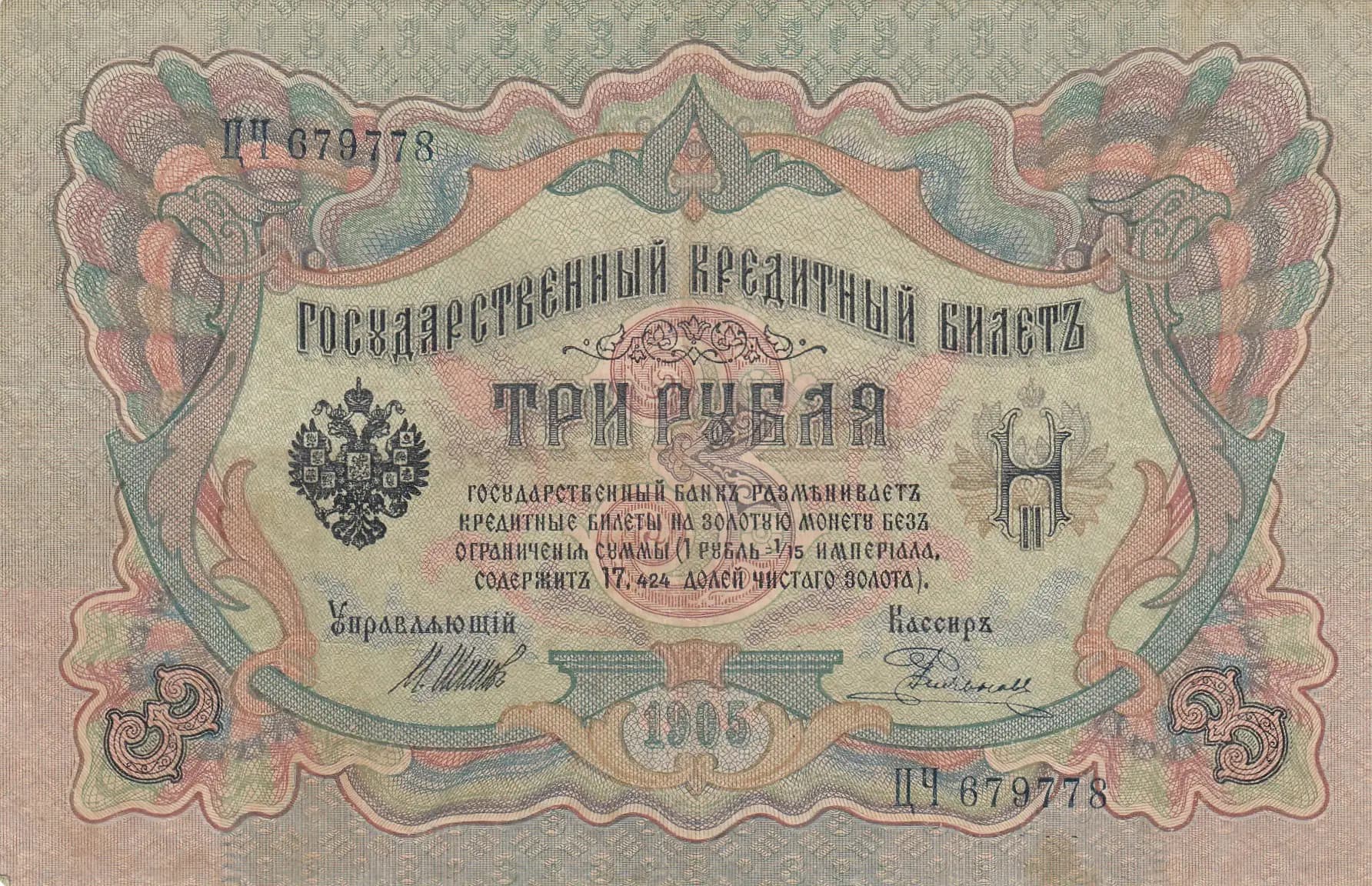
This VF-graded 3 Ruble note from 1905 represents a classical example of Russian Imperial credit currency at the height of the gold standard era. The banknote displays the characteristic ornate design of early 20th-century Russian State Credit Notes, with intricate multi-color engraving in pink, green, and tan tones framing the Imperial double-headed eagle. The note shows honest age-related wear including creasing and minor foxing consistent with historical circulation, while maintaining legible text and vibrant color separation that speaks to its quality engraving and preservation.
Common. The 3 Ruble denomination from 1905 (Pick 9c) was issued in substantial quantities as a standard circulating denomination of the Russian State Bank. No specific print run restrictions, short-term issuance, or known recalls apply to this Pick number. The VF condition grade and signature variety (Rodionov) are typical of notes that have entered the collector market from historical circulation. While early Russian Imperial notes have appreciation potential as historical artifacts, this specific Pick number remains commonly available in the numismatic market.
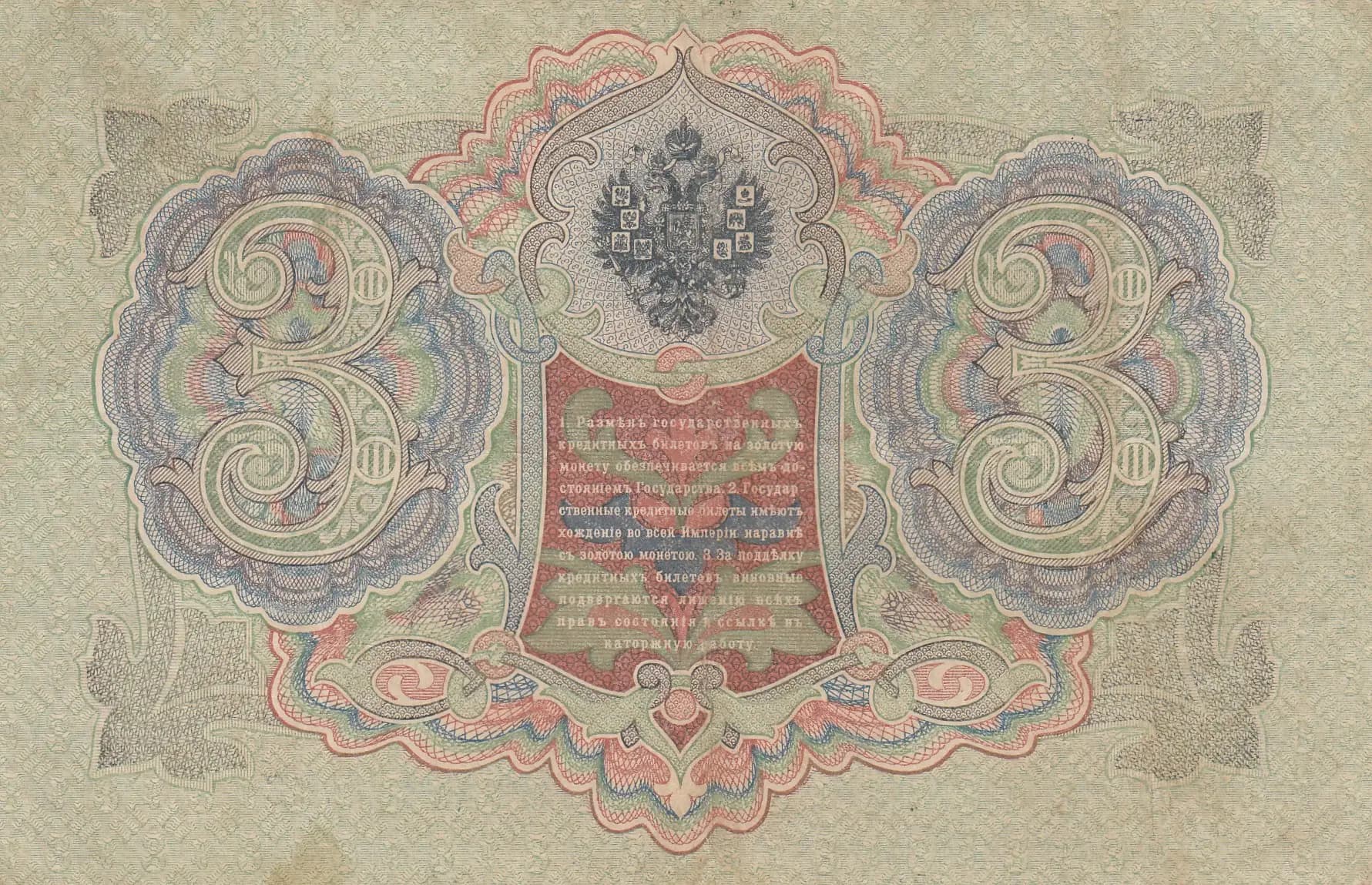
Issued during the reign of Tsar Nicholas II under the reformed monetary system established by Finance Minister Sergei Witte, this 1905 note represents the Russian Empire's commitment to gold-backed currency stability following the Monetary Reform of 1895. The elaborate legal text on the reverse explicitly references the April 29, 1895 law establishing the gold standard, promising direct exchangeability for gold coin (with 1 ruble equal to 1/15 of an Imperial gold coin containing 17.424 grains of pure gold). The Imperial coat of arms dominating both sides symbolized the state's monetary authority and the backing of imperial sovereignty behind the currency itself.
The 3 Ruble note showcases the Imperial Russian State Bank's design standard for mid-denomination currency. The obverse features the Imperial Russian double-headed eagle coat of arms positioned on the left side, surrounded by an elaborate baroque-style ornamental frame composed of geometric guilloche patterns, scrollwork, and flourishes in the characteristic pink, green, and tan color palette. The reverse presents a more heraldic composition, with two large ornamental spiral medallions flanking a central cartouche containing the Imperial double-headed eagle with crown, all integrated within an architectural frame of baroque scrollwork. Text panels occupy the lower portions of both sides, with the reverse containing the detailed legal text regarding the gold exchange guarantee. No portraits appear on this denomination, reflecting the Russian tradition of heraldic rather than portraiture-based designs for credit notes of this era.
FRONT SIDE: Serial number 'ПГ 679778' appears in top and bottom corners. Central text reads 'ГОСУДАРСТВЕННЫЙ КРЕДИТНЫЙ БИЛЕТ' (State Credit Note) and 'ТРИ РУБЛЯ' (Three Rubles). The major inscription states: 'The State Bank exchanges credit notes for gold coin without limitation of amount (1 ruble=1/15 of an imperial, containing 17.424 grains of pure gold).' Signature lines are labeled 'справляющий' (Acting [official]) and 'кассир' (Cashier). BACK SIDE: Extensive legal text reading: 'Class of State Credit Notes. In accordance with the law of April 29, 1895, credit notes can be exchanged for gold coins, valued in accordance with Article 2 of the State Regulation. Credit notes are in circulation throughout the empire on par with gold coins. In the treasury office, credit notes are automatically subject to removal of all torn and worn edges in accordance with the regulations.'
This note was produced using steel-plate engraving and multi-color letterpress printing, evidenced by the fine line detail visible in the guilloche patterns, the precise color separation between the pink, green, tan, and black inks, and the crisp definition of ornamental elements. The State Security Printing Works (Экспедиция Заготовления Государственных Бумаг) in St. Petersburg was the primary printer for Russian Imperial currency during this period. The complexity and sophistication of the engraved security patterns—including the intricate spiral medallions, geometric borders, and fine linework—represent the security standards of the Imperial monetary system and were designed to prevent counterfeiting through the extraordinary technical skill required to reproduce such work.
This note bears the signature of Rodionov as one of the authorized officials (either in the 'справляющий'/Acting or 'кассир'/Cashier capacity). Russian Imperial credit notes from 1905 exist with multiple signature combinations as different officials held these positions throughout the year. The serial number prefix 'ПГ' indicates the production series; variations in letter prefixes and numbering sequences denote different print runs. The Pick 9c(8) designation itself indicates this is variety 8 within the 9c classification, likely referring to a specific signature or serial number combination. Further research into Russian Imperial State Bank records would be necessary to precisely identify which official position Rodionov held and whether this represents a scarce signature variety.