3 rublja 1905
“Sig.Y.Metz”
About This Note
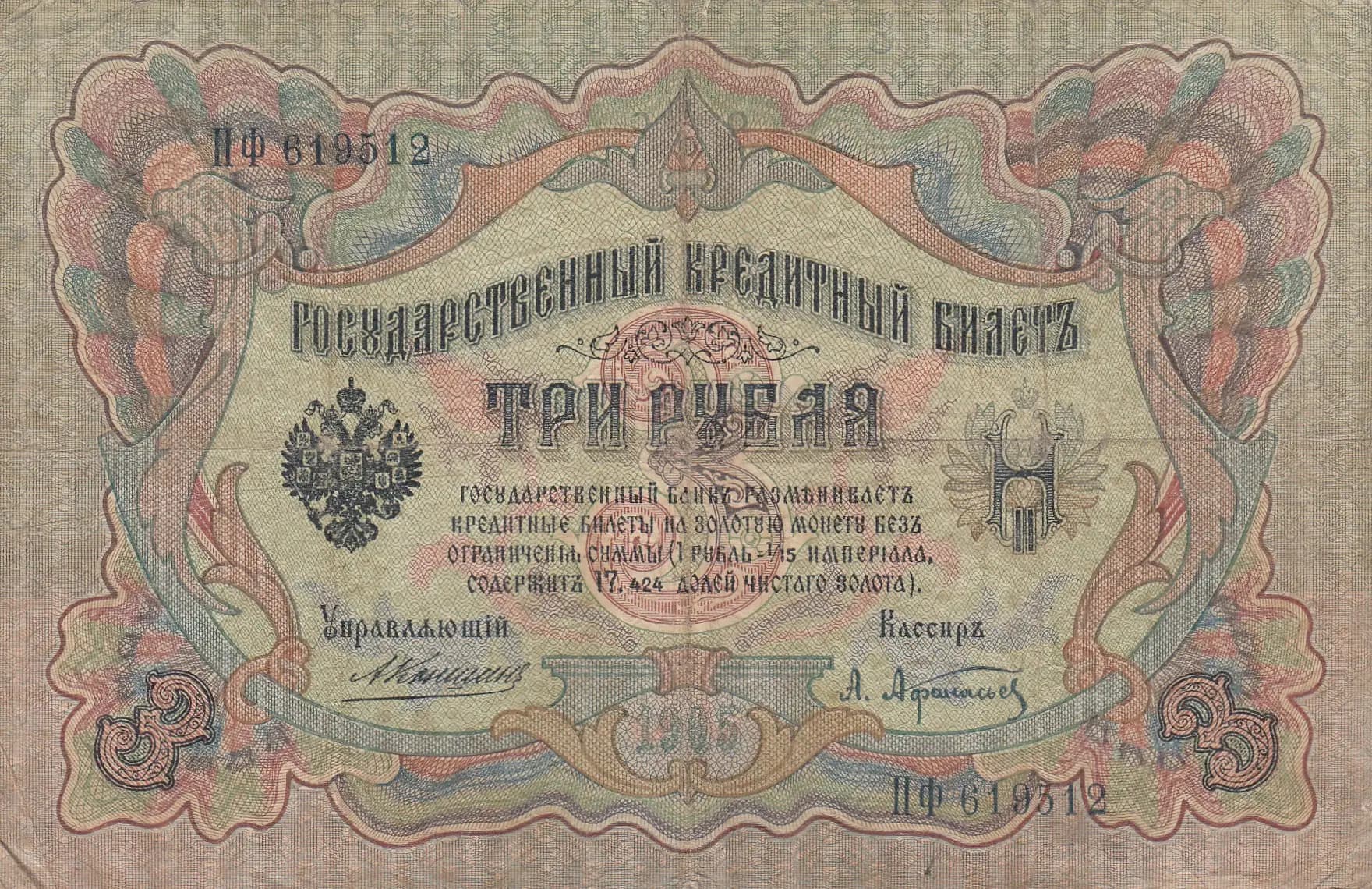
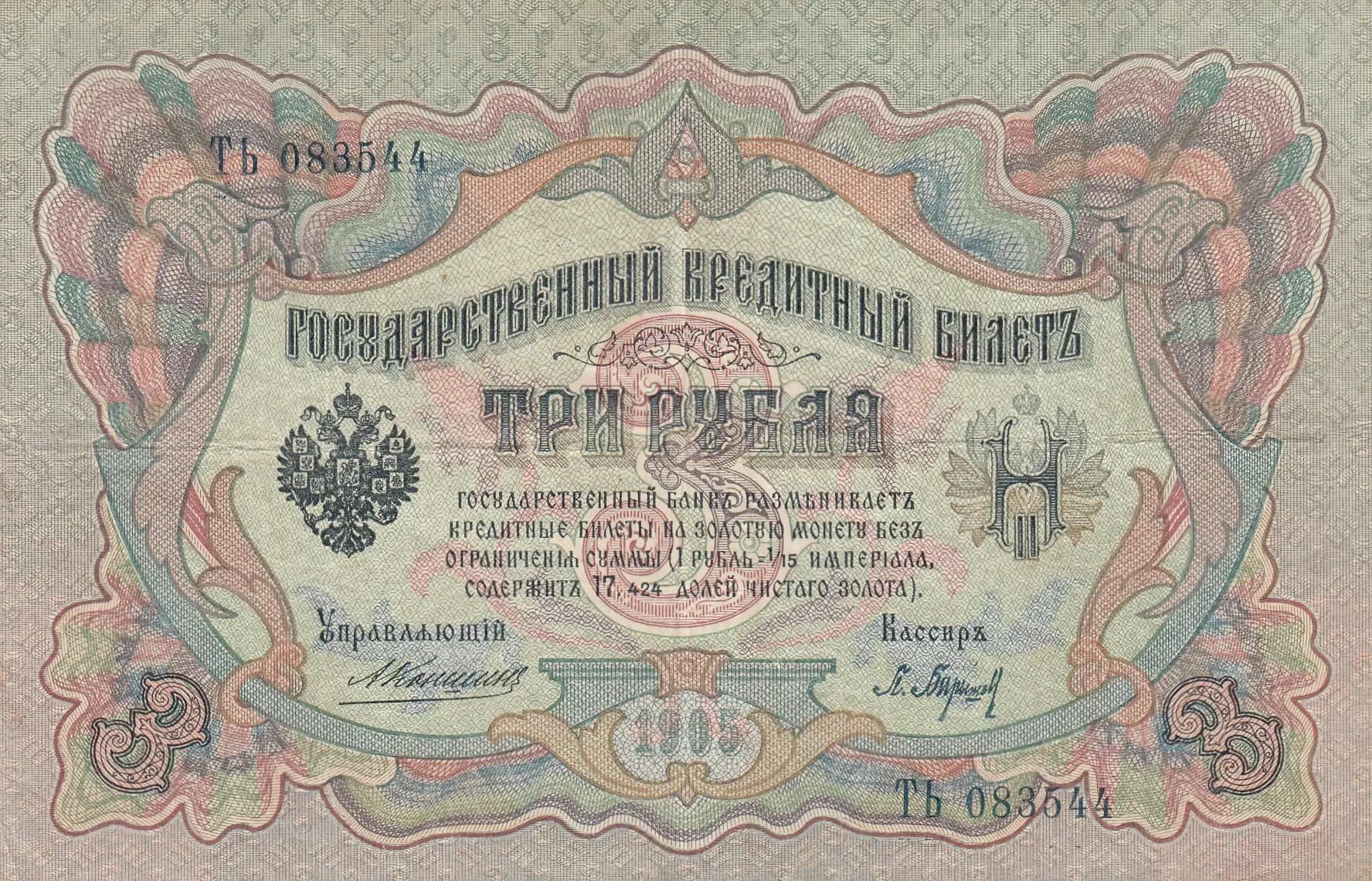
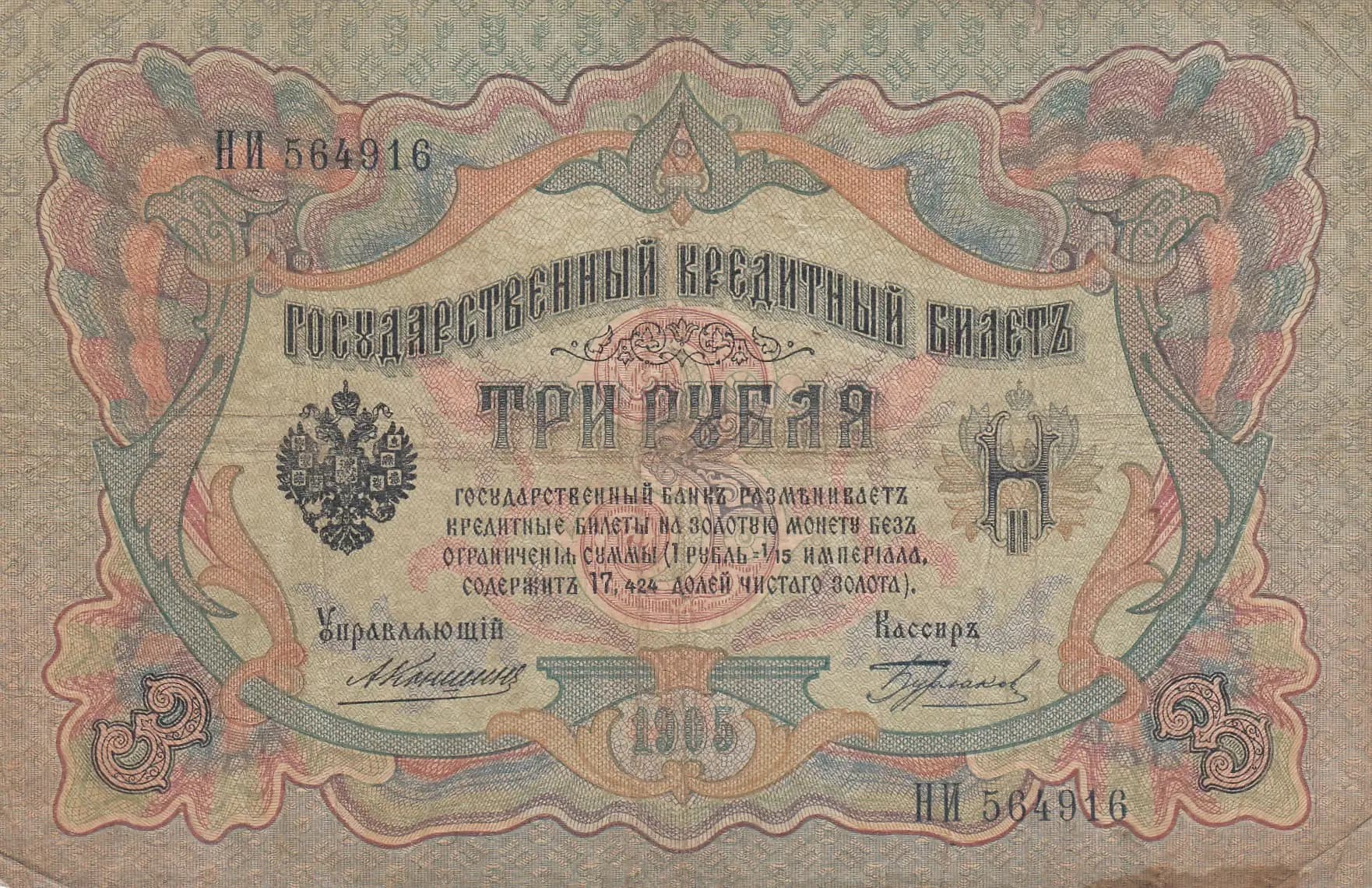
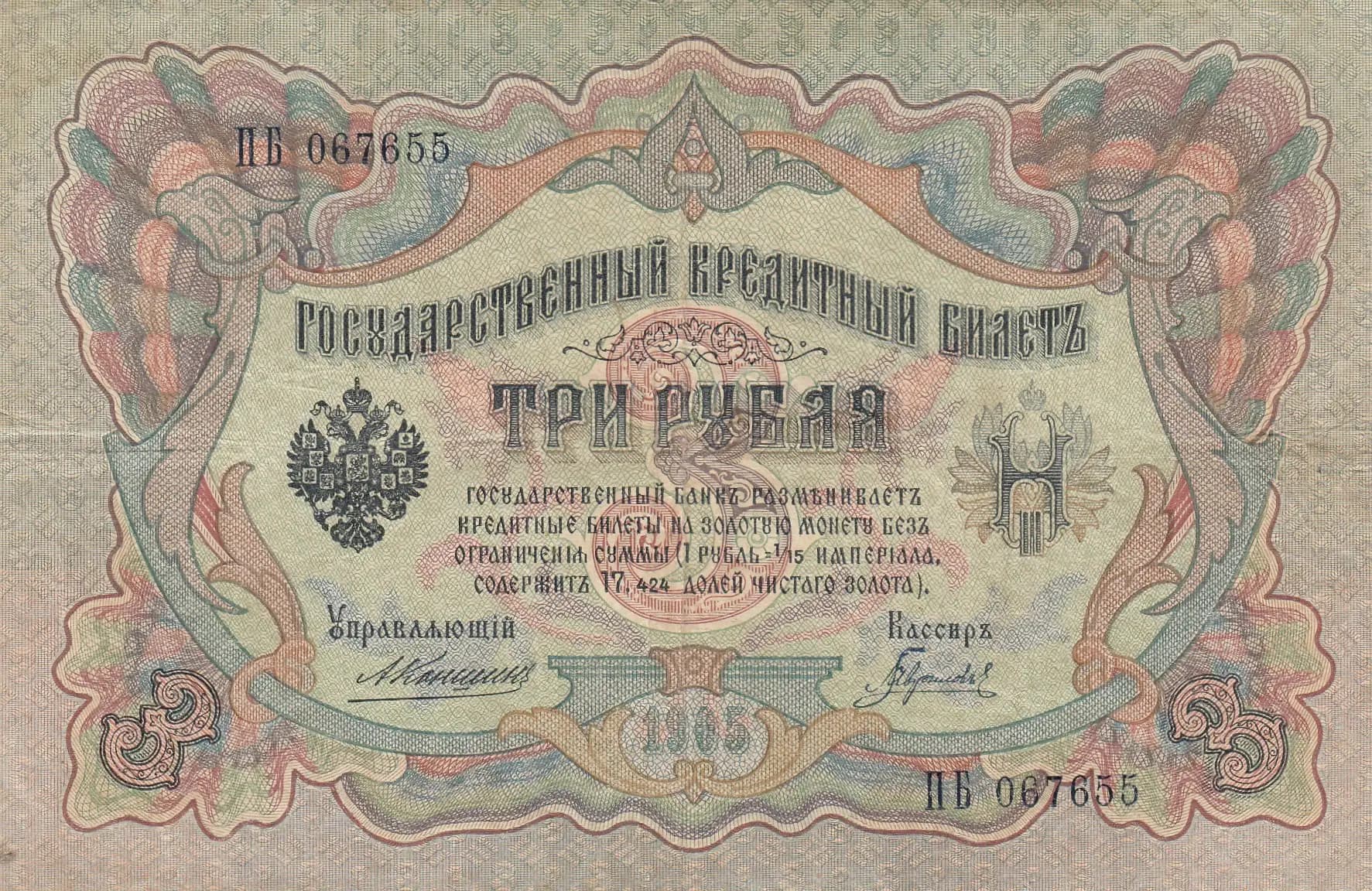
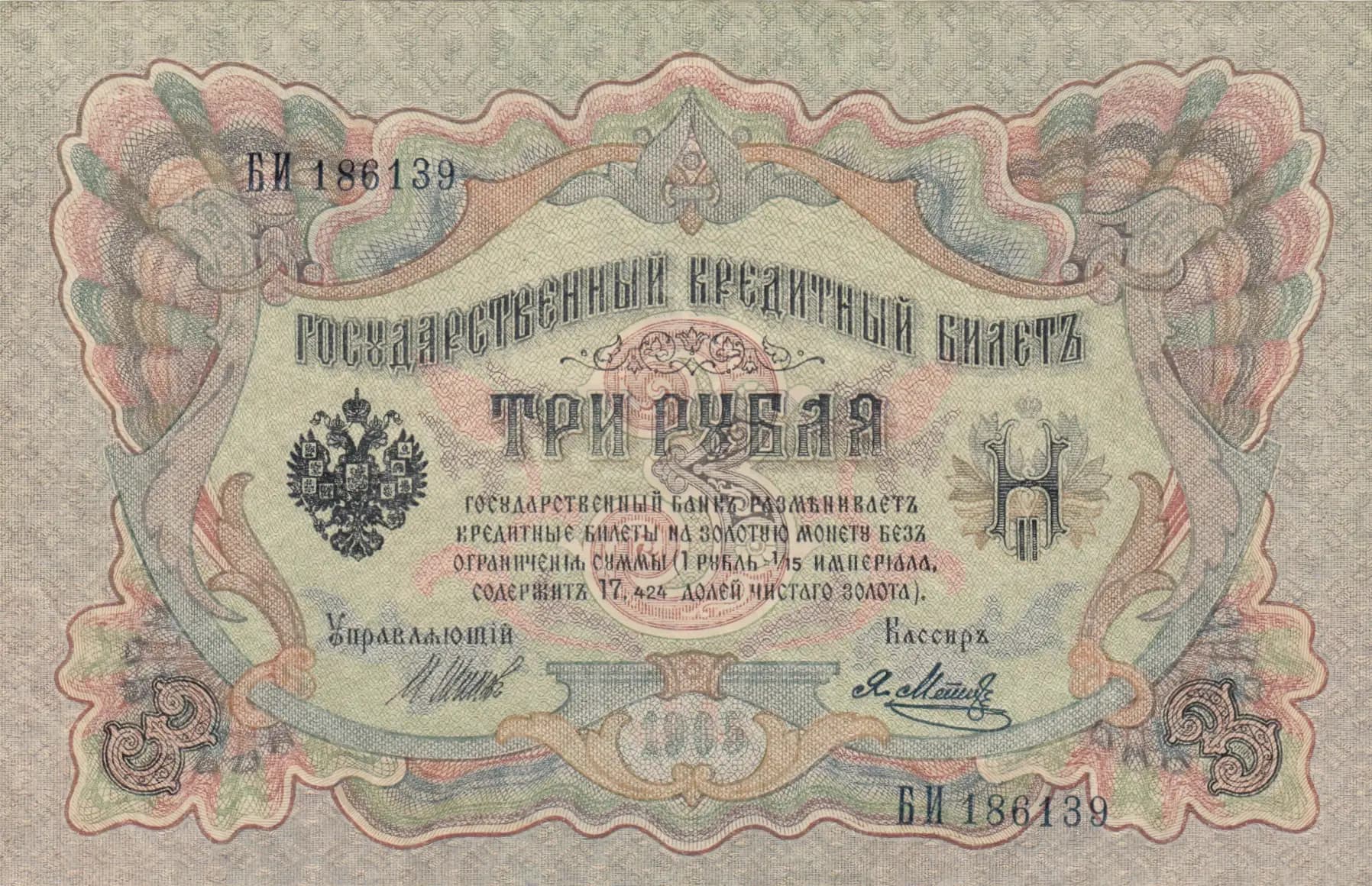
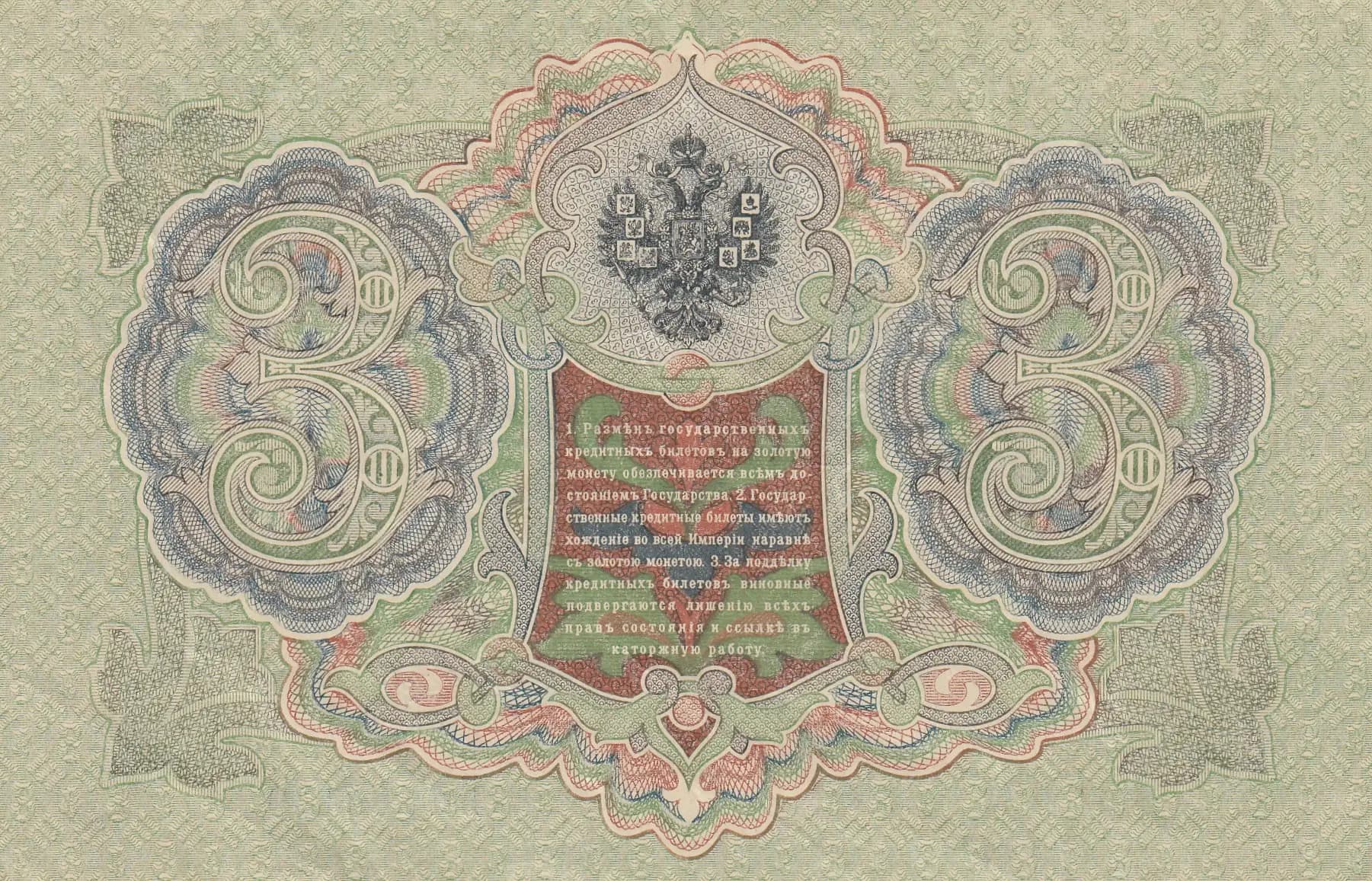
A handsome example of the Russian Imperial 3 Rubles State Credit Note from 1905, displaying the characteristic ornate design of the Tsarist era with fine engraving throughout. The note presents in VF condition with excellent color preservation—the cream, pink, and green palette remains vibrant—and exhibits sharp, clear printing with no significant wear, tears, or foxing. The dual-sided design prominently features the Russian Imperial double-headed eagle and extensive decorative scrollwork, making this a visually striking representative of early 20th-century Russian numismatics with the notable Y. Metz signature.
Common. The 3 Rubles denomination from 1905 was issued in substantial quantities as a widely-circulating medium denomination of the Russian Imperial monetary system. The Pick catalog designation P-9c(5) indicates this is a well-documented variety within a large series. No evidence suggests limited print runs, early recall, or scarcity in the market. While individual examples in VF condition command modest collector interest, notes from this series regularly appear in auctions and dealer inventories, confirming common status. The Y. Metz signature does not appear to be from a rare signature combination for this note type.
Issued during the final decades of Tsarist Russia, this 1905 credit note reflects the State Bank's gold-backed currency system established under the Witte Reforms, as explicitly stated in the lengthy inscription on the front describing the gold standard backing (1 ruble = 1/15 of an Imperial, containing 17.424 parts pure gold). The Imperial double-headed eagle with crown and regalia, prominently displayed on both front and back, symbolized the authority of the Russian Empire at a turbulent moment—1905 marked the Revolution and the Russo-Japanese War. The ornate engraved design and multiple signature lines represent the formal security standards of imperial financial institutions.
This note exemplifies the high security engraving standards of Russian Imperial currency. The front features an elaborate central oval cartouche containing denominational and issuer text, flanked by two signature lines designated for the Manager (Управляющий) and Cashier (Кассир) of the State Bank. The reverse is dominated by the Russian Imperial double-headed eagle with crown, scepter, and orb—the heraldic symbol of the Romanov dynasty—positioned centrally and surrounded by symmetrical decorative cartouches and scrollwork. Both sides employ extensive fine-line engraving with cross-hatching, spiral patterns, and floral flourishes in cream, pink, green, and brown tones. The serial number "BI 186139" appears in opposite corners (top left and bottom right on the front), a standard anti-counterfeiting practice. No portraits are featured on this denomination; instead, the Imperial eagle serves as the primary identifying symbol. The overall design reflects the formal, bureaucratic aesthetic of late Tsarist financial instruments.
FRONT SIDE: "БИ 186139" (Serial number BI 186139); "ГОСУДАРСТВЕННЫЙ КРЕДИТНЫЙ БИЛЕТ" (State Credit Note); "ТРИ РУБЛЯ" (Three Rubles); "ГОСУДАРСТВЕННЫЙ БАНК РАЗМЕЩИВАЕТ КРЕДИТНЫЕ БИЛЕТЫ НА ЗОЛОТО МОНЕТЫ БЕЗ ОГРАНИЧЕНИЯ СУММЫ (1 РУБЛЬ = 1/15 ИМПЕРИАЛА, СОДЕРЖИТ 17,424 ДОЛЕЙ ЧИСТОГО ЗОЛОТА)." (The State Bank issues credit notes backed by gold coins without limit of sum [1 ruble = 1/15 of an Imperial, containing 17.424 parts of pure gold]); "УПРАВЛЯЮЩИЙ" (Manager/Director); "КАССИР" (Cashier). BACK SIDE: "Размен государственных кредитных билетов на золотую монету производится всеми золотоискательными государственного... Государственного казначейства кредитные билеты имеют хождение по всей Империи наравне с золотою монетою. За подделку, подлог, изменение... ссылке в каторжную работу." (Exchange of state credit notes for gold coins is carried out by all gold exchange offices of the State Treasury. State Treasury credit notes circulate throughout the Empire equally with gold coins. For counterfeiting, forgery, alteration, [penalties including] exile to hard labor.)
Intaglio engraving (steel plate engraving), the dominant security printing method for Russian Imperial credit notes. The visual characteristics—fine line work, complex cross-hatching, sharp detail reproduction, and the ability to render minute text with precision—are all consistent with professional engraved steel plate production. Russian Imperial notes of this period were typically produced by the State Printing Works in St. Petersburg (Печатный двор) or contracted to specialized security printers. The multi-color printing (cream base with pink, green, and brown inks) suggests separate plate passes for each color layer, a standard practice in high-security intaglio work of the era.
This example is identified as Pick P-9c(5), indicating it belongs to the 1905 issue with the specified signature variety (Y. Metz). The serial number prefix "БИ" (BI in Latin transliteration) and the sequential numbering "186139" represent the standard practice for this issuing period. Known varieties of the 1905 3 Rubles note include different signature combinations of State Bank officials; the Y. Metz signature appears on multiple known examples. This particular note does not exhibit visible overprints, date variations, or other distinguishing marks that would denote a rare or limited variety within the P-9c(5) classification.