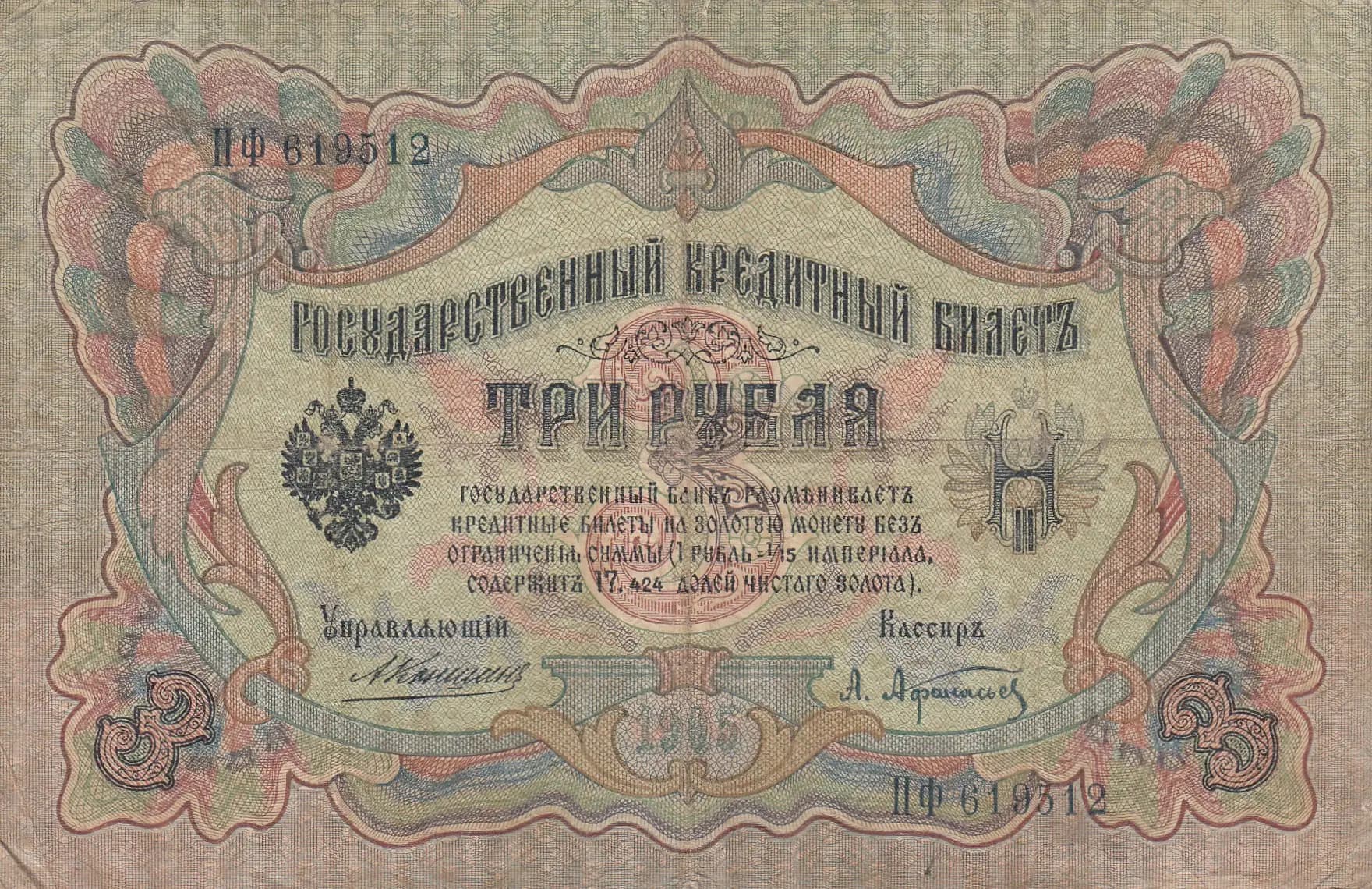
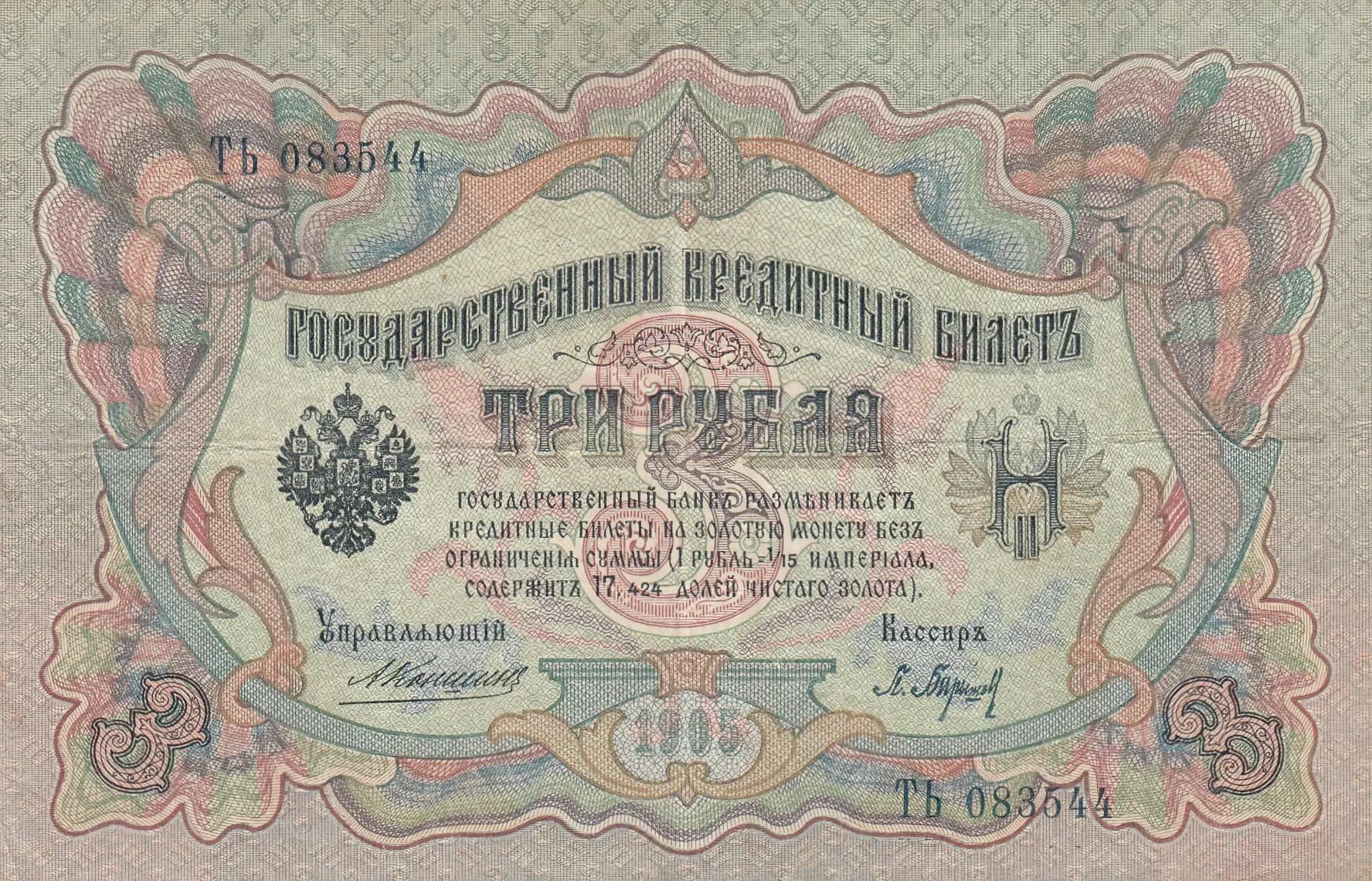
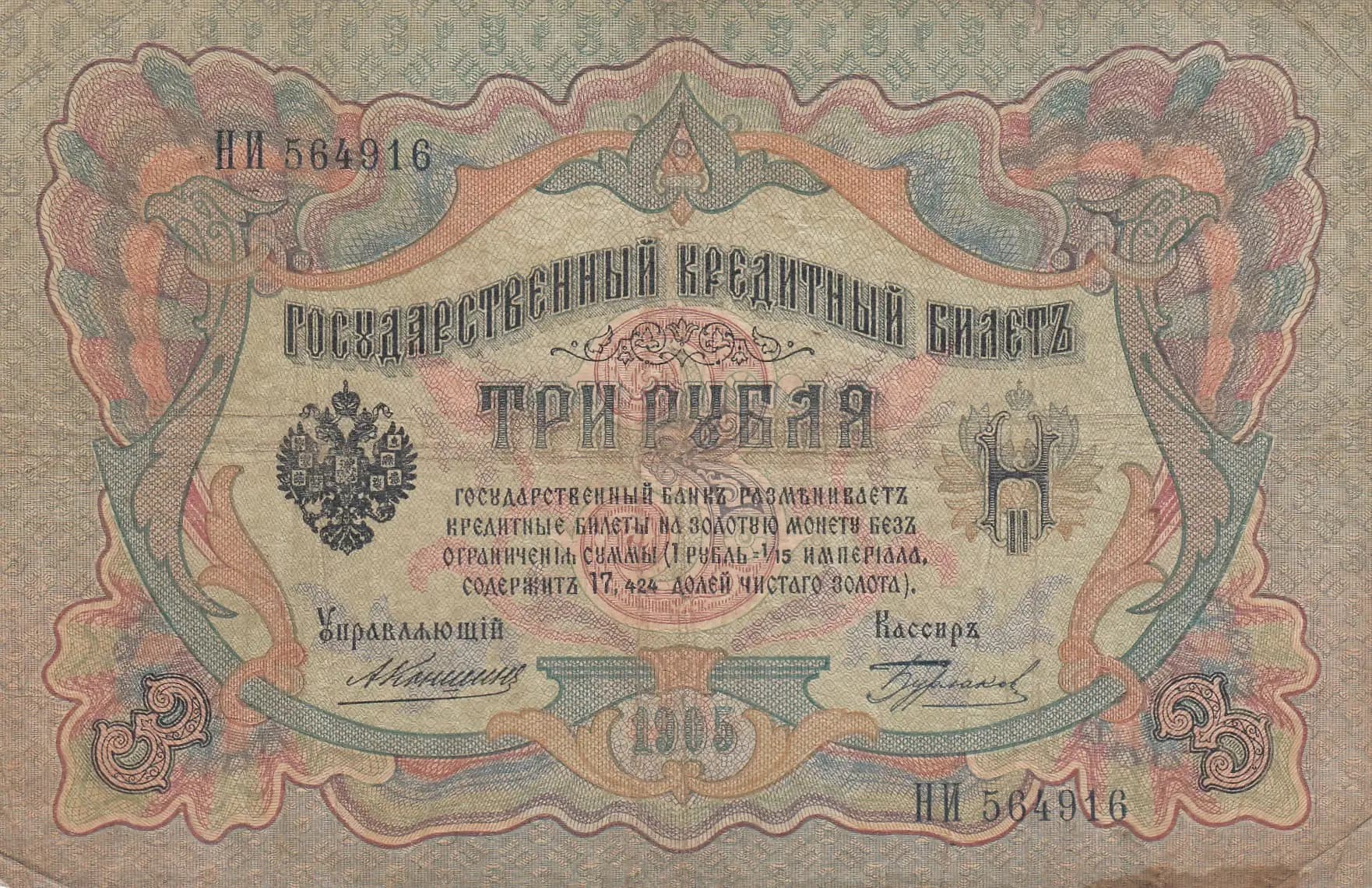
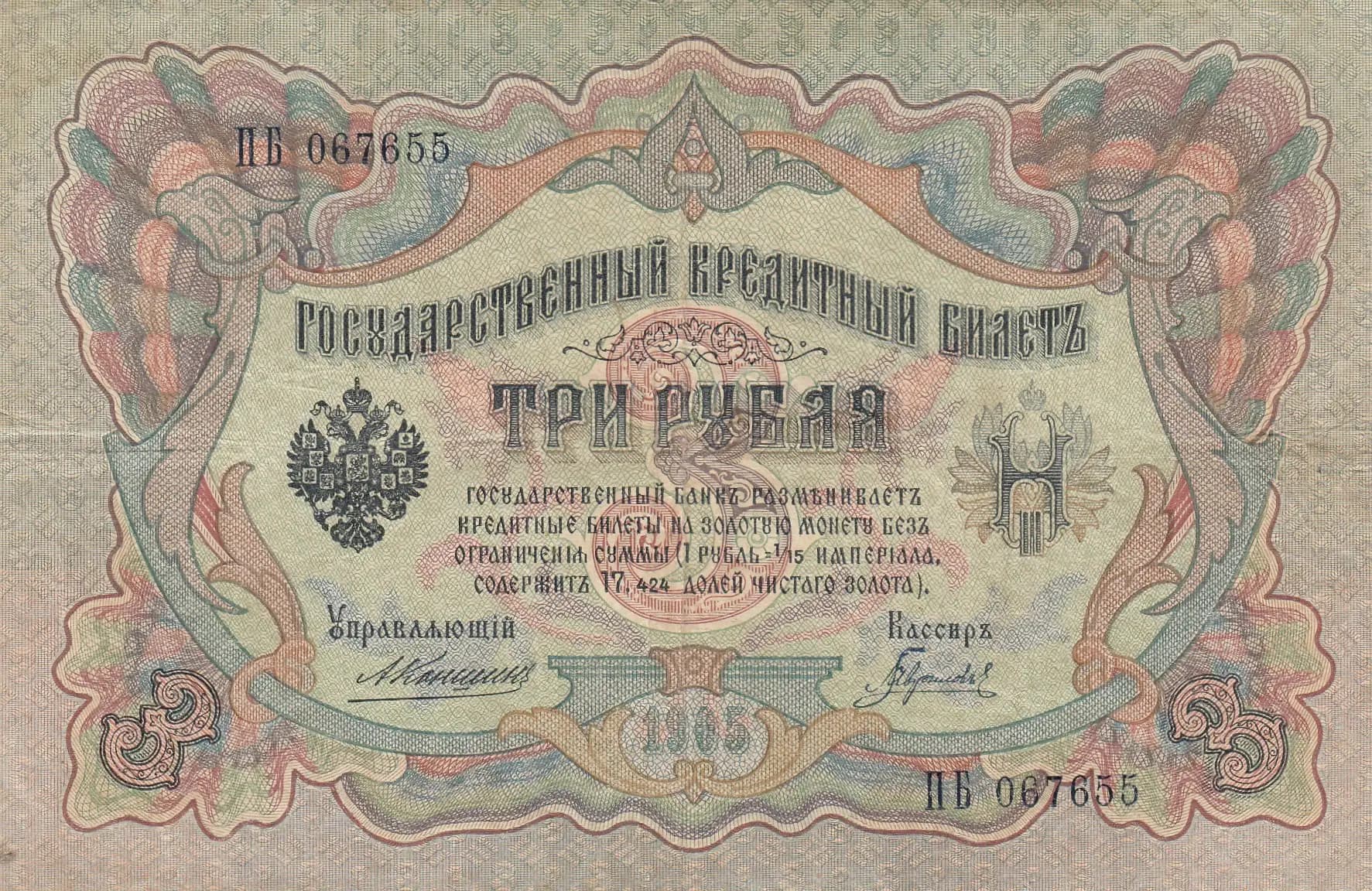
3 rublja 1905
“Sig.Schmidt”
About This Note
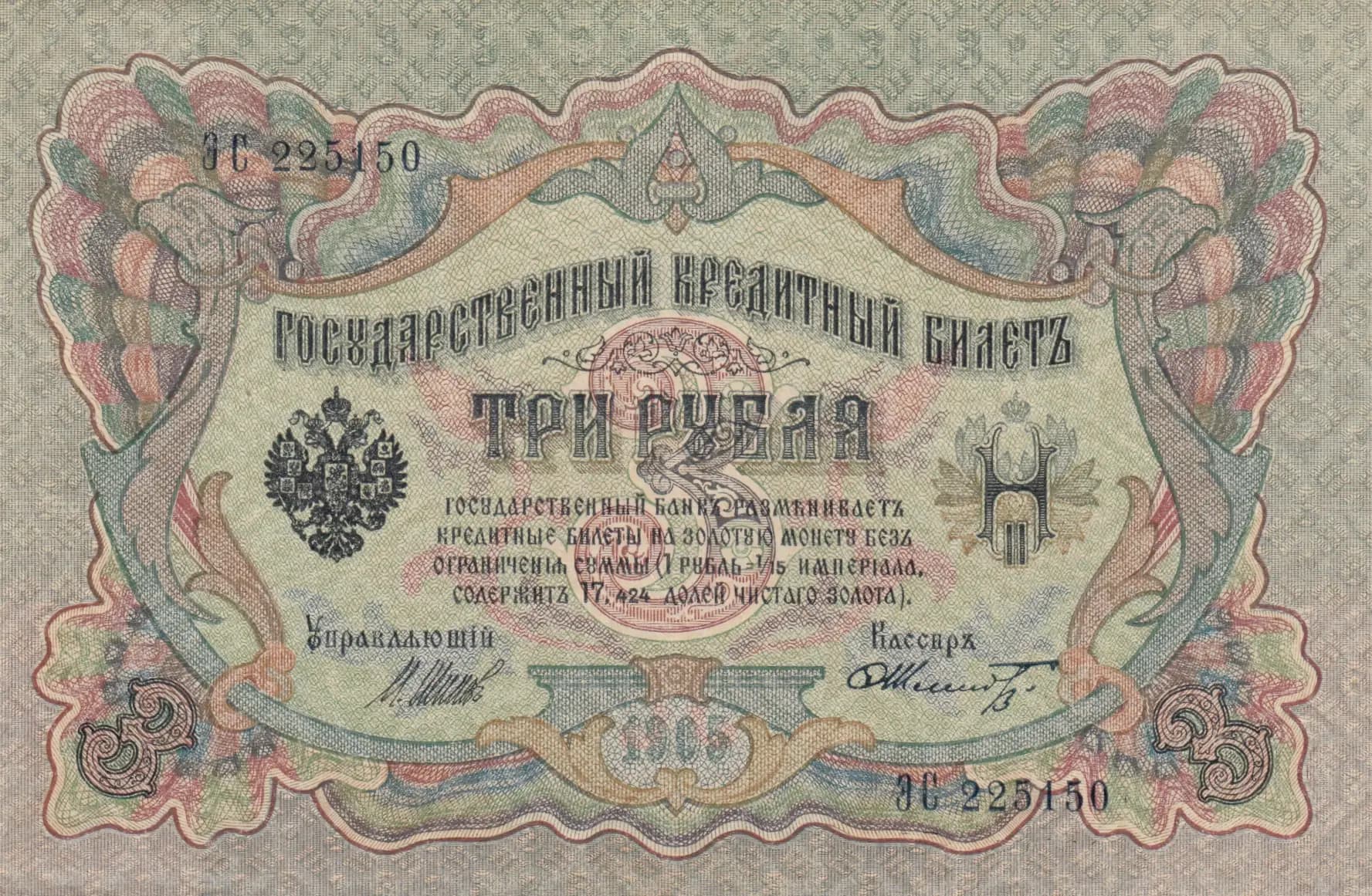
A well-preserved example of Russia's 1905 Imperial 3 Ruble State Credit Note (Pick-9c(12)), graded AU with visible but not severe aging characteristics. The note features the iconic double-headed eagle coat of arms in a masterfully engraved ornamental frame rendered in soft pink, green, and beige tones. While moderate creasing and foxing indicate circulation history, the clarity of the fine line engraving and legible inscriptions make this an attractive specimen for collectors of Russian Imperial currency, particularly those interested in the pre-Revolutionary monetary system and Czarist heraldry.
Common. The 3 Ruble denomination from the 1905 Imperial issue was produced in substantial quantities as a workhorse denomination for everyday circulation throughout the Russian Empire. No evidence suggests a limited print run, special recall, or short-lived issuing period. The AU condition grade is desirable but not extraordinary for surviving specimens, as many Imperial notes from this series remain in circulated conditions. Unless specific serial number prefixes or signature varieties command collector premiums (not indicated here), this Pick-9c(12) should be considered a standard offering in the Imperial Russian banknote market.
This 1905 banknote was issued during the reign of Tsar Nicholas II at a turbulent period in Russian history, just months before the 1905 Revolution. The front inscription emphasizes the State Bank's guarantee of credit notes backed by gold coin (with the specific notation that 1 ruble equals 1/5 of an Imperial and contains 17.424 parts pure gold), reflecting Russia's adherence to the gold standard during this era. The elaborate imperial symbolism—particularly the prominent double-headed eagle and references to the Samoderžhetz (Autocrat)—represents the zenith of Czarist monetary authority, just years before the fall of the Romanov dynasty.
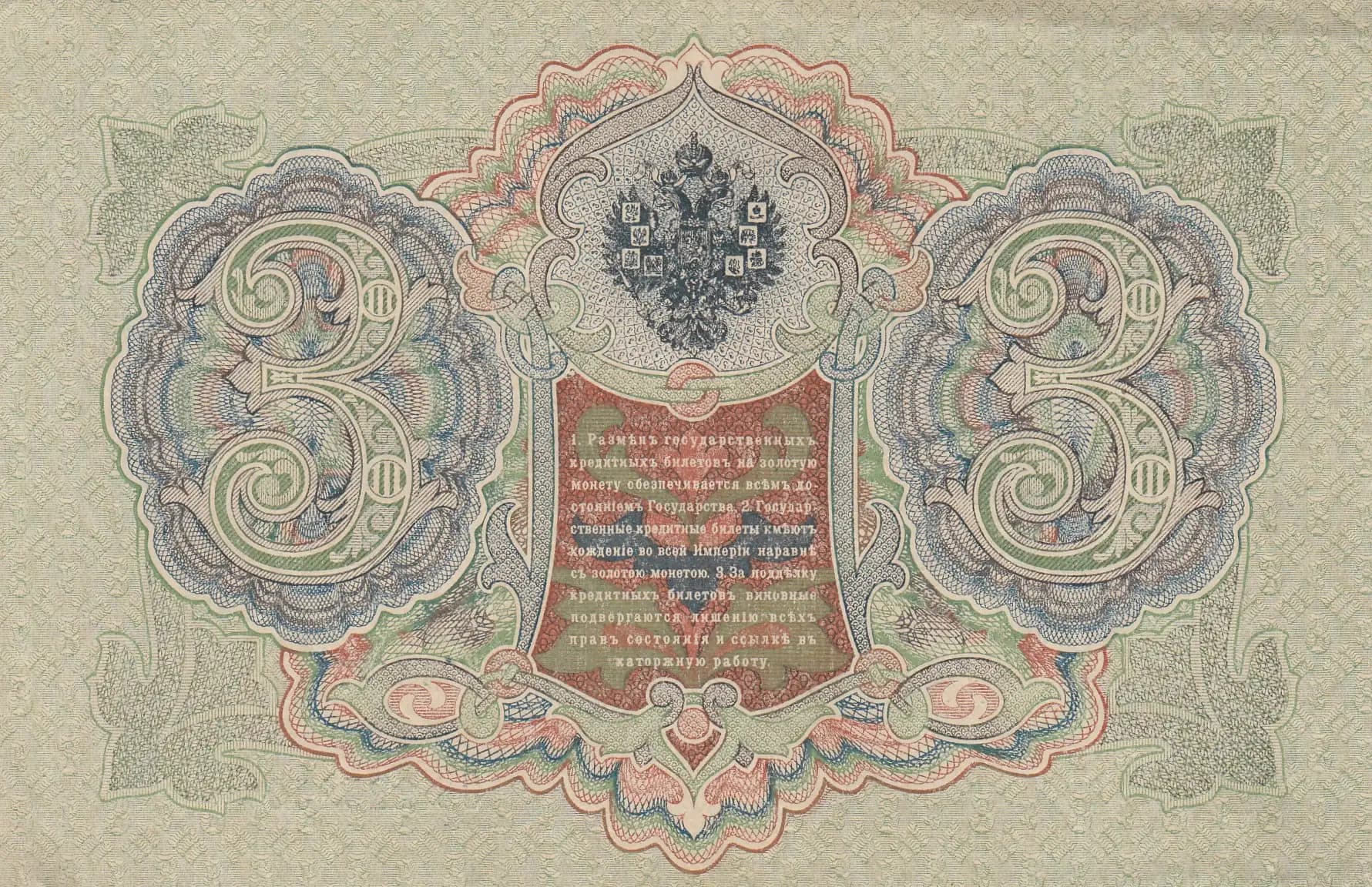
This Imperial Russian State Credit Note exemplifies the high artistic and security standards of late Czarist monetary design. The obverse features a commanding Imperial double-headed eagle coat of arms—the heraldic symbol of Russian state authority—positioned centrally within an elaborate frame of interlocking scrollwork, floral motifs, and geometric patterns executed in soft earth tones (beige, pink, sage green) with black line work. Two signature lines at the bottom are designated for the Managing Director (Управляющий) and Cashier (Кассирь), with contemporary handwritten signatures visible (per collector notes, signed by Schmidt). Serial number ДБ.225150 appears in opposite corners. The reverse presents a symmetrical ornamental composition dominated by substantial spiral scrollwork flanking a central cartouche containing the three legal guarantee clauses printed in red/maroon text. The entire design employs symmetrical baroque-influenced ornamentation typical of high-security Imperial currency, with no individual portraits—the eagle itself serves as the primary iconographic element representing the Russian state.
FRONT SIDE: 'ГОСУДАРСТВЕННЫЙ КРЕДИТНЫЙ БИЛЕТ' (State Credit Note); 'ТРИ РУБЛЯ' (Three Rubles); 'ГОСУДАРСТВЕННЫЙ БАНК САМОДЕРЖАВЦЕАЕТ КРЕДИТНЫЕ БИЛЕТЫ НА ЗОЛОТО МОНЕТУ БЕЗЬ ОГРАНИЧЕНИЯ СЕМЬИ (1 РУБЛЬ = 1/5 ИМПЕРИАЛА, СОДЕРЖИТ 17,424 ДОЛЕЙ ЧИСТАГО ЗОЛОТА)' (The State Bank of the Autocrat issues credit notes on gold coin without family limitation [1 ruble = 1/5 Imperial, contains 17.424 parts of pure gold]); 'Управляющий' (Managing [Director]); 'Кассирь' (Cashier); Serial numbers: 'ДБ.225150' (appearing top-left and bottom-right). BACK SIDE: '1. Развитие государственных кредитных билетов на золото монету обеспечивается всеми достояниями государства. 2. Государственные кредитные билеты имеют хождение по всей Империи наравне с золотою монетою. 3. За подделку кредитных билетов рядовые подвергаются иными всеми гражданами и согласно законодательству работу' (1. The circulation of state credit notes on gold coin is ensured by all assets of the state. 2. State credit notes circulate throughout the Empire on equal terms with gold coin. 3. For counterfeiting credit notes, ordinary individuals are subject to punishment along with all other citizens according to legislation).
Intaglio engraving (line engraving/copperplate) combined with chromolithography. The fine line work, intricate scrollwork, and security pattern details characteristic of intaglio printing are evident throughout both sides. The multi-color application (beige, pink, green, red, black) indicates chromolithographic color separation techniques standard for Russian Imperial banknotes of this period. The State Bank of Russia employed St. Petersburg's premier security printers for these denominations; this series was produced under the direction of the Imperial printing facilities with techniques designed to prevent counterfeiting through complex engraved patterns and precision color registration.
Serial number ДБ.225150 with signature identified as Schmidt (per collector notation). The Pick catalog designation P-9c(12) indicates this is a cataloged variety within the broader 3 Ruble 1905 issue. Russian Imperial notes from this period show variations in signatures (Managing Directors and Cashiers changed over the note's circulation period), and serial number prefixes may denote different batches. The ДБ prefix and specific serial number should be cross-referenced against Russian Imperial currency catalogs to determine if this represents a scarce batch or signature combination; however, without additional documentation of known scarce signature pairings for this denomination, the variety designation should be treated as standard unless specialty catalogs indicate otherwise.