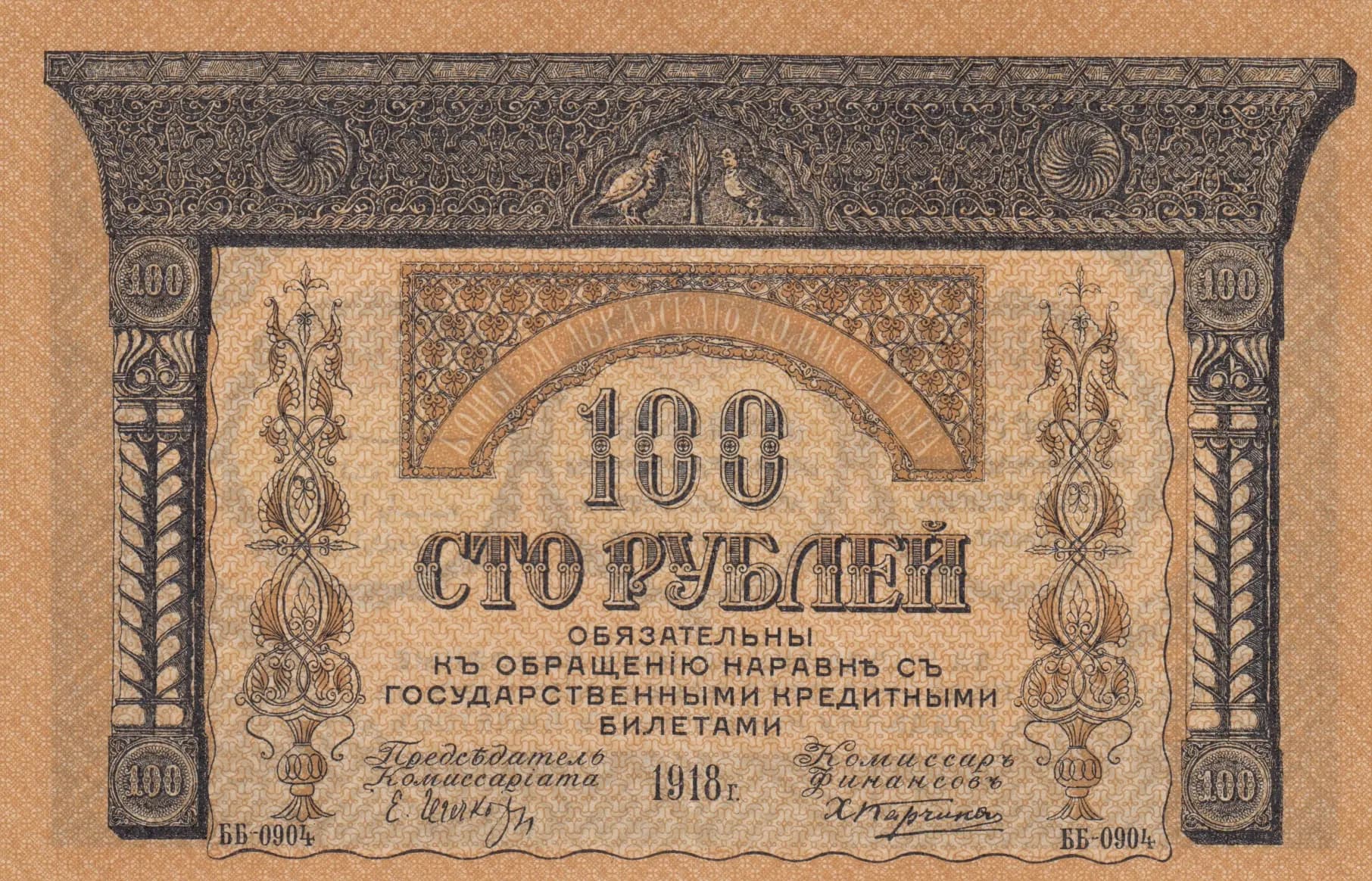
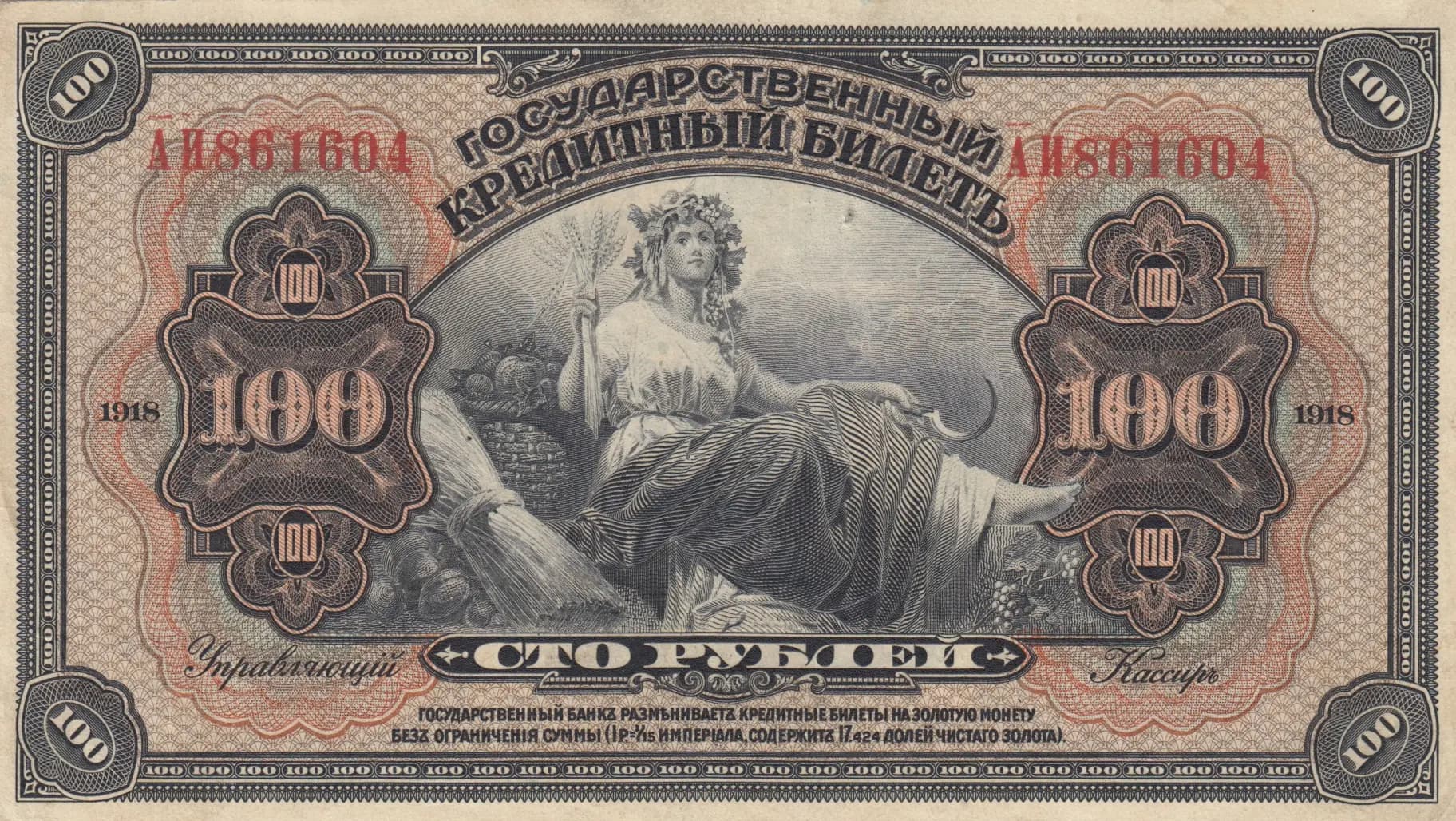
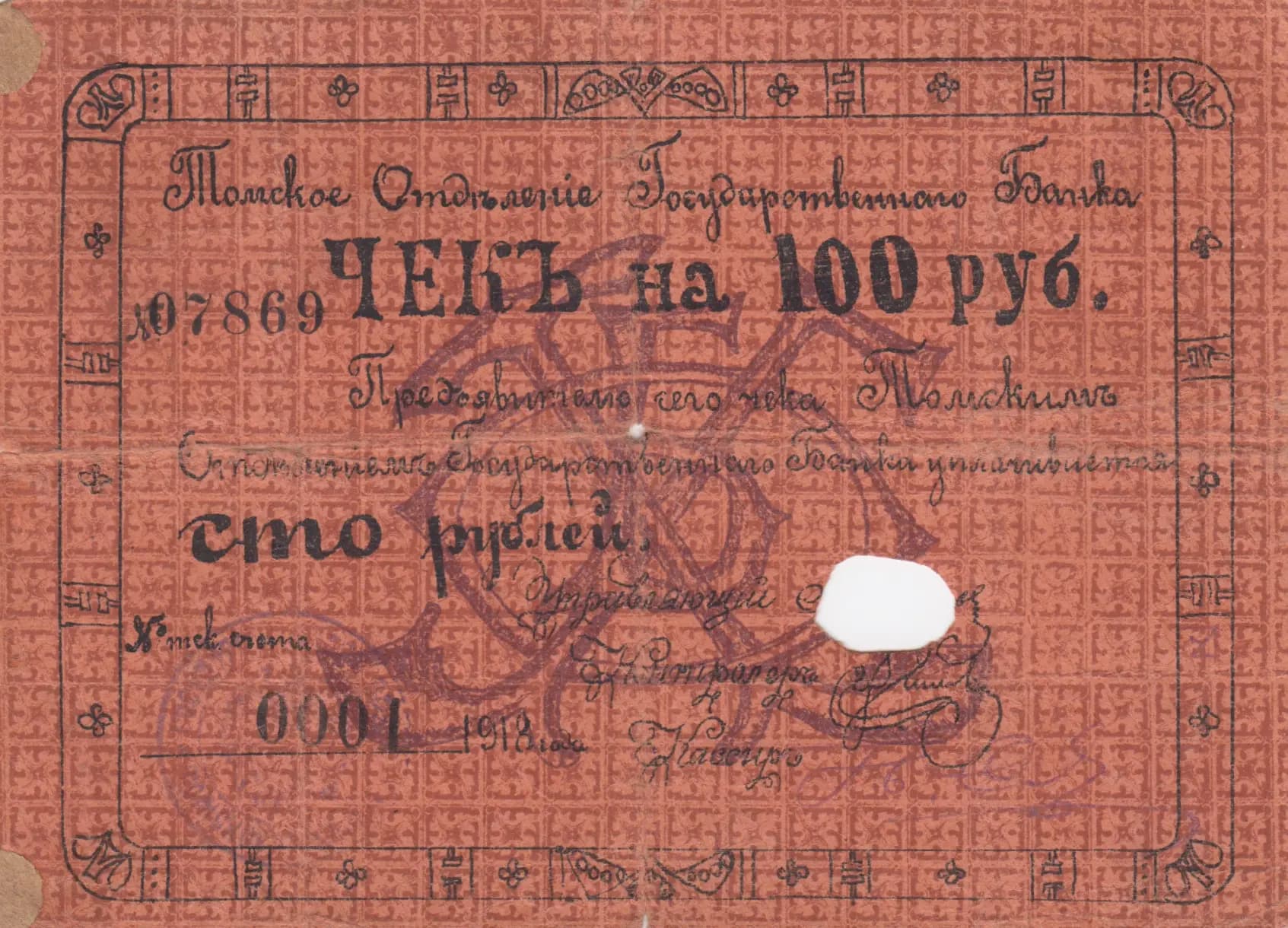
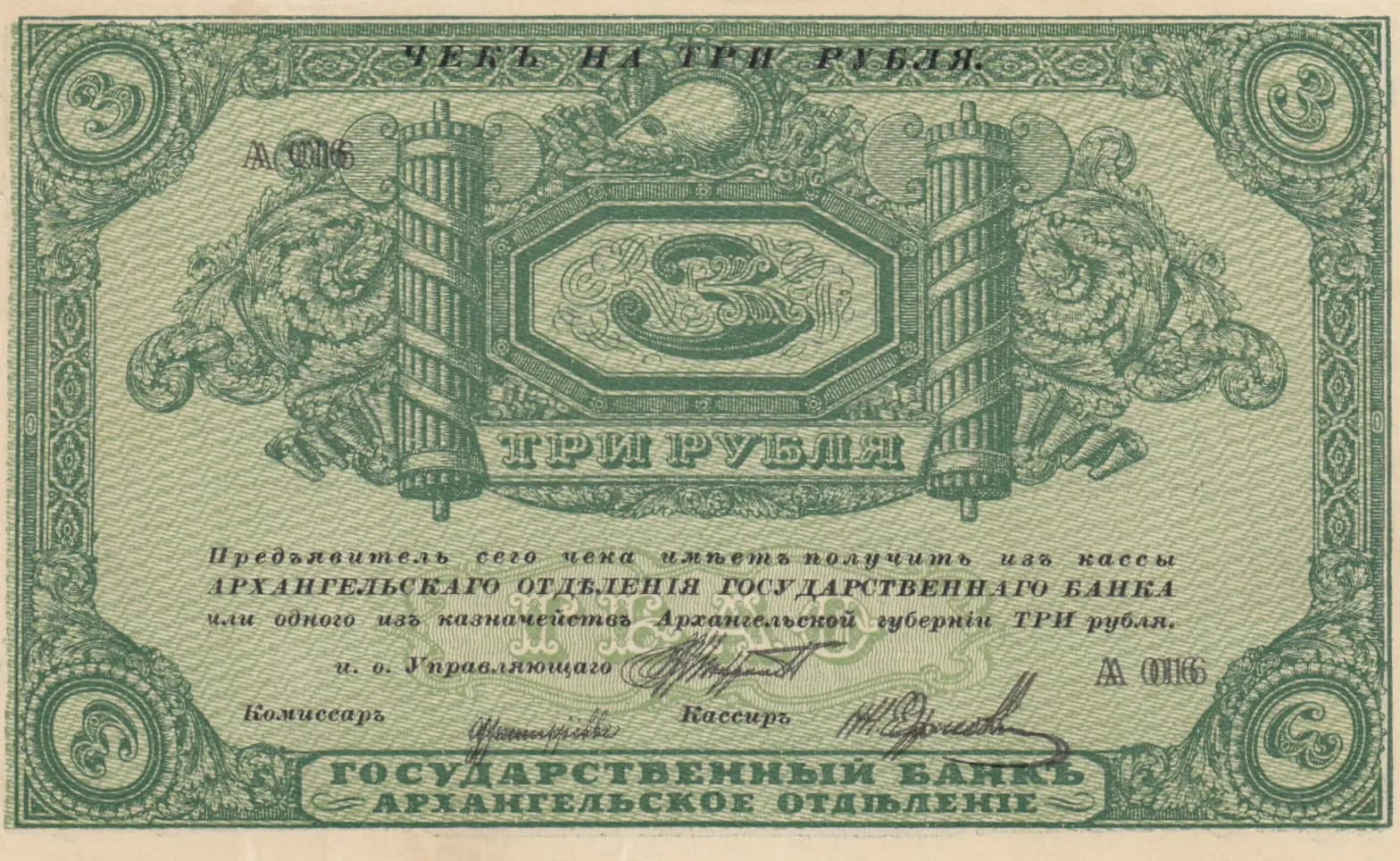
100 rublei 1918
“Samara”
About This Note
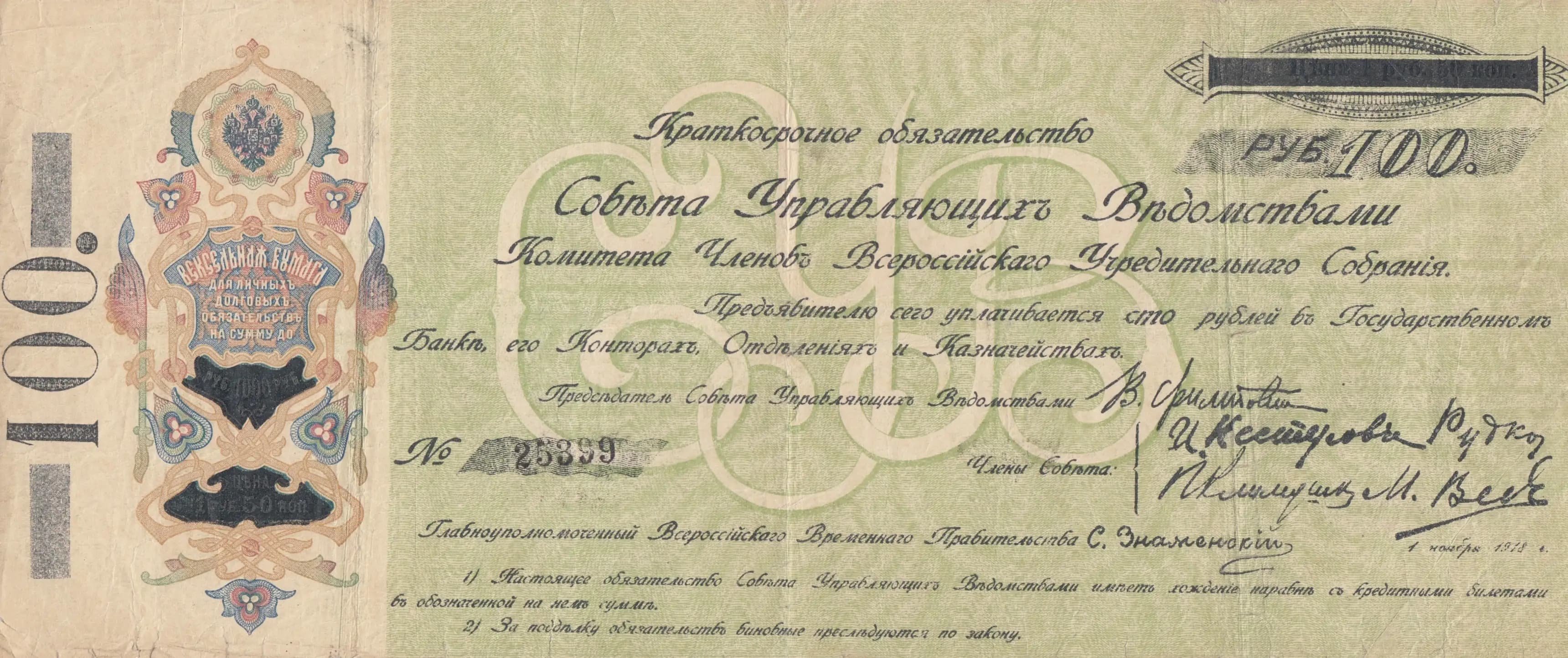
This Russian 100 rublei note from 1918 features an ornate Imperial Russian eagle emblem and decorative rococo-style borders in cream, brown, and blue tones. The note is graded F (Fair) and shows clear signs of age with yellowing, foxing, and multiple fold lines creating a grid pattern across the back. As a product of the Samara-based Board of Governors Offices Committee during the tumultuous Russian Civil War period, this represents an important provisional currency issued by the All-Russian Constituent Assembly authorities.
common
This banknote was issued in 1918 by the Board of Governors Offices Committee Members of the All-Russian Constituent Assembly, representing a critical transitional period when competing Russian political authorities were issuing their own currencies during the Russian Civil War. The presence of the Imperial Russian double-headed eagle with crown reflects the note's connection to pre-revolutionary state symbolism, even as revolutionary forces were consolidating power. The prominent approval signature of S. Emelyanova from the All-Russian Provisional Government anchors this note to the legitimate government authority attempting to maintain financial stability during the collapse of Imperial Russian institutions.
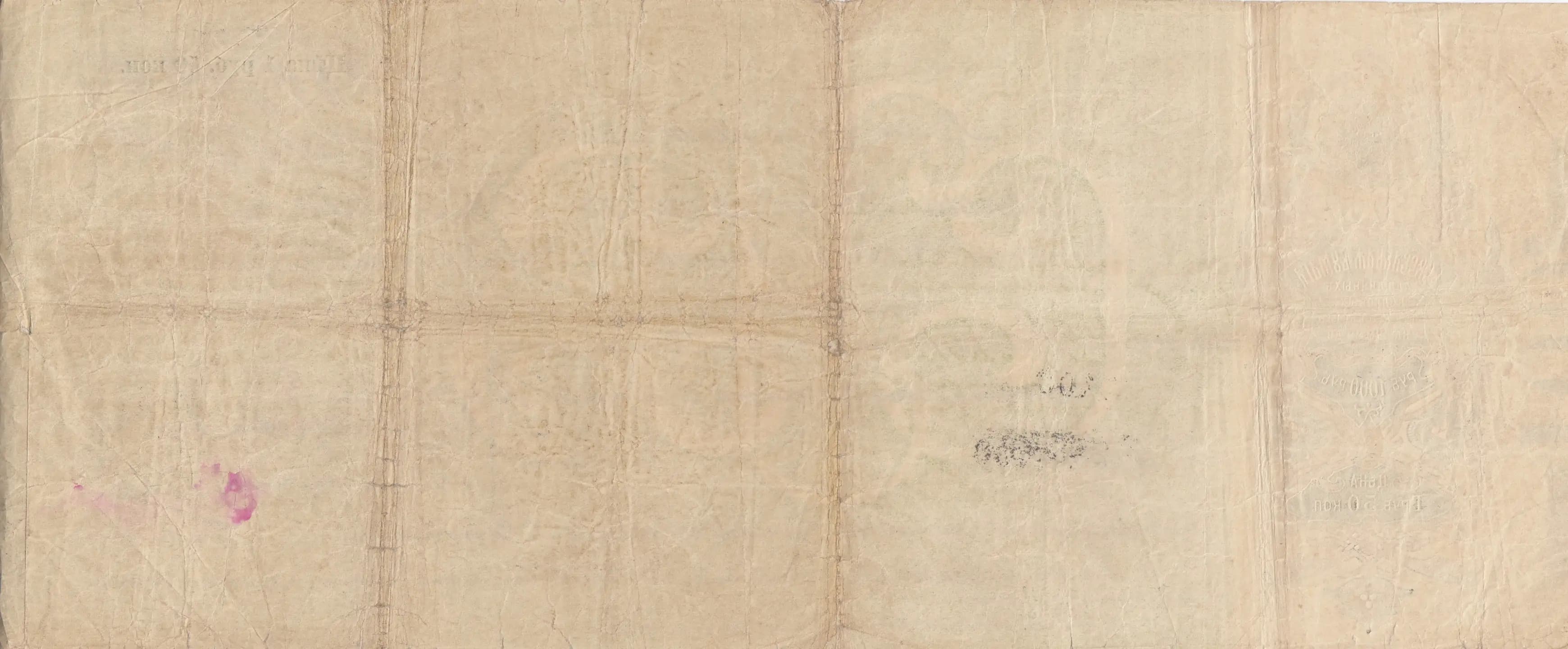
The obverse features a centered Imperial Russian double-headed eagle emblem with crown at the top, flanked by ornamental rosettes and flourishes typical of late Imperial heraldic design. Large denomination numerals '100' appear prominently on the left side in brown ink. The note is framed by ornamental rococo-style borders with detailed embellishments consisting of decorative cartouches with dark rectangular plaques and circular watermark-like patterns distributed throughout the design field. Multiple text blocks in varying sizes of Cyrillic script occupy the center and right portions, arranged in a formal hierarchical layout. Signature lines and handwritten signatures from authorized officials appear in the lower right area. The color palette employs cream/beige as the primary paper tone with brown, blue, red/pink, and black inks for contrast and design elements. The reverse is largely blank, indicating this as a provisional obligation note rather than a fully designed currency note. The overall aesthetic reflects the transitional nature of 1918 Russian financial instruments, maintaining Imperial symbolism while serving the Constituent Assembly's administrative needs.
FRONT SIDE: Denomination: 100 РУБ (100 rubles). Title: 'Краткосрочное обязательство' (Short-term obligation). Issuer: 'Совета Управляющего Вспомогательными Комитета Членов Всероссийского Учредительного Собрания' (Council Managing Auxiliary Committees of Members of the All-Russian Constituent Assembly). Main text: 'Предоставляю всего уд.лицьется сто рублей ва Государственнаго Банка, его Конторе, Отделениям и Казначействах' (I present this note for one hundred rubles in the State Bank, its offices, branches and treasuries). Serial Number: № 28999. Signatories: 'В.Орлицкий' (V. Orlitskiy - Chairman), 'М.Вольский, Ю.Гос' (M. Volskiy, Yu. Gos - Members), 'М.Каульбауэр, М. Вольф' (M. Kaulbauer, M. Wolf - Members). Legal notices: '1) Автозаказчик деятельность Совета Управляющего Вспомогательными имеет исключительно частную со Кредитными билетами' (1) The activity of the Council Managing Auxiliary has exclusively private character with Credit notes), '2) За подделку обязательство виновные преследуется по закону' (2) For forging obligations the guilty shall be prosecuted by law). Approval: 'Павлоустневутененный Всероссийского Временного Правительства С.Эмельяниова' (Approved by All-Russian Provisional Government S. Emelyanova). Date: 'Главно 1918' (Main/Chief 1918). BACK SIDE: Largely blank with scattered illegible marks and possible watermark areas, no clearly legible inscriptions.
This note exhibits characteristics consistent with lithographic printing, evidenced by the detailed ornate borders, varied line weights, and tonal gradations visible in the decorative elements and circular patterns. The multiple ink colors (brown, blue, red/pink, black) and their precise registration suggest multi-stone or multi-plate lithography. The fine detail in the rococo embellishments and the Imperial eagle indicate skilled lithographic craftsmanship. Handwritten signatures and possibly manuscript additions were applied post-printing. The printer for this specific Samara-based issue is not definitively identified in available catalogs, though Russian provincial printing offices during 1918 typically employed lithographic presses for such obligation notes.
Serial number 28999 observed on this example. The note displays signatures of V. Orlitskiy (Chairman), M. Volskiy, Yu. Gos, M. Kaulbauer, and M. Wolf as Council Members, along with approval signature of S. Emelyanova. Varieties of this issue likely exist based on different signature combinations and serial number ranges, as was typical for provisional obligation notes. The handwritten nature of some signatures and official stamps suggests potential state variations within the series. Without access to comprehensive variety catalogs specific to Samara Board of Governors issues, detailed variety classification beyond signature variations cannot be definitively stated, but collectors should note that multiple signature combinations may exist within Pick-S808.