100 rublei 1920
About This Note
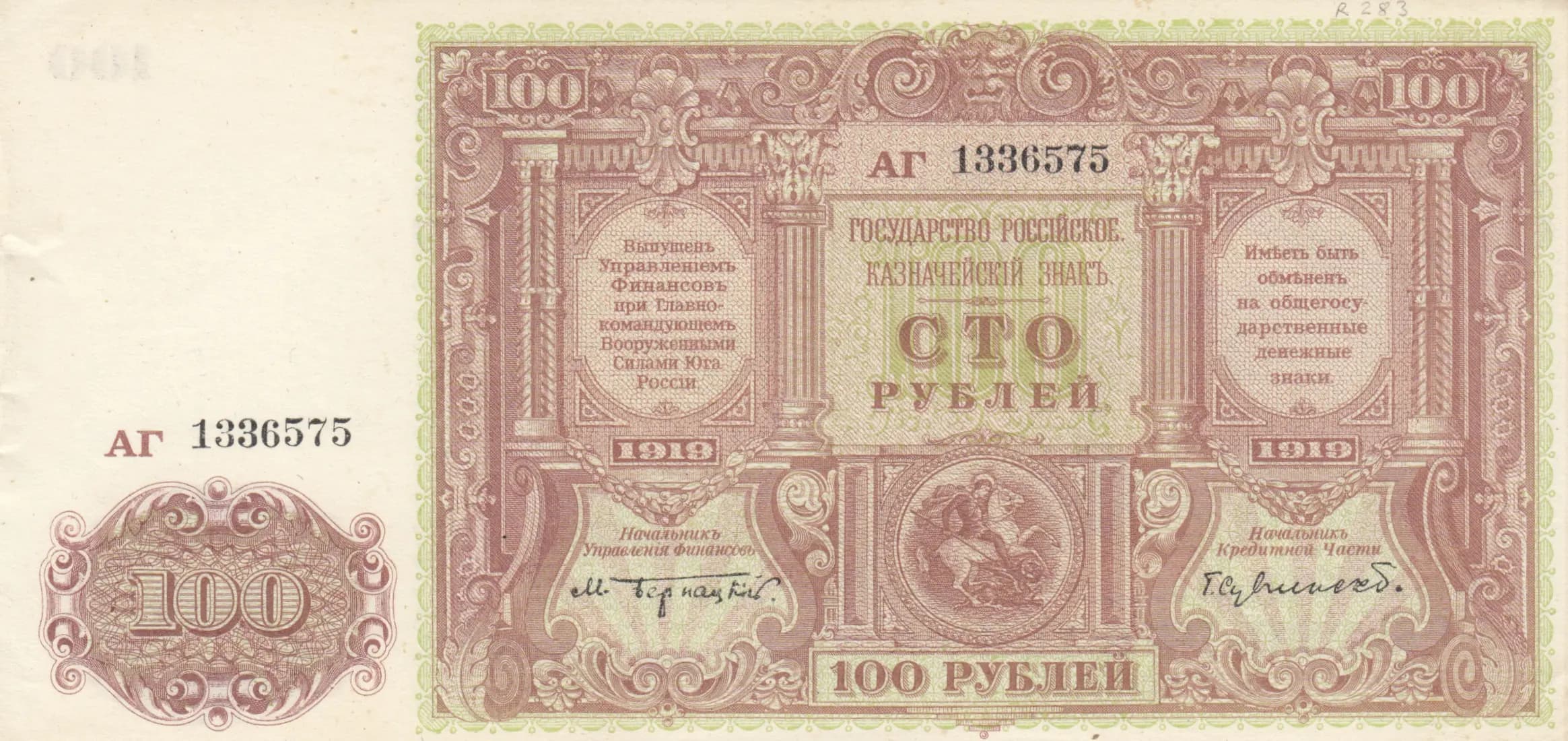
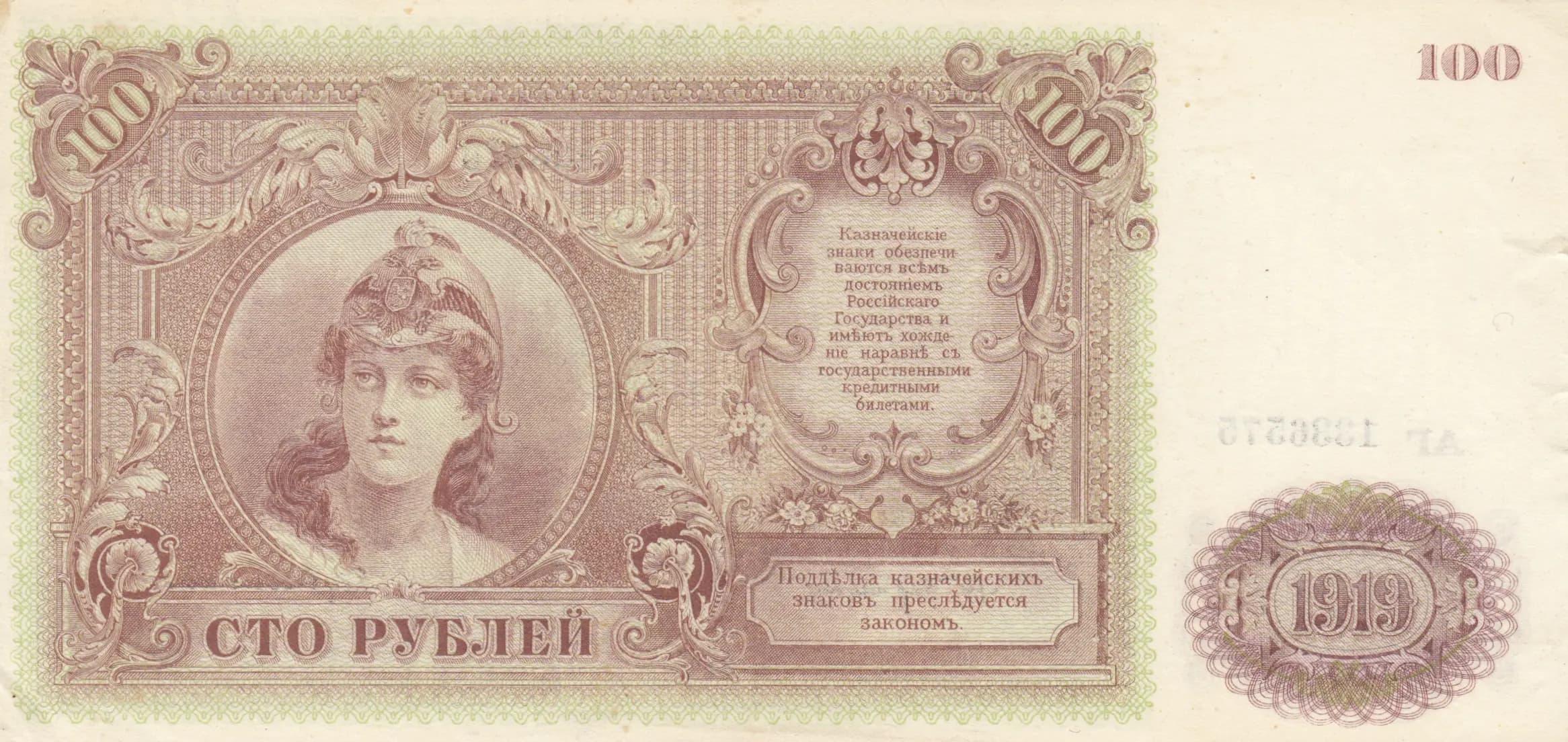
This AU-graded 100 Rublei note from 1920 represents an exceptional example of Russian Civil War-era Treasury currency issued by the White Army's South Russian Command. The note features striking Art Nouveau design with ornate rococo scrollwork in mauve and rose tones, framing architectural elements on the obverse and a classically-rendered female portrait on the reverse. Despite light foxing and age-related toning consistent with circulation, the note retains excellent clarity in its intricate engraved details and remains a significant collector piece documenting the fractious monetary systems of post-revolutionary Russia.
Common. While this note was issued by a short-lived and ultimately defeated military authority (the White Army's South Russian Command), the 100 Rublei denomination from the P-S439 series was produced in substantial quantities during 1918-1920 to support military operations and civilian transactions in controlled territories. The prevalence of this denomination and series in collector markets, combined with the note's AU condition grade still permitting circulation wear, indicates robust historical print runs. Civil War-era Russian notes, while historically significant, remain readily available in the numismatic marketplace.
Issued in 1920 by the Finance Department under the Commander-in-Chief of the Armed Forces of South Russia, this note reflects the White Army's control of southern territories during the Russian Civil War (1918-1922). The ornate design and explicit declaration that 'Treasury notes are secured by all the wealth of the Russian State' represent the White forces' attempt to establish monetary legitimacy in opposition to Bolshevik currency. The dual dates of 1918 and 1919 on the face indicate authorization periods during the height of White Army operations before their ultimate defeat in 1920.
This banknote exemplifies the refined Art Nouveau aesthetic applied to Russian Civil War currency. The obverse features a symmetrical composition with Corinthian-capitaled classical columns and building facades visible within ornate circular medallions, flanking the central denomination text 'СТО РУБЛЕЙ'. The design incorporates an Imperial Russian double-headed eagle and ornamental circular seal bearing the numeral 100. The reverse showcases a portrait of a classical female figure with long wavy hair adorned with an ornate tiara or headdress, positioned within an elaborate circular frame on the left side. Throughout both sides, rococo-style acanthus leaf motifs and floral scrollwork provide decorative borders and cartouches. The palette of mauve, rose, and cream creates a cohesive and elegant presentation characteristic of pre-revolutionary Russian banking aesthetics adapted for White Army purposes.
{"front":{"mainDenomination":"СТО РУБЛЕЙ (One Hundred Rubles)","numericalDenomination":"100","serialNumber":"АГ 1336575","issuingAuthority":"ГОСУДАРСТВО РОССИЙСКОЕ, КАЗНАЧЕЙСКИЙ ЗНАК (Russian State, Treasury Note)","issuanceStatement":"Выпущены Управлением Финансов при Главно-командующем Вооруженными Силами Юга России (Issued by the Finance Department under the Commander-in-Chief of the Armed Forces of South Russia)","authorizationDates":"1918, 1919","signatoryTitles":"Начальник Управления Финансов (Head of Finance Department), Начальник Казначейской Части (Head of Treasury Department)"},"back":{"denominationRepeat":"СТО РУБЛЕЙ (One Hundred Rubles)","numericalDenomination":"100","securityStatement":"Казначейские знаки обеспечиваются всем достоянием Российского Государства и имеют хождение наравне с государственными кредитными билетами (Treasury notes are secured by all the wealth of the Russian State and have equal circulation with state credit notes)","counterfeittingWarning":"Подделка казначейских знаков преследуется законом (Counterfeiting of treasury notes is prosecuted by law)","plateOrIdentifier":"119"}}
This note was produced using steel engraving, a security printing method evidenced by the fine line work, intricate scrollwork, detailed portrait shading, and complex ornamental patterns visible in the visual analysis. The precision of the Corinthian capitals and acanthus leaf detailing, along with the nuanced toning in the female portrait, confirm this as intaglio printing executed by a skilled security printer. While the specific printer identification requires additional documentation, the quality and sophistication of the engraving reflects the standards of established Russian security printing houses of the early 20th century.
This specimen bears the serial number prefix 'АГ' (AG) with the serial number 1336575, representing one of the multiple prefix varieties issued for this denomination. The notation '119' on the reverse likely indicates a plate number, potentially distinguishing between different engraved plates used in production. Pick catalog P-S439a designates this as the 'a' variety; collectors should note that different signature combinations, overprints, or serial number prefixes may exist as separate Pick varieties (P-S439b, P-S439c, etc.). The 1918 and 1919 authorization dates visible on the obverse are consistent with the issuance period for this series, though the actual printing date of this individual note may postdate these authorizations.