1 rubel 1918
“Siberia”
About This Note
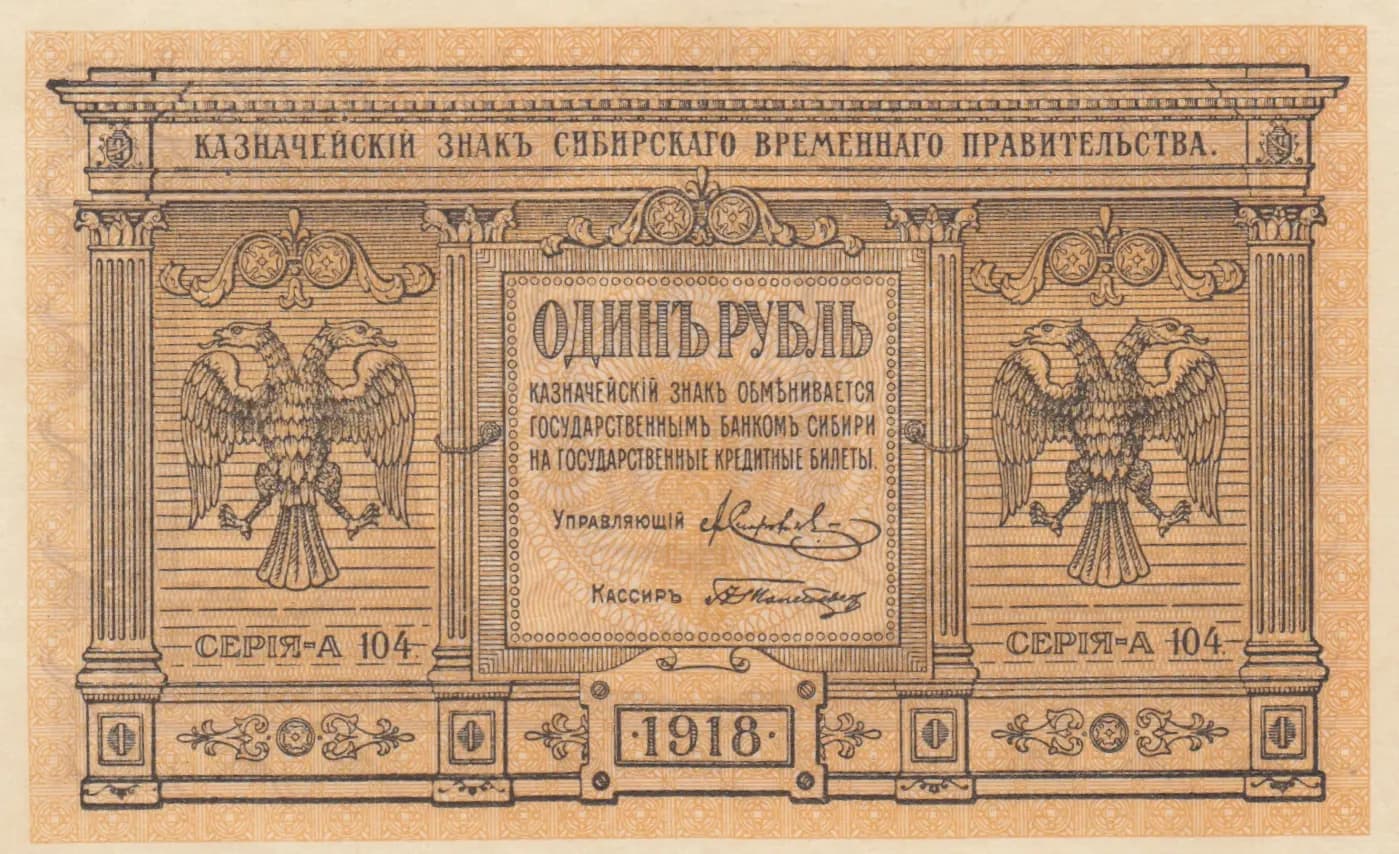
This 1918 Siberian Temporary Government 1 Ruble treasury note presents a fine example of Russian Civil War era currency from the short-lived Siberian Administration. The note features elegant classical architectural framing with symmetrical double-headed eagles and ornate capitals, rendered in warm tan and brown tones consistent with its age. In UNC condition with no visible creases or wear, this note represents an important transitional currency issued during Russia's period of political fragmentation.
Uncommon. The Siberian Temporary Government operated for a limited period (1918-1920) and issued relatively modest quantities of currency before its collapse. While not extremely rare, surviving examples in UNC condition are less frequently encountered than mainstream Imperial or Soviet issues. The specific series designation (Series A 104) and the note's excellent preservation status indicate this represents a select survivor from the Civil War period. Notes from short-lived regional authorities during this era typically command moderate collector premiums.
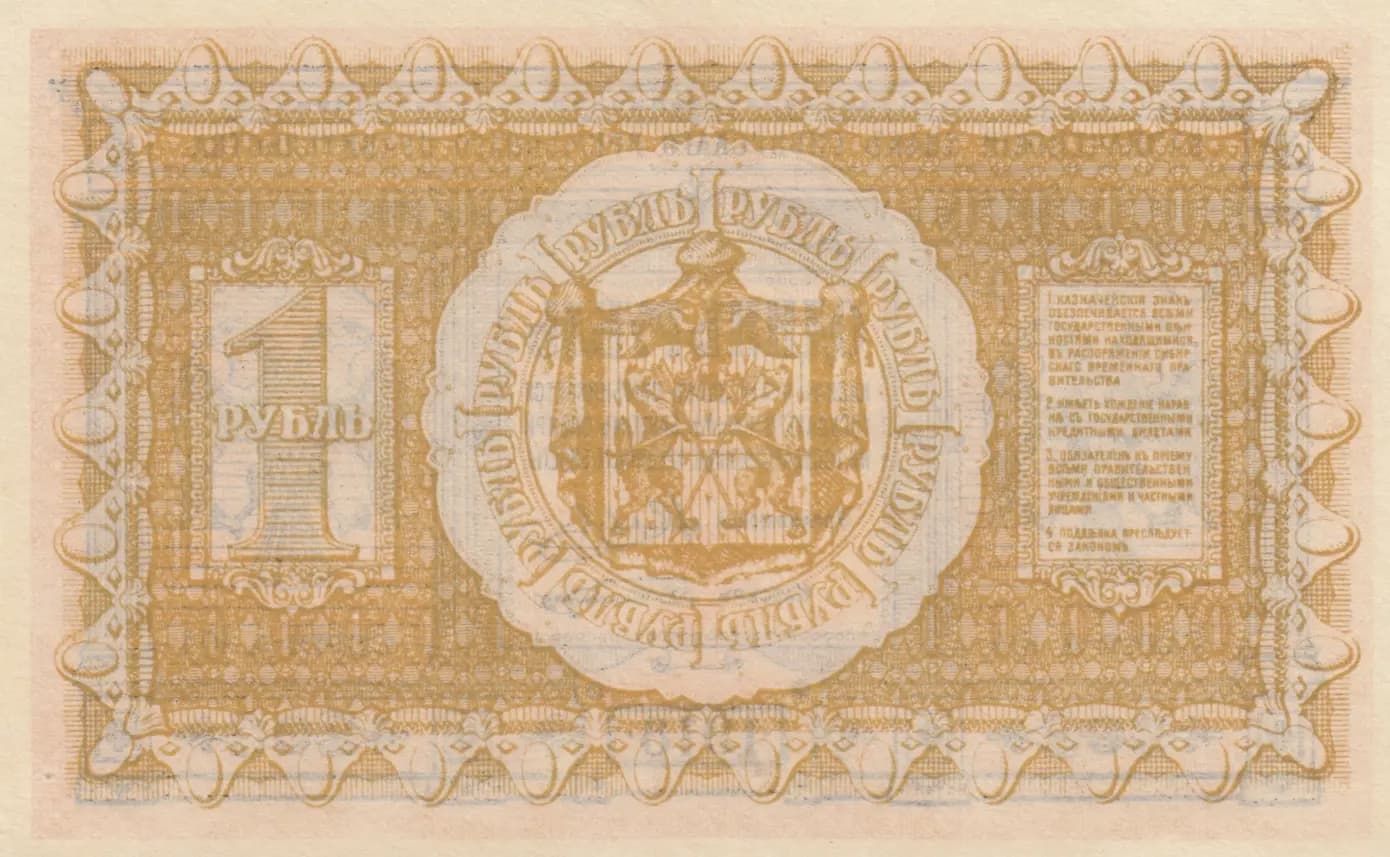
Issued by the Provisional Siberian Administration during the Russian Civil War (1918-1922), this treasury note represents the Siberian government's attempt to establish independent monetary authority in the face of Bolshevik consolidation. The prominent double-headed eagle imagery—both on the front flanking the central panel and dominating the reverse within an ornamental circular seal—invokes Tsarist imperial symbolism, reflecting the anti-Bolshevik White faction's claims to legitimacy. The note's exchange mechanism (redeemable for State Bank of Siberia credit notes) underscores the fragmented financial systems operating across Russian territory during this period.
The obverse features a classical architectural design with paired Corinthian or Composite capitals flanking a central rectangular denomination panel. Two imperial double-headed eagles appear symmetrically on either side of this central field, representing continuity with pre-revolutionary Russian state symbolism. The reverse dominates with a large circular heraldic seal containing a double-headed eagle bearing a shield on its chest, surrounded by ornamental scalloped borders and geometric patterns. The numeral '1' appears prominently on the left side of the reverse. Fine line engraving work throughout both sides creates a sophisticated security pattern typical of high-quality governmental currency. The overall aesthetic draws from late Imperial design traditions while serving the Siberian Administration's need for legitimate currency during wartime conditions. No portraits appear on either side, consistent with Russian governmental treasury notes of this period.
FRONT SIDE: 'КАЗНАЧЕЙСКИ ЗНАК СИБИРСКОГО ВРЕМЕННОГО ПРАВИТЕЛЬСТВА' (Treasury Note of the Siberian Temporary Government); 'ОДИН РУБЛЬ' (One Ruble); 'КАЗНАЧЕЙСКОЙ ЗНАК ОБМЕНИВАЕТСЯЮСУДАРСТВЕННЫМ БАНКОМ СИБИРИ НА ГОСУДАРСТВЕННЫЕ КРЕДИТНЫЕ БИЛЕТЫ' (This treasury note is exchanged by the State Bank of Siberia for state credit notes); 'Управляющий' (Manager/Director); 'Кассир' (Cashier); 'СЕРІЯ-А 104' (Series A 104); '1918' (Year). BACK SIDE: 'РУБЛЬ' (Ruble); '1' (Denomination numeral); 'КАЗНАЧЕЙСКИЙ ЗНАК ОБМЕНИВАЕМАЯ БАЛОМ В ГОСУДАРСТВ КРЕДИТНЫЕ БИЛЕТЫ' (Treasury note exchangeable for state credit notes); Fine print text containing regulatory information (not legible at this resolution).
Intaglio (engraved) printing on cotton-fiber paper. The fine line work, intricate border patterns, and detailed heraldic design visible throughout both sides are characteristic of steel die engraving. The security features—including the complex ornamental capitals, scalloped borders, and detailed circular seal with heraldic elements—would have been produced using traditional engraving plates rather than lithography, consistent with Russian state security printing standards of 1918.
Series A 104 variety noted. The series designation visible on the obverse ('СЕРІЯ-А 104') indicates this belongs to Series A, sheet number 104. Signatures of the Manager (Управляющий) and Cashier (Кассир) are present but not clearly legible in the images; signature varieties may exist across this series. No overprints or significant print varieties are evident from the visual analysis, though comprehensive cataloging of Siberian Administration notes may document variations in signature combinations or series numbering not visible in this specimen.