5 dollars 1978
About This Note
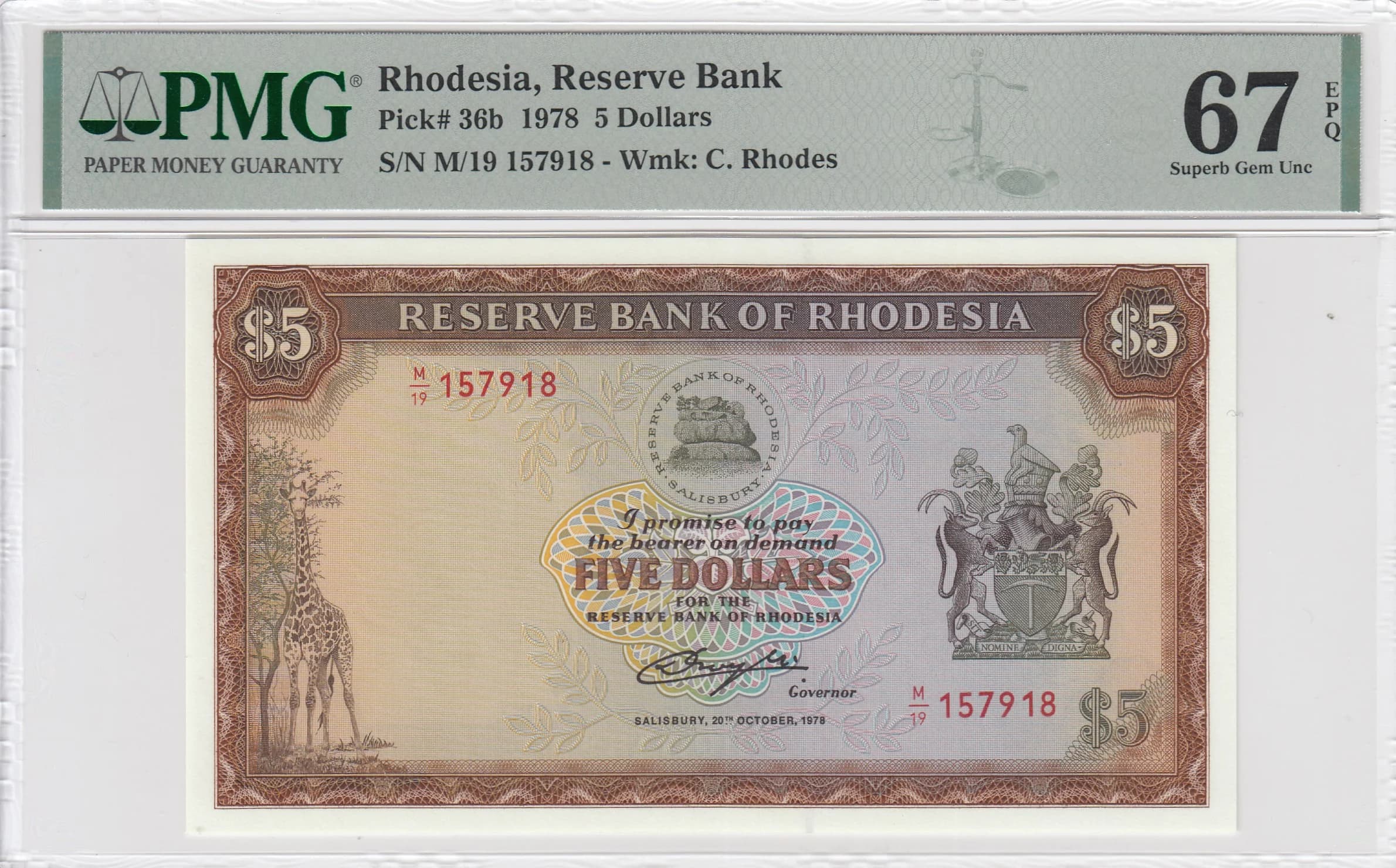
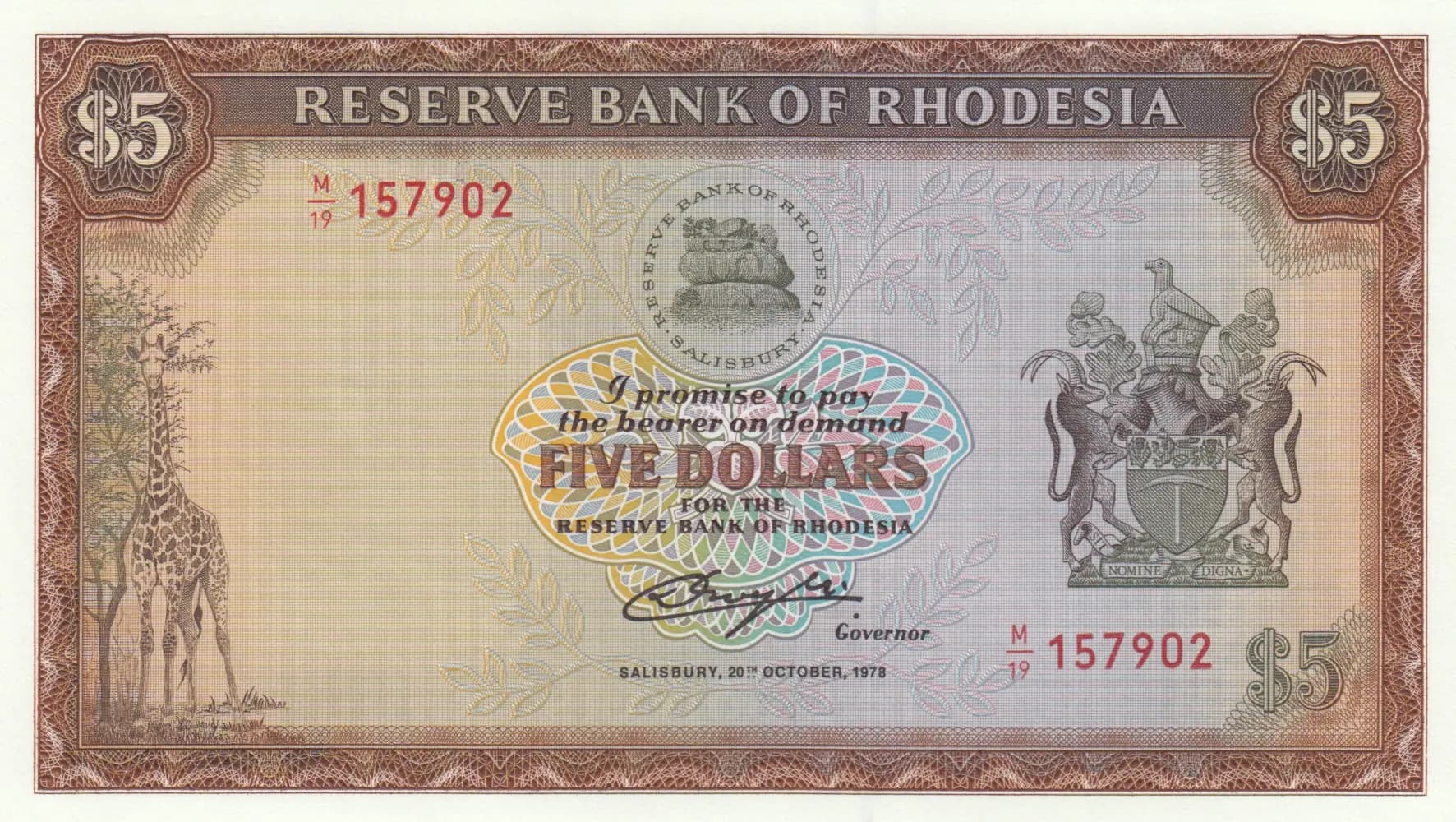
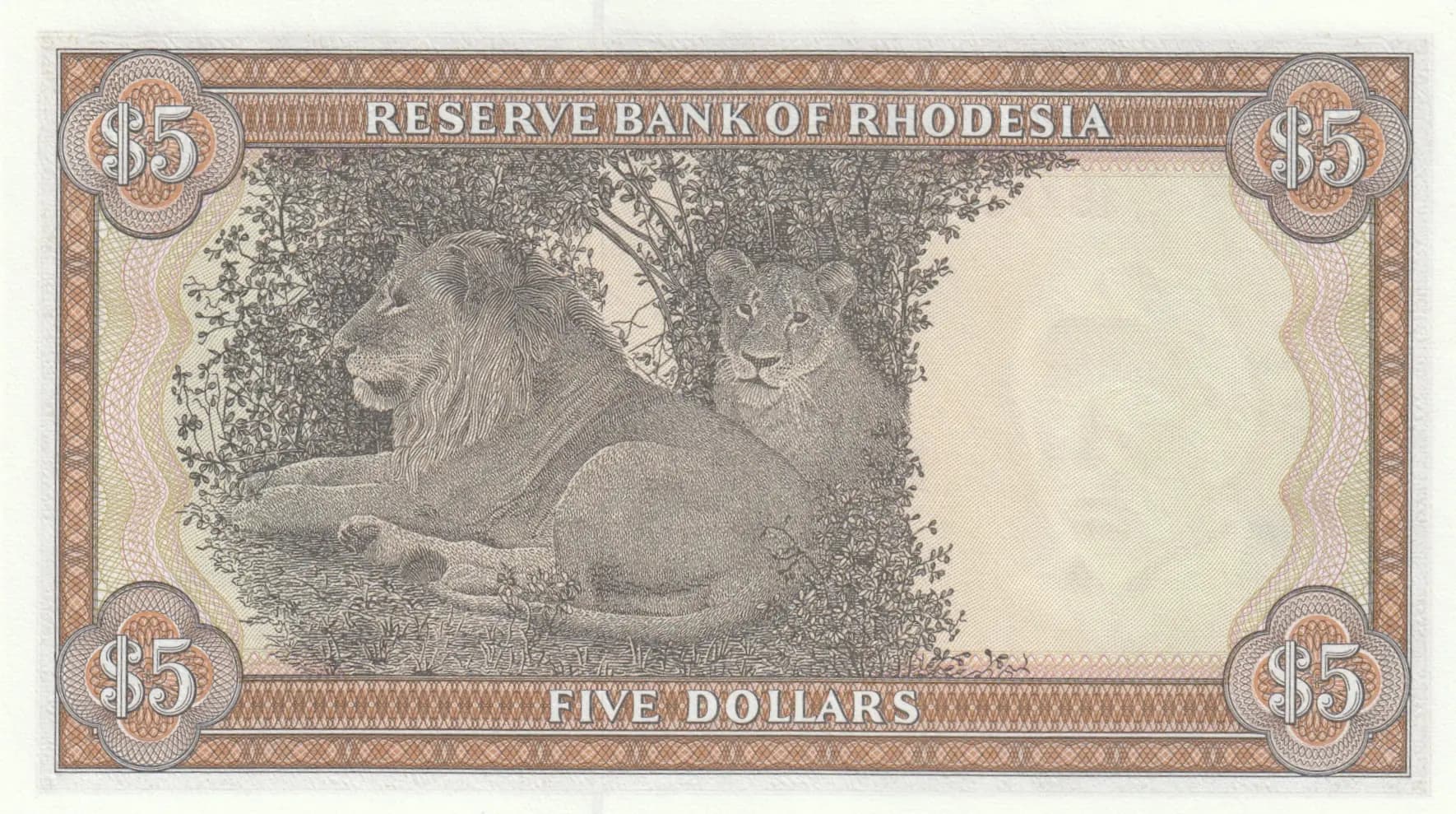
This is a pristine UNC example of the Rhodesian Reserve Bank's 1978 Five Dollar note (Pick 36b), featuring an elegant brown and tan color scheme with exceptional engraving detail. The obverse showcases a giraffe in natural landscape on the left and the Rhodesian coat of arms on the right, while the reverse depicts two lions resting in African savanna vegetation, representing the nation's wildlife heritage. The note exhibits no signs of wear or circulation, with crisp engraving and excellent image clarity throughout, making it an attractive example of Rhodesian currency from the final years of the nation's independence.
Common. The 1978 Five Dollar note of the Reserve Bank of Rhodesia (Pick 36) was issued during an active circulation period and represents a standard denomination from a final series before the currency's discontinuation in 1980. While these notes are no longer in circulation and have collector appeal due to Rhodesian historical significance, the print run was substantial enough for the denomination to remain readily available in the numismatic market. UNC examples are not scarce, and this note's condition grade does not elevate it significantly above market norm for this issue. The specific variety (Pick 36b variant) may be slightly less common than 36a, but both remain in the 'common' category for collectors.
This note was issued on October 20, 1978, during Rhodesia's turbulent final period as an independent state, just months before the Lancaster House Agreement that led to the end of white minority rule and the transition to Zimbabwe. The imagery—featuring giraffes and lions representative of African wildlife—reflects Rhodesian national identity and the nation's natural heritage that was central to its self-conception. The Reserve Bank of Rhodesia's issuance of this denomination in 1978 represents one of the later series before the dramatic political and monetary transformations that would follow in 1979-1980.
The obverse features a carefully composed left-right balance: on the left, a detailed engraving of a giraffe among acacia trees, a quintessential African subject emphasizing Rhodesian wildlife identity; on the right, the full heraldic coat of arms of Rhodesia featuring a rampant lion as the primary charge, with supporting heraldic elements and shield divisions. The center contains an ornate oval denomination panel prominently displaying 'FIVE DOLLARS' with the promise-to-pay text and space for the Governor's signature. A circular seal or emblem (likely depicting Fort Salisbury or another national landmark) appears in the upper center. All four corners display ornamental designs incorporating the dollar sign ($). The reverse showcases a naturalistic wildlife scene of two lions (male and female) resting among African savanna vegetation and foliage, rendered with exceptional fine-line engraving technique to create depth and texture. Both sides employ intricate decorative borders with geometric patterns and security-style line work. The dominant color scheme of brown, tan, cream, and beige creates a warm, earthy aesthetic appropriate to the African subject matter.
FRONT: 'Reserve Bank of Rhodesia' (issuing authority); 'I promise to pay the bearer on demand' (standard promise clause); 'FIVE DOLLARS' (denomination); 'FOR THE RESERVE BANK OF RHODESIA' (official declaration); 'Governor' (signature line authority); 'SALISBURY, 20th OCTOBER, 1978' (date and place of issue); Serial number 'M 19 157902' appears in red on left and right sides, with the 'M' prefix and '19' indicating the year 1978. BACK: 'RESERVE BANK OF RHODESIA' and 'FIVE DOLLARS' (denomination text). Additionally, the Latin inscription 'NOMINE DIGNA' appears on the front, translating to 'Worthy by name' or 'By dignity of name,' representing a classical heraldic motto.
Intaglio engraving (steel plate engraving with letterpress printing), the traditional security printing method for banknotes of this era. The exceptionally fine line work, cross-hatching, and stipple techniques visible throughout the design, particularly in the wildlife scenes and background areas, are characteristic of high-security intaglio production. The Rhodesian banknotes of this series were typically produced by Thomas De La Rue or similar specialized security printers, utilizing multiple plates and careful registration to create the complex multi-color effect (brown and black on cream/tan stock). The level of engraving detail and the crisp reproduction visible in this UNC example are consistent with De La Rue's production standards of the period.
This note is identified as Pick 36b, indicating it is a variant of the 1978 Five Dollar issue. The 'b' designation typically reflects differences in signature, serial number prefixes, or minor design elements compared to the 36a variety. The observed serial number 'M 19 157902' shows the prefix 'M' and '19' (for 1978), which would be characteristic of notes from the latter part of the 1978 issuance. No overprints or obvious modifications are visible. Collectors should note that Rhodesian currency varieties are primarily differentiated by signature combinations and serial number prefixes, with the M prefix appearing to be standard for this series date.