20 nouveaux francs 1971 specimen
About This Note
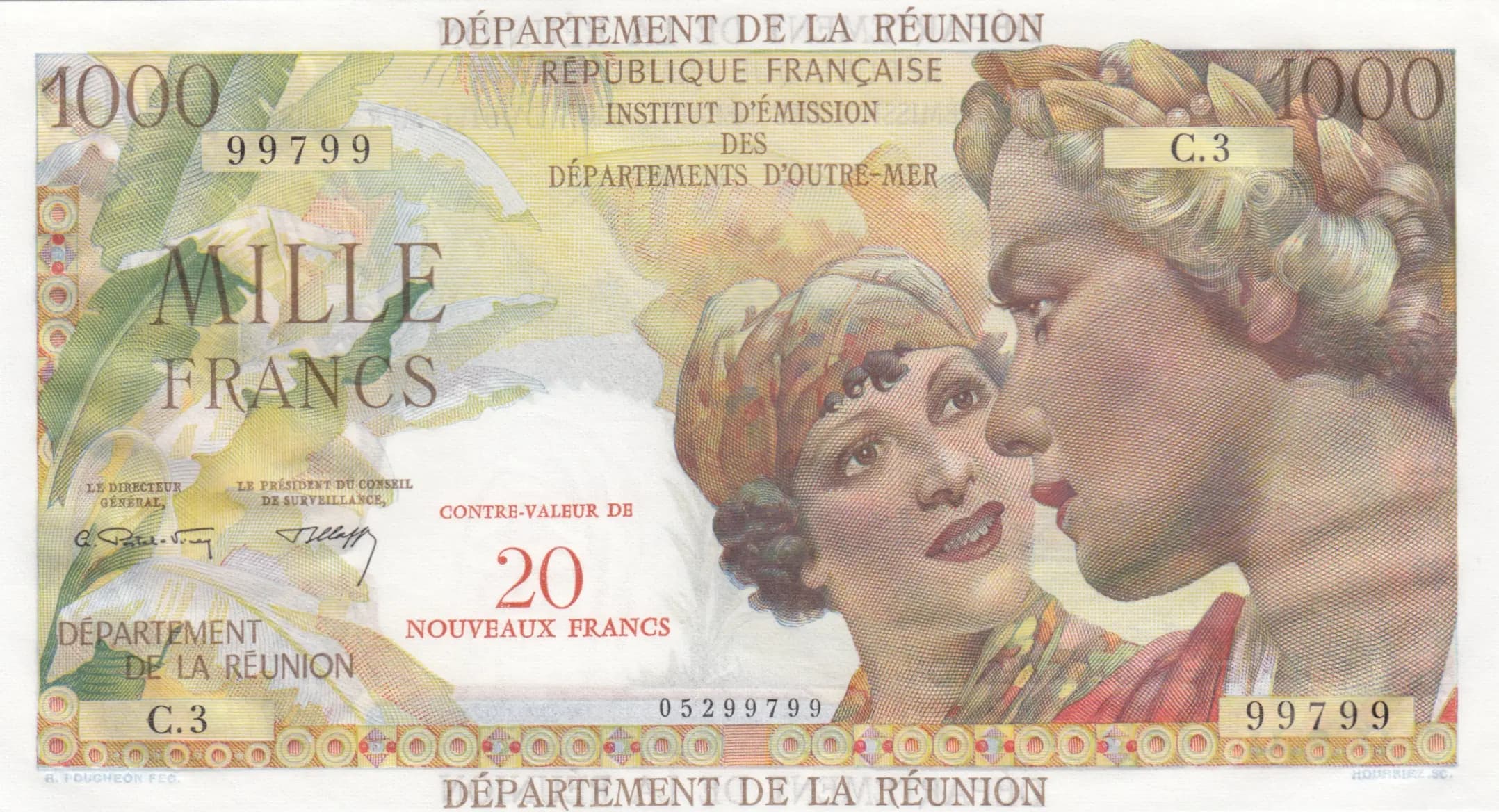
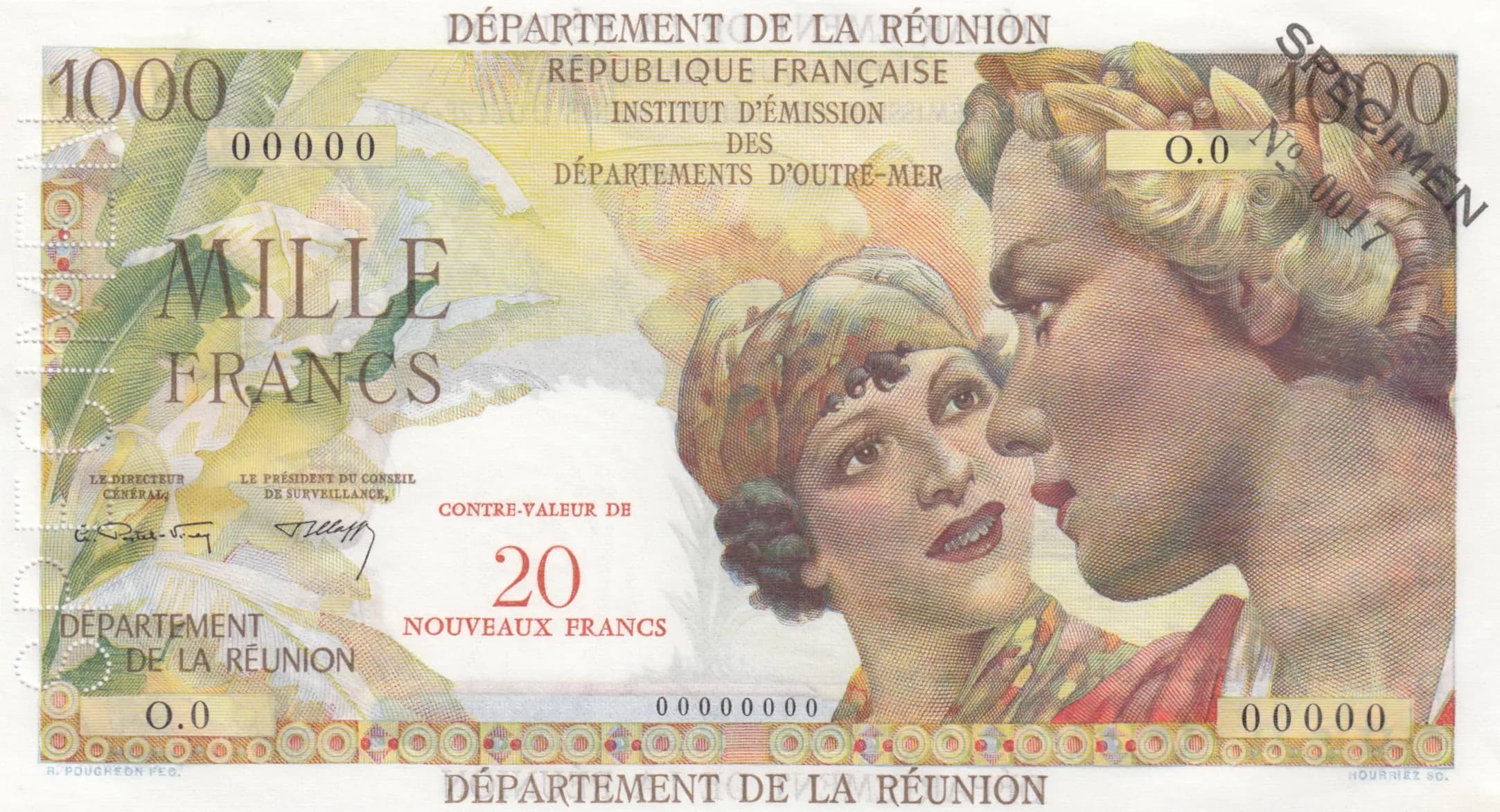
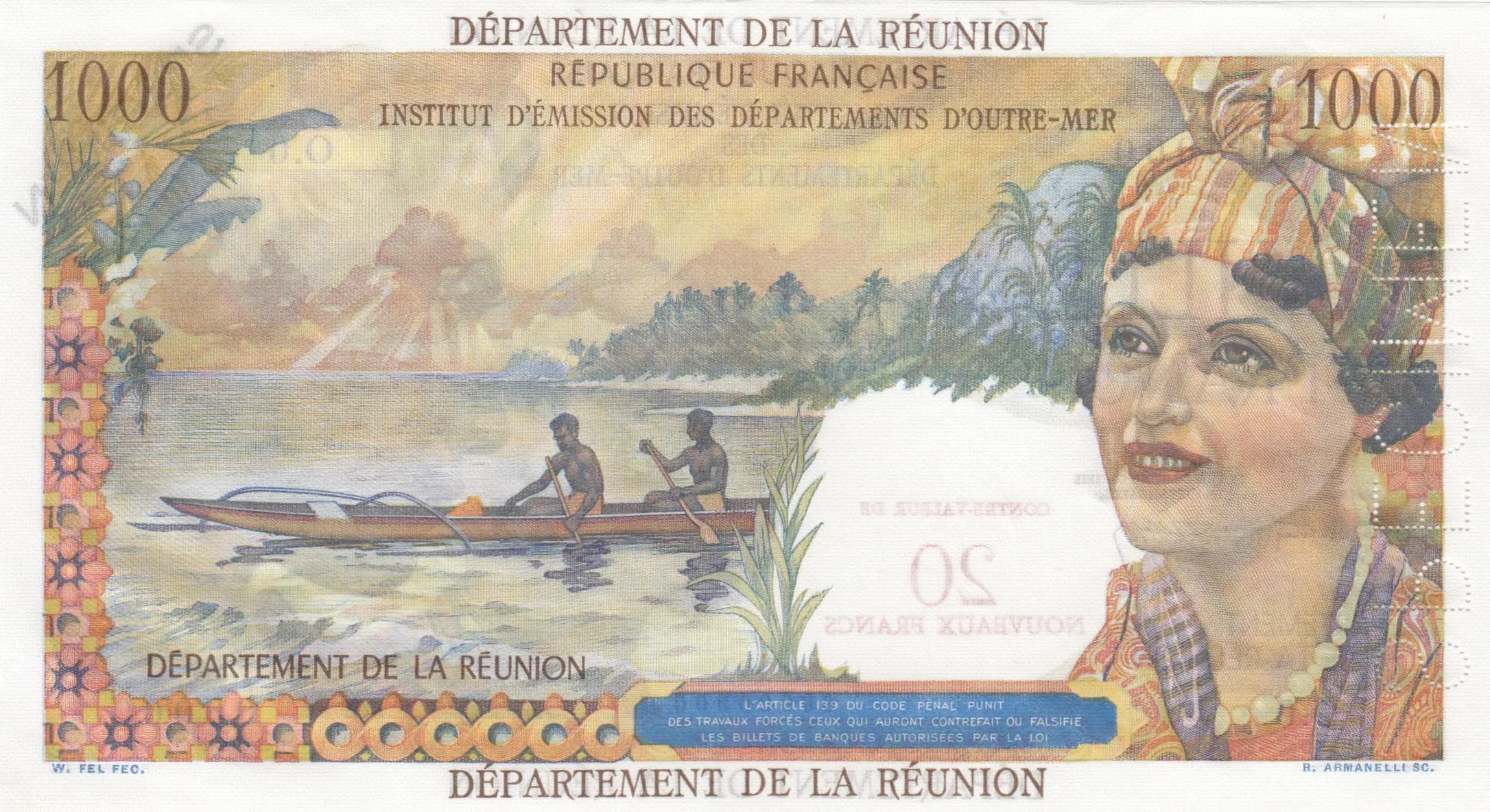
This is a striking 1971 specimen banknote from Département de la Réunion, denominated as 20 nouveaux francs (counter-value on a 1000 francs base note), issued by the Institut d'Émission des Départements d'Outre-Mer. The note exhibits exceptional UNC condition with no circulation wear, featuring vibrant tropical imagery including dual female portraits on the obverse and a detailed landscape scene with boating figures on the reverse, rendered in cream, green, blue, and orange tones with fine guilloche border work. The specimen markings and pristine presentation make this an excellent example of French overseas colonial-era currency design.
Common. While this is a specimen note (indicated by the zero serial markings and specimen designations), the P-55bs variety appears in standard catalogs without notation of limited printing. Specimen notes are produced in moderate quantities for presentation and archival purposes by currency authorities. The existence of multiple Pick variants (P-55a, P-55b, P-55bs, P-55s) suggests adequate surviving population across these related issues. Reunion overseas department currency from this period, though no longer circulating, was produced in reasonable quantities during its operational window (1967-1971).
This note represents a transitional period in French monetary history when overseas departments like Réunion maintained semi-autonomous currency systems under the Institut d'Émission des Départements d'Outre-Mer. The tropical imagery—featuring indigenous female portraits, lush forest landscapes, and river scenes with local boats—reflects Réunion's colonial identity and natural character during the early 1970s, while the denomination structure (with a counter-value conversion) documents the complex relationship between metropolitan French francs and overseas department currency. The formal legal warning on the reverse regarding counterfeiting penalties underscores the note's official status within the French Republic's monetary system.
The obverse features two female bust portraits rendered in sepia and brown tones positioned on the right side, representing Réunion's diverse population, accompanied by ornamental botanical elements and a circular medallion seal on the left. The denomination numerals '1000' appear prominently in upper corners with the counter-value designation in red. A decorative border with circular motifs frames the lower portion. The reverse showcases a romanticized tropical landscape depicting two figures in a small canoe or pirogue navigating a river with dense forest, mountains, and shoreline vegetation in the background, complemented by a female portrait bust wearing a colorful orange and patterned headwrap on the right side. Ornamental floral designs and botanical elements border the left margin, with geometric circular patterns in blue and orange at the bottom. The fine engraving work throughout suggests high-quality intaglio production typical of prestigious French security printing. The artists W. Fel and R. Armanelli are credited for the original artwork and engraving.
FRONT SIDE: 'DÉPARTEMENT DE LA RÉUNION' (Department of Reunion), 'RÉPUBLIQUE FRANÇAISE' (French Republic), 'INSTITUT D'ÉMISSION DES DÉPARTEMENTS D'OUTRE-MER' (Institute of Issue of Overseas Departments), 'MILLE FRANCS' (One Thousand Francs), 'CONTRE-VALEUR DE 20 NOUVEAUX FRANCS' (Counter-value of 20 New Francs), 'LE DIRECTEUR GÉNÉRAL' (The General Director), 'LE PRÉSIDENT DU CONSEIL DE SURVEILLANCE' (The President of the Supervisory Board), with specimen markings '0.0' and '00000000' serial number format. REVERSE SIDE: 'DÉPARTEMENT DE LA RÉUNION' (Department of Reunion), 'RÉPUBLIQUE FRANÇAISE' (French Republic), 'INSTITUT D'ÉMISSION DES DÉPARTEMENTS D'OUTRE-MER' (Institute of Issue of Overseas Departments), 'L'ARTICLE 133 DU CODE PÉNAL PUNIT LES TRAVAUX FORCÉS CEUX QUI AURAIENT CONTREFAIT OU FALSIFIÉ LES BILLETS DE BANQUES AUTORISÉS PAR LA LOI' (Article 133 of the Penal Code punishes with hard labor those who would have counterfeited or falsified authorized banknotes by law), with engraver attributions 'W. FEL FEC.' and 'R. ARMANELLI SC.'
Intaglio engraving (taille-douce) on banknote stock, characteristic of high-security French currency production. The fine guilloche patterns, detailed line work in the portraits and landscape, and the crisp clarity of all inscriptions indicate professional bank-note engraving. The water-mark areas visible in white space suggest incorporation of security watermarks. This note was produced by the Banque de France's security printing division or an authorized contractor, typical of IEDOM-issued notes from this period.
This is specifically identified as Pick P-55bs, the specimen variant (indicated by the 's' suffix denoting specimen status). The note is a specimen on the 1000 Francs base with 20 Nouveaux Francs counter-value. The PMG population report confirms four cataloged variants exist within this base Pick number: P-55a, P-55b, P-55bs (this note), and P-55s, suggesting these represent different production runs or signature combinations. The specimen markings ('O.0', '0.0', and '00000000' serial numbering) and absence of standard serial numbers confirm this as a presentation specimen rather than a currency note intended for circulation.