1 riyal 1960
About This Note
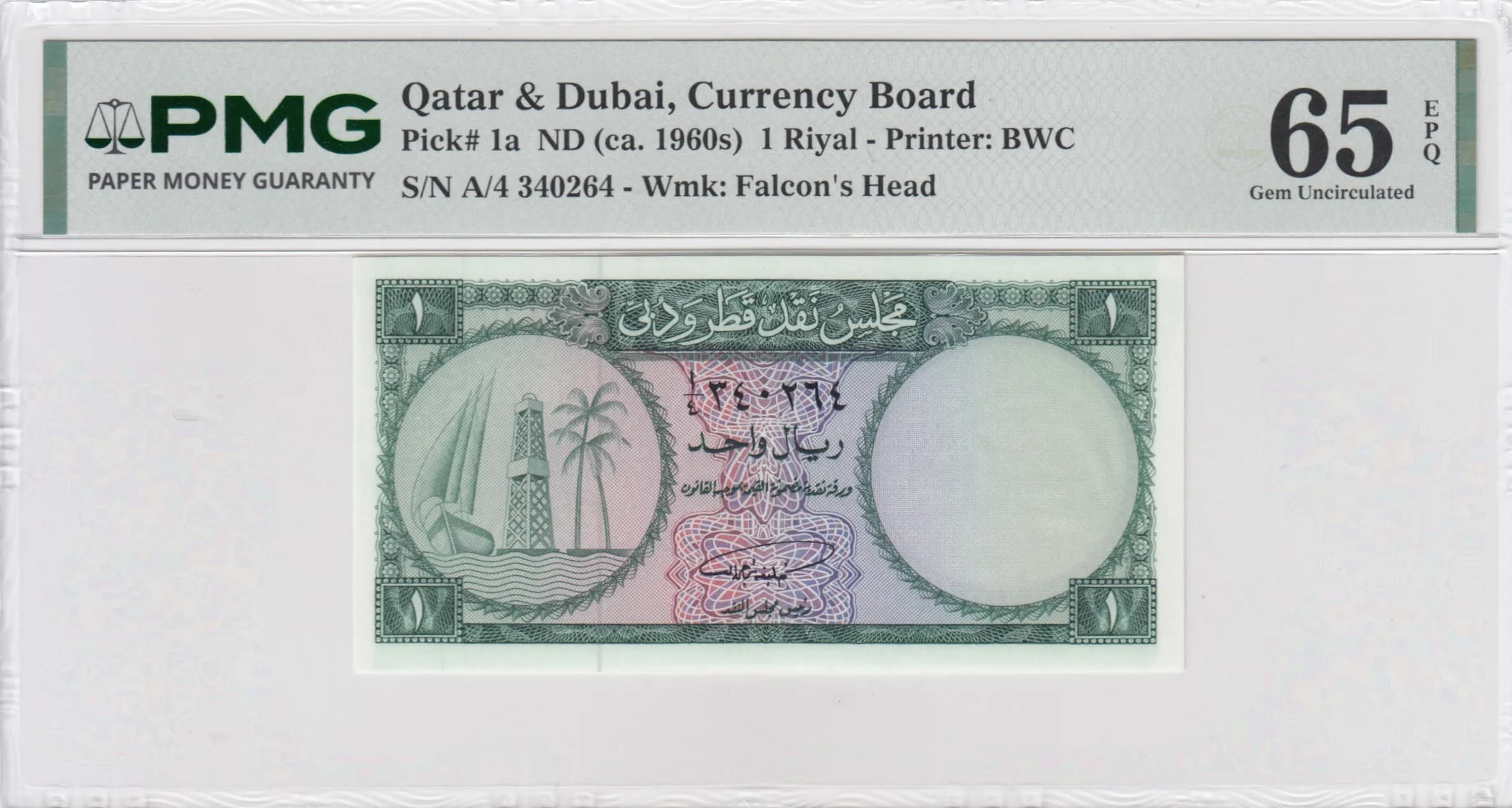
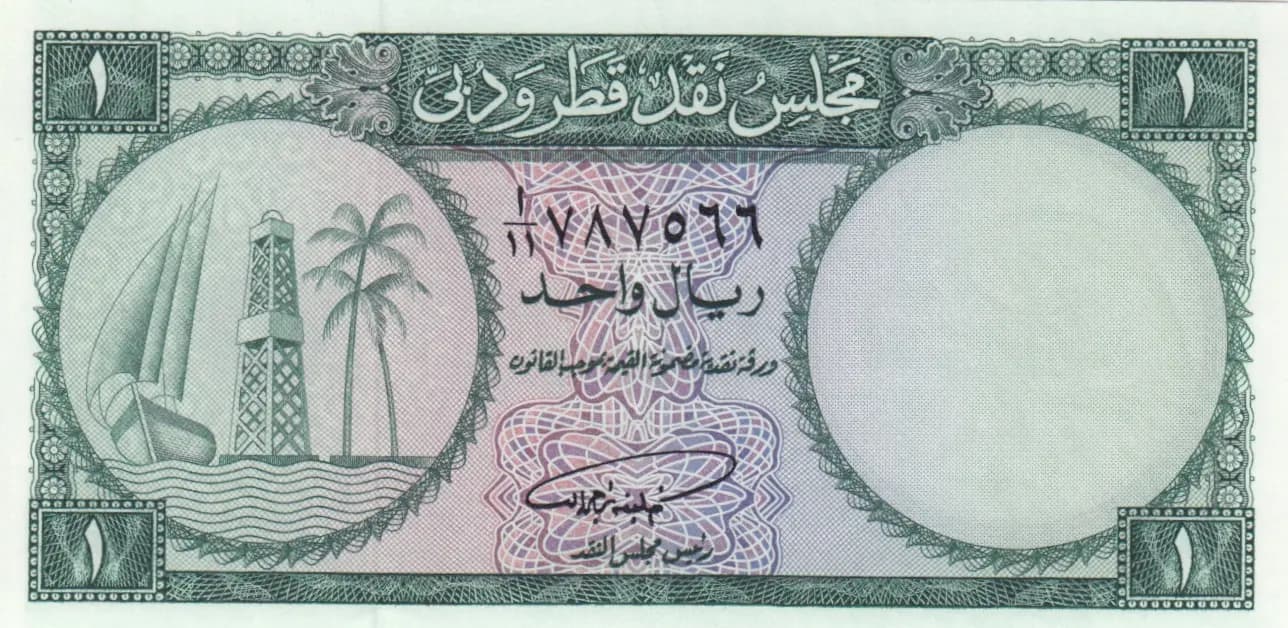
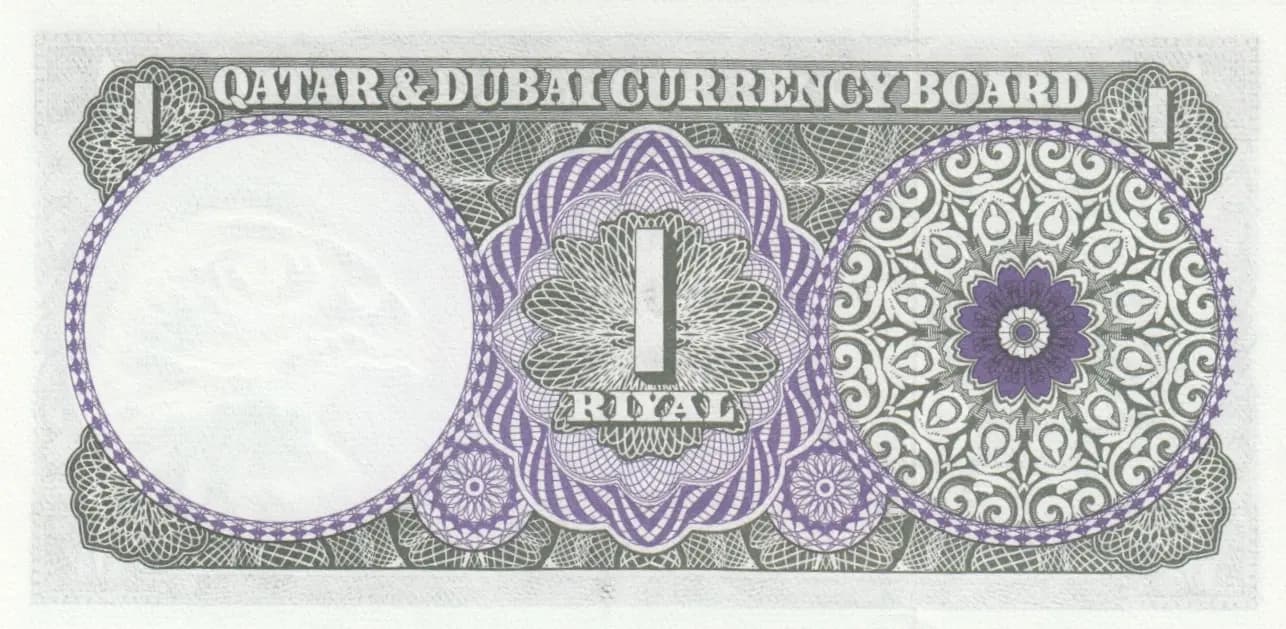
This is an exceptionally well-preserved example of the Qatar & Dubai Currency Board's 1 Riyal note from 1960 (Pick P-1), graded UNC. The note showcases exquisite engraved design work with a prominent Islamic minaret and palm tree on the obverse, complemented by ornate geometric and floral patterns in purple/pink and green. The reverse displays the issuer's name in English and features symmetrical blank circular vignettes flanking an ornate central denomination frame, representing a significant early monetary issue from the brief Qatar & Dubai Currency Board period before the establishment of independent monetary authorities.
Common. While this is an early note from a short-lived issuing authority (Qatar & Dubai Currency Board, 1960), the 1 Riyal denomination in the P-1 series appears to have been issued in substantial quantities for circulation. The existence of multiple documented varieties (P-1a, P-1cts, P-1s) and its presence in uncirculated condition in the market suggests adequate original production runs. Notes from defunct territorial authorities are highly collectible but not inherently rare unless accompanied by specific evidence of limited production or high redemption rates.
This note was issued during 1960 by the Qatar & Dubai Currency Board, a short-lived monetary authority that predated the establishment of separate central banks for Qatar and the United Arab Emirates. The Islamic architectural imagery—specifically the minaret with latticed windows and accompanying palm tree—reflects the cultural and architectural heritage of the Arabian Gulf region. The dual-territory issuing authority on this note represents a unique period in Gulf monetary history, as Qatar and Dubai would soon establish independent monetary systems.
The obverse features a circular vignette on the left depicting an Islamic minaret with characteristic latticed window patterns and an adjacent palm tree, symbolizing the architectural and natural heritage of the Arabian Gulf. The center contains elaborate ornamental patterns in purple/pink and green with fine geometric and floral elements. The reverse is dominated by an ornate flower-shaped frame containing the denomination numeral '1', with symmetrical blank circular security areas on either side. Both sides are bordered by intricate engraved geometric patterns in green (obverse) and gray/black (reverse), representing the formal monetary design of the early Gulf banking era.
Front side: 'محمد الطويل درهم' (Muhammad Al-Tawal Dirham/monetary unit reference); Corner denominations in Arabic numerals: '1'. Back side: 'QATAR & DUBAI CURRENCY BOARD' (English inscription identifying the issuing authority); Central denomination: '1' (Arabic/Western numeral); Arabic text below denomination (partially unclear in visual analysis but consistent with period monetary inscriptions).
Intaglio engraving (recess printing), evidenced by the fine line work, sharp detail in the architectural vignette, intricate guilloche border patterns, and the characteristic appearance of the ornamental elements. The precision of the corner squares, the delicate latticed patterns in the minaret window, and the complex floral designs are all consistent with high-quality security printing of the era. The printer for the P-1a variety is known to be BWC (British-American Banknote Company), a leading security printer of the period.
This specimen is consistent with the P-1 base pick number for the 1 Riyal denomination issued by the Qatar & Dubai Currency Board in 1960. The visual characteristics suggest it may be the P-1a variety (printed by BWC - British-American Banknote Company), the primary circulation variety of this denomination. The note displays the characteristic design elements of the 1960 series without visible overprints or alterations. PMG cataloging indicates at least three primary varieties exist (P-1a, P-1cts, P-1s), though the specific variety classification would require examination of printing details, serial number prefixes, and signature variations not fully discernible in the provided images.