10 pesos 1944
“Negros Emerg.”
Market Prices
1 saleAbout This Note
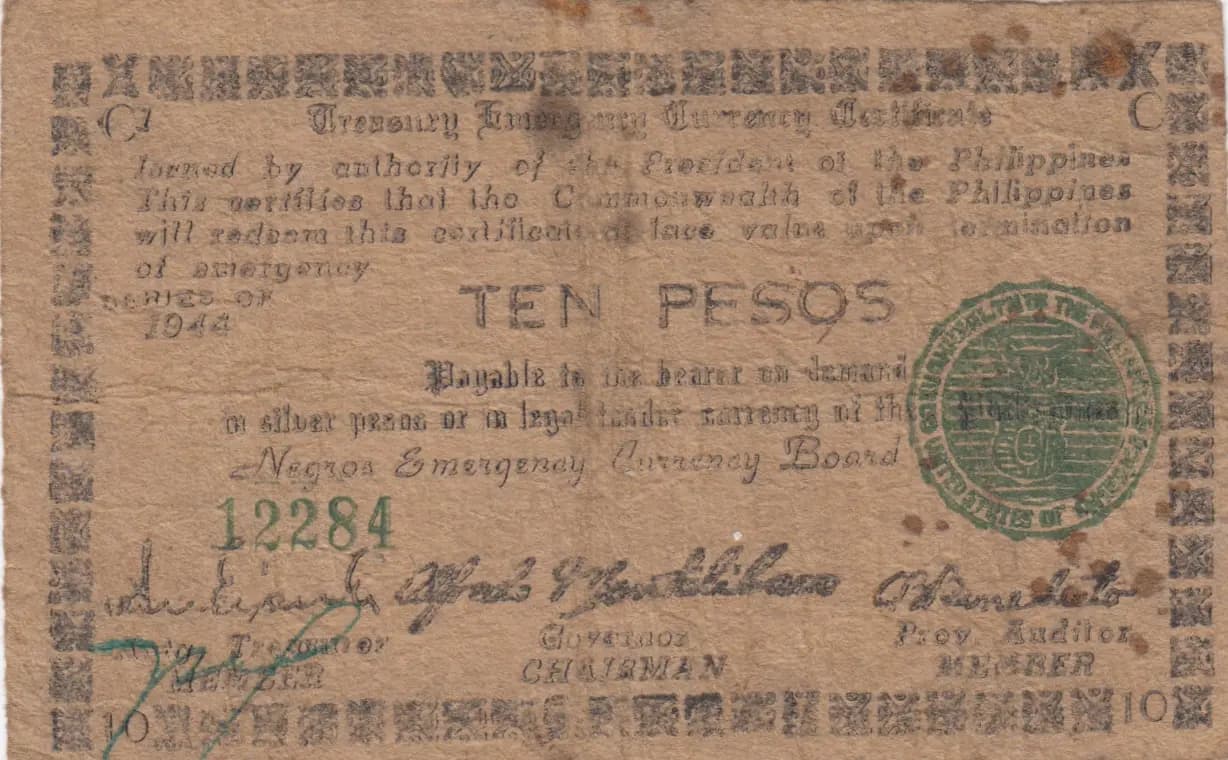
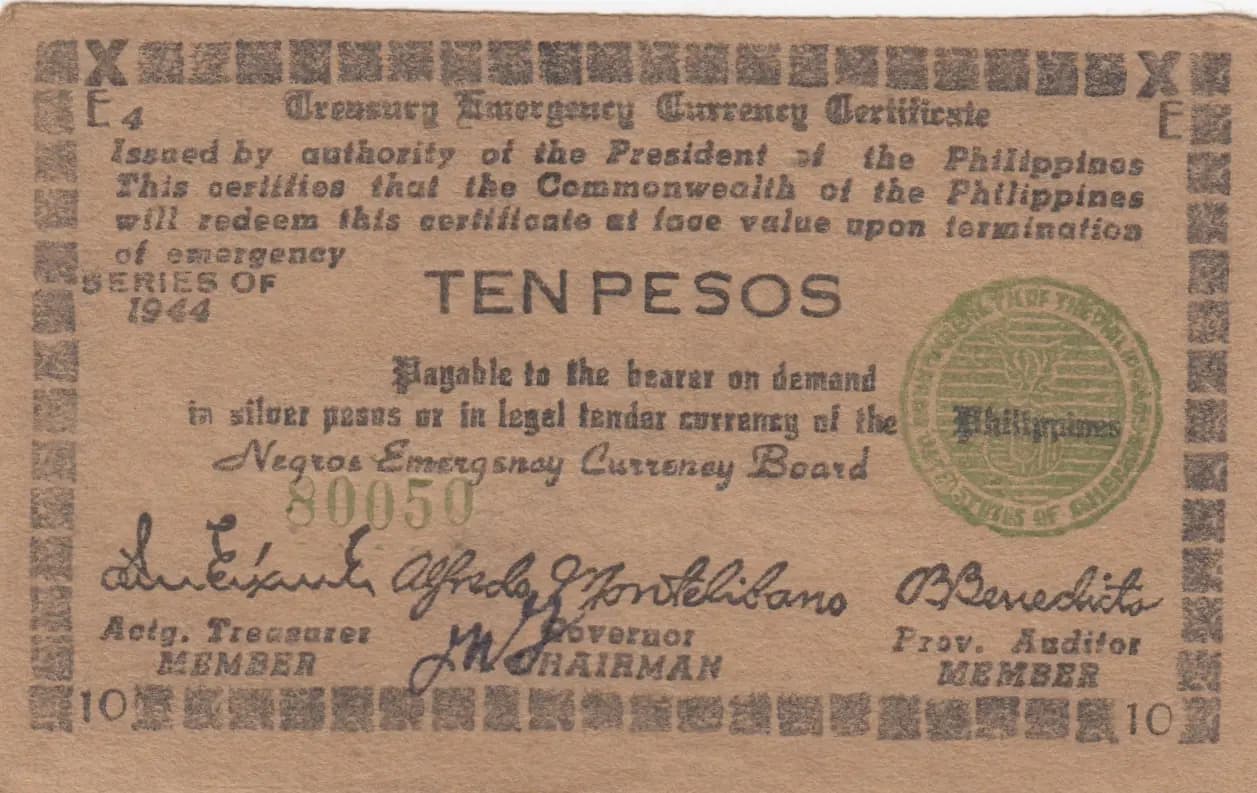
This is a Philippine Treasury Emergency Currency Certificate from 1944, issued by the Commonwealth of the Philippines during wartime conditions. The note displays the characteristic tan/beige coloring and decorative border typical of emergency currency from this period, with an official Commonwealth seal and multiple signatures from government officials. In AU condition, this specimen represents a well-preserved example of the Negros Emergency Currency Board issue, with legible text and minimal wear despite its nearly 80-year age.
Common. Emergency currency certificates from the Philippines dated 1944 were produced in substantial quantities to meet wartime circulation needs across different provinces. The eBay price reference of $2.73 for a VF example indicates these notes have minimal collector premium and are readily available in the secondary market. Serial number 30050 suggests a mid-range production number consistent with healthy print runs. While historically significant, these notes are not scarce in collector terms.
This emergency currency certificate was issued under the authority of the Philippine President during 1944, a critical year in World War II when normal currency production and distribution were disrupted. The Negros Emergency Currency Board inscription indicates this was a regional issue specific to the Negros province, which required local emergency financial solutions during the Japanese occupation period. The redemption clause promising repayment 'upon termination of emergency' reflects the temporary nature of these certificates, which were meant to address immediate liquidity needs in areas cut off from central banking facilities.
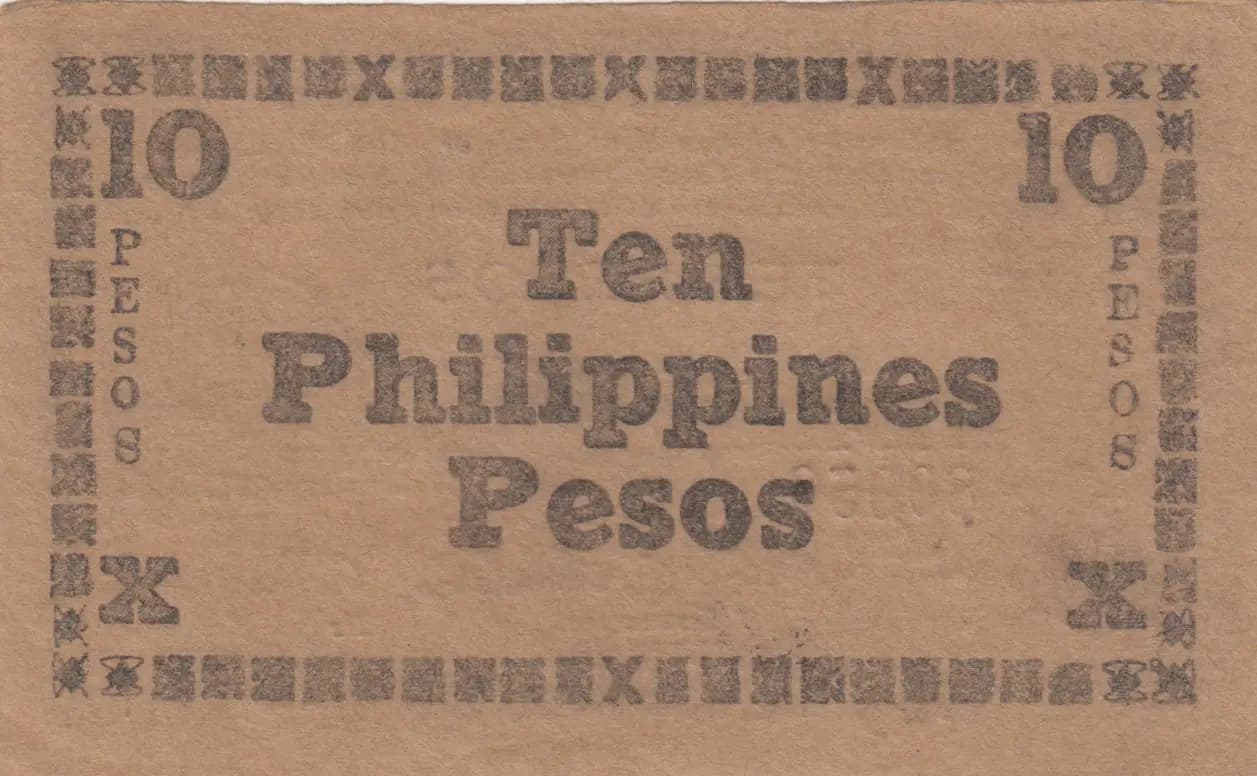
The note features a simple but official design befitting an emergency currency certificate. The front side displays the formal government text and redemption guarantee prominently, with the circular green seal of the Commonwealth of the Philippines positioned on the right side as the primary security element. Four signature lines represent the official authorization structure of the Negros Emergency Currency Board, indicating multi-level approval. The decorative border pattern frames all text on both sides, providing a formal appearance. The back is more minimalist, with the denomination '10 PESOS' repeated at top and bottom corners surrounding the centered text 'Ten Philippines Pesos', emphasizing the face value. The overall design prioritizes clarity and official legitimacy over artistic elements, appropriate for emergency wartime currency.
FRONT SIDE: 'Treasury Emergency Currency Certificate' — 'Issued by authority of the President of the Philippines' — 'This certifies that the Commonwealth of the Philippines will redeem this certificate at face value upon termination of emergency' — 'SERIES OF 1944' — 'TEN PESOS' — 'Payable to the bearer on demand in silver pesos or in legal tender currency of the Negros Emergency Currency Board' — Serial number '30050' — Signature lines for 'Acting Treasurer', 'Governor' (marked CHAIRMAN), 'Provincial Auditor' (marked MEMBER), and additional 'MEMBER' position. BACK SIDE: Denomination display showing '10' and 'PESOS' in multiple positions framing the center text 'Ten Philippines Pesos'.
Letterpress printing on aged paper stock. The note exhibits the characteristic crisp text impression and border definition typical of letterpress work from this era. The green seal on the front side appears to be applied separately, possibly as an embossed or stamped impression. The multiple signature lines are hand-signed in ink, as was standard for official government certificates of this period.
Pick catalog P-S676 designation indicates this is the standard Negros Emergency Currency variant. The specific serial number 30050 observed on this specimen falls within typical production sequences. Varieties of Philippine emergency currency from this period are generally distinguished by serial number ranges, signature combinations, and provincial issuing authority variations. No overprints or secondary markings are visible on this example. The 1944 series date is consistent with the primary wartime emergency issue.