10 pesos 1944
“Mindanao”
Market Prices
About This Note
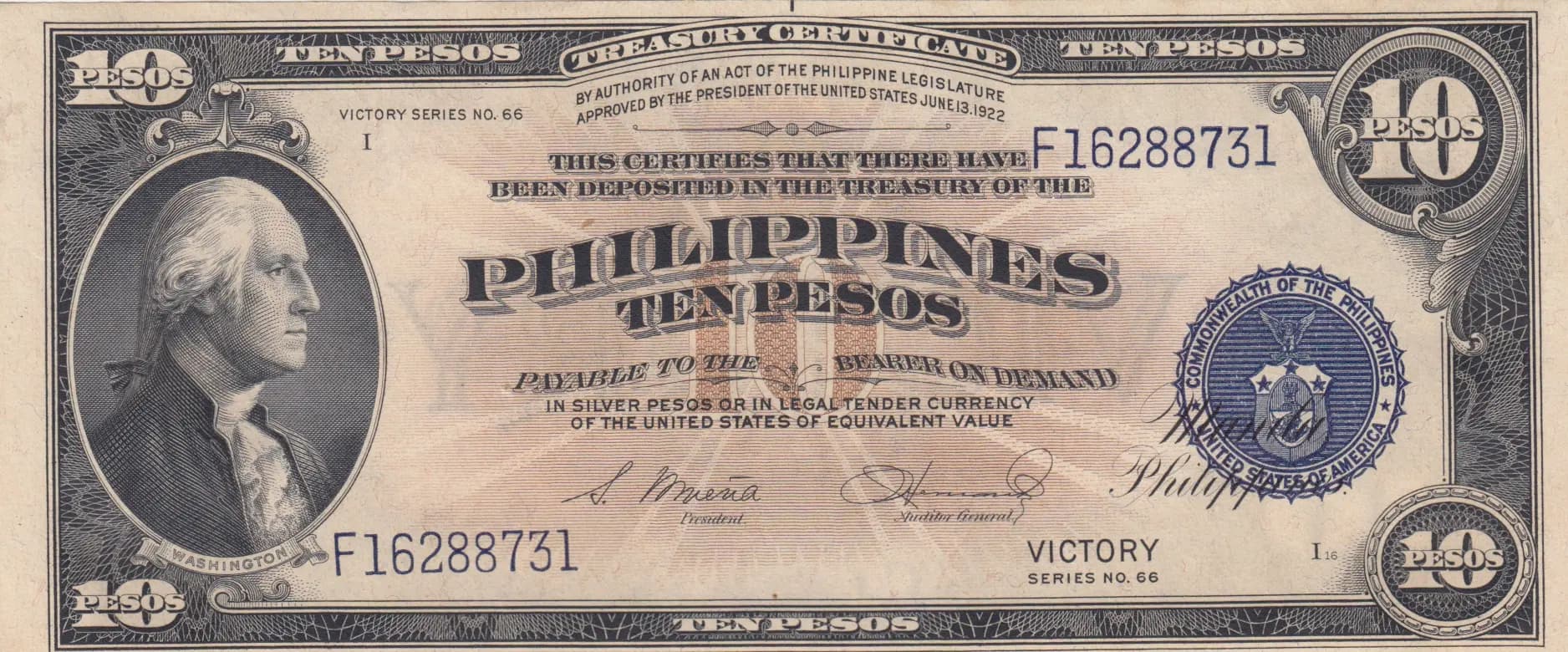
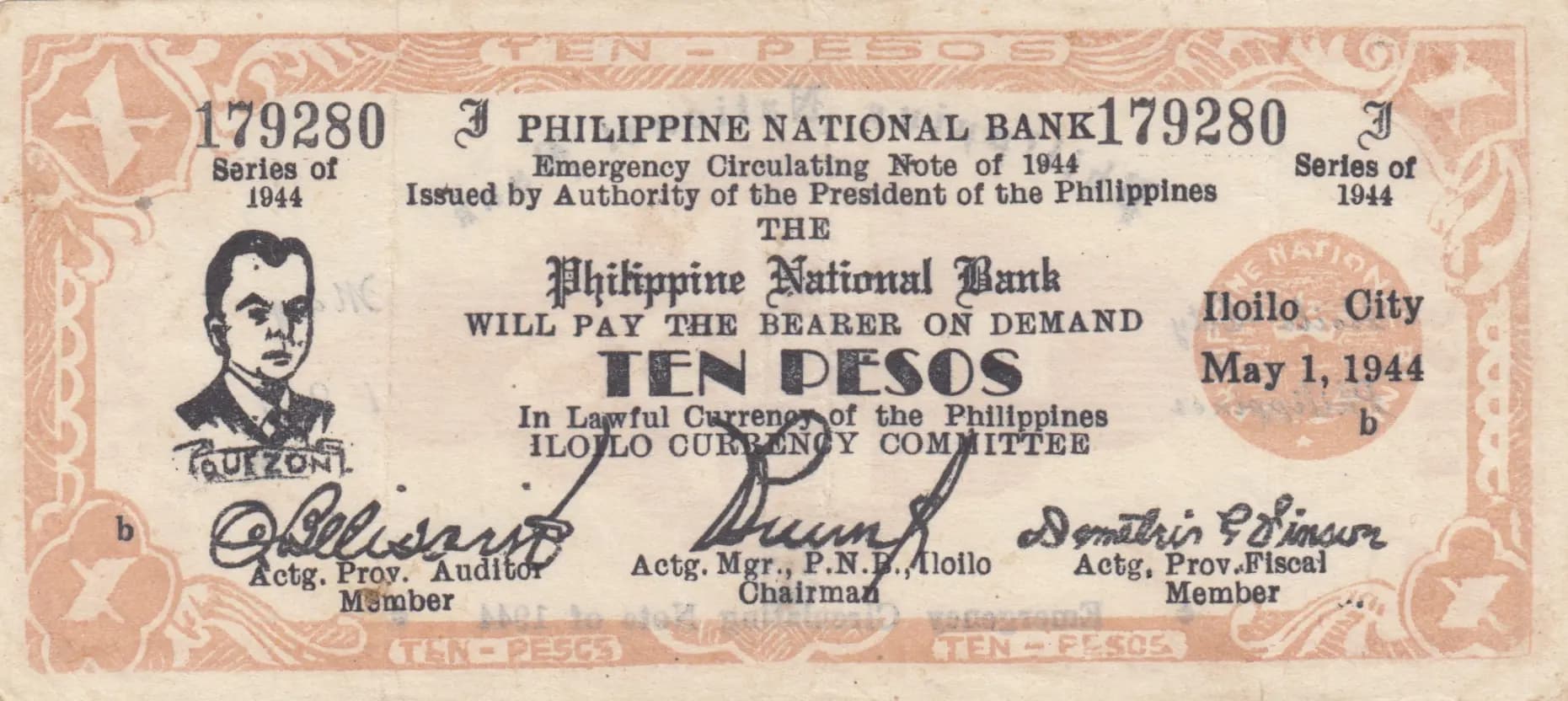
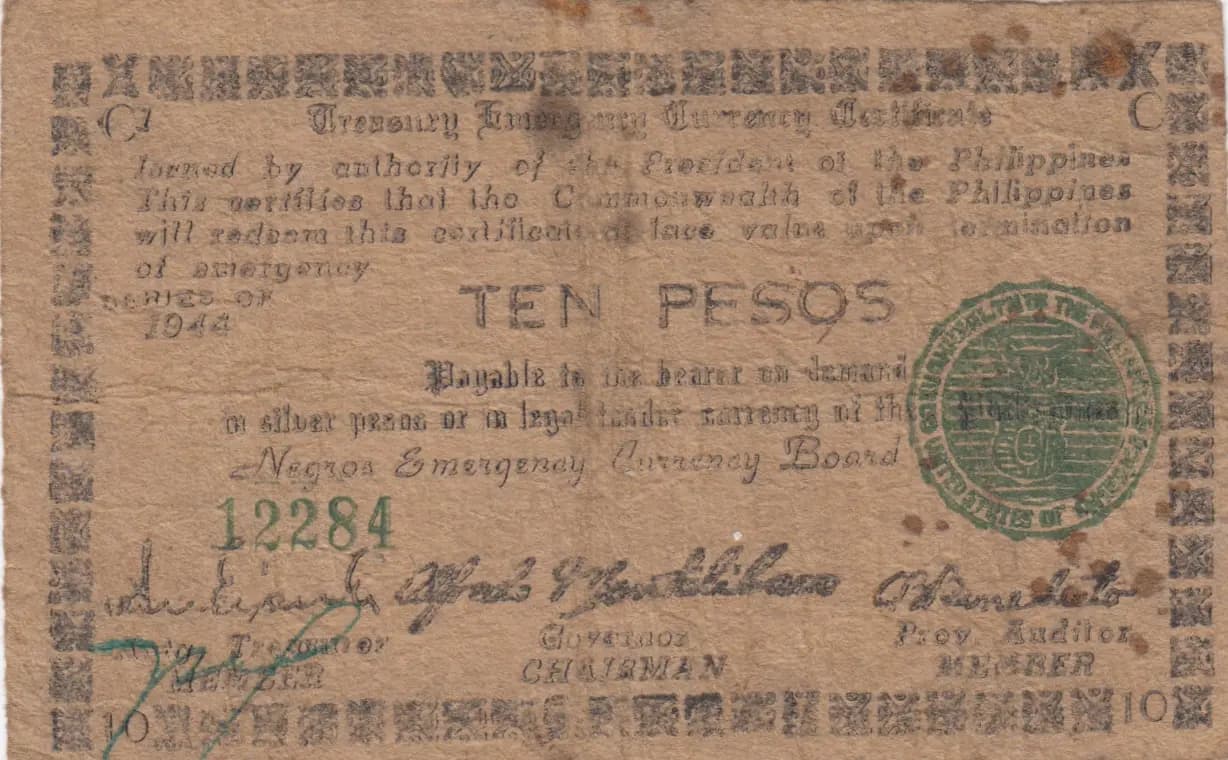
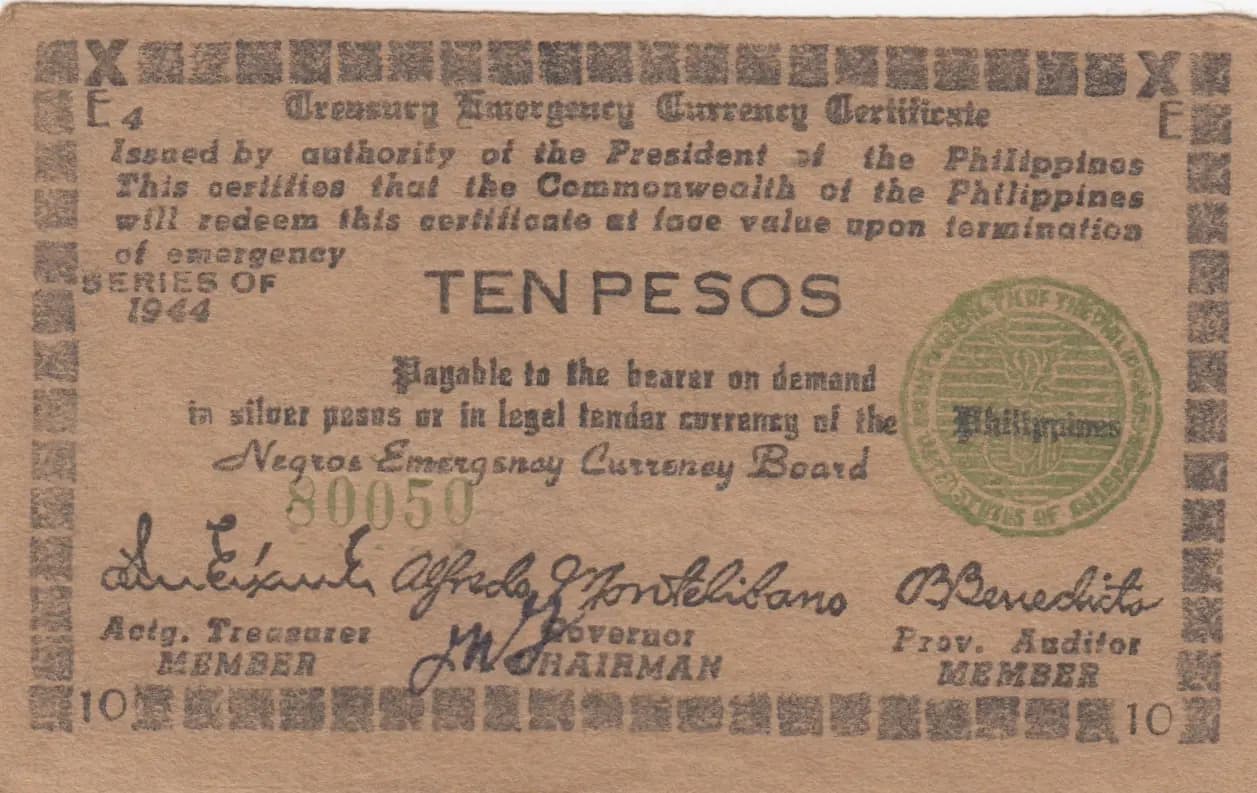
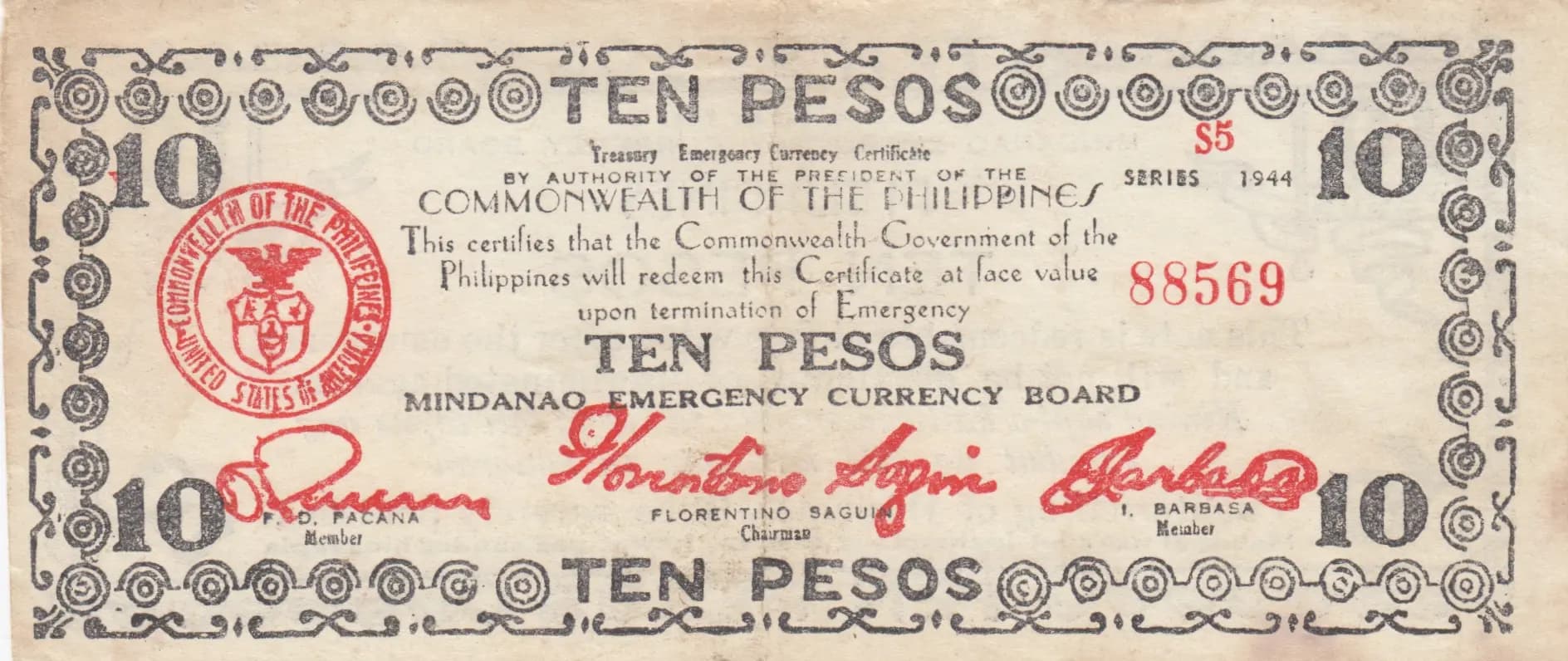
This 10 pesos Treasury Emergency Currency Certificate from 1944 represents a fascinating piece of Philippine wartime monetary history, issued by the Mindanao Emergency Currency Board during the Japanese occupation. The note exhibits typical VF condition with noticeable foxing, creasing, and age-related discoloration on its tan/beige background, while the bold red Commonwealth seal with eagle and shield remains relatively vibrant. The bilingual inscriptions in English and Cebuano/Filipino, combined with the ornamental circular border designs and red signatures, make this an important regional emergency issue that collectors value for its historical significance and scarcity.
Common. The eBay market data shows multiple sales across a wide price range ($2.02 to $488.88 USD), with VF-condition examples consistently selling for $14.99 to $150.00 USD—a relatively modest range indicating steady but not exceptional collector demand. The presence of numerous sales listings and the broad price variance typical of common notes in varying conditions suggest this is a frequently encountered variety. While the Mindanao Emergency Currency Board issues are certainly less common than standard Philippine Commonwealth notes, the Pick P-S527e series was produced in sufficient quantity that examples remain available to collectors at modest price points. The VF condition grade of this specimen, paired with typical market pricing around $50-150 USD, confirms it as a standard collectible rather than a rare or scarce variant.
This note was issued during the final year of World War II when the Commonwealth of the Philippines was under Japanese occupation, necessitating emergency currency production by regional authorities rather than the central government. The Mindanao Emergency Currency Board's issuance of this certificate reflects the fragmented monetary conditions in the Philippine archipelago during the war, with different regions producing their own emergency currency to maintain commerce. The redemption promise printed on the note—assuring holders it would be honored at face value after the emergency ended—was a critical confidence measure in a period of severe monetary disruption.
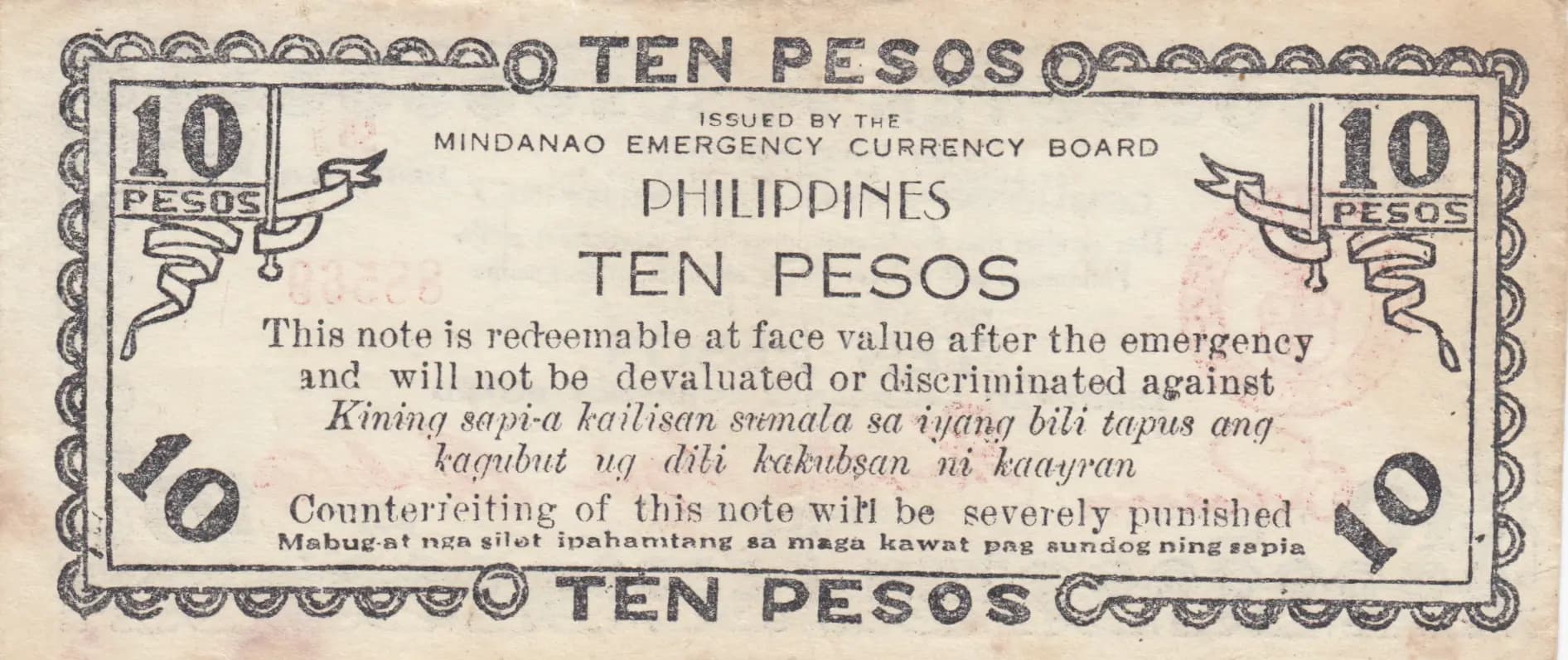
This emergency currency certificate features a utilitarian wartime design dominated by decorative circular emblems arranged in borders along the left and right margins, providing a formal yet austere appearance appropriate to emergency wartime conditions. The front displays a large red circular seal containing the Commonwealth of the Philippines eagle and shield emblem, positioned prominently on the left side as the primary security feature and governmental authority symbol. The denomination '10 PESOS' appears in large numerals at the top left and right corners, with the main body text centered and explaining the note's status as a Treasury Emergency Currency Certificate redeemable by the Commonwealth government. The back side maintains the decorative circular border motif and ornamental ribbon or banner designs in the corners, with larger denomination numerals and bilingual text in English and Cebuano/Filipino. The three authorized signatures in red ink appear at the bottom of the front, including Florentino Sagui as Chairman, representing the authority of the Mindanao Emergency Currency Board. The overall design reflects practical wartime printing constrained by available resources, utilizing simple geometric ornamental patterns rather than complex security features or portraiture.
FRONT SIDE: 'TEN PESOS' / 'Treasury Emergency Currency Certificate' / 'BY AUTHORITY OF THE PRESIDENT OF THE COMMONWEALTH OF THE PHILIPPINES' / 'This certifies that the Commonwealth Government of the Philippines will redeem this Certificate at face value upon termination of Emergency' / 'MINDANAO EMERGENCY CURRENCY BOARD' / 'S5' / 'SERIES 1944' / Serial number: '88569' / Signatures: 'Florentino Sagui, CHAIRMAN' / 'I. BARBASA, Member' / 'Member' [third signature unclear]. BACK SIDE: 'TEN PESOS' (repeated in corners) / 'ISSUED BY THE MINDANAO EMERGENCY CURRENCY BOARD, PHILIPPINES' / 'This note is redeemable at face value after the emergency and will not be devalued or discriminated against' / Cebuano/Filipino equivalent: 'Kining sapi-a kailisan semala sa iyang bili tapus ang kagubut ng diti kakubsan ni kaayran' / 'Counterfeiting of this note will be severely punished' / Cebuano/Filipino equivalent: 'Mabug-at nga silot ipahamtang sa mga kawat pag sundog ning sapia'
This note was produced using letterpress printing, the standard commercial printing method of the 1940s, evidenced by the characteristic crisp registration of text and the uniform black ink on the tan/beige paper stock. The red seal and red signatures show the use of multiple color runs typical of letterpress production. The serial number and denomination numerals display the bold, clearly-defined characteristics of metal type impression. Given the emergency wartime circumstances of 1944 Mindanao, this was likely printed by whatever printing facilities were available locally or by the Philippine government's emergency printing operations, rather than by an international security printer. The relatively simple ornamental borders and lack of advanced security features reflect the constrained circumstances of wartime emergency currency production.
This specimen is identified as Pick P-S527e, the 'e' designation indicating a specific variety within the 10 pesos 1944 Mindanao Emergency Currency Board series. The note bears Series designation 'S5' and serial number 88569 (both printed in red), with signatures of Florentino Sagui as Chairman and I. Barbasa as Member. The variety designation in the Pick catalog system (P-S527e) likely indicates specific printing characteristics, signature combinations, or serial number ranges that distinguish it from other varieties in the same series (P-S527a through P-S527d and potentially beyond). Without access to complete Pick catalog specifications for all S527 varieties, the primary distinguishing features of this P-S527e variety appear to be the signature combination of Sagui and Barbasa and the specific 'S5' series designation, suggesting there were multiple printings or authorization signature variations within the 1944 Mindanao issue.