10 pesos 1942
“Iloilo”
Market Prices
About This Note
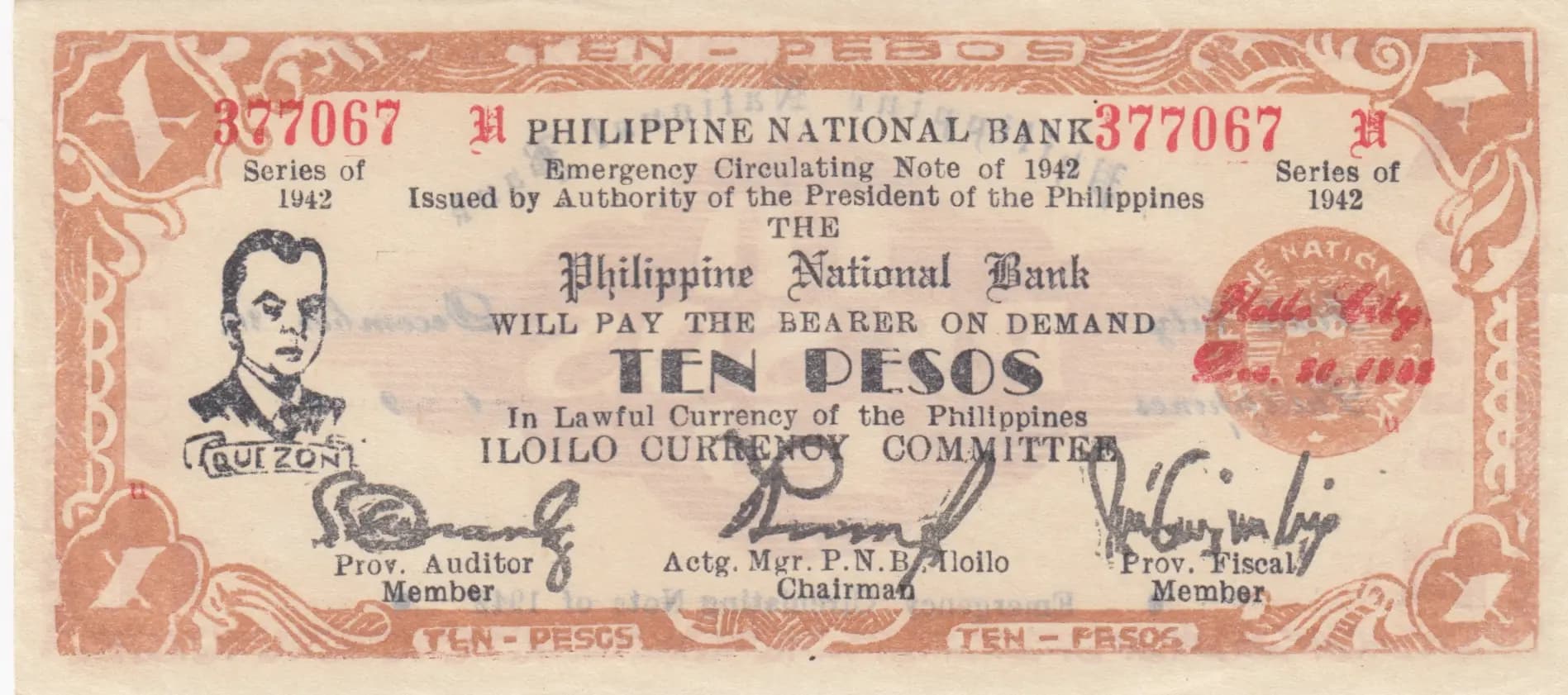
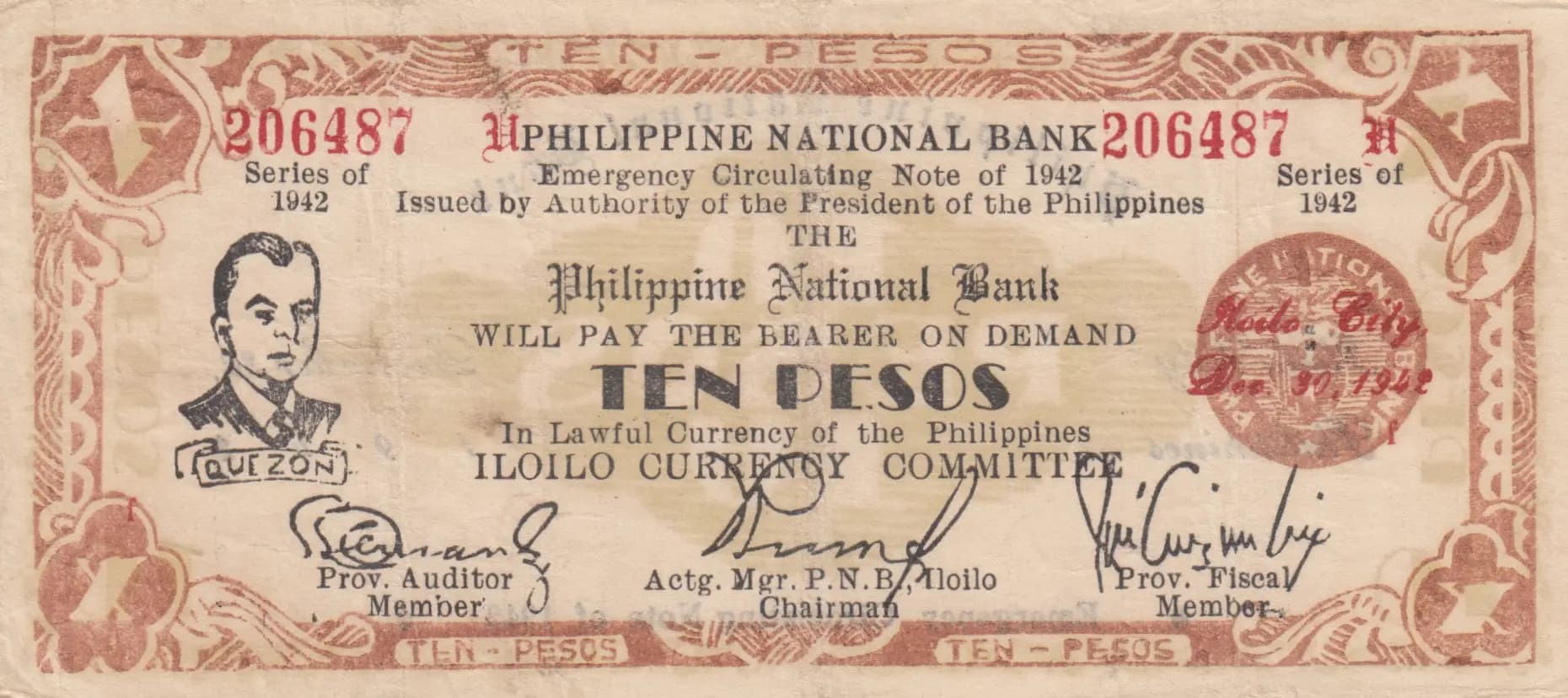
This Philippine National Bank 10 pesos emergency circulating note from 1942 represents a fascinating piece of World War II-era Philippine monetary history. The note features a portrait of President Quezon and displays the characteristic ornate reddish-brown border design typical of emergency currency from this period. In VF condition with visible aging, creasing, and foxing, this Iloilo-issued example shows authentic circulation wear and includes handwritten date and location inscriptions on the reverse, making it a historically significant artifact from the Japanese occupation period.
Common. eBay market data shows these emergency notes trading consistently in the $2-10 USD range across various condition grades (circulated, XF, AU, UNC), with most transactions under $5 USD. The high volume of eBay listings with multiple examples at low price points confirms this is a readily available note in the collector market. Emergency currency from this period was issued in substantial quantities for regional circulation, and surviving examples are not scarce. VF condition specimens like this one fall within normal collector demand and do not command premium pricing.
Issued during the Japanese occupation of the Philippines in 1942, this emergency circulating note was authorized by the President of the Philippines and administered through local currency committees, as evidenced by the 'ILOILO CURRENCY COMMITTEE' designation. The prominent portrait of President Manuel Quezon reflects Philippine national identity even during occupation. The specific Iloilo City issuance date of December 30, 1942, connects this note to regional emergency monetary measures implemented when conventional currency supplies were disrupted.
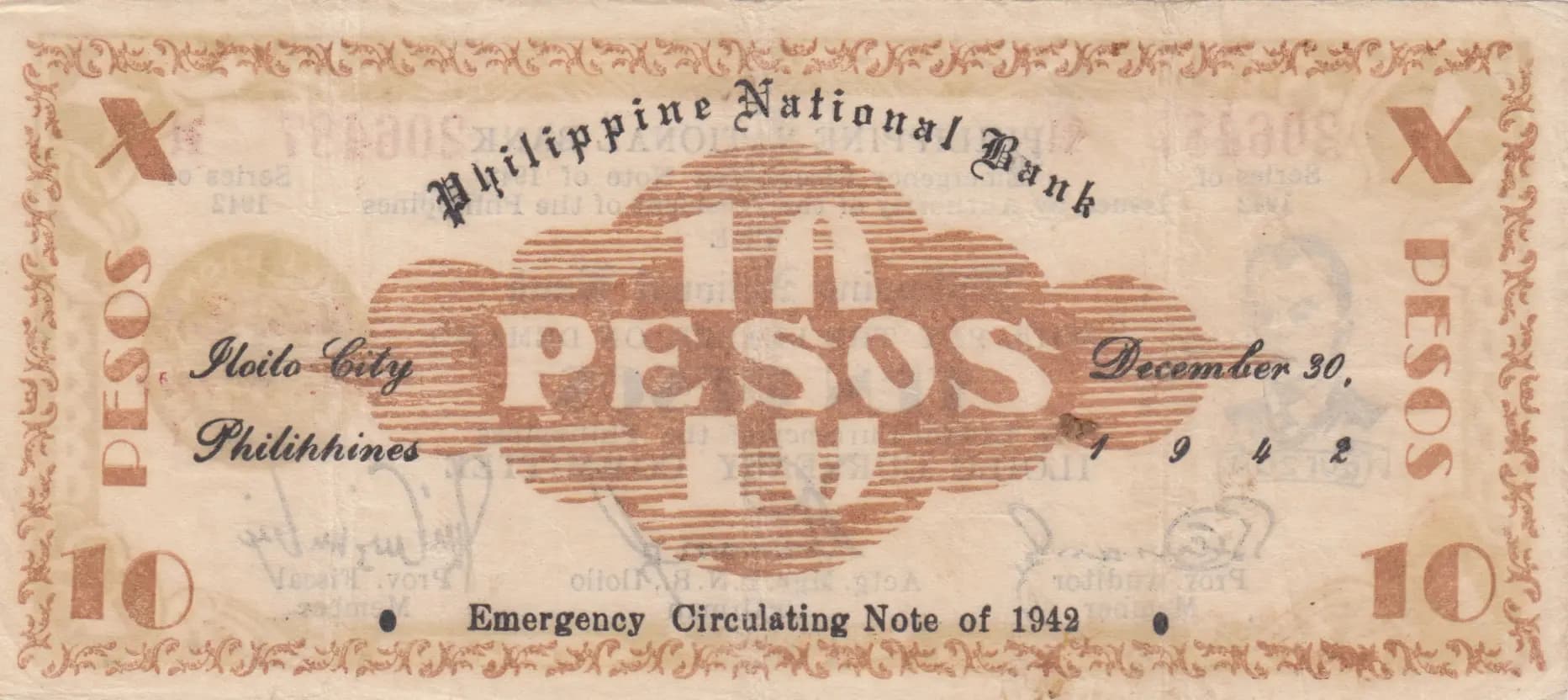
This emergency currency note features President Manuel L. Quezon in a formal left-facing portrait on the obverse, rendered in black and white engraving against a cream/beige background. The entire note is framed by an ornate decorative border executed in reddish-brown, characteristic of Philippine emergency notes from this period. The reverse displays a large denomination cartouche containing '10 PESOS' within a shaded oval or cloud-shaped design, flanked by large 'X' marks in opposite corners—a distinctive security feature indicating emergency currency status. The note measures in the typical Philippine banknote format and includes handwritten administrative details (location, date, and committee signatures) on the reverse, reflecting the localized, committee-supervised nature of emergency currency issuance during World War II.
FRONT: Serial number 206487 appears in top left and right corners. 'PHILIPPINE NATIONAL BANK' - issuing institution. 'Emergency Circulating Note of 1942' - note classification. 'Series of 1942' - series designation. 'Issued by Authority of the President of the Philippines' - authorizing authority. 'WILL PAY THE BEARER ON DEMAND' - promise to pay. 'TEN PESOS' and 'TEN - PESOS' - denomination in English. 'In Lawful Currency of the Philippines' - legal tender declaration. 'QUEZON' - portrait identification (President Manuel L. Quezon). 'ILOILO CURRENCY COMMITTEE' - issuing committee. Committee members listed as: 'Actg. Mgr. P.N.B. Iloilo Chairman' (Acting Manager, Philippine National Bank Iloilo, Chairman), 'Prov. Auditor Member' (Provincial Auditor Member), and 'Prov. Fiscal Member' (Provincial Fiscal Member). BACK: 'Philippine National Bank' - issuing institution repeated. '10 PESOS' - denomination in oval cartouche. 'Iloilo City' and 'Philippines' - issuing location. 'December 30, 1 9 4 2' - handwritten issuance date. 'Emergency Circulating Note of 1942' - note classification repeated.
Intaglio engraving (line engraving) was employed for the primary design elements, portraits, and decorative borders, as evidenced by the precise detail visible in the Quezon portrait and ornamental border work. Serial numbers and denomination text appear to be letterpress printed. The large 'X' marks and cartouche design utilize line shading characteristic of engraved currency production. Handwritten elements (date, location, and committee member signatures) were added post-printing by authorized committee representatives. No specific security printer is identified in the catalog data; Philippine National Bank likely utilized domestic or available printing facilities during the wartime occupation period.
This specific example is identified as Pick S317a, indicating a known variety designation in the standard catalog. The Iloilo City issuance (as opposed to other Philippine regions that issued similar emergency notes) represents a geographical variety. Serial number 206487 is unique to this individual note. The handwritten date of December 30, 1942, and committee member signatures would vary across examples, as these were applied individually during issuance. Additional cataloged varieties of this denomination and period may exist with different serial number ranges, committee member names, or regional issuing authority designations (such as notes issued from Manila or other provincial centers), though this information is not detailed in the available catalog data.