1 peso 1942
“Cagayan”
Market Prices
About This Note
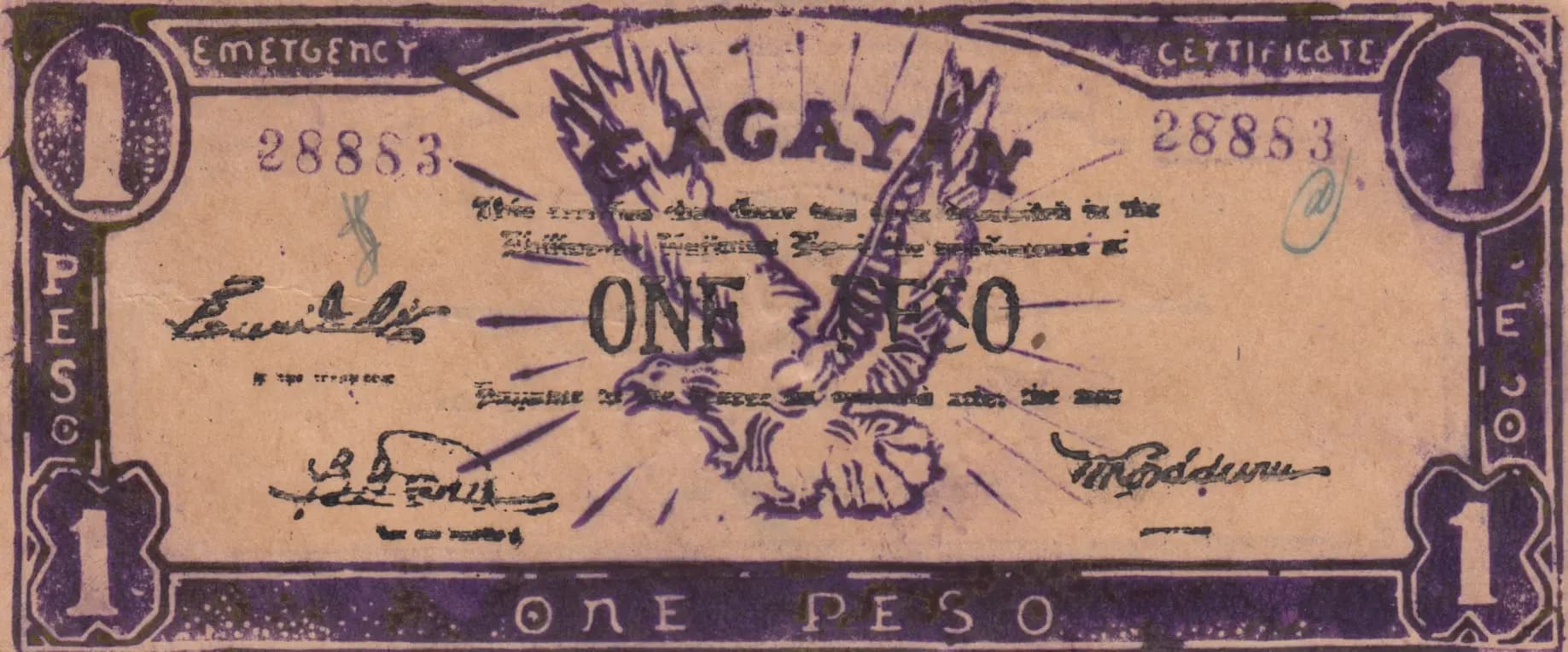
This is a Commonwealth of the Philippines 1 peso emergency certificate from 1942, graded AU, featuring a striking central sun/star design with radiating rays printed in purple and blue-black ink on tan paper. The note exhibits significant age-related wear including foxing, faded ink, and multiple handwritten signatures, characteristic of emergency currency that circulated during wartime conditions. The Cagayan provincial designation and serial number 28853 make this a regionally-specific emergency issue of historical interest to Philippine numismatists.
Common. The eBay market data shows consistent sales in the $2-20 USD range across various condition grades, with most circulated examples selling for under $15 USD. Print runs of these Commonwealth emergency certificates were substantial given the widespread need during the occupation period, and surviving examples remain readily available to collectors. The AU grade represents better condition, which explains the higher end of pricing in comparable eBay sales, but the note type itself is not scarce.
This emergency certificate was issued by the Commonwealth of the Philippines during 1942, a critical year of World War II in the Pacific when the Japanese occupation disrupted normal currency supplies and banking operations. The deliberate sun/star motif with radiating design symbolized hope and national resilience during the occupation period, while the provincial designation of Cagayan reflects localized emergency currency distribution across the archipelago. Emergency certificates served as essential substitutes for regular currency when metal coins became scarce and official banknote printing was impossible under wartime conditions.
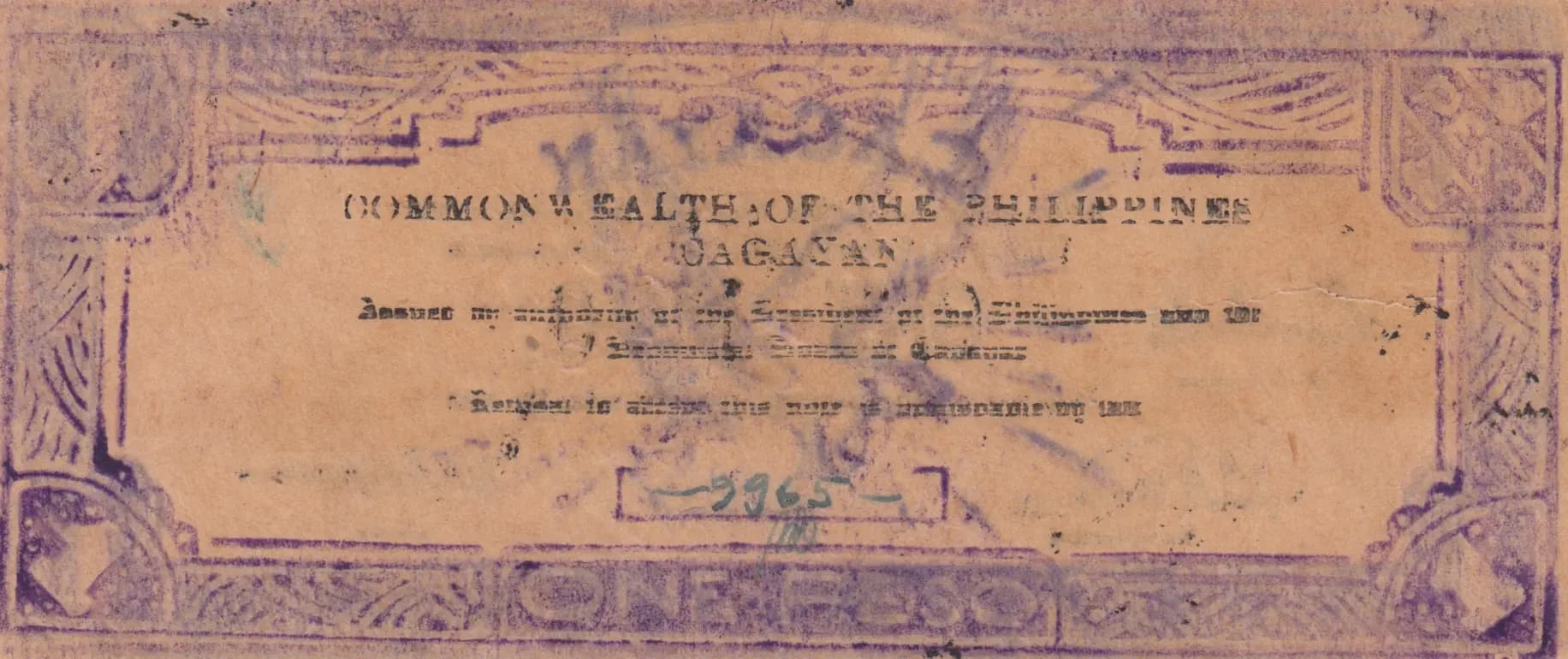
The note features a symmetrical design centered on a stylized sun or radiant star motif, a common symbol in Philippine heraldry representing national identity and sovereignty. No portrait figures are depicted, consistent with emergency certificate design practices of the period. The denomination '1' appears in decorative circles at all four corners, framed by ornamental border patterns featuring geometric and floral design elements typical of 1940s Philippine currency aesthetics. The reverse maintains the ornamental border treatment while providing the administrative text identifying it as an authorized emergency certificate of the Commonwealth of the Philippines, specifically issued in Cagayan province.
Front side: 'EMERGENCY CERTIFICATE' (header); 'ONE PESO' (denomination); Serial numbers '28853' (left and right); Handwritten authorizing signatures (bottom margins). Back side: 'COMMONWEALTH OF THE PHILIPPINES' (official issuer); 'CAGAYAN' (provincial designation); 'Issued in pursuance of the provisions of the Philippine and US' (legal authorization text); 'Pursuant to order, this note is authorized for' (authorization clause); Date marking '1962' (appears to be a catalog or verification date stamp, not issue date).
Letterpress printing using multiple passes of purple/violet and blue-black inks, evidenced by the sharp serif typography and distinct color layering visible on the tan/beige paper stock. The handwritten signatures and potential typewritten authorization text suggest this was a semi-manual production process typical of emergency certificates produced with limited facilities during wartime. The ornamental borders and central design were likely prepared from engraved or relief blocks, with serial numbers and signatures applied as finishing operations.
This specific example is identified as Pick catalog P-S187, representing the standard Commonwealth of the Philippines 1 peso emergency certificate type from 1942. The serial number 28853 indicates it was from the middle range of the production run. The Cagayan provincial designation is a notable variety marker, as these emergency certificates were issued in different provincial variants. The presence of handwritten signatures may represent individual authorizing officer variants, though without comprehensive research these cannot be definitively catalogued as distinct varieties. The typewritten authorization text on the reverse suggests this may be from a specific printing batch, though condition and legibility issues prevent detailed variety determination.