50 soles 1954
Market Prices
2 salesAbout This Note
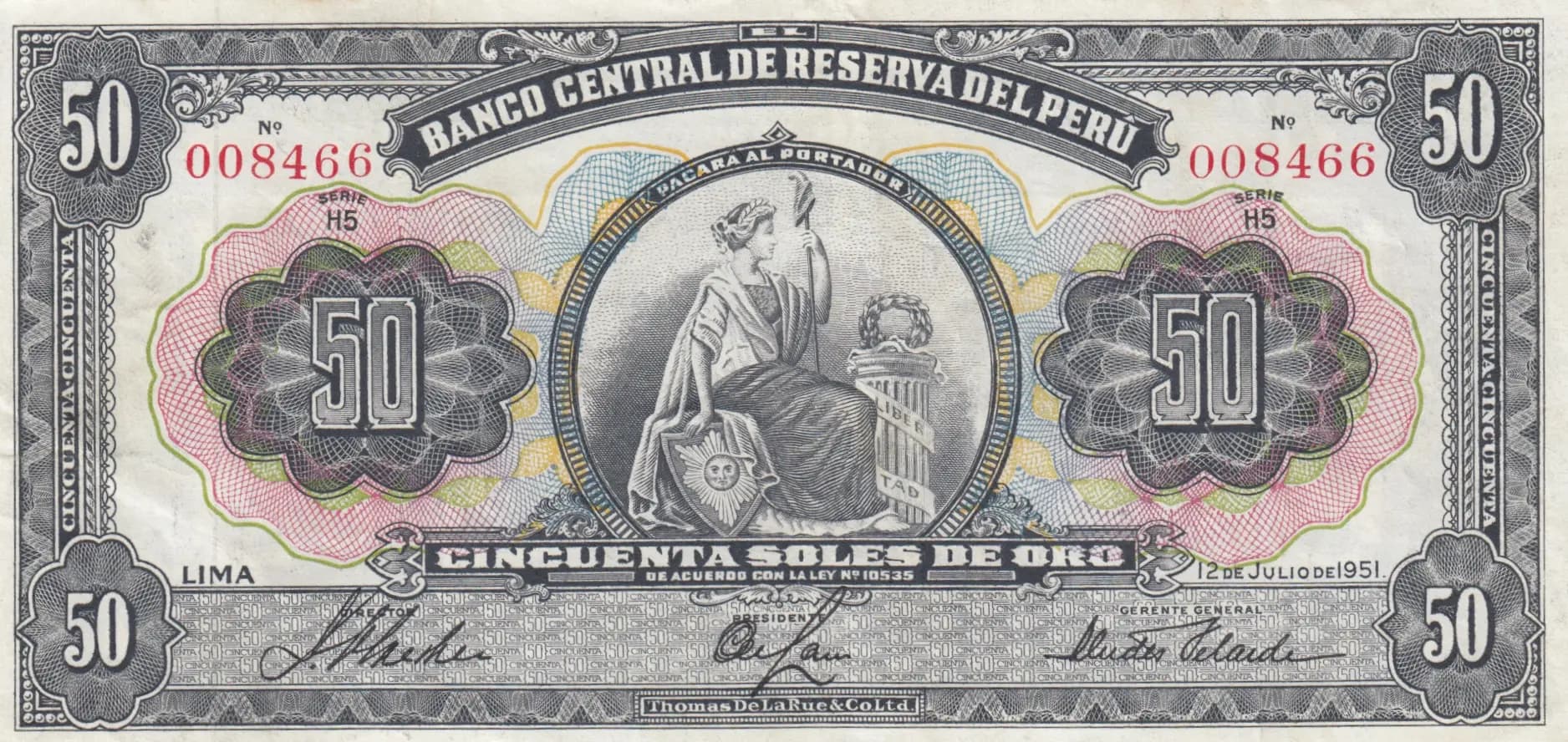
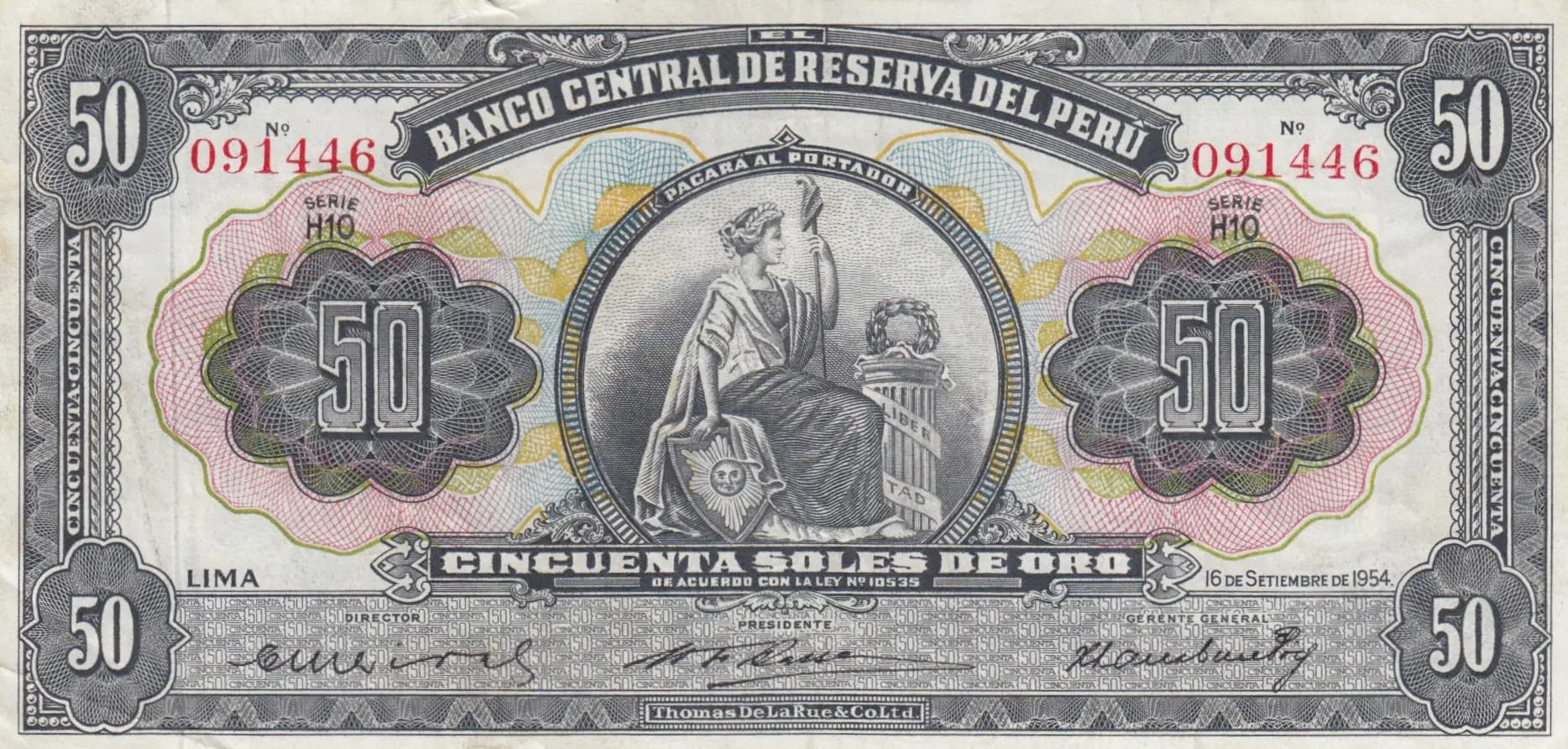
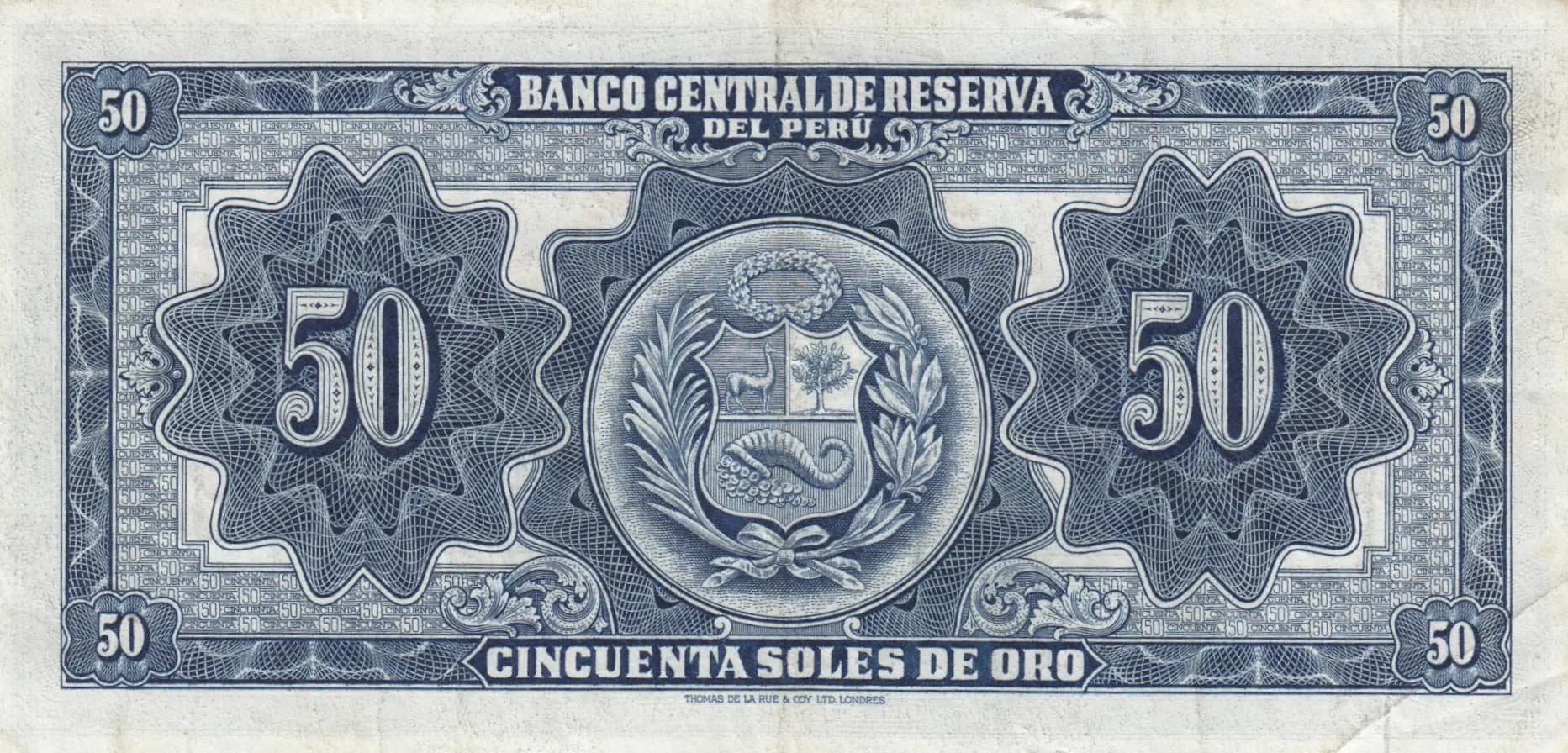
This is a well-preserved 1954 Peruvian 50 Soles de Oro note issued by the Banco Central de Reserva del Peru on September 16, 1954. The note displays exceptional condition with crisp, clean surfaces and no visible wear, creases, or damage. The intricate engraving work by Thomas de la Rue is clearly visible, featuring a classical allegorical Liberty figure on the obverse and Peru's national coat of arms on the reverse, making it a visually striking example of mid-20th century South American currency design.
Common. The catalog value data from 2016 shows VF grade notes at $5, and eBay market data from 2014 reflects comparable specimens selling in the $4-$32 range depending on condition (with AUNC examples commanding the higher prices). The 1949-1954 issue series was a standard circulating issue with substantial print runs. No evidence of limited mintage, recall, or scarcity exists for this Pick number. The series H notation and sequential serial numbering (091446) indicate normal production runs.
This note was issued during Peru's mid-20th century period under the Banco Central de Reserva del Peru, representing the nation's monetary authority. The classical Liberty imagery reflects international design conventions of the era, while the prominent national coat of arms on the reverse emphasizes Peru's sovereignty and national identity. The 1954 date places this within Peru's post-World War II modernization period, when the country was standardizing its currency designs through contracts with the prestigious London security printer Thomas de la Rue.
The obverse features a classical allegorical female figure representing Liberty, seated at center and holding a torch or staff with a classical urn positioned beside her. This personification of Liberty is rendered in fine engraved detail and surrounded by elaborate decorative borders featuring pink, green, and gray tones with floral and geometric patterns. Large ornate numerals '50' appear in all four corners within scalloped decorative frames. The reverse displays Peru's national coat of arms as a central circular emblem surrounded by a wreath of laurel or palm fronds, with heraldic elements visible within the shield including what appears to be a vicuña or similar animal and symbolic plant imagery. Matching ornate '50' numerals appear in all four corners. The dominant color palette on the obverse is multicolor (gray/black with pink, green, and yellow/gold accents), while the reverse is predominantly blue with white/cream and gray elements.
FRONT SIDE: 'BANCO CENTRAL DE RESERVA DEL PERÚ' (Central Bank of Reserve of Peru) | 'CINCUENTA SOLES DE ORO' (Fifty Soles of Gold) | 'SERIE H10' (Series H10) | 'N° 091446' (Serial Number 091446) | 'LIMA' (Lima) | '16 DE SETIEMBRE DE 1954' (September 16, 1954) | 'DIRECTOR' (Director) | 'PRESIDENTE' (President) | 'GERENTE GENERAL' (General Manager) | 'Thomas De La Rue & Co Ltd' (printer attribution). BACK SIDE: 'BANCO CENTRAL DE RESERVA' (Central Bank of Reserve) | 'DEL PERÚ' (of Peru) | 'CINCUENTA SOLES DE ORO' (Fifty Soles of Gold) | 'THOMAS DE LA RUE & COY LTD LONDRES' (Thomas De La Rue & Co Ltd London).
This note was produced using traditional intaglio engraving, the primary security printing method for currency of this era. The fine cross-hatching, intricate line work, and detailed engraving characteristic of classical banknote production are evident throughout both sides. The complex geometric and floral patterns, scalloped frames, and multi-layered decorative elements serve as security features inherent to the intaglio process. Thomas de la Rue & Co Ltd of London, the world's leading security printer of the period, executed the engraving and printing.
This specimen is identified as Series H10 with serial number 091446, specifically dated 16 de Setiembre de 1954. The Pick catalog notes this denomination was issued across multiple dates (1949, 12.7.1951, 16.9.1954), indicating this is the final variant from the September 1954 printing. Signature varieties exist for this issue type as noted in the reference catalogs, though the specific signatures are not clearly legible in the image analysis provided. The Series H designation identifies this as a specific print batch within the broader 1949-1954 regular issue series.