5 soles 1960
Market Prices
11 salesAbout This Note
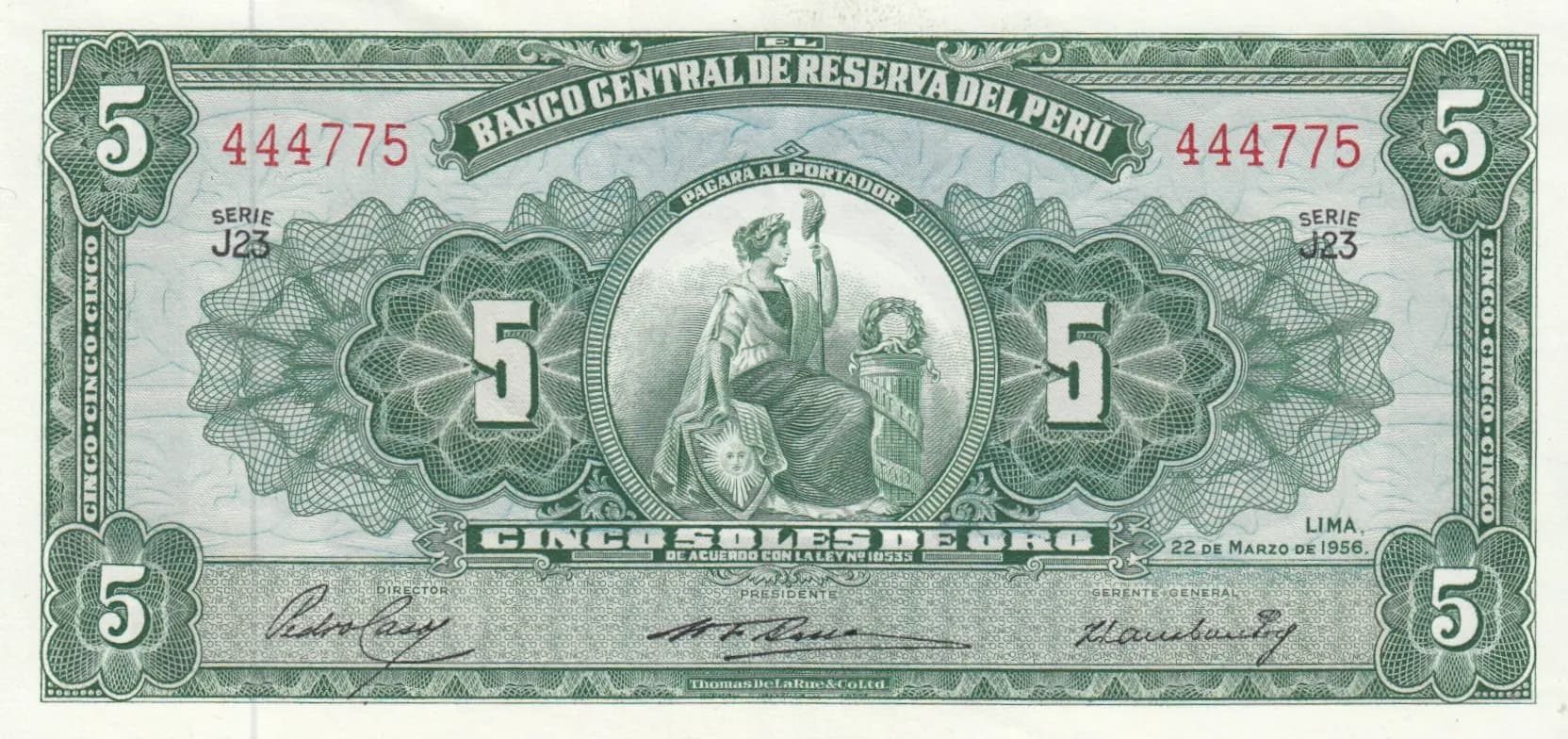
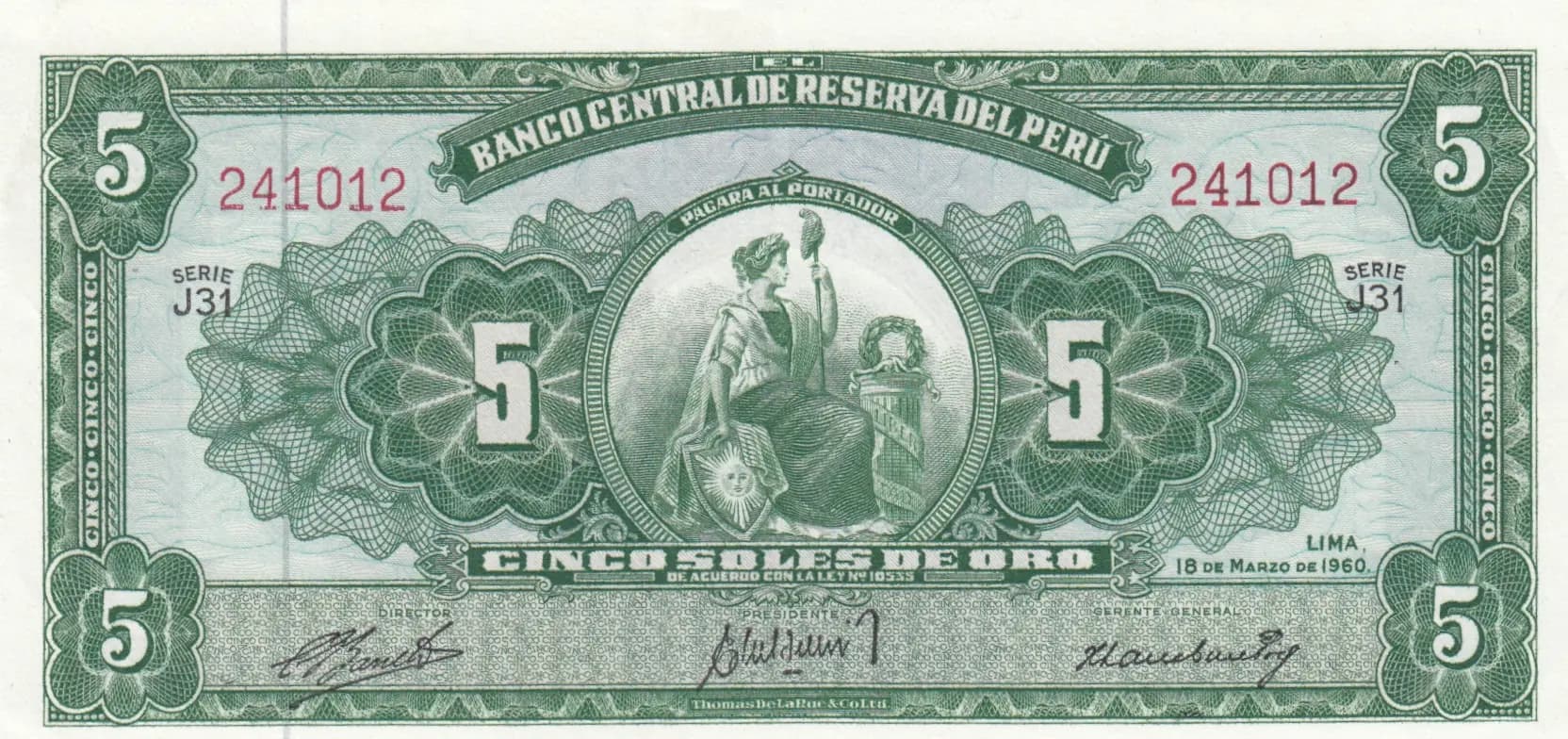
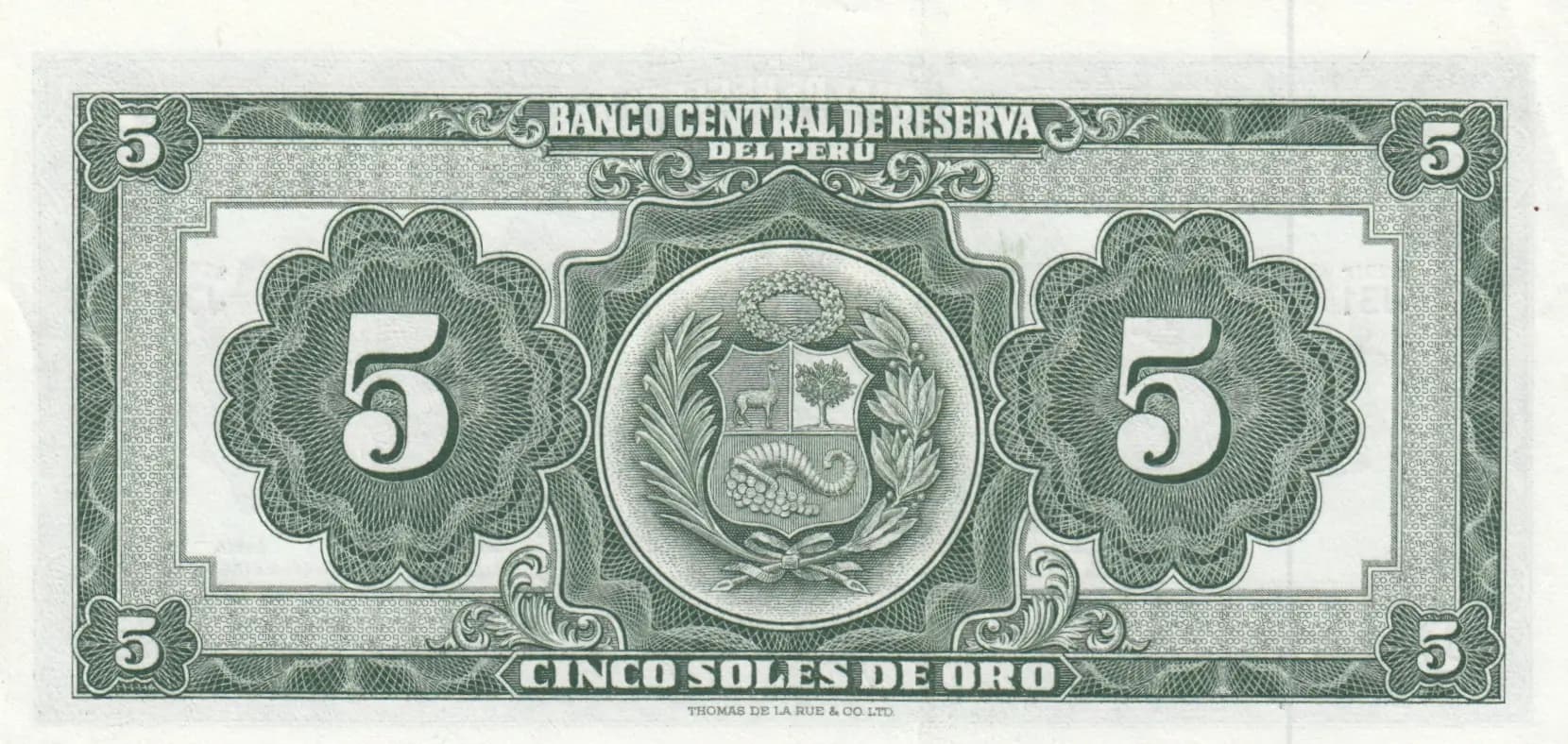
This is a 1960 Peru 5 Soles de Oro (Pick P-76) in AU condition, printed by Thomas de la Rue and bearing the March 18, 1960 date. The note features an elegant allegorical Liberty figure with classical styling on the obverse and Peru's national coat of arms on the reverse, both rendered in fine green and blue tones with exceptional detail work. The example shows moderate circulation wear including a horizontal fold and light foxing, consistent with AU grading, but maintains excellent overall preservation with no major damage.
Common. This Pick P-76 variant shows up regularly in the secondary market with eBay sales data indicating modest valuations: VF notes sell for approximately $1.50-2.50, while UNC examples achieve $2-5. The 2019 catalogue values confirm this assessment (VF: $1.50, UNC: $5). With print runs spanning multiple years (1956-1960) and multiple signature varieties known, this is a standard circulation issue. Even graded examples (PMG 65-67) sell in the $15-44 range, placing it firmly in the common category. The AU condition grade of this example, while desirable, does not elevate it to scarce status.
This note was issued during a period of monetary reform in Peru, with dates spanning from March 1956 to March 1960 under the Banco Central de Reserva del Perú. The allegorical 'Pácara al Portador' (Bearer Note) imagery reflects Peru's classical republican symbolism, while the coat of arms on the reverse displays the nation's three geographic and economic pillars: the Andean condor (fauna), the cinchona tree (flora), and the cornucopia (agriculture and wealth). The Thomas de la Rue printing indicates this was part of Peru's international currency modernization efforts during the mid-20th century.
The obverse features a classical allegorical female figure representing Liberty (labeled 'Pácara al Portador'), seated and accompanied by a child, holding symbolic implements of state authority. The figure is enclosed in a circular medallion frame and rendered with fine classical styling. Large ornamental '5' denominal cartouches occupy all four corners with elaborate rosette patterns. The reverse displays Peru's national coat of arms centered in a circular heraldic composition: the shield is divided into three sections containing the Andean condor (representing fauna and mountain regions), a cinchona tree (representing flora and tropical regions), and a cornucopia overflowing with fruits (representing agricultural abundance and coastal regions). The shield is flanked by laurel wreaths and ornamental foliage. Both sides employ intricate geometric crosshatch patterns and fine-line engraving throughout the decorative borders, creating a layered security design.
FRONT: 'BANCO CENTRAL DE RESERVA DEL PERÚ' (Central Reserve Bank of Peru); 'PÁCARA AL PORTADOR' (Bearer Note); 'CINCO SOLES DE ORO' (Five Soles of Gold); 'LIMA, 18 DE MARZO DE 1960' (Lima, March 18, 1960); 'AGENTE GENERAL' (General Agent); 'Thomas de La Rue & Co Ltd.' (printer attribution); Serial number '241012' and series 'J31' in red. BACK: 'BANCO CENTRAL DE RESERVA DEL PERÚ' (Central Reserve Bank of Peru); 'CINCO SOLES DE ORO' (Five Soles of Gold); 'THOMAS DE LA RUE & CO LTD' (printer attribution).
Intaglio engraving (line engraving and crosshatch work) executed by Thomas de la Rue & Co Ltd., London, a leading security printer. The visual analysis confirms the use of fine-line engraving for the allegorical figure and heraldic coat of arms, with complex geometric patterns and overlapping decorative layers typical of high-security currency production of the 1950s-1960s era. Multiple color printing (green as primary color with light blue/gray underprint) applied over the engraved base.
This example is dated March 18, 1960 (18 DE MARZO DE 1960) with serial number 241012 and series J31. The catalog data indicates signature varieties exist for this Pick number. The note is from the later issuance date within the P-76 series (compared to the 1956 dates also issued). The series designation 'J31' may indicate a specific printing run or signature variety, though definitive variety attribution would require consultation of a comprehensive Peruvian currency catalog. This is the standard green-on-light-blue design consistent with the 1960 issue date.