5 soles 1952
Market Prices
2 salesAbout This Note
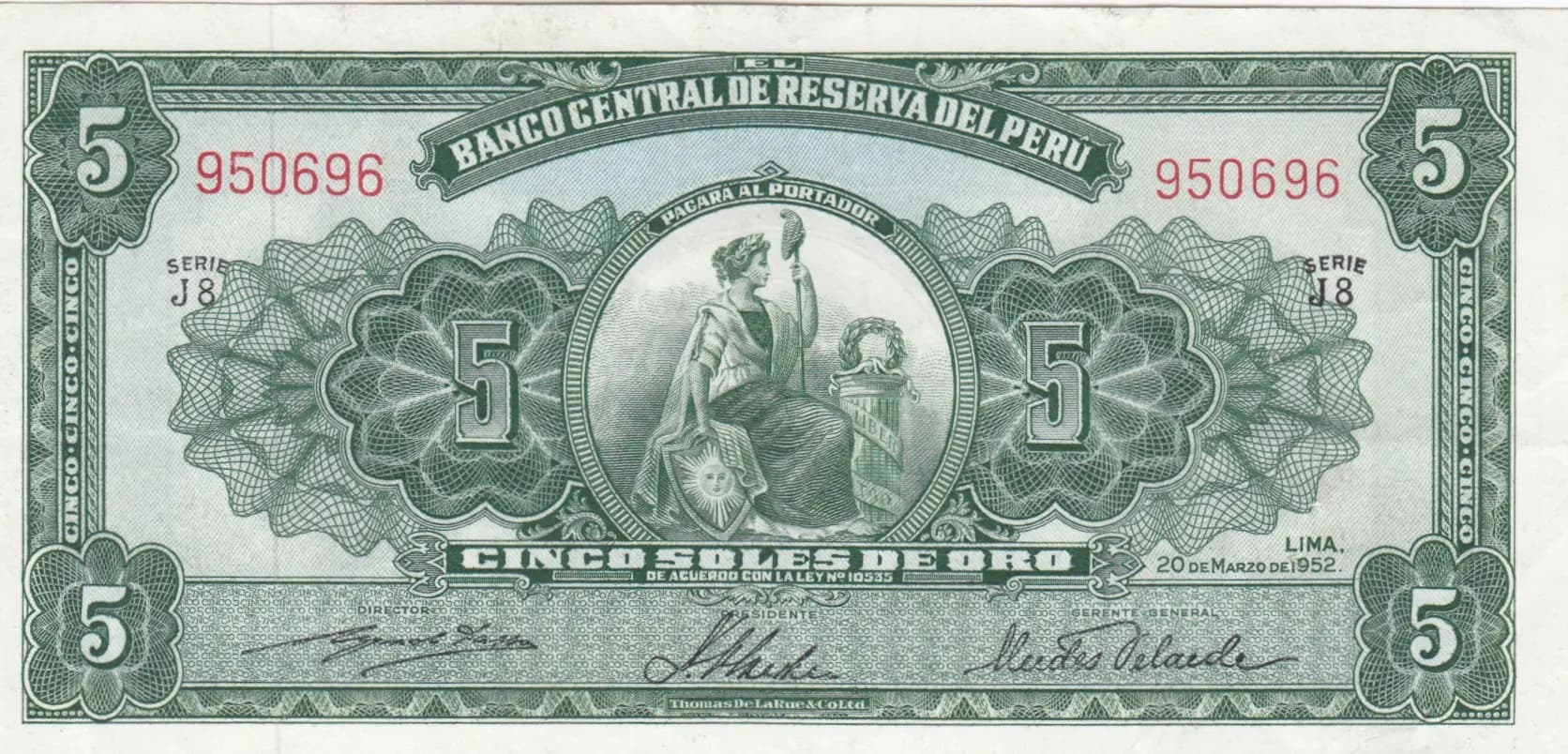
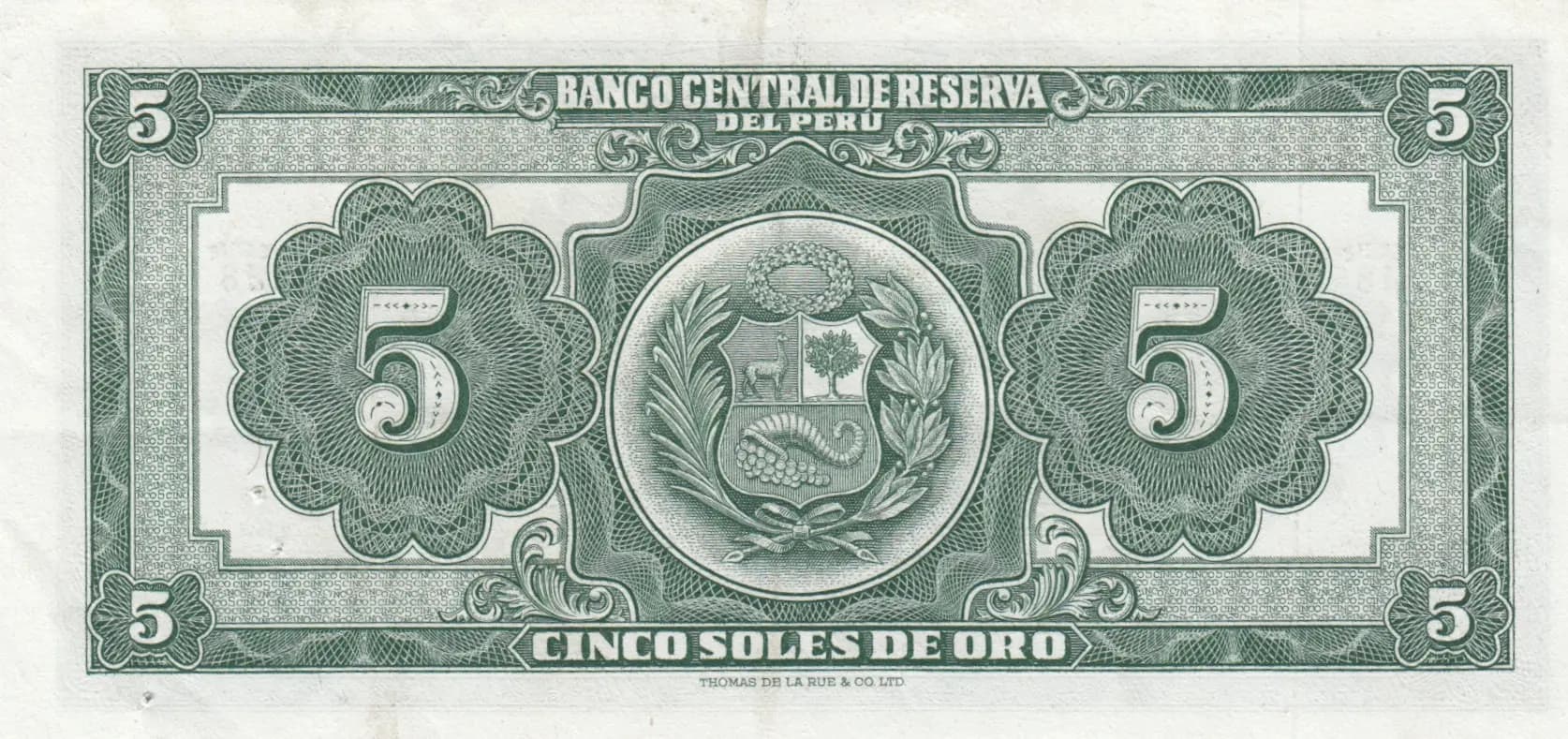
This is a VF-grade Peruvian 5 Soles de Oro from 1952, printed by Thomas de la Rue in London. The note features striking green intaglio work on a light blue underprint with a classical seated Liberty allegorical figure holding a torch and shield on the obverse, and the Peruvian coat of arms on the reverse. The sharp printing quality and well-preserved condition suggest minimal circulation, making this an attractive example of mid-20th century Peruvian currency design.
Common. Despite the 1952 date and VF condition, this note remains commonly available in the market. eBay transaction data shows VF examples selling for approximately $2.25-$3.00 USD, with UNC examples reaching $7-$8.50, indicating steady but modest collector demand without scarcity premiums. The Banco Central de Reserva del Perú maintained consistent production runs through the 1950s, and this denomination was not subject to recall or short-lived circulation. The note's accessibility and regular market appearance confirm common status.
Issued on March 20, 1952, by the Banco Central de Reserva del Perú under Law No. 1335, this note represents Peru's post-war monetary stabilization period. The allegorical Liberty figure (Pacara al Portador) symbolizes Peru's democratic values and national sovereignty during a period of political reconstruction, while the central placement of the Peruvian coat of arms on the reverse emphasized national identity and governmental authority during the early years of the Central Reserve Bank's expanded operations.
The obverse features an allegorical female figure labeled 'Pacara al Portador' in classical Greco-Roman style, seated centrally and holding both a torch (symbolizing enlightenment) and a staff or scepter (symbolizing authority). A small cherub or putti figure appears to the right of the main figure. The design is framed by ornate floral and geometric borders with decorative medallions containing the numeral '5' positioned in all four corners. The reverse displays the Peruvian national coat of arms—a shield featuring agricultural and natural wealth symbols—placed within a circular medallion and flanked by ornate floral wreaths. The entire design demonstrates the classical allegorical style typical of Thomas de la Rue's high-security banknote work from this era.
FRONT: 'BANCO CENTRAL DE RESERVA DEL PERU' (Central Reserve Bank of Peru) | 'CINCO SOLES DE ORO' (Five Soles of Gold) | 'LIMA, 20 de MARZO de 1952' (Lima, March 20, 1952) | 'DE ACUERDO CON LA LEY No1335' (In accordance with Law No. 1335) | 'THOMAS DE LA RUE & CO LTD' (printer identification) | 'PRESIDENTE' (President) and 'DIRECTOR' (Director) with signatures | Serial number: 950696, Series J8. BACK: 'BANCO CENTRAL DE RESERVA DEL PERU' (Central Reserve Bank of Peru) | 'CINCO SOLES DE ORO' (Five Soles of Gold) | 'THOMAS DE LA RUE & CO LTD' (printer identification).
Intaglio (line engraving) printing on a light blue underprint, executed by Thomas de la Rue & Co Ltd in London. The note exhibits characteristic security features of fine-line engraving work including intricate guilloche patterns throughout, complex geometric crosshatch patterns in background areas, and detailed engraved line work in borders and vignettes. The sharp, precise execution visible in the visual analysis is hallmark of De la Rue's photogravure and hand-engraving techniques used for high-denomination currency during the mid-20th century.
This is P-70a, the primary 1952 issue variant. The note displays Series J8 with serial number 950696. The pick catalog notes variant dates of 1952 and 1954 for similar notes; however, this specific specimen is dated Lima, March 20, 1952. Known signature varieties exist for this issue reflecting different bank officials, though the signatures on this particular note are not fully legible in the visual analysis. Related issues include P-76, P-81, and P-83 as noted in catalog cross-references.