5 soles 1941
Market Prices
8 salesAbout This Note
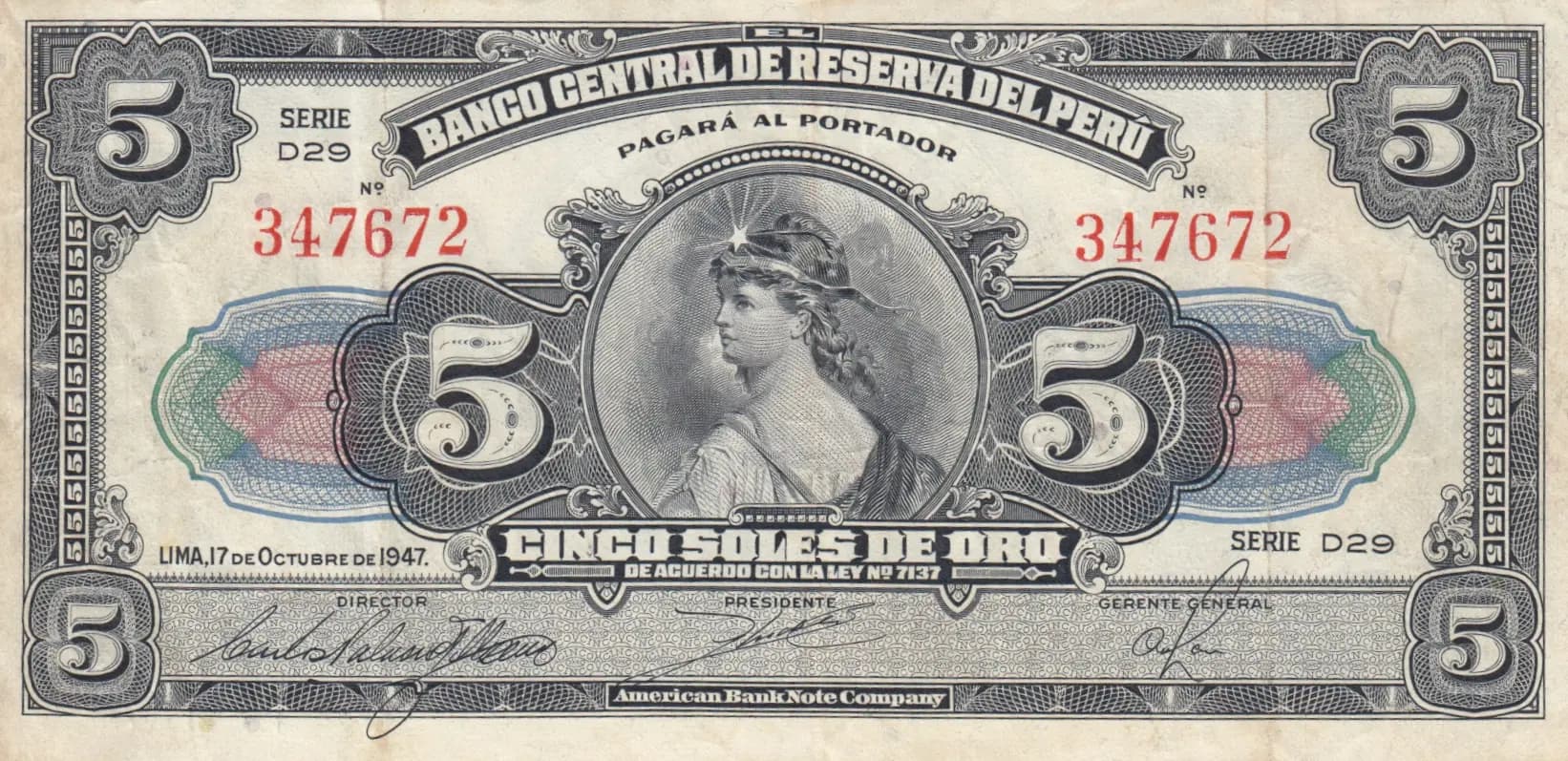
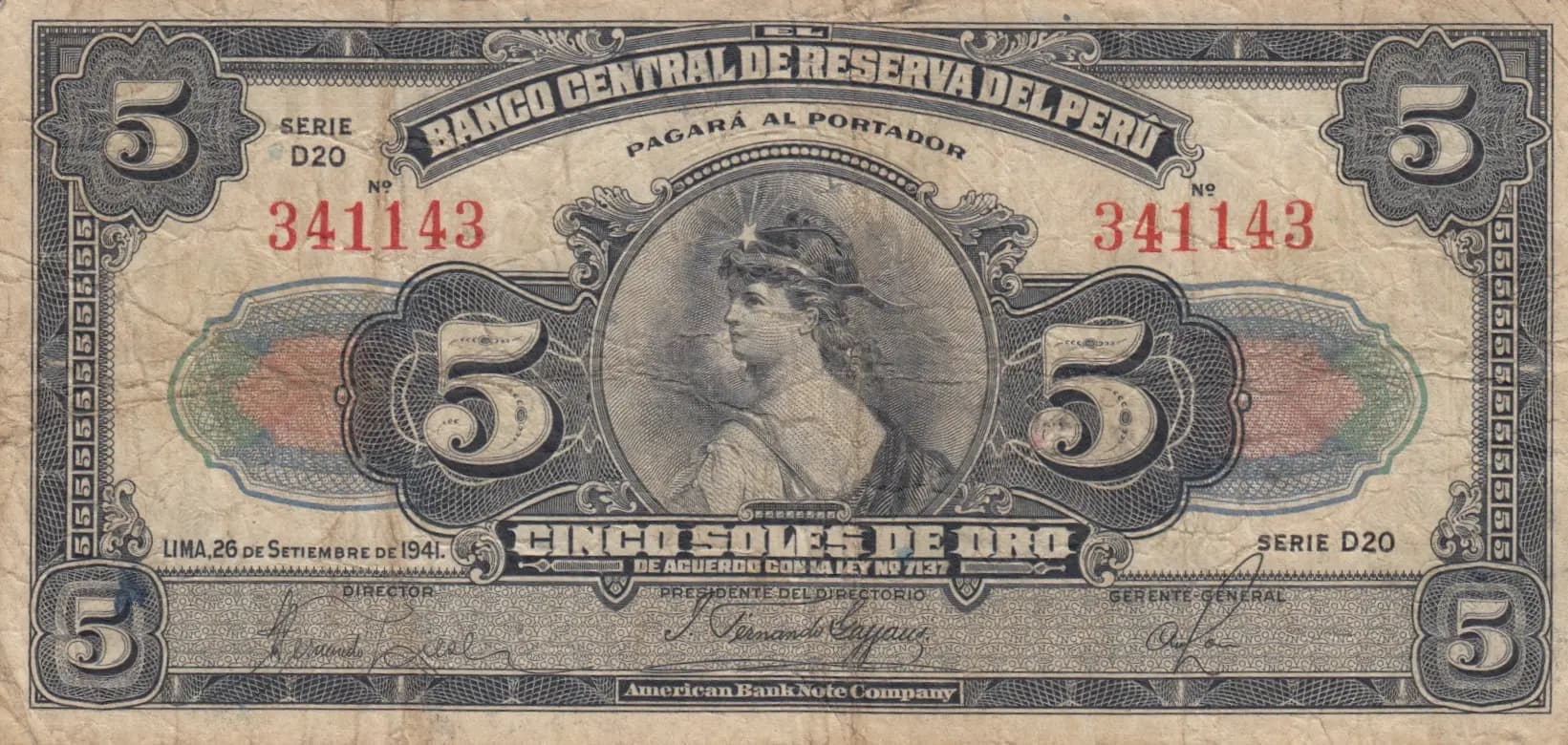
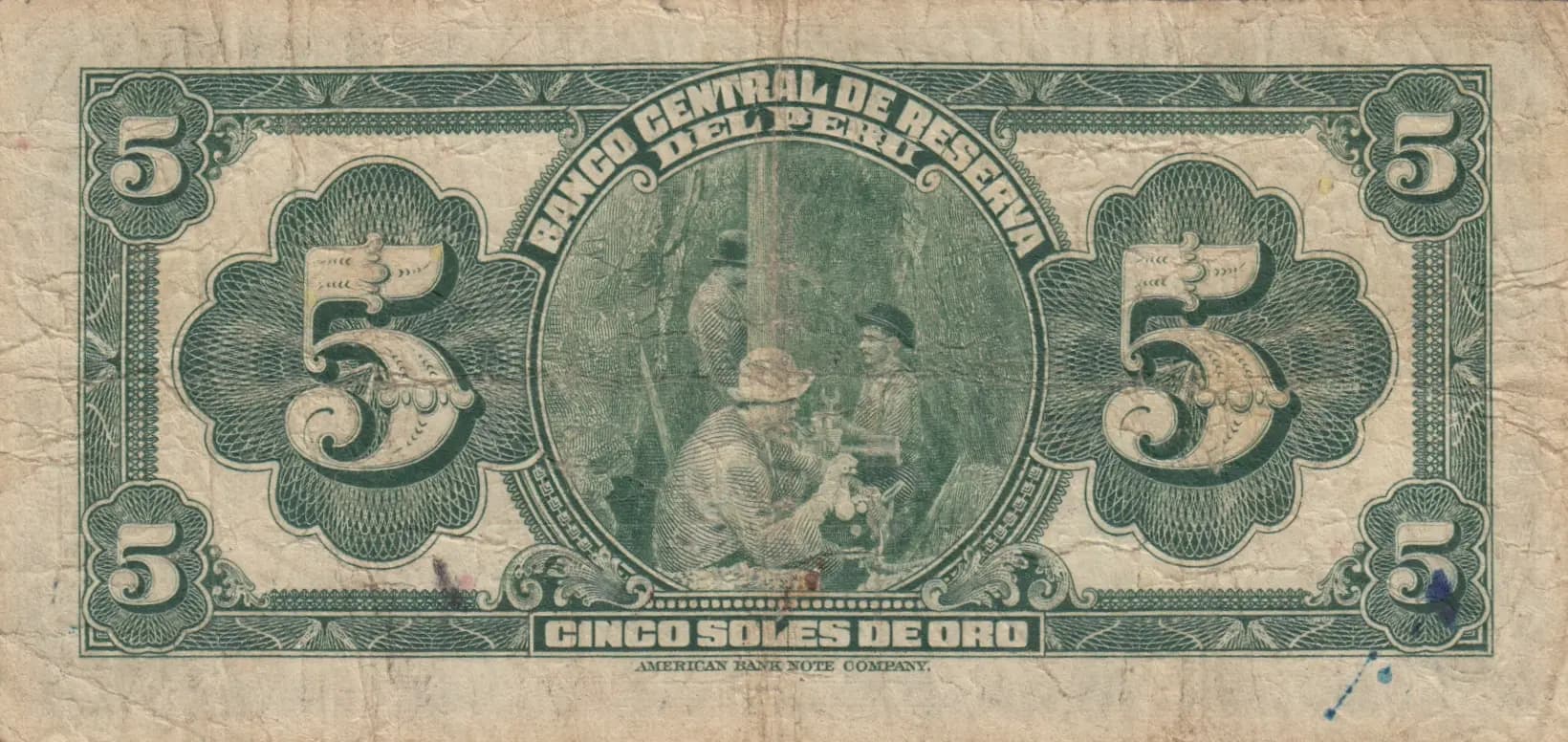
This is a 1941 Peruvian 5 Soles de Oro (Pick-66A) issued by the Banco Central de Reserva del Perú on September 26, 1941. The note features a classical female portrait (Liberty) on the front and a two-figure scene on the back, both rendered in fine engraved detail with ornate decorative borders. In Fair condition, the note shows expected wear including multiple creases, foxing, and age-related discoloration, but remains structurally sound and fully legible—a typical mid-20th century Peruvian banknote representative of the country's interwar currency period.
Common. This is a standard circulating issue from a major central bank with substantial print runs across multiple date variants (1933-1941). eBay market data confirms common status: notes in Fair condition typically sell for $5-$10 USD, with VF examples bringing $13-$15.70, far below the threshold that would indicate scarcity. The PMG population report recognizes three variants (P-66, P-66A, P-66s), indicating this was part of a larger series with multiple printings. No evidence of recall, short print run, or limited distribution.
This note was issued during Peru's economic transition in the 1940s, following the establishment of the Banco Central de Reserva del Perú as the nation's central bank. The depiction of Liberty on the obverse reflects 1930s-1940s international banking aesthetics, while the two-figure scene on the reverse—likely depicting workers or economic activity—symbolizes Peru's industrial and resource-based economy of the era. The note's denomination in 'Soles de Oro' (Gold Soles) maintained a reference to the gold standard system, though actual circulation had long since become fiat-based.
The obverse features a classical allegorical female portrait (Liberty) centered within an ornate oval medallion, rendered in fine intaglio engraving. The portrait faces left in profile, wearing classical or period dress, and is framed by elaborate scrollwork and geometric borders. The design incorporates star-shaped ornamental elements in all four corners, with intricate geometric patterns throughout the background. The color scheme is predominantly grayish-blue with red serial numbers, light beige/tan accents, and green highlights. The reverse displays a two-figure scene (likely depicting workers or economic activity) in a similar ornate oval medallion, printed predominantly in green with cream and gray undertones. Large decorative numeral '5' appears in ornamental frames at all four corners of the reverse. Both sides feature the characteristic 'PAGARÁ AL PORTADOR' (bearer obligation) language typical of this era's currency design.
FRONT SIDE: 'BANCO CENTRAL DE RESERVA DEL PERÚ' (Central Reserve Bank of Peru); 'PAGARÁ AL PORTADOR' (Will pay to bearer); 'SERIE D20' (Series D20); Serial number '341143'; Denomination '5'; 'LIMA, 26 de Setiembre de 1941' (Lima, September 26, 1941); 'CINCO SOLES DE ORO' (Five Soles of Gold); 'DE ACUERDO CON LA LEY Nº 7137' (In accordance with Law No. 7137); 'DIRECTOR' (Director); 'PRESIDENTE DEL DIRECTORIO' (President of the Board); 'GERENTE GENERAL' (General Manager); 'American Bank Note Company' (printer attribution). BACK SIDE: 'BANCO CENTRAL DE RESERVA DEL PERÚ' (Central Reserve Bank of Peru); 'CINCO SOLES DE ORO' (Five Soles of Gold); Denomination '5' in corner medallions; 'American Bank Note Company' (printer attribution).
This note was produced using traditional intaglio engraving (also called copperplate or steel engraving), the primary security printing method of the American Bank Note Company (ABNC) during the 1930s-1940s. The fine line work visible throughout both obverse and reverse, the intricate geometric background patterns, ornate borders, and detailed portraiture are all characteristic hallmarks of ABNC's intaglio process. The multicolor printing on the obverse and green printing on the reverse were achieved through multiple passes, a standard practice for high-security banknote production of this period.
This note is identified as Pick-66A, the 1941 dated variety issued on September 26, 1941 (as specifically stated on the note: 'LIMA, 26 de Setiembre de 1941'). The serial number prefix 'D20' and serial number '341143' are visible. The Pick catalog notes variants including P-66, P-66A, and P-66s; this specimen represents the -A variant. The catalog reference notes indicate related earlier notes span 1933-1939 (per external reference dating), with the 1941 issue representing a later printing of this design series. Series designation 'D' would indicate this is from a later printing sequence.