10 soles 1956
Market Prices
14 salesAbout This Note
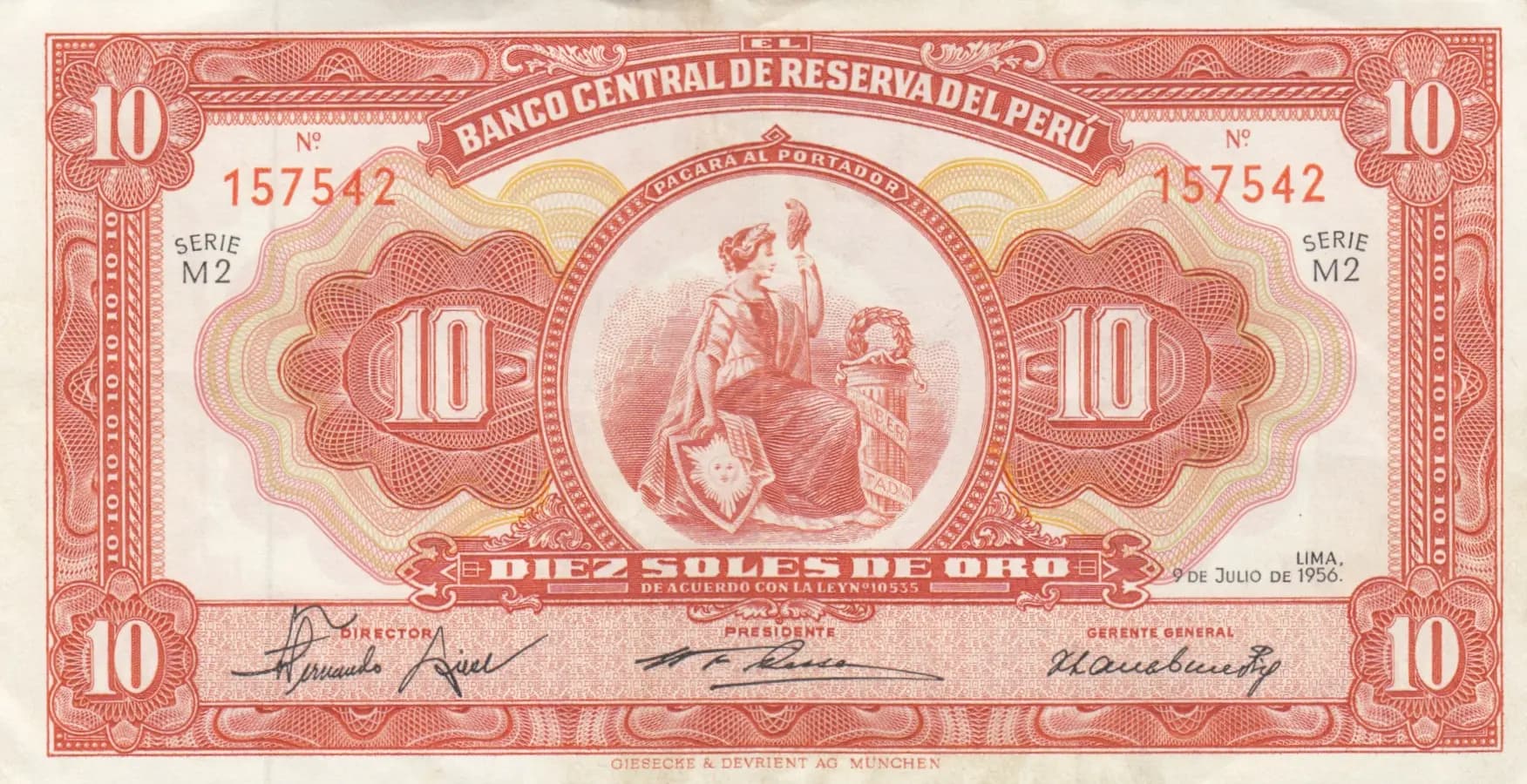
This Peru 10 Soles de Oro from 1956 (Pick P-77) presents a well-preserved example of mid-20th century Peruvian currency featuring an elegant allegorical Liberty figure seated with a torch and lion, rendered in red and cream tones with fine engraving throughout. The note displays typical age-related toning and circulation wear consistent with VF grade, including visible creasing and foxing, yet remains structurally sound with no major tears. As a regular issue from the Banco Central de Reserva del Perú and printed by the prestigious Giesecke & Devrient, this note represents an accessible and attractive addition to Peru collections.
Common. Market data from realbanknotes.com shows consistent eBay sales activity across multiple condition grades over the past decade, with VF specimens regularly trading in the $7–9 range and 2019 catalog valuation at $6 VF. The note was a regular issue by the Banco Central de Reserva and shows no evidence of limited print run or scarcity; circulation examples remain readily available to collectors at modest prices.
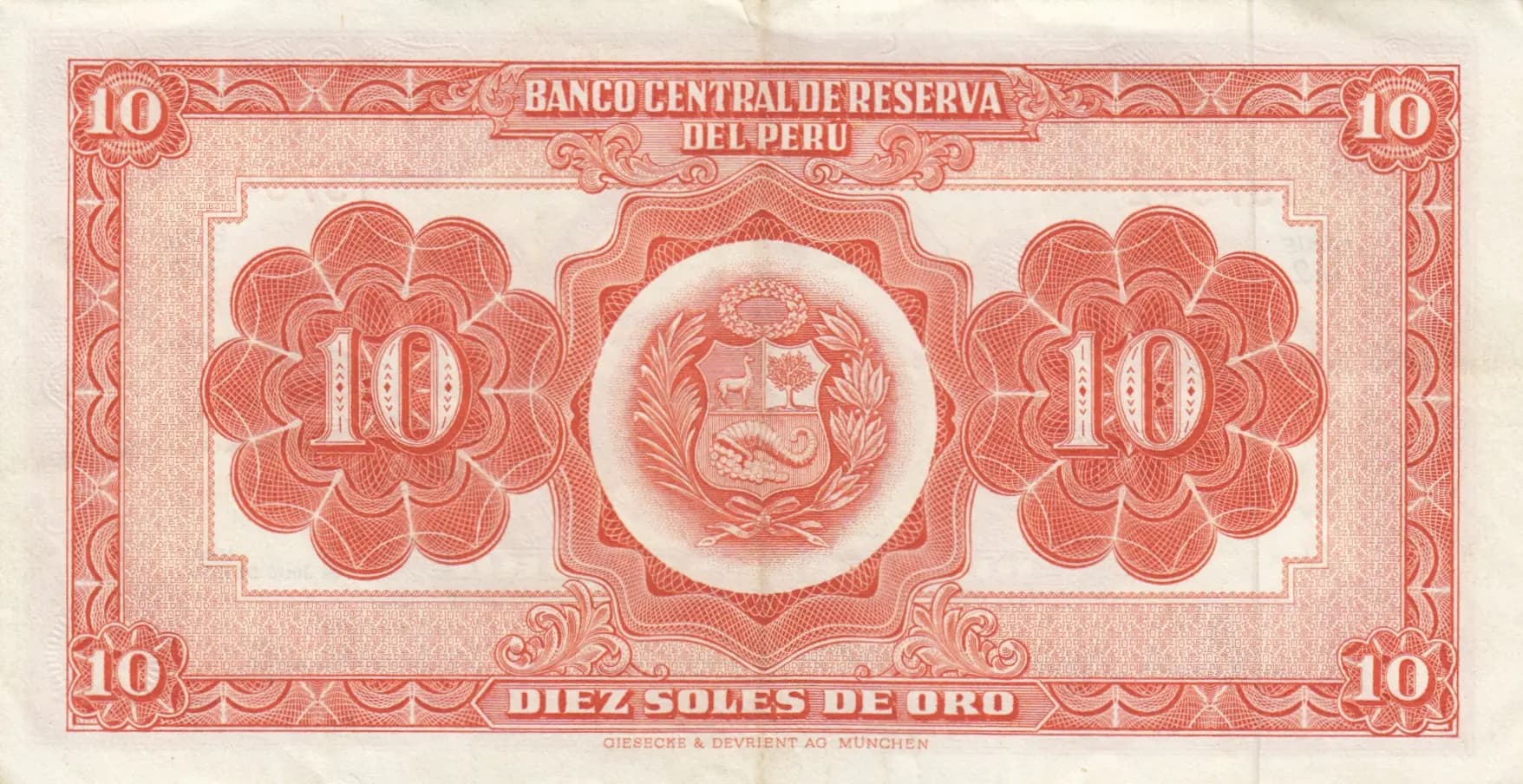
Issued on July 9, 1956, this banknote reflects Peru's post-war economic consolidation under the Banco Central de Reserva, established as the nation's central bank. The use of allegorical Liberty imagery—depicted as a seated female figure with torch and lion—draws on classical republican iconography to represent Peru's sovereignty and national identity during a period of political reorganization. The formal heraldic coat of arms on the reverse reinforces the authority and legitimacy of the central banking institution during Peru's transition in the mid-twentieth century.
The obverse features an ornate border in red and cream with corner denominations, centering on a circular allegorical vignette depicting Liberty (or Peru personified) as a seated female figure holding a torch or staff, accompanied by a lion symbolizing strength and protection, set against classical architectural elements suggesting democratic institutions. The reverse displays the Peruvian coat of arms (shield with heraldic devices) at center, surrounded by a wreath of laurel branches and palm fronds in a symmetrical heraldic composition, framed by the same decorative border scheme. Both sides employ fine line engraving with complex cross-hatching and geometric patterns characteristic of security printing, with the issuing authority, denomination, date, and printer information distributed symmetrically.
FRONT: 'BANCO CENTRAL DE RESERVA DEL PERÚ' (Central Bank of Reserve of Peru); 'DIEZ SOLES DE ORO' (Ten Soles of Gold); 'DE ACUERDO CON LA LEY N°10535' (In Accordance with Law No. 10535); '9 DE JULIO DE 1956' (July 9, 1956); 'LIMA'; 'SERIE M2' (Series M2); Serial number '157542'; Officer titles: 'DIRECTORA' (Director), 'PRESIDENTE' (President), 'GERENTE GENERAL' (General Manager); 'GIESECKE & DEVRIENT AG MÜNCHEN' (Giesecke & Devrient AG Munich—printer). BACK: 'BANCO CENTRAL DE RESERVA DEL PERÚ' (Central Bank of Reserve of Peru); 'DIEZ SOLES DE ORO' (Ten Soles of Gold); 'GIESECKE & DEVRIENT AG MÜNCHEN' (Giesecke & Devrient AG Munich—printer).
Intaglio engraving (line engraving and steel plate printing), executed by Giesecke & Devrient AG of Munich, one of Europe's leading security printers. The fine line work, intricate cross-hatching in decorative elements, and complex geometric borders visible throughout the note are characteristic of traditional intaglio security printing methods employed for high-security banknotes of this era.
The note exhibits Series M2 and serial number 157542. The PMG population report indicates one cataloged variant for Pick P-77. Signature varieties are noted as existing for this issue (as referenced in realbanknotes.com), though the specific signatures visible on this example would require comparison to known officer signature sets from 1956. No overprints or special markings are apparent on the observed specimen.