10 soles 1951
Market Prices
24 salesAbout This Note
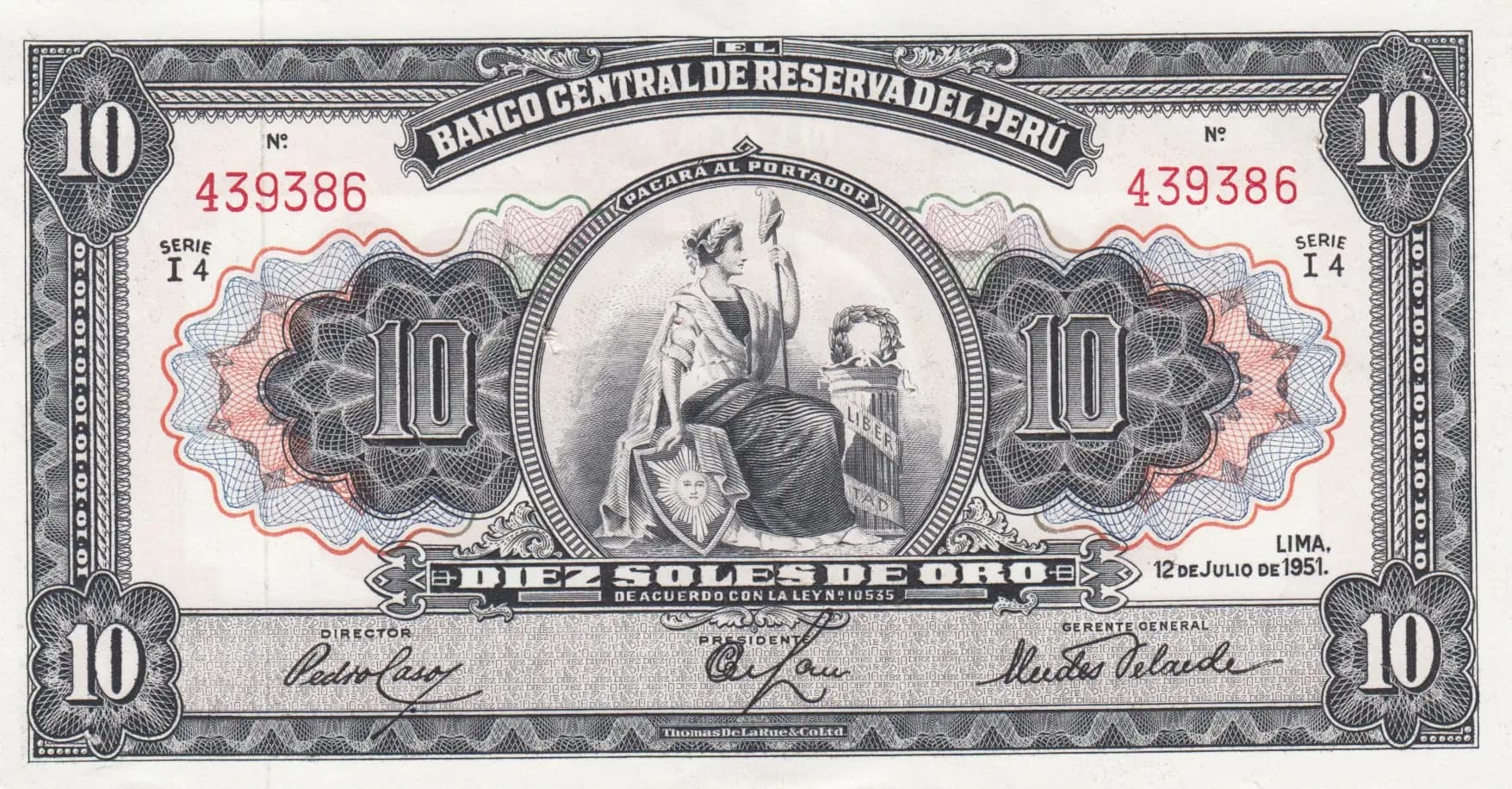
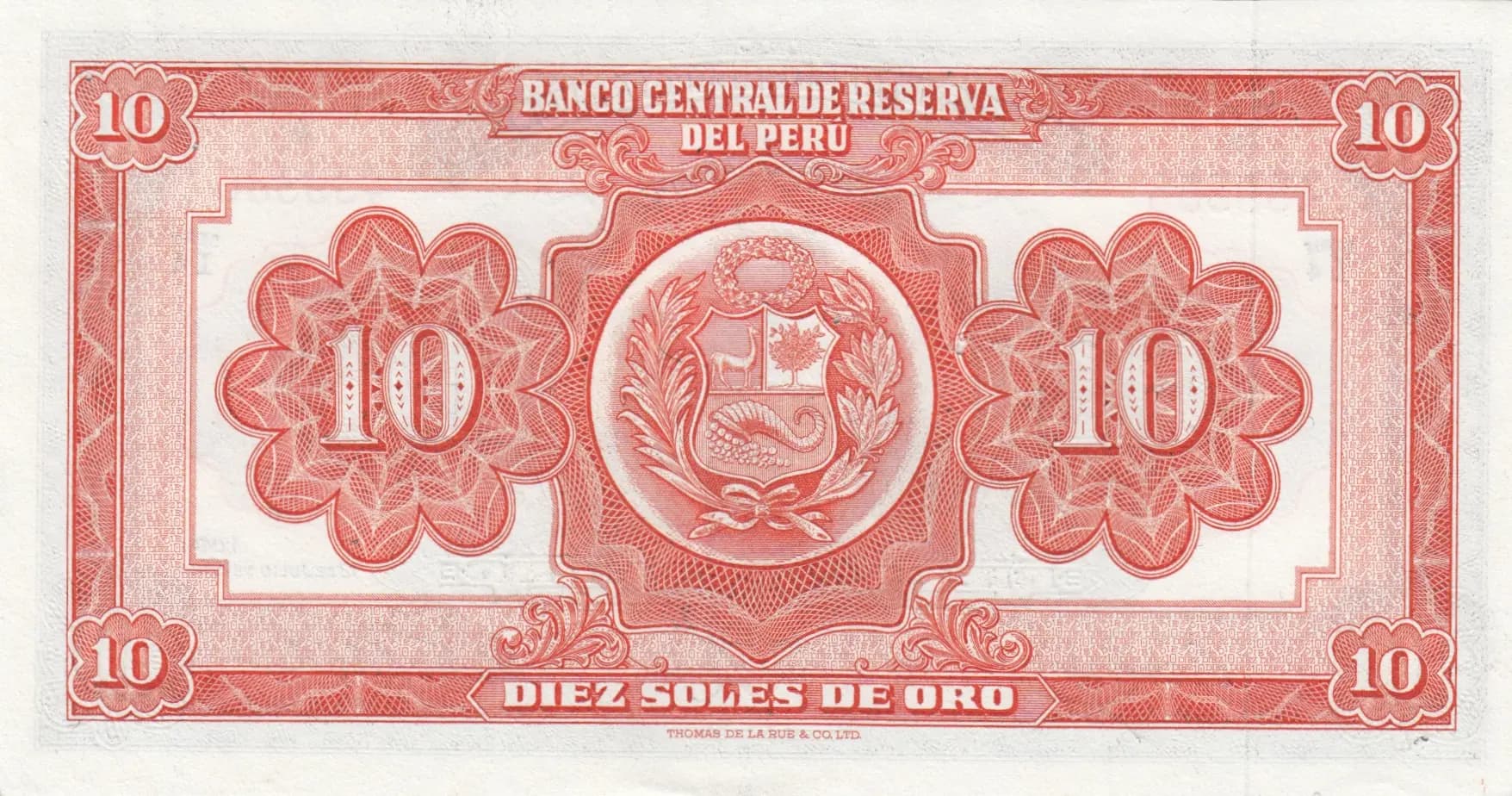
This is a beautifully preserved AU-grade Peruvian 10 Soles de Oro from 1951, printed by Thomas de la Rue in London. The note exhibits exceptional clarity with sharp detail throughout both sides—the classical allegorical vignette on the obverse and the intricate Peruvian coat of arms on the reverse remain crisp and unblemished. This particular example shows excellent paper quality and pristine condition, making it a desirable specimen for collectors of mid-20th century South American currency.
Common. This note is from a regular issue spanning 1951-1955 with substantial circulation. eBay market data shows consistent sales of this Pick number across multiple condition grades (F through UNC) at relatively modest prices, with AU/AUNC specimens typically selling in the $11-22 range and lower grades selling for $3-10. Such broad availability and consistent pricing across multiple transactions indicate healthy supply in the collector market. The 2016 catalogue value of $8 UNC further confirms this as a standard, readily available issue rather than a scarce or rare variety.
Issued by the Banco Central de Reserva del Perú on July 12, 1951, this note reflects Peru's post-WWII monetary stabilization under the gold standard framework (referenced as 'Soles de Oro'). The allegorical imagery—featuring Liberty with staff and seated figures—emphasizes the nation's democratic ideals and classical heritage during the early years of the Central Bank's independent currency management. The coat of arms featuring the vicuña underscores Peru's natural wealth and cultural identity during this formative period of the republic.
The obverse features a classical allegorical composition centered on Liberty (Libertad)—depicted as a standing female figure holding a staff or scepter—flanked by a seated figure and a child, rendered in the refined engraving style characteristic of Thomas de la Rue's security printing. Ornamental corner frames in all four corners display the denomination '10' in decorative cartouches with red/coral numerical accents. The reverse presents the national coat of arms of Peru dominantly centered within a circular medallion: the shield displays a vicuña (South American camelid symbolic of Peru's natural wealth), with laurel wreaths symmetrically flanking the escutcheon. Large decorative frames containing the numeral '10' anchor both left and right sides of the reverse composition. Throughout both sides, elaborate guilloche patterns, geometric borders, and fine cross-hatching provide the security features characteristic of this era's intaglio printing.
Front side: 'BANCO CENTRAL DE RESERVA DEL PERU' (Central Bank of Reserve of Peru); 'DIEZ SOLES DE ORO' (Ten Gold Soles); 'DE ACUERDO CON LA LEY Nº1053' (In Accordance with Law No. 1053); 'LIMA, 12 DE JULIO DE 1951' (Lima, July 12, 1951); Series designation 'I 4'; Serial number '439386'; signature titles 'DIRECTOR', 'PRESIDENTE', 'GERENTE GENERAL' (Director, President, General Manager). Back side: 'BANCO CENTRAL DE RESERVA' and 'DEL PERU' (Central Bank of Reserve of Peru); 'DIEZ SOLES DE ORO' (Ten Gold Soles); 'THOMAS DE LA RUE & CO LTD' (printer attribution).
Intaglio engraving (line engraving and copperplate printing), executed by Thomas de la Rue & Co Ltd, London. The visual analysis confirms deep, precise line work with complex guilloche patterns, fine cross-hatching, geometric stippling, and ornamental flourishes characteristic of high-security banknote production. The multicolor underprint on the obverse (black primary engraving with red/coral accents) and single-color reverse (red/coral engraving) are consistent with mid-20th century intaglio methodology.
Variant P-71a is catalogued by PMG for this base Pick number. The observed example shows series designation 'I 4' and serial number '439386'. Signature varieties are documented for this issue across its production span (1951-1955), though specific signature identification would require comparison with reference materials. No overprints, date variations, or other distinguishing features are apparent in the visual analysis that would indicate a scarce sub-variety; this appears to be a standard production note from the 1951 issue date.