10 soles 1941
Market Prices
11 salesAbout This Note
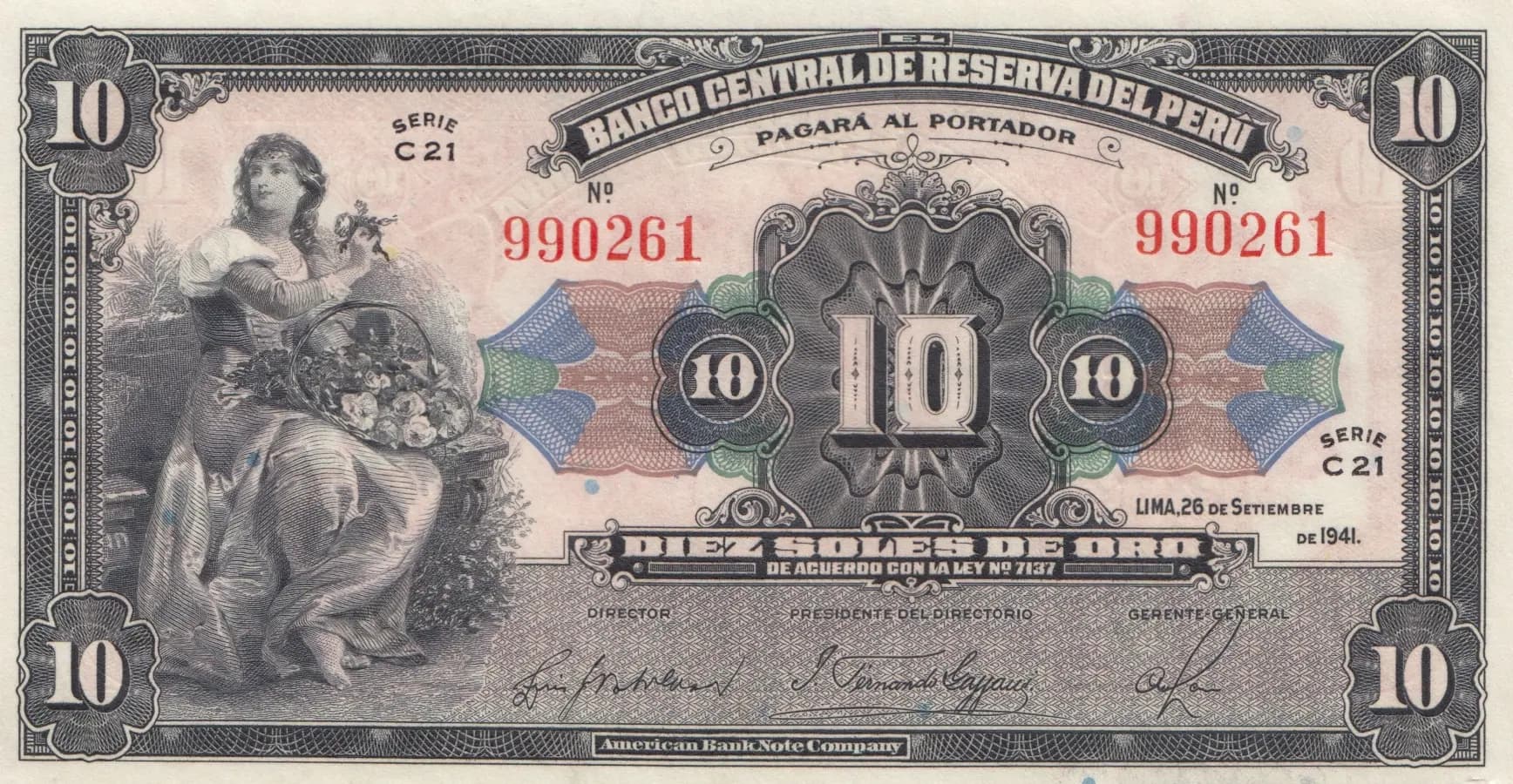
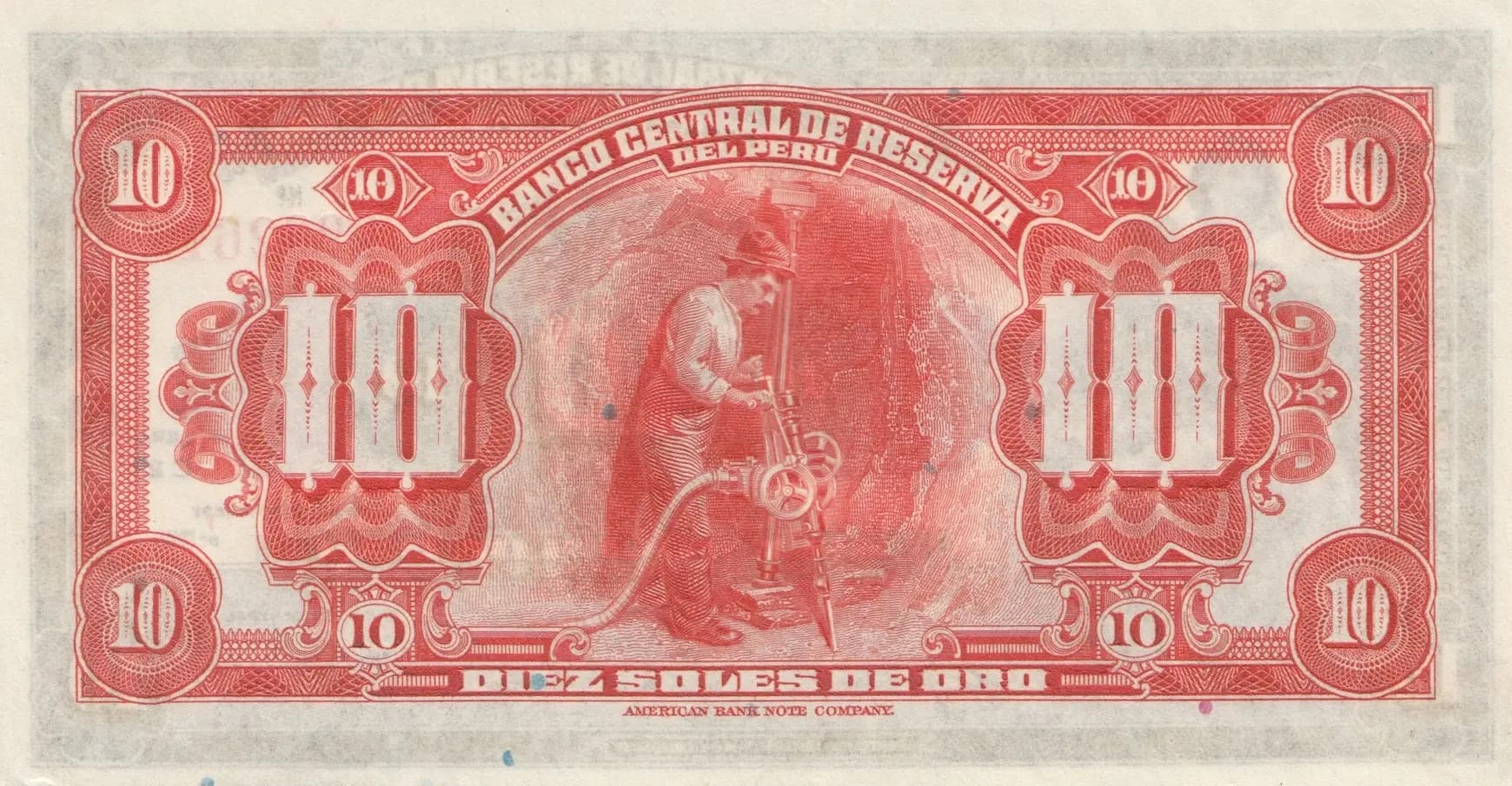
This is a stunning AU-grade 10 Soles de Oro note from Peru dated September 26, 1941, issued by the Banco Central de Reserva del Peru and printed by the American Bank Note Company. The front features a classical allegorical Liberty figure in black engraving holding a cornucopia and basket of flowers, while the reverse displays a striking red industrial worker figure in an ornate design. The note exhibits crisp printing, clean margins, and exceptional preservation with no visible wear, making it an attractive example of Peruvian mid-20th century currency design.
Common. eBay market data shows consistent sales ranging from approximately $4-$10.50 for Fine to VF grades, with catalog values of $30 UNC. The note was issued as a regular circulation issue with the date 1941 printed on the face itself (indicating this specific printing run). Multiple examples appear regularly in the secondary market. The AU condition grade of this specific note is not uncommon, and there is no evidence of limited mintage, recall status, or short-lived issue that would elevate rarity.
This 1941 note represents Peru's monetary system during the early World War II era, when the country maintained the gold standard (Soles de Oro). The imagery reflects Peru's economic values of the period: the obverse celebrates Liberty and agricultural abundance through the classical female figure with cornucopia and flowers, while the reverse honors industrial development and labor through the depicted mine driller or industrial worker. The note's legal basis in Law No. 7137 reflects the regulatory framework governing Peru's central bank at this transitional period in the nation's financial history.
The obverse features an allegorical representation of Liberty or Abundance (Abundancia) rendered in classical engraving style, positioned at left in profile holding a cornucopia (horn of plenty) and a basket of flowers, symbolizing Peru's agricultural wealth and prosperity. The center displays an ornate decorative shield containing the denomination '10' in elaborate frames. The reverse, rendered entirely in red/pink tones, depicts an industrial worker or mine driller—representative of Peru's mining sector and industrial labor—seated or reclining at right, surrounded by ornamental scrollwork. Denomination numerals '10' appear in decorative frames in all four corners and center top of the reverse. Fine scrollwork, floral motifs, and classical borders frame both sides, reflecting the artistic standards of American Bank Note Company's production.
FRONT: 'BANCO CENTRAL DE RESERVA DEL PERU' (Central Reserve Bank of Peru); 'PAGARA AL PORTADOR' (Will Pay to Bearer); 'DIEZ SOLES DE ORO' (Ten Soles of Gold); 'DE ACUERDO CON LA LEY No 7137' (In Accordance with Law No. 7137); 'LIMA, 26 DE SETIEMBRE DE 1941' (Lima, September 26, 1941); 'DIRECTOR' (Director); 'PRESIDENTE DEL DIRECTORIO' (President of the Board); 'GERENTE GENERAL' (General Manager); 'SERIE C21' (Series C21); 'No 990261' (Serial Number 990261); 'American BankNote Company'. BACK: 'BANCO CENTRAL DE RESERVA DEL PERU' (Central Reserve Bank of Peru); 'DIEZ SOLES DE ORO' (Ten Soles of Gold); 'American BankNote Company'.
Intaglio engraving (line engraving), the signature technique of the American Bank Note Company. The visual analysis confirms the characteristic fine line work, intricate scrollwork, and sharp detail reproduction typical of high-security intaglio production. The multicolor elements on the obverse (black engraving, red serial numbers, cream underprint) and monochromatic red reverse are consistent with ABNC's mixed-technique approach for currency of this era.
This note is cataloged as Pick P-67A and represents the 1941 printing with the date 'LIMA, 26 DE SETIEMBRE DE 1941' printed on the obverse. The visual analysis shows Series C21, Serial Number 990261. The banknote.ws reference notes that similar notes were issued with various dates (1933, 6.3.1936, 5.8.1938, 8.9.1939), with the 1941 date on this specimen representing a later printing within the P-67A designation. The specific series letter and serial range are consistent with standard Peruvian currency production practices of the period.