10 soles 1976
Market Prices
37 salesAbout This Note
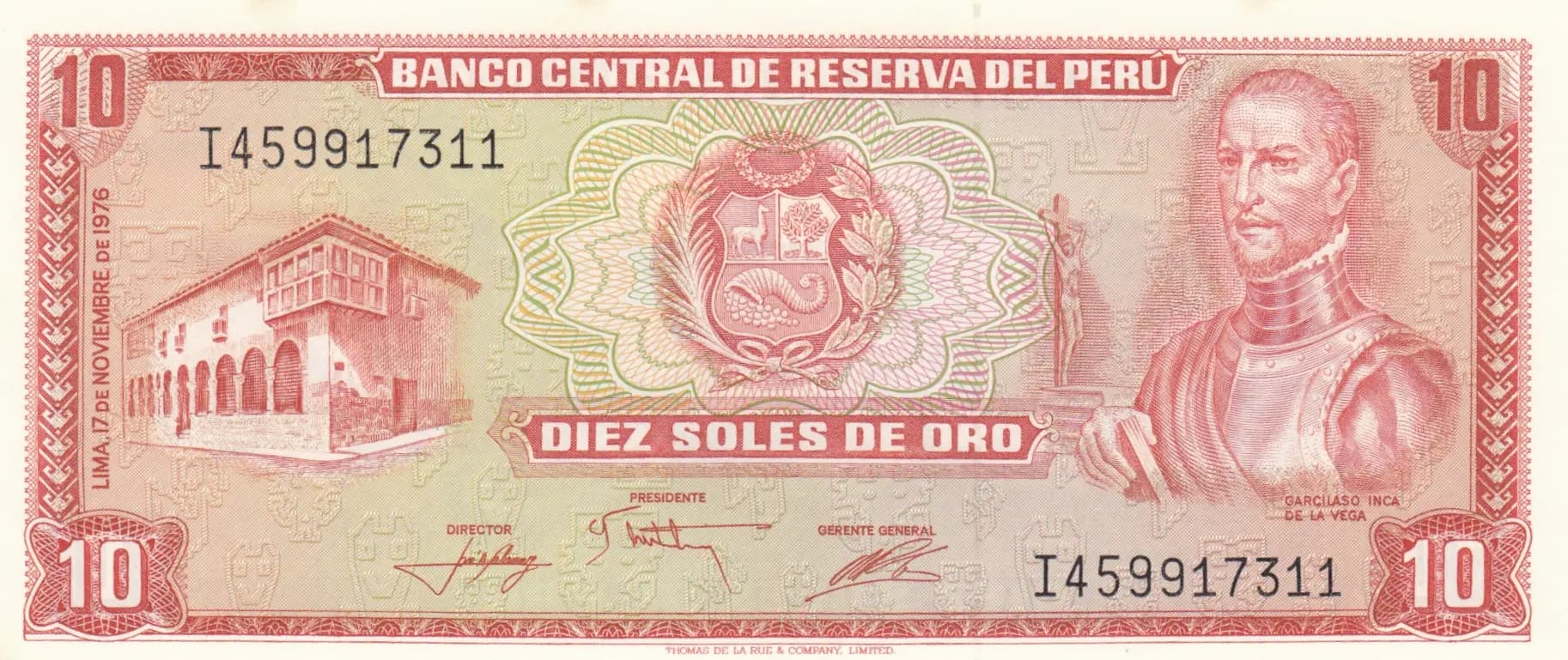
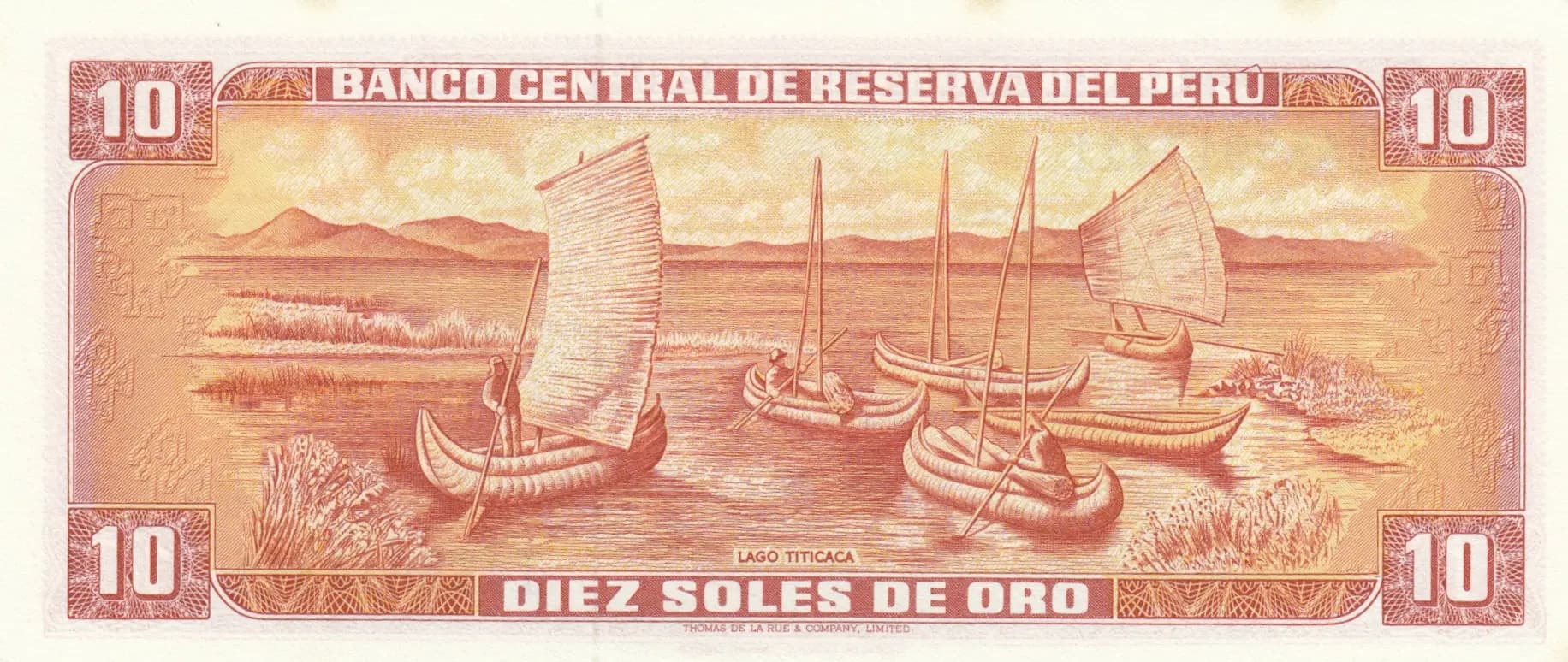
This is an uncirculated 1976 Peruvian 10 Soles de Oro note (Pick P-112) printed by Thomas de la Rue, featuring a striking red-pink color scheme with sharp, pristine printing characteristic of the grade. The obverse displays a portrait of Garcilaso Inca de la Vega alongside a colonial building (his house in Cuzco), while the reverse showcases a detailed engraving of Lake Titicaca with traditional reed boats—both historically and culturally significant Peruvian imagery. This is a common issue but remains collectible for its attractive design and the historical figures it commemorates.
Common. The eBay price tracking data demonstrates consistent circulation and moderate market volume, with UNC examples regularly selling in the $1.00–$1.50 range as recently as 2026, and catalog values (2019) listing UNC at only $1.50. This indicates a substantial print run with ready availability in the collector market. No evidence of scarcity, recall, or limited issuing suggests this is a standard circulation issue.
Issued in November 1976 during Peru's military government period, this note reflects the nation's cultural pride through its selection of historical and geographic imagery. Garcilaso Inca de la Vega, the depicted historical figure, was a 16th-century mestizo writer and chronicler who documented Incan history, making him a symbol of Peru's indigenous and colonial heritage. Lake Titicaca, depicted on the reverse, holds deep cultural significance as the legendary birthplace of the Incan civilization and remains central to Peruvian and Andean identity.
The obverse features a right-facing profile portrait of Garcilaso Inca de la Vega, the mestizo chronicler and writer, rendered in fine engraving detail with historical armor or formal attire. To the left is an architectural representation of Garcilaso's house in Cuzco, shown with characteristic colonial arched windows and doorways. The center displays the ornate Peruvian coat of arms featuring a shield with heraldic elements including a llama, flora, and other national emblems. The reverse presents an elaborate landscape engraving of Lake Titicaca, depicting traditional totora reed boats with sails on the water, with mountains in the background and shoreline vegetation. The entire design employs a dominant color palette of red, pink, and cream with yellow-green and yellow-brown accents, creating a warm and distinctively Peruvian aesthetic.
Front side: 'BANCO CENTRAL DE RESERVA DEL PERÚ' (Central Bank of Reserve of Peru), 'DIEZ SOLES DE ORO' (Ten Soles of Gold), 'LIMADE NOVIEMBRE DE 1976' (Lima of November 1976), 'GARCILASO INCA DE LA VEGA' (proper name), 'PRESIDENTE' (President), 'DIRECTOR' (Director), 'GERENTE GENERAL' (General Manager), 'THOMAS DE LA RUE & COMPANY, LIMITED' (printer identification), and serial number 'I4599173I1'. Back side: 'BANCO CENTRAL DE RESERVA DEL PERÚ' (Central Bank of Reserve of Peru), 'DIEZ SOLES DE ORO' (Ten Soles of Gold), 'LAGO TITICACA' (Lake Titicaca), and 'THOMAS DE LA RUE & COMPANY, LIMITED' (printer identification).
Intaglio engraving (steel plate printing) by Thomas de la Rue & Company, Limited, London—the world-renowned security printer. This technique is evidenced by the sharp, finely detailed line work visible in the portrait, architectural elements, landscape scenery, and ornamental guilloche patterns throughout. The intricate engraved patterns and fine rendering of security details are characteristic of Thomas de la Rue's high-security currency production standards.
This specimen is identified as Pick P-112 (regular issue, Series I, not a replacement note). The visual analysis confirms the absence of a security thread and the lack of 'Pagará al Portador' (payable to bearer) text at the top, distinguishing it from related notes P-93, P-100, and P-106. The serial number format (I4599173I1) with letter prefix 'I' appears consistent with regular Series I production. PMG records indicate two variants catalogued under this Pick number (P-112 and P-112s, the latter being a specimen or special variety), but the present note matches the standard P-112 classification.