1 sol 1918
Market Prices
5 salesAbout This Note
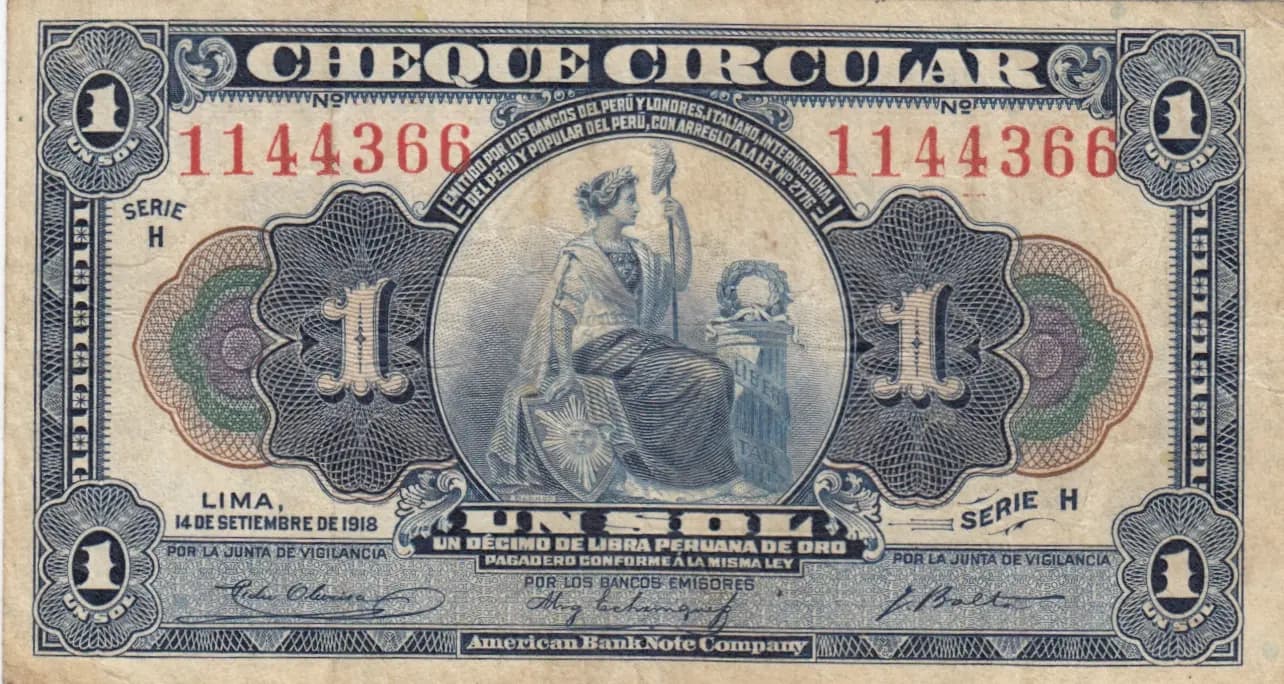
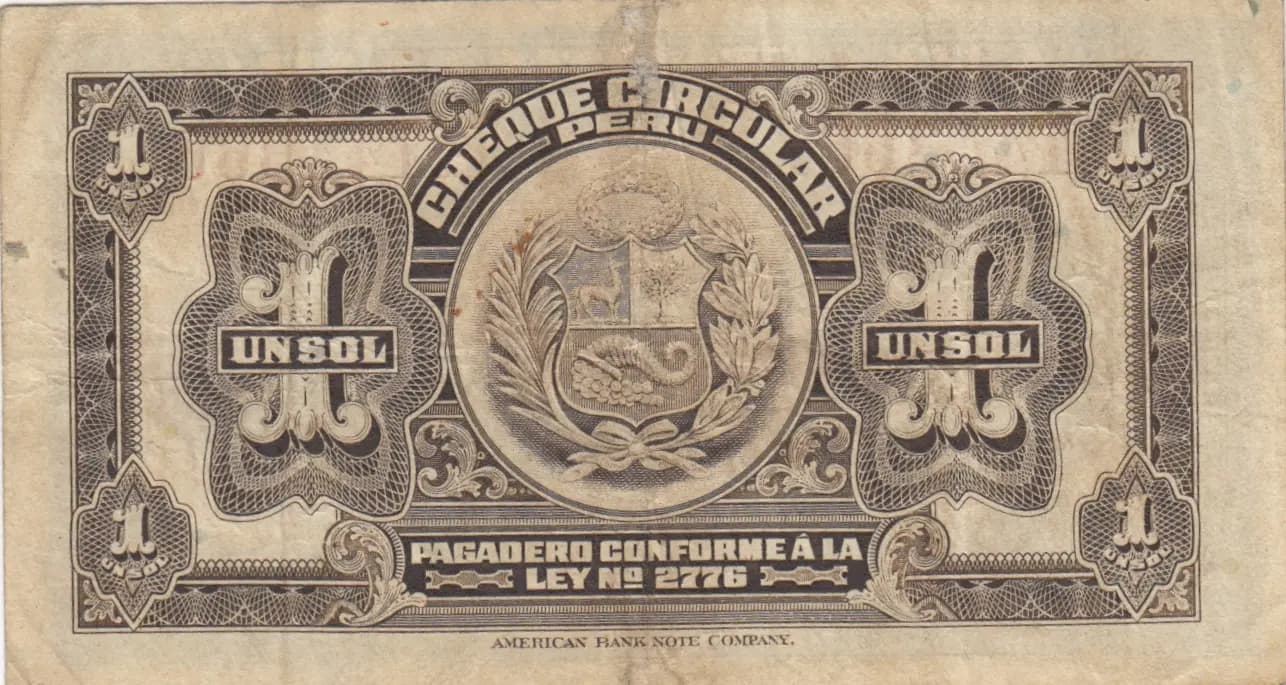
This is a Peruvian 1 Sol circulating check from September 14, 1918, issued by the Peruvian banking consortium and printed by the American Bank Note Company. The note features an elegant allegorical Liberty figure on the obverse and Peru's national coat of arms on the reverse, rendered in fine engraved detail with blue, black, and red inks. In VF condition, it displays age-appropriate creasing and foxing consistent with early 20th-century circulation, yet remains crisp and largely legible—a desirable example of Peru's pre-modern monetary instruments.
Common. This is a regular-issue circulating check from a major, well-established printing authority (American Bank Note Company) with a broad institutional issuer (consortium of Peruvian banks). Market evidence strongly supports commonality: eBay sales data shows VF examples selling for approximately $22–23, well below the $40+ threshold that would indicate scarcity. Print runs for such circulating checks were typically substantial, and surviving examples remain readily available in the collector market. The note is neither scarce nor particularly difficult to locate.
This circulating check was issued in 1918 during Peru's transition period following the 1909 monetary reform, representing one-tenth of a Peruvian Gold Pound (as inscribed on the obverse). The note's allegorical Liberty imagery reflects the classical design traditions favored by the American Bank Note Company, while the prominent Peruvian condor coat of arms on the reverse asserts national identity and official sanction. Issued under Law No. 2776 by the vigilance board (Junta de Vigilancia), this instrument served as an alternative to traditional banknotes in facilitating commerce among Peru's banking institutions during the early republican period.
The obverse features an ornate rectangular frame in blue and black with red serial numbering, centering on an allegorical female figure representing Liberty or Peruvian prosperity, seated and holding a staff or scepter, accompanied by a cherubic putto figure symbolizing protection or national vigilance. Large decorative numeral '1' frames occupy the left and right margins, incorporating shell and fan-like ornamental motifs. The reverse displays Peru's national coat of arms—a shield featuring the Andean condor as the primary heraldic element—positioned within a circular wreath of laurel branches, emphasizing legitimacy and official authority. Symmetrical numeral '1' frames in all four corners anchor the design. The entire composition demonstrates the refined line-engraving techniques characteristic of high-security banking documents.
FRONT SIDE: 'CHEQUE CIRCULAR' (Circular Check); 'SERIE H' (Series H); 'LIMA' (Lima); '14 DE SETIEMBRE DE 1918' (September 14, 1918); 'POR LA JUNTA DE VIGILANCIA' (By the Vigilance Board); 'UN DÉCIMO DE LIBRA PERUANA DE ORO' (One Tenth of a Peruvian Gold Pound); 'PAGADERO CONFORME A LA MISMA LEY' (Payable in accordance with the same law); 'American BankNote Company' (printer attribution); Serial number '1144366'. BACK SIDE: 'GENUINE CIRCULAR' (Genuine Circular); 'UNSOL' (One Sol, abbreviated form); 'PAGADERO CONFORME A LA LEY Nº 2776' (Payable in accordance with Law No. 2776); 'AMERICAN BANK NOTE COMPANY' (printer attribution).
Steel plate intaglio engraving (line engraving), executed by the American Bank Note Company of New York. The security features include intricate cross-hatching, fine line work throughout the vignette, complex decorative borders, and detailed engraving of the coat of arms—all hallmarks of the taille-douce (intaglio) process that prevents counterfeiting through the depth and complexity of the printed image. No evidence of additional security printing methods such as microprinting is apparent in the visual analysis.
This note is identified as Pick P-40, with a known variant P-40s also catalogued by PMG. The observed specimen bears Series H designation with serial number 1144366. The specific date of issue is September 14, 1918 (14 DE SETIEMBRE DE 1918), which appears consistent across the known issue. Collectors should note that variant differences may involve signature variants, series letters, or printing differences not fully discernible from this visual analysis alone; consultation of PMG or PCGS population reports would clarify whether this specimen represents the standard P-40 or the P-40s variant.